


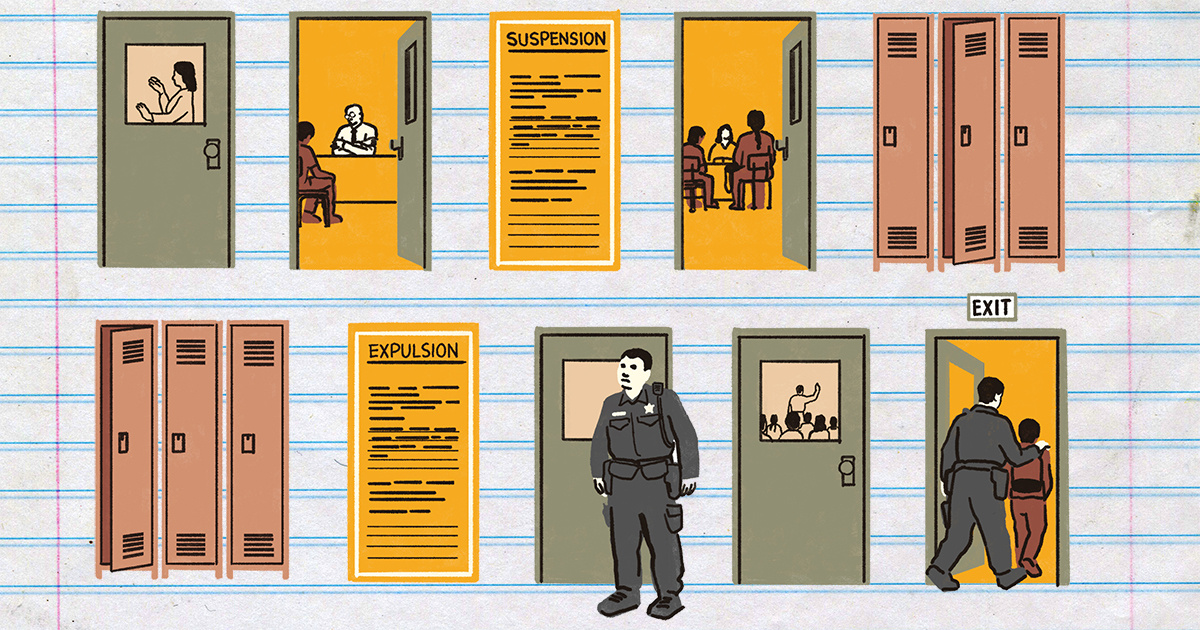
Navajo students in one of New Mexico’s largest school districts are subject to a climate of pervasive discrimination and fear, according to a report released last week by the Navajo Nation Human Rights Commission.
The 25-page report is based on testimony from parents and community members at four public hearings held in the district’s Navajo Nation communities. It is asking the New Mexico Attorney General’s Office to release the results of a two-and-a-half year investigation into the district’s discipline of Native American students.
The Navajo Nation Human Rights Commission report cites a December 2022 study by New Mexico in Depth and ProPublica that found that Native American students received harsher discipline than other students in New Mexico over the four-year period ending in 2020. The Gallup-McKinley School District, which has the largest Native student body of any local school district in the country, was a major contributor to the disparity, an analysis of student discipline records across the state found. Attorney General Raul Torres launched an investigation into the district’s disciplinary practices in 2023.
On Wednesday, Torres’ chief of staff, Lauren Rodriguez, said a years-long investigation into him had been completed and found “questionable disciplinary conduct.” She added that the agency’s “thorough” investigation requires the state Department of Public Instruction to enforce student discipline data reporting requirements and better track that information. Mike Hiatt, the district’s former longtime superintendent, has previously downplayed the amount of discipline Native students receive and blamed inadequate data collection.
“It’s our children, our students, who are suffering from the effects of deep-rooted racism,” Wendy Greyeyes, chair of the committee that published the new report and an associate professor of Native American studies at the University of New Mexico, said in an interview.
Greeyes said the Department of Public Instruction should have identified discipline disparities in the data it collects from school districts. “It is clear that there is no clear auditing of the data collected,” she says.
The attorney general’s office told New Mexico in Depth that despite the findings, it is unclear under state law whether the attorney general’s office “may take formal legal action against the district for this specific conduct.”
A spokesperson said Torres has been pushing for comprehensive state civil rights legislation since 2023 because of a lack of legal clarity.
Under New Mexico’s civil rights law, private individuals can sue public entities for violating the state constitution, but the law does not explicitly give the attorney general the authority to investigate and prosecute public entities for systemic inequities, as the federal Justice Department does. In 2023, the New Mexico Legislature passed a bill giving the attorney general broad powers to investigate state or local agencies for civil rights violations. The bill had bipartisan support, but Governor Michelle Lujan Grisham defeated it with a pocket veto. (Lujan Grisham did not issue a formal statement about the veto, but said at the time that the bill, while well-intentioned, would “create chaos” and that “much of the work outlined in the bill could be performed by the AG, whether or not it is signed into law.”
At the time, Torres told New Mexico in Depth that his office has implicit authority to pursue such cases, but that it would be “very clear” if it were enshrined in law.
A spokesperson for Mr. Torres said he remains committed to passing these bills.
At four meetings held by the Navajo Human Rights Commission in September and October, parents, students, and community members described harsh discipline, language barriers, discriminatory hiring practices, problems with special education programs, and inadequate classroom heating systems.
Greyeyes explained that fear of retribution is widespread. She said some witnesses cried during the hearing — fearing their words would be heard in the district — and parents spoke up for children who were too scared to testify. Transcripts of their testimony have not been made public.
The commission’s report recommends a formal agreement between the Navajo Nation and Gallup McKinley for the district to adopt a discipline policy based on restorative justice, a strategy that seeks to rebuild relationships rather than simply punishing students who have caused harm. Such a policy could be modeled on existing talking circle programs at Cuba Independent School District in New Mexico and STAR Schools on the Navajo Nation east of Flagstaff, Arizona, Greeyes said.
The report also recommends a comprehensive state financial audit of the district’s spending on Indigenous education compared to other students, and calls on the state education department to better manage and track district student discipline data.
The school district did not respond to voice messages or emails seeking comment on the Navajo Nation Human Rights Commission report.
The problems identified in the commission’s report are “rooted in colonization,” Greyeyes said. “It’s rooted in systemic racism. Many of these things are sometimes even accepted by our Navajo Nation, so we need to bring this information to light and find ways to address these issues.”
The report’s recommendations “start that conversation,” she said.
