


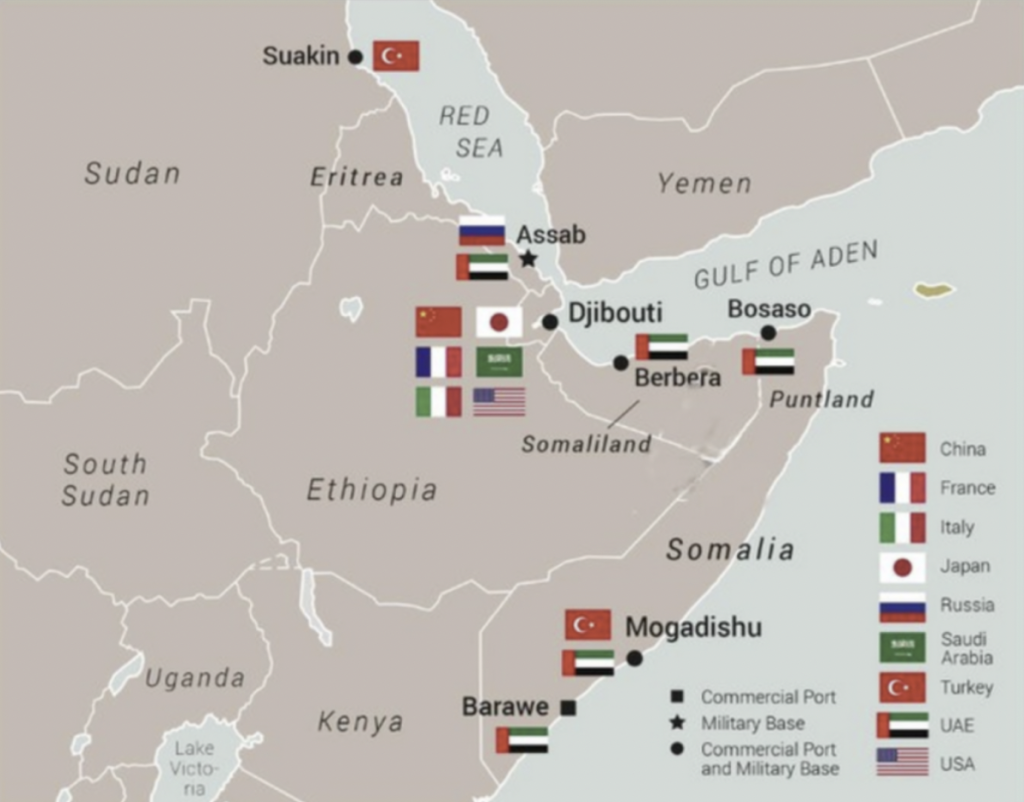
Mr. Connor: Mr. Korivko claims that Israel’s move is about Turkey’s presence in Somalia, but let’s not forget about the others there.
The US has (at least) several hundred troops in Somalia, most of them in the Danab (“Lightning”) Brigades, a US-backed special forces unit established in 2014.
Last year, the United States signed an agreement with the Somali government to build five military bases for the Somali National Army, in the name of strengthening the Somali National Army’s capabilities in the ongoing fight against insurgents. These bases were primarily for Danab, and the United States initially provided funding through the State Department, which contracted with private security firm Bancroft Global. More recently, funding has come from the Pentagon’s Proxy Warfare Fund, known as the 127e program, which allows U.S. special operations forces to use foreign military forces as proxies for counterterrorism missions, circumventing Congressional oversight.
Will the Trump administration follow Israel’s example and recognize Somaliland? That’s not surprising, since President Trump likes to brag about how his administration is bought and financed by oligarchic Zionists, but so far Trump has said the issue requires “further study.” There is no doubt that he is focusing on historical documents and academic research at this very moment, and that position could change at any time.
Despite the fact that Somalia receives aid from the US to pay government salaries, it launched a massive lobbying campaign following President Trump’s victory and hired major companies like BGR. According to Africa Report, Somalia’s president is also trying to woo Elon Musk by giving him a Starlink license to operate in the country. Somaliland, on the other hand, is aware of its strategic position and is trying to sell itself as a modern-day Panama, appealing to America’s desire to control key shipping points.
In July, Somaliland offered the United States access to strategic military bases near the Red Sea and trade in vital minerals in exchange for official recognition. The U.S. government has not yet jumped on the proposal, likely because of how it would complicate the U.S. presence in Somalia.
Although the United States and Israel are criminal partners in the region, the UAE already has a significant presence in Somaliland, operating a port and military airstrip in Berbera, and Abu Dhabi has not stopped its port and base presence in Somalia.
Project 2025 recommends “recognition of the state of Somaliland as a hedge against a deteriorating US position in Djibouti.” As Semaphore reported a year ago, members of the Trump administration have expressed interest in recognizing Somaliland. The move could allow U.S. intelligence agencies to monitor arms movements in the volatile region and launch long-term operations to monitor Chinese activity. And in January, the U.S. House of Representatives’ influential U.S.-China Subcommittee called on the State Department to open a representative office in Somaliland.
Increased US airstrikes in Somalia (at least 119 in the first year of Trump 2.0, more than double the previous record) have further destabilized the situation and led to growing calls for recognition of Somaliland. Once again, the Trump administration is simply reinforcing existing US policy with a twist. Although Biden has formally supported Somalia’s territorial integrity, the Pentagon has received several visits from African military personnel and expressed interest in having a presence in Berbera.
For now, condemnation of Israel’s move is rapidly rising from all over Africa and the Middle East (and China), but do any of them really think so, and are they prepared to do anything about it?
Andrew Korybko is a Moscow-based American political analyst specializing in the global systemic transition to multipolarity in the new Cold War. He holds a doctorate from MGIMO, which is affiliated with the Russian Ministry of Foreign Affairs. Originally published on his website.
Israel has gained strategic depth in close proximity to the Somali facilities at Turkiye to monitor and, if necessary, to destroy them if evidence emerges that they are being used for nuclear purposes, as the media suspects that the purpose behind the planned spaceport and military cooperation with Pakistan is being used for nuclear purposes.
Israel became the first UN member state to recognize Somaliland. Some casual observers believe this is driven by a desire to station allies near Iran-aligned Houthi-controlled North Yemen and/or in front of Somaliland, which reportedly hosts large numbers of Gazans. Regarding the first hypothesis, Israel has already proven that it can easily attack North Yemen and therefore does not need regional bases to do so, while the second imperative hypothesis is no longer a priority.
The article argues that the real reason Israel unexpectedly took this action at this very moment is actually due to its rivalry with Turkiye. Although the casual observer probably does not realize it, Turkiye now exerts influence over virtually all significant areas of Somalia, which lends credence to the alarming national security scenario from an Israeli perspective that will soon be discussed. Before we get into that, it’s important to take a quick look at exactly what influence Tolkien has there.
The Turkish Cooperation and Coordination Agency, equivalent to USAID, has implemented more than 500 projects since its inception in 2011. Turkiye has also been training Somali troops since opening Turkey’s largest overseas base, Turkom Base, in 2017. Economic and military cooperation between the two countries will then be strengthened through a related agreement in early 2024, with Somalia reportedly modernizing its navy in exchange for supplies to Turkiye. 90% of ocean energy revenues.
By the end of the year, Somalia had confirmed that Turkiye was building a spaceport within its territory, although previous reports had claimed that it may have a dual purpose as a ballistic missile testing range (unlike the western Indian Ocean, the eastern Mediterranean is too crowded for Turkiye to test such weapons from its territory). Earlier this summer, Pakistan, Turkiye’s (de facto junior) partner, entered into a similar military training agreement with Somalia, marking a significant concentration of both countries’ military interests in Somalia.
All this led to a popular article in Israel Hayom in early December titled “Turkey’s quiet power struggle in the Red Sea turns Somalia into a proxy”, which discussed the alarming national security scenario that contextualized Israel’s decision to Somaliland. They say Turkiye is building a “second strategic geography” in Somalia to test nuclear weapons and delivery systems (hidden in spaceports) that can be gained through Niger’s uranium and Pakistan’s missile and nuclear expertise.
Although some may scoff at this, Prime Minister Netanyahu’s expression of gratitude to the Mossad chief in his post regarding Israel’s recognition of Somaliland suggests that his decision was indeed driven by very serious national security considerations, perhaps considerations related to the above. Recognizing Somaliland would give Israel close strategic depth to Turkiye’s Somali facilities, allowing them to monitor and, if necessary, destroy the facilities if there is evidence that they are being used for nuclear purposes.
Israel could also organize a political movement from Somaliland to weaken Turkiye’s (possibly hegemonic) control over Somalia as a means to pre-emptively avoid this worst-case scenario by non-kinetic means, something Somaliland might tolerate as it would help ensure its own security. The point is that Israel recognizes Somaliland for reasons more related to conflict with Turkiye than with Iran, and given what is at stake, Turkiye may soon encourage Somalia to cause further problems with Somaliland.
