


This article revisits the 1956 Suez crisis and examines how financial constraints can cripple military power. Although the United States is not the United Kingdom under Bretton Woods, it faces increasing global military involvement in tandem with increasing financial burdens. History may not repeat itself, but it can rhyme.
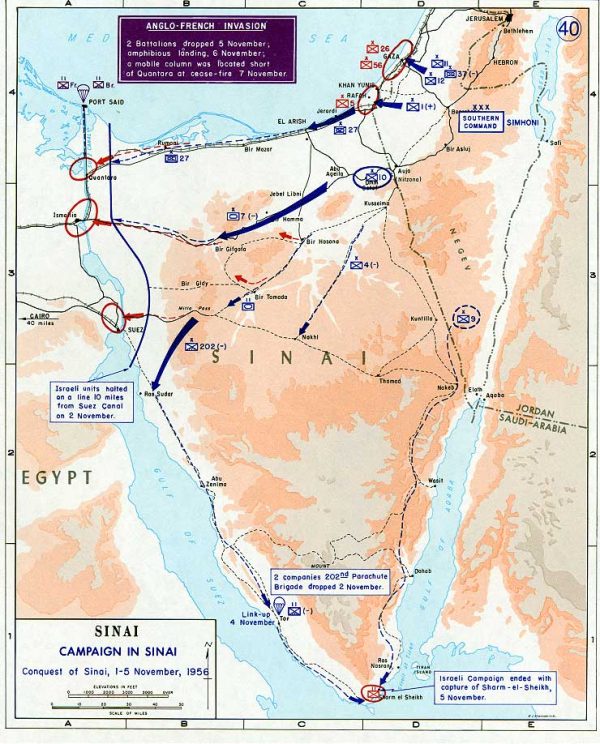
In October 1956, Israel, Britain, and France invaded Egypt after Gamal Abdel Nasser nationalized the Suez Canal. The military operation was initiated by Israel’s attack on the canal on October 29, triggering a pre-arranged Anglo-French ultimatum demanding the withdrawal of Egypt and Israel from the Canal Zone. When Cairo rejected the ultimatum, British and French forces launched airstrikes to neutralize the Egyptian air force, followed by amphibious and airborne landings at Port Said in early November.
Operationally, the operation proceeded almost as planned. British and French forces quickly captured important positions along the canal. They enjoyed naval superiority, air superiority, and the ability to consolidate territorial gains. From a battlefield perspective, Britain and France did not face imminent defeat. This intervention appeared militarily manageable. What they lacked was time. Even as Port Said fell, the value of sterling was under accelerating pressure. The tactical momentum on the canal coincided with the depletion of London’s financial reserves. Military progress could not offset financial erosion. Within days, battlefield successes became of no strategic importance. Britain was forced to cancel the Suez campaign for financial reasons.
The Pound Crisis and the Decline of the Empire
The pound operated within the Bretton Woods system of fixed exchange rates. Britain needed to maintain parity against the dollar, but foreign governments throughout the sterling zone held large sterling balances that could be converted into dollars. Post-war reconstruction, chronic balance of payments deficits, and high import dependence meant that Britain’s gold and dollar reserves were limited, amounting to around $2-3 billion by the end of 1956 (Bank of England data, IMF historical statistics). That cushion was thin compared to the potential transformation pressure.
The 1956 invasion caused immediate market anxiety. The Suez Canal was blocked, pipelines in the Middle East were blocked, and oil shipments to Europe were disrupted. Insurance premiums have increased significantly. Investors and central banks began selling the pound. To protect parity, the Bank of England aggressively drew down dollar reserves. Losses in reserves accelerated within days (Foreign Relations of United States, 1955–1957, Vol. XVI).
As reserves dwindled, markets anticipated devaluations, prompting further shifts in a self-reinforcing cycle. The UK sought significant IMF funding, initially over $500 million and over $1 billion for broader stabilization needs (IMF Archive, Diane Kuntz, Economic Diplomacy of the Suez Crisis). The drawings required U.S. consent.
America intervenes financially
The Eisenhower administration applied public pressure. The US government refused to support the pound in exchange markets, opposed rapid IMF spending on Britain without a ceasefire, and made clear that continuing military operations would put stabilization funds at risk. Pending liquidity was sufficient. American officials understood that British operations could not be sustained beyond reserve forces.
Britain was not bankrupt. It was illiquid. However, under fixed exchange rates, illiquidity risked currency devaluation, inflation, and domestic political crisis. Faced with depleting foreign exchange reserves and mounting financial burdens, Prime Minister Anthony Eden’s government withdrew. The fall of Suez was not because the British were defeated, but because they were unable to defend the pound without American support.
geopolitical influence
The regional impact was immediate. Under pressure from the United States and the United Nations, Britain and France accepted a ceasefire and withdrew. UN emergency forces were deployed along the canal, the first major UN peacekeeping operation. Nasser remained in power and appeared politically strengthened. Although the Egyptian army had suffered tactically, the story of defiance against European intervention resonated throughout the Arab world.
Suez accelerated the decline of Britain’s overt influence in the Middle East. Within a decade, London will formally withdraw from “East of Suez,” abandon its permanent military presence in the Persian Gulf, and scale back its involvement across Asia. This episode proved to regional actors that European imperial enforcement no longer had independent credibility. Power has decisively shifted to Washington and Moscow.
The strategic damage was not only territorial but also reputational. Britain’s ability to act without American approval was tested and proved to be conditional. Although the channel remained open, Britain’s global position had changed. Suez demonstrated that geopolitical hierarchies can be enforced through financial markets. Military capability turned out to be subordinate to financial autonomy. Although Britain possessed a reliable military and global engagement, its strategic independence was constrained by its dependence on external dollar support. The British Empire did not collapse immediately in 1956; A structural limit has been reached. Financial constraints disciplined imperial ambitions.
american divergence
The United States of today is not the United Kingdom of 1956. The United States issues the world’s major reserve currency and operates with a floating exchange rate. External authorities cannot refuse funds. But the Suez analogy worries about a disconnect, a widening gap between growing military commitments and the financial and industrial base needed to sustain them. The question is not whether the United States can fund its military, but how much it will cumulatively cost and how much less flexible it will be.
The federal debt exceeds 120 percent of GDP (U.S. Treasury data), and deficits in the trillions of dollars are common during peacetime. Net interest payments will reach $900 billion annually (projected by the Congressional Budget Office). If the effective cost of borrowing continued to rise by 150 basis points, it would add hundreds of billions of dollars to annual interest costs.
The government bond market is much deeper than the sterling market in 1956, but its size also means its exposure. Trillions of securities must be rolled back every year. A combination of geopolitical escalation and rising inflation expectations could lead investors to demand higher term premiums. Sustained yield increases mean higher maintenance costs, not bankruptcy.
The Federal Reserve could intervene, as it did in 2020. However, bond purchases under inflationary stress run the risk of obscuring the potential for stabilization through monetization. Raising interest rates to lock in inflation will further increase debt servicing costs. Cutting interest rates to protect growth risks weakens price confidence. The constraint lies in the trade-offs.
Industrial infrastructure considerations
There are parallel economic constraints on U.S. industrial capacity. Expanding production of artillery shells and precision munitions requires a multi-year schedule (Department of Defense Statement, 2023-2024). Shipbuilding schedules span multiple years. The pool of specialized labor remains limited. Fiscal expansion cannot immediately create industrial capacity. Spending moves faster than shipyards and supply chains. Efforts will simultaneously span Europe, the Indo-Pacific, and the Middle East. Each remote theater requires expensive procurement, logistics, and implementation support. Taken together, they speculate that fiscal and industrial capacity may be declining.
economic shock scenario
Fiscal constraints on U.S. power are likely to emerge through crises that produce negative economic consequences. Consider the following example.
An energy shock associated with escalating relations with Iran could tighten global oil supplies. A sustained rise in oil prices will spill over into headline inflation within weeks. Rising inflation expectations will complicate Federal Reserve policy. If the Fed tightens to protect price stability, it would increase emergency defense spending and at the same time raise Treasury yields and increase debt service costs. If the Fed balks, term premiums could widen as investors seek compensation for inflation risk. In either case, financing costs will rise.
The second path involves an Indo-Pacific conflict. A maritime crisis affecting Taiwan and major sea lanes would disrupt semiconductor supply chains and global trade flows. Stock markets will rapidly reprice risk. Initially, money will flow into U.S. Treasuries, potentially pushing yields lower. However, if the disruption continues, growth forecasts will weaken and deficit spending will rise. As issuance size increases, investors may demand higher compensation for duration and geopolitical uncertainty. What started as a safe haven could turn into a financial strain.
The third scenario concerns simultaneous activation of theaters. Combining increased deterrence in Europe with heightened tensions in the Middle East will require rapid troop build-ups, supplies, and additional spending. Defense spending will rise sharply against the backdrop of already rising baseline deficits. Rating agencies and large reserve managers may not abandon Treasuries, but greater diversification of margins could push yields higher. Small adjustments become even more complex when applied to trillions in outstanding debt.
Each shock can be treated individually. The United States maintains considerable fiscal depth and financial flexibility. Risks occur in sequence. If energy shocks are followed by trade disruptions followed by multi-dimensional consolidation, interest rate and cost increases will remain embedded in fiscal norms. By the third episode, stabilization requires greater intervention to achieve the same effect. The margin of error is narrowed.
Cumulative effect of consecutive shocks
The modern-day US “Suez moment” would not resemble the UK’s refusal to provide IMF funding. It arises from the cumulative dynamics described above. The United States is likely to be able to absorb geopolitical and economic shocks only once. The biggest risk lies in repetition. Each episode of destabilization leaves behind residues such as higher interest costs, wider risk premiums, and more fragile inflation anchoring. A series of shocks changes expectations. Ultimately, investors will evaluate structural risks rather than temporary disruptions. The dollar’s reserve currency status will delay constraints. It does not exclude it. Repeated shocks, such as Iran-related energy disruptions and disruptions to supply chains in the Indo-Pacific, will gradually narrow options and ultimately reduce the scope of America’s global dominance.
conclusion
Escalating tensions with Iran show how the process of financial destabilization in the United States begins. Disruptions in energy markets could raise inflation expectations and at the same time widen Treasury risk premiums. The decisive arena in such a crisis may not be the battlefield, but the U.S. Treasury market. The Suez crisis could then be echoed by a US withdrawal from the Middle East. America remains powerful and wealthy. However, structural contradictions are quietly accumulating. The question is not whether countries can withstand one costly military conflict, but whether they can withstand multiple military conflicts without having to choose between ambition and stability. When that moment arrives, markets, unlike the military, do not negotiate.
