


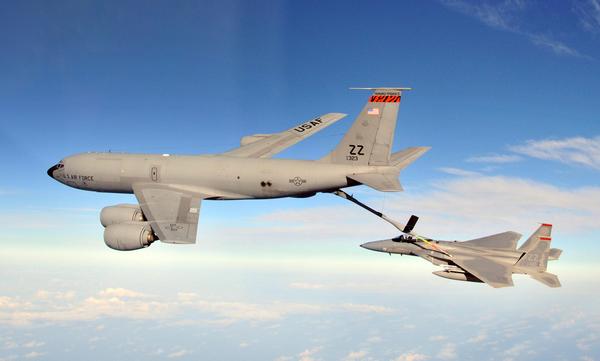
The ability to project military air power rests on physical systems: aircraft, fuel, depots, airfields, maintenance crews, spare parts, and the logistics chains that bind them together. Among these, aerial refueling is foundational. It is the mechanism by which range is extended, persistence is maintained, and operational flexibility is preserved. Without it, the operational reach of the U.S. military contracts sharply. This article examines the deteriorating condition of U.S. aerial refueling capabilities and the strategic implications.
The Hidden Backbone of Modern Air Power
Modern U.S. military air operations depend on aerial refueling to a high degree. Fighters, bombers, ISR platforms, and transports all rely on tankers to extend range and sustain operations. The ability to generate presence, maintain pressure, cover multiple axes of advance, and exploit fleeting opportunities is inseparable from tanker availability. Without tankers, tactical aircraft lose deep-strike capability, ISR coverage collapses, sortie generation declines sharply with distance, and the entire geometry of theater operations changes. Aerial refueling transforms regional airpower into global reach. It is the invisible infrastructure behind global military action. That is why tanker deficiency is a significant vulnerability.
An Aging Fleet Facing Expanding Demands
The core of the U.S. aerial tanker fleet remains the KC-135, with many aircraft approaching seventy years of service. While technically maintainable, these aircraft are now operating deep into regimes that were never envisioned in their original design life. They are not simply old. Aging airframes gradually move from a condition of predictable wear into one of accumulating structural uncertainty.
KC-135 – Aging workhorse of the U.S. tanker force
The central engineering problem is metal fatigue. Over decades of operation, structural components such as fuselage skins, lap joints, stringers, frames, and longerons accumulate micro-cracking due to repeated stress cycles. The KC-135 experiences fewer pressurization cycles than a commercial airliner, but that does not exempt it from fatigue. It still carries substantial fuel loads, undergoes repeated bending stresses, and flies long-duration missions that load the structure in persistent ways. Aircraft aging is not a calendar measure. It is the cumulative record of stress.
Corrosion compounds the fatigue problem. Over decades, moisture, contaminants, and operational exposure attack joints, interfaces, fastener holes, and internal structural surfaces that are not always visible during routine inspections. Corrosion can weaken material directly, but it also accelerates crack initiation and crack growth. In aging aluminum airframes, corrosion and fatigue do not operate as separate phenomena. They reinforce each other, reducing structural margin while increasing uncertainty about the real state of the aircraft.
The Air Force responds to these realities through heavy inspection and depot maintenance regimes. Nondestructive inspection methods, structural repair programs, parts replacement, and ongoing sustainment work can keep aircraft airworthy far longer than earlier planners might have expected. But there are diminishing returns here: each added year of service life tends to require more effort, more inspection intensity, and more specialized maintenance than the year before. The aircraft become progressively more maintenance-intensive to keep in service.
Availability declines accordingly. Maintenance man-hours per flight hour rise. Unexpected findings during inspections create cascading delays. Aircraft remain on the books, but more of them are in the hangar, in depot, or awaiting parts and structural work. This is why the nominal size of the fleet becomes a misleading indicator. Headline inventory can remain stable while effective operational capacity shrinks. The result is a divergence between nominal force size and usable force output, a gap that planning assumptions often fail to capture.
A Replacement That Has not Stabilized
The KC-46 was supposed to solve this problem by replacing the KC-135 and restoring long-term stability to the refueling force. Instead, it has introduced a prolonged transitional instability. Persistent technical deficiencies, retrofit needs, and delayed operational maturity have prevented it from fully assuming the mission in the way recapitalization plans required. A major KC-46 difficulty has been persistent deficiencies in its Refueling Vision System (RVS), the camera-based interface used to control the boom, which has suffered from distortion, lighting sensitivity, and depth-perception errors that complicate safe and reliable refueling operations.
As a result of KC-46 technical problems, the old KC-135 fleet must be retained because the new fleet has not fully stabilized. But resources devoted to keeping the old fleet alive are resources not available for a faster or broader transition. The system therefore carries the burden of two fleets without realizing the full benefit of either. This is not modernization in the clean sense. It is overlap without resolution.
KC-46 tanker – Replacement platform with unresolved deficiencies
The KC-135 fleet continues to age, with increasing maintenance demands and declining availability. At the same time, the KC-46 has not yet matured into a fully stable and scalable replacement. Its fielding has been interrupted by production halts; its deficiencies have constrained operational confidence; and future procurement numbers remain uncertain. Under these conditions, continued disruption in the replacement program would not simply delay modernization. It would create the conditions for a capability gap, in which declining legacy capacity is not offset by the incoming fleet.
Attrition Assumptions
Most adequacy arguments for the tanker force rest, implicitly or explicitly, on a zero-loss assumption. They compare requirements against available inventory as though that inventory will remain intact. Recent combat operations in the Iran war call that assumption into question. Even under conditions of overwhelming U.S. airpower, aircraft losses and damage have not been zero. Public reporting confirms the loss and damage of multiple U.S. aircraft, including high-value platforms, and there are credible indications that the full extent of damage to tankers may not be completely reflected in official disclosures.
Open-source imagery and post-strike analysis suggest that U.S. tanker aircraft parked at exposed airbases have been damaged in missile attacks at a rate difficult to reconcile with minimal loss reporting. In addition, multiple instances of emergency transponder activations (7700 squawks) by tanker aircraft during the conflict point to elevated rates of in-flight malfunction, battle damage, or operational stress. While each individual incident may have a benign explanation, their frequency under sustained operations is itself indicative of a system operating under strain.
The precise number of tanker losses is therefore less important than the broader pattern: attrition in modern air operations is both real and partially obscured. Aircraft may be destroyed, damaged beyond immediate use, or removed from service through precautionary grounding, maintenance backlog, or base disruption. These effects are not always visible in headline loss figures, but they are operationally equivalent.
Tankers are particularly vulnerable within this dynamic. On the ground, they are concentrated on large, fixed airfields that are susceptible to missile attack, runway denial, and fuel infrastructure disruption. In the air, they are high-value, non-stealthy assets that must operate predictably to fulfill their mission. An adversary does not need to destroy large numbers of tankers to impose significant costs. It need only degrade availability, force greater standoff distances, or disrupt basing patterns.
Attrition in this context is not linear. It is multiplicative. Each increment of loss or degradation reduces not only available capacity, but also flexibility, redundancy, and recovery margin. A tanker force that appears marginally sufficient under zero-loss assumptions can become inadequate once even modest levels of attrition or disruption are introduced.
Stealth Tanker Feasibility and Cost Challenges
One proposed answer to tanker attrition is a stealthy future tanker. Existing tankers are vulnerable because their size makes them highly visible to radar. In an anti-aircraft missile threat environment, tankers are forced to remain far from contested airspace. Thus, a low-observable tanker could promise restored access. But the concept is much harder in practice than in proposal form.
Because of fuel volume requirements a stealthy tanker must be a large aircraft. Size complicates low observability. A large, blended airframe can reduce radar signature, but a basic problem remains: aerial refueling is not an inherently stealthy activity. Volume, structural geometry, fuel plumbing, and mission equipment all push against the clean forms and internalization that favor low radar observability.
Stealthy tanker concept depiction
The refueling process creates significant stealth problems. Booms, drogues, doors, actuators, and extended structures all compromise radar signature management. The radar reflectivity of a stealthy tanker would worsen during the actual refueling event, the time when it must expose refueling apparatus and operate in proximity with receiver aircraft that may themselves be non-stealthy. A stealthy tanker would be less detectable on ingress than a KC-135, but that does not mean it would remain difficult to detect while performing the mission for which it exists.
Then there is cost. A stealthy tanker would be much more expensive than a commercial-derivative tanker. It would require advanced materials, more demanding manufacturing, stricter tolerances, and more burdensome maintenance. A stealthy tanker would impose a production cost premium measured in multiples, not percentages. That means the force would be smaller. The strategic tradeoff is severe: survivability per platform might improve, but aggregate fuel-delivery capacity would fall because fewer aircraft could be deployed. The result would not be a replacement for the existing tanker force, but a contraction of it—trading aggregate capacity for marginal survivability.
Pacific Campaign Demand vs. Available Force
Once aging, recapitalization friction, tempo constraints, and attrition are combined, effective tanker capacity falls well below nominal levels. What appears sufficient in inventory terms looks increasingly narrow in campaign terms. This is the point at which force structure arithmetic overrides declaratory policy. The issue is not whether the United States can field tankers. It is whether it can sustain enough usable tanker output, day after day, at the distances and tempo required by an expeditionary war. That is a much harder standard. It is this constrained tanker force that would face its most severe test in a Pacific conflict.
A military conflict with China would impose the greatest distance burden on the U.S. tanker force. Pacific operations introduce a severe time penalty. Tanker missions would often be long-duration sorties that consume an aircraft, crew, and maintenance cycle for most or all of a day. A tanker that might generate multiple sorties per day in a permissive environment may generate only one extended sortie in a Pacific scenario. Strikes on regional bases would likely push tanker operations to more distant airfields, further reducing refueling efficiency.
At the same time, refueling demand in this large-scale conflict would be very high. Fighters require repeated refueling cycles. ISR platforms need persistence. Maritime operations extend loiter time and increase the need for airborne support. In practical terms, the Pacific combines the worst features for tanker planning: fewer sorties per tanker, less efficient fuel offload, and greater aggregate demand from receivers. Under these conditions, margins narrow quickly.
This is the critical point: supply contracts while demand expands. The tanker force is therefore not merely strained, but structurally mismatched to the requirements imposed upon it. What appears marginally sufficient under nominal assumptions becomes inadequate under operational conditions.
Conclusion: A Strategy–Capability Mismatch
U.S. militarized foreign policy continues to expand in scope and intensity, assuming the availability of sustained long-range force projection. Yet the systems that enable that projection are under increasing strain. The tanker fleet illustrates this contradiction with unusual clarity. Aging aircraft reduce availability. Replacement systems remain uneven in capability. Distance degrades effective output. High-tempo operations reduce tanker productivity. Wartime attrition threatens both the fleet and the forward bases on which it depends. Each factor alone can be managed as a planning complication. Taken together, they point to something more consequential: a material narrowing of force-projection capacity occurring alongside an increasingly expansive strategic posture.
The United States does not lack tanker aircraft on paper. It lacks assured capacity under realistic conditions. That distinction is critical. Military strategy is not validated by nominal inventory, but by what a force can actually deliver when distance, tempo, maintenance, survivability, and attrition are accounted for. The U.S. aerial tanker fleet is not simply old; it is aging in ways that demand increasing maintenance effort and reduce effective availability. It is not being replaced cleanly, but through an uneven transition to a still-maturing platform. And it is not merely vulnerable in theory, but exposed in the very theaters where its role is most essential.
The danger, then, is not only insufficiency, but delayed recognition of insufficiency. The United States is writing militarized policy checks that the armed services may not be able to cash. The tanker fleet is one of the clearest indicators of this imbalance. It is not the only constraint, but it is among the first likely to assert itself. If tanker capacity proves inadequate, the broader claim of seamless global reach will be revealed as conditional rather than assured. When that moment comes, the question will not be whether the United States can project power at scale, but why it so badly misjudged the capabilities on which that claim depended.
