


Military superiority is assumed to provide offensive strategic advantage. It is believed that a state with overwhelming military power can intimidate a weaker enemy. However, recent conflicts suggest that this assumption is crumbling. Large inventories of precision missiles, mobile launch systems, and cheap attack drones are spread throughout the international system, allowing smaller powers to threaten critical infrastructure far beyond their borders. What is emerging is a new strategic condition that may be called distributed deterrence. That is, a world in which the ability to impose significant costs on adversaries no longer depends on the arsenals of a few superpowers, but instead results from precision strike capabilities increasingly available to many nations. This change does not eliminate conflict, but it changes military power calculations.
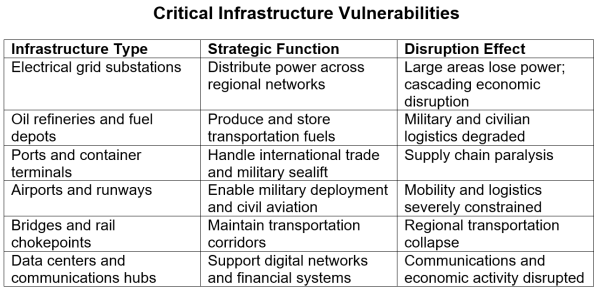
Two developments are behind this change. The first is the increasing vulnerability of modern infrastructure. Developed countries rely on dense and vulnerable networks for power generation, fuel refining, transportation hubs, digital communications and computing facilities, etc. that are often difficult to defend, slow to repair, and costly to repair. Critical infrastructure can be disabled in minutes, but restoration can take weeks or months. Precise missile or drone strikes against such targets can cause disproportionate disruption throughout the economy.
The second development is the steady decline in the cost of precision striking systems. Solid-fuel ballistic missiles, satellite-guided weapons, and long-range drones are becoming increasingly available to intermediate military powers. Together, these trends are changing the architecture of deterrence. Strategic chaos no longer requires large air and naval fleets or nuclear weapons. A dispersed inventory of precision weapons could be sufficient to impose significant costs on a militarily superior adversary.
Infrastructure vulnerabilities
Modern societies are particularly exposed to such pressures because their economic functioning depends on vulnerable critical nodes. Electrical substations, oil refineries, container ports, major bridges, and railway junctions support the logistics metabolism of developed countries. Damage to just a few of these facilities can have cascading effects on supply chains and energy networks. The vulnerabilities in these systems are not just theoretical. Large infrastructure facilities are expensive, geographically fixed, and often take time to repair. Even minor interruptions can have repercussions far beyond the immediate point of attack. This reality means that strategic disruption no longer requires large-scale bombing campaigns. Precision strike systems allow a relatively small number of weapons to have a wide range of economic impact.
A revolution in the cost and effectiveness of precision striking
The technology needed to perform precision strikes is becoming increasingly readily available. Solid-fuel ballistic missiles have become a mature and reliable technology. Unlike older liquid fuel systems, it can be stored for long periods of time and can be started up with minimal preparation. The mobile transporter erector launcher allows missiles to be dispersed and hidden over a large area. High-precision guidance systems derived from satellite navigation and inexpensive electronics have improved targeting accuracy and made it possible to reliably attack infrastructure facilities with far fewer weapons than before. As a result, medium-sized states will be able to field substantial inventories of intermediate-range missiles at a cost that is manageable in their defense budgets.
Hypersonic missiles represent a further step in this technological evolution. Mobile gliders and high-speed atmospheric entry systems reduce warning times and complex interception. Even if the number of such weapons is relatively small, they can impose uncertainty on defense planners by introducing flight profiles that are more difficult to track and predict, making interception extremely difficult.
Long-range attack drones are even more cost-effective than ballistic missiles. It can be procured in large quantities and is capable of precision attacks that are difficult to prevent. The effectiveness of such drones was convincingly demonstrated in the Ukraine war, inflicting heavy losses on both sides of the conflict.
Missile defense cost trap
Missile defense systems are struggling to keep up with this change. The fundamental problem is economic. Interceptor systems such as Patriot, THAAD, and Aegis standard missiles are technologically sophisticated and expensive. While defensive interceptor missiles can cost millions of dollars each, offensive missiles often cost significantly less. This creates a persistent asymmetry in which defenders must deploy and expend large numbers of expensive interceptor weapons versus relatively inexpensive weapons.
Typical missile defense doctrine assigns two interceptors to each incoming target to achieve a high probability of kill. In addition, the defender must successfully intercept most attacking missiles, while the attacker only needs a few accurate hits to inflict serious damage. Attackers can concentrate their attacks and saturate defenses, but defenders must be ready to defend all critical locations. Hypersonic missiles, terminal operations, decoys, and coordinated drone attacks can further complicate interception. The result is a dynamic cost exchange that significantly favors the attacker. This dynamic transforms missile defense from a solution to a resource depletion problem.
a viable deterrent
These technological developments have facilitated the emergence of new deterrence architectures based on dispersion and survivability. Instead of relying on a small number of air bases and fixed missile facilities, countries can now deploy large numbers of mobile launch systems, underground storage networks, and distributed drone caches. Transporter erector launchers can travel over large areas, complicating surveillance and targeting. Tunnel complexes and buried launch sites protect missile and drone inventories from a first strike. Decoy systems and electronic countermeasures make it even more difficult to detect operational launchers. The problem moves from destruction to detection. Survivability is achieved not only by reinforcement, but also by the difficulty of finding the target in time.
.
Unmanned aerial vehicles add another layer to this decentralized architecture. Long-range attack drones provide reconnaissance, targeting, and attrition attack capabilities at relatively low cost. Swarms of drones could saturate defense systems or act as decoys complicating the interception of more destructive missiles.
Diffusion of deterrence
A second form of distribution is also emerging at the system level. Technologies that enable the dispersion of deterrence are spreading throughout the international system. High-precision missiles, long-range drones, and mobile launch systems are increasingly available internationally. Regional powers, medium-sized militaries, and even irregular rebel forces are acquiring variations of these capabilities. As a result, deterrence is expanding across a wide range of actors. Deterrence is no longer concentrated at the top of the world’s power hierarchy. It is being distributed around the world.
porcupine model
The widespread use of this technology has facilitated the so-called porcupine deterrence model. States adopting this strategy do not attempt to counter more powerful adversaries with conventional military force. Instead, it builds the ability to impose unacceptable costs in the event of conflict. Distributed missile inventories, survivable launch infrastructure, and large drone fleets create a defensive posture that makes attacks dangerous and uncertain. The objective is not to completely defeat the enemy or defend territory in the traditional sense, but to ensure that invasion carries significant strategic risks through assured retaliatory disruption.
New limits on power projection
Major military powers have invested heavily in airborne and naval power projection to provide global military reach, but these capabilities rely on the existence of secure overseas bases and staging areas. Missile defense is no longer a reliable shield against missile and drone attacks, and the ability to deploy expeditionary forces for ground attack is increasingly limited. Even if offensive ground forces are successfully deployed, they will face missile and drone attacks for which no cost-effective defenses currently exist. Logistics to sustain a strike force would need to run a gauntlet of missile and drone fire. This raises fundamental questions about whether large-scale expeditionary warfare remains a viable policy tool under conditions of distributed deterrence.
Case study: Iran
Elements of this model are evident in the current Middle East conflict. Iran’s approach represents the practice of distributed deterrence under conditions of traditional military inferiority. Iran has invested heavily in ballistic missile forces, enhanced mobile launch infrastructure, and long-range unmanned aircraft systems as a means of offsetting the military advantages of its adversaries. The principles underlying these investments emphasize survivability through dispersion and the ability to threaten infrastructure objectives across large geographic areas. The effectiveness of Iran’s strategy remains dependent on its survivability in the event of sustained counterforce pressure, but the asymmetric strategic potential of missile and drone weapons has already been demonstrated.
conclusion
The emergence of decentralized deterrence suggests that the strategic environment is undergoing a major transformation. Precision strike technology and distributed missile arsenals are gradually eroding the traditional advantages of superpower supremacy. As these capabilities proliferate, even the most powerful armies must assume that weaker adversaries can inflict significant retaliatory damage. If distributed deterrence becomes a widely adopted defense principle, armed conflict may become less likely to occur as the costs of military aggression become increasingly unacceptable. However, widespread adoption of such capabilities could increase the frequency of low-level conflicts and increase the risk of rapid escalation in situations of miscalculation. Although the ceiling for escalation may remain limited, these dynamics can prolong conflicts by sustaining repeated cycles of mutual destruction. It would be a welcome irony of strategic history if the same technologies that once threatened global catastrophe ended up imposing new limits on conventional warfare.
