


The most important change in modern warfare is not the proliferation of drones and missiles, but the collapse of the cost of precision guidance. Weapons no longer need to be highly sophisticated to be accurate. All you need is to be good enough, and “good enough” is now cheap. For decades, precision strikes have been treated as a special capability of a few great powers. Guided munitions were expensive, technically complex, and in limited supply. Accuracy was used sparingly against high-value targets by attackers who could afford it. The ability to place munitions within meters of a target represented a combination of advanced engineering, industrial capability, and enormous financial resources. That model no longer works. Advances in sensors, navigation, and software have consistently lowered the cost of achieving sufficient operational accuracy. Precision is no longer in short supply. It’s becoming a baseline feature.
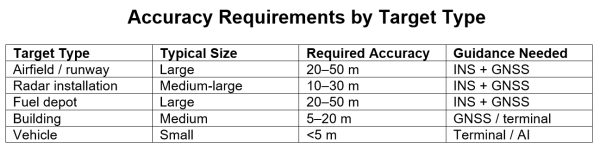
All strike systems operate within implicit constraints of how much error they can tolerate while still achieving the desired effect. Large fixed targets can be defeated even with large miss distances, while smaller or moving targets require tighter accuracy. In each case, the mission defines a maximum tolerance, an accuracy budget that cannot be exceeded. This article explains how this precision budget became affordable for much larger military powers. Advances in the three technologies described in this article (satellite navigation, inertial guidance, and device homing) are driving this transformation.
Satellite navigation (GNSS)
Global satellite navigation systems, such as the United States’ GPS and Russia’s GLONASS, determine location by measuring the time delay of signals transmitted by multiple satellites. By comparing signals from at least four satellites, the receiver can calculate a three-dimensional geographic position with meter-level accuracy under good conditions. Accuracy varies depending on signal quality, satellite geometry, and environmental factors, but even degraded signals can provide useful position fixes.
In reality, GPS provides the geographic location of the weapon during its flight. This information can be used alone to guide the weapon or supplemented with other guidance systems to correct accumulated errors. Continuous reception is not strictly necessary. Intermittent updates are often sufficient to maintain accuracy within operational error. Historically, this functionality has been expensive and limited. Military-grade receivers are specialized devices with anti-jamming capabilities and often require additional infrastructure for high-precision positioning. Civilian access has also been deliberately reduced for many years.
The technical and economic constraints that once limited GPS-based guidance have largely been eliminated. Inexpensive GPS receivers are now integrated into billions of consumer devices, including smartphones, automobiles, and industrial systems. Multi-constellation receivers (GPS, GLONASS, Galileo, BeiDou) and augmentation techniques further improve robustness and accuracy. Economic changes are decisive. Capabilities once limited to specialized military systems are now low-cost, mass-produced components. The marginal cost of adding precise positioning is effectively approaching zero.
Waveshare L76K Multi-GNSS Module – Price: $13
Inertial Navigation System (INS)
Inertial navigation systems use gyroscopes and accelerometers to estimate position by measuring acceleration and rotation. These measurements are integrated over time to produce a continuous estimate of velocity and position. Because INS does not rely on external signals, it is inherently immune to jamming, spoofing, or signal loss.
The limit of inertial navigation is drift. Small errors in sensor measurements accumulate over time, causing the estimated position to gradually deviate from the actual position. The longer the system operates without correction, the greater this error becomes. As a result, inertial systems are typically combined with an external reference such as GPS to periodically reset accumulated drift. Historically, reducing drift required very precise sensors such as mechanical, ring laser, or fiber optic gyroscopes. These systems were expensive, often costing tens to hundreds of thousands of dollars each, and were limited to high-end military and aerospace platforms.
The introduction of microelectromechanical systems (MEMS) sensors has changed this situation. MEMS devices are manufactured using semiconductor manufacturing processes and produced at large scale for consumer electronics, automotive systems, and industrial applications. Although MEMS sensors are less accurate than traditional high-end systems, their costs are orders of magnitude lower and their performance continues to improve.
For many collision scenarios, especially those at short to medium ranges, MEMS-based inertial systems provide sufficient accuracy when initialized or periodically corrected by satellite navigation. The design problem has shifted from achieving near-perfect accuracy to maintaining acceptable accuracy at low cost.
Haoyu GY-521 MEMS Inertial Guidance Module – Price $2
Terminal homing and target recognition
The terminal guidance system improves accuracy during the final stages of flight by directly sensing the target or its surroundings. This role is increasingly performed by optical and infrared (IR) systems rather than traditional radar or laser designations. Electro-optic sensors capture visual images and infrared seekers detect heat signatures, allowing the system to identify targets based on physical characteristics rather than pre-programmed coordinates.
These approaches are particularly effective for fixed or semi-fixed targets whose visual or thermal signatures are known in advance. The system can be provided with a reference image, such as a satellite photo, reconnaissance image, or a stored template, and use onboard sensors to match what it detects during a terminal approach to that reference. This process, known as scene matching or image correlation, allows for accurate targeting even when navigation errors accumulate.
Historically, such capabilities required specialized sensors and significant onboard processing power, limiting their use to high-end weapons. That constraint is rapidly crumbling. Advances in commercial imaging technology and embedded processing through smartphones, self-driving cars, and AI applications have made high-resolution cameras and powerful processors widely available at low prices.
This enables a new class of systems that combine optical or infrared sensing with machine vision algorithms. Rather than simply navigating to coordinates, these systems can identify, classify, and target targets based on learned features. Although there are still constraints due to environmental conditions and countermeasures, the trajectory is clear. Terminal guidance is moving from specialized hardware to software-driven image recognition. As with other components of the precision ecosystem, the key change is economic. The implementation of image-based target recognition and homing is no longer limited to custom-built military systems. More and more can be achieved using mass-produced components, allowing high-precision guidance to scale to low-cost platforms.
Teledyne Lepton Thermal Imager – Price: $109
The components shown above are typical commercially available products and are not uniquely available from any particular manufacturer.
strategic results
Taken together, these changes illustrate the dynamics at the heart of the precision revolution. Each component has been moved from a dedicated high-cost system to mass-produced technology. Accurate guidance no longer depends on expensive and rare features. It depends on the combination of cheap things. The result is not perfect accuracy, but sufficient accuracy at large scale. The transition from precision guidance as an expensive technological achievement to a widely available capability has direct strategic consequences.
This environment makes defense against precision weapons more difficult. Electronic warfare can reduce navigation capabilities, but it is unlikely to eliminate them. Interception systems are expensive and limited, and hardening and dispersion only reduce vulnerabilities, not eliminate them. This creates cost asymmetry. Missile attacks become cheaper and more scalable, while missile defense becomes more complex and expensive.
The proliferation of low-cost precision strike systems has significant implications for expeditionary warfare. When an attacker projects power into a competitive environment, it must function within the attack range of the defender. Historically, this has favored attackers who can rely on superior accuracy and standoff ability. That advantage is disappearing. If a relatively inexpensive system can provide sufficient accuracy at short to medium ranges, it becomes easier to meet a defender’s accuracy budget as distance approaches. Forward bases, logistics hubs, airfields, and staging areas are increasingly vulnerable to repeated, low-cost attacks. Attackers must either rely on expensive long-range systems with limited inventory to stay farther away or accept increased exposure to cheaper defensive weapons. In long campaigns, this dynamic imposes cost and sustainability burdens that favor defenders who can recover their offensive capabilities.
The current war in the Middle East clearly demonstrates this change. Iran’s military and proxies use large numbers of relatively cheap drones and missiles, forcing defenders to deploy expensive interceptors and aircraft. Even if most of the incoming system is shut off, residual leakage, combined with economic asymmetries, puts sustained pressure on the defense system. Using saturation tactics further increases the cost of defense compared to attack.
The result is decentralized, economically driven deterrence. The defender does not need to completely defeat the attacker; it is sufficient to impose attrition risk within the attacker’s continuous operating range. For expeditionary forces, closer distance increases exposure to accurate, low-cost defensive attacks that can disrupt offensive campaigns. This change could force a rethinking of how military power can be projected and at what cost.
conclusion
The central fact of the precision revolution is economic. The components needed to meet many precision budgets are now produced globally for the civilian market, driving continuous improvement while reducing costs. This lowers barriers to entry and enables mass production and widespread adoption. Precision strike capabilities are no longer limited to industrialized nations and can now be deployed in large numbers over a wide area. Precision weapons are no longer produced at great expense. It is assembled from cheap parts. More than individual weapons or platforms, it is what is changing the character of modern warfare.
