


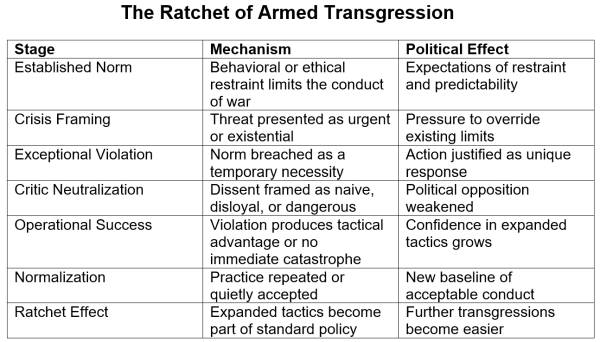
In war, codes of conduct and ethics rarely collapse all at once. They erode in stages. The current conflict in the Middle East has made this development disturbingly clear through a series of assassinations. Targeted killings of Hamas officials were followed by deadly attacks on Hezbollah leadership. As a result of these operations, cross-border beheading attacks as a policy tool gradually became the norm. This development culminated in the killing of Ayatollah Khamenei, Iran’s head of state and leading authority of the Shiite religion, whose status historically exceeded that of a wartime target.
The killing of militant commanders was justified as a counter-terrorism measure. The spread of cross-border strikes was framed as a necessary response to regional threats. By the time the movement reached the level of national leadership, the traditional barriers between battlefield violence and political authority had weakened. What was once considered an anomalous norm violation may now be presented as a logical extension of previous behavior.
Ratchet of Armed Violations
This progression reveals a broader process in which repeated violations gradually dissolve the behavioral and ethical constraints that once shaped conflict behavior. Norms, reinforced through decades of practice, lose their stabilizing power when they are violated without meaningful consequences. The ratchet metaphor describes this directional movement. Once the boundary is crossed, it becomes difficult to recover the previous restraints. Future decision makers act within an expanded sphere of action established by previous precedent. Ratchet phenomena proceed according to a recognizable sequence. A perceived emergency is used to justify an exceptional violation of a code of conduct or ethics. This behavior is presented as temporary and necessary, and is often accompanied by assurances that the underlying inhibitions are intact. Critics who question the leak may be portrayed as naive about the severity of the threat or unconcerned with national security. If a violation does not cause immediate catastrophe, it is easier to repeat the violation. What was initially championed as extraordinary gradually becomes commonplace.
Targeted killings in the Middle East show how quickly this process can unfold. Initial operations have focused on actors widely considered to be legitimate military targets, such as rebel commanders. Subsequent actions would apply the same logic to politically sensitive individuals whose operational roles are ambiguous but whose removal would be seen as advantageous. With each successive stage, the conceptual boundaries between battlefield combatants and political leaders become weaker. As a result, the behavioral environment in war gradually changes. Practices that would once have provoked widespread condemnation have become regular instruments of state strategy. Over time, hopes for a once stable conflict begin to erode, and uncertainty about what the adversary will do increases.
Neutralization of existential threats and restraints
Rarely does a ratchet of armed violations proceed without just cause. Violations of established limits must be framed in a way that is politically acceptable to domestic audiences and allied governments. The most powerful justification available to political leaders is the claim that the nation faces an existential threat. When conflict is defined in existential terms, the calculus of restraint changes dramatically. The behavioral and ethical constraints that normally constrain the war effort begin to seem secondary to the imperatives of survival. Actions that might otherwise provoke widespread opposition can be defended as an unfortunate but inevitable necessity. The existence of nuclear weapons further amplifies this power relationship. This is because, no matter how remote the possibility of a nation’s destruction, it lends extraordinary force to the argument that its very survival is at risk.
Existential frameworks also weaken political opposition to exceptional measures. When a nation’s survival is perceived to be at risk, arguments about legal or ethical limits can be dismissed as an irresponsible distraction from the task of eliminating the threat. Critics may be portrayed as naive, dishonest, or sympathetic to their opponents. Thus, language expressing existential danger plays a key role in propelling Ratchet forward. Each violation is presented not as a precedent, but as a necessary response to an unusual situation. By the time the long-term effects of an action become clear, political debate has often moved on to the next emergency. The result is a mutually reinforcing cycle of escalating rhetoric and tactics. As perceptions of the threat grow, the restraints that once dominated the war effort are losing political support.
rebellious leadership
Conflict dynamics alone cannot explain how restraints can quickly erode. The actions of political leaders also matter. Some leaders display a remarkable willingness, and sometimes even enthusiasm, to cross established boundaries in the pursuit of strategic or political advantage. For such leaders, transgression itself can become a source of authority. Violating established codes of conduct and ethics is treated as a sign of strength and determination rather than a regrettable necessity.
Therefore, a willingness to ignore established limits becomes evidence of decisive leadership, and restraint is portrayed as weakness. When this leadership style intersects with the aforementioned ratchet effect, the breakdown of self-control can be dramatically accelerated. Each border crossing strengthens a leader’s reputation for boldness while expanding the range of actions available to the state. Thus, leadership psychology can play a role in accelerating armed violations.
History has examples of leaders who treated violating established constraints as a deliberate political strategy. Benito Mussolini’s career clearly shows this. Mussolini repeatedly demonstrated strength by visibly rejecting international and domestic restrictions, from the use of chemical weapons in Ethiopia to the normalization of paramilitary violence at home. In such regimes, transgression itself becomes a source of political authority, reinforcing the perception that assertive leadership requires a willingness to ignore traditional constraints.
The current Middle East conflict shows that similar incentives can operate in modern democracies facing intense security pressures. In both the United States and Israel, leaders function in political environments that reward decisive demonstrations of military might. Therefore, actions that cross established behavioral or ethical boundaries can have domestic political advantages, especially if they are framed as a necessary response to an existential crisis.
nuclear limits
The erosion of traditional constraints on warfare rarely results in immediate catastrophe. Each violation appears to be manageable on its own and may also provide tactical advantages in the short term. The danger lies in the cumulative effects. The most dangerous dividing line in this landscape is the long-standing taboo against the use of nuclear weapons. Since the atomic bombings of Hiroshima and Nagasaki, nuclear-weapon states have avoided crossing this line despite numerous crises and wars. But the logic of Violation Ratchet suggests this alarming possibility. As restrictions on behavior weaken and existential rhetoric intensifies, pressure to break even the most serious prohibitions may increase.
There is already active speculation about Israel’s possible use of nuclear weapons against Iran. Having declared that the military threat from Iran is incompatible with Israel’s security, what prevents the use of nuclear weapons to eliminate it? The current US administration has armed and supported Israel in its devastating attack on Gaza. Are we willing or able to prevent Israel from launching a nuclear attack on Iran?
conclusion
The rise of transgressive political leaders who pose existential threats to normalize acts of unprecedented military violence poses a grave threat to world peace. If the process of armed violations continues unchecked, the path forward will lead to the collapse of the nuclear taboo and the possibility of a global catastrophe. Preventing that outcome requires a deliberate restoration of the ethical and legal constraints that once constrained the conduct of war. If the gears of armed violations continue to move forward, the next border to fall may become a nuclear border.
