


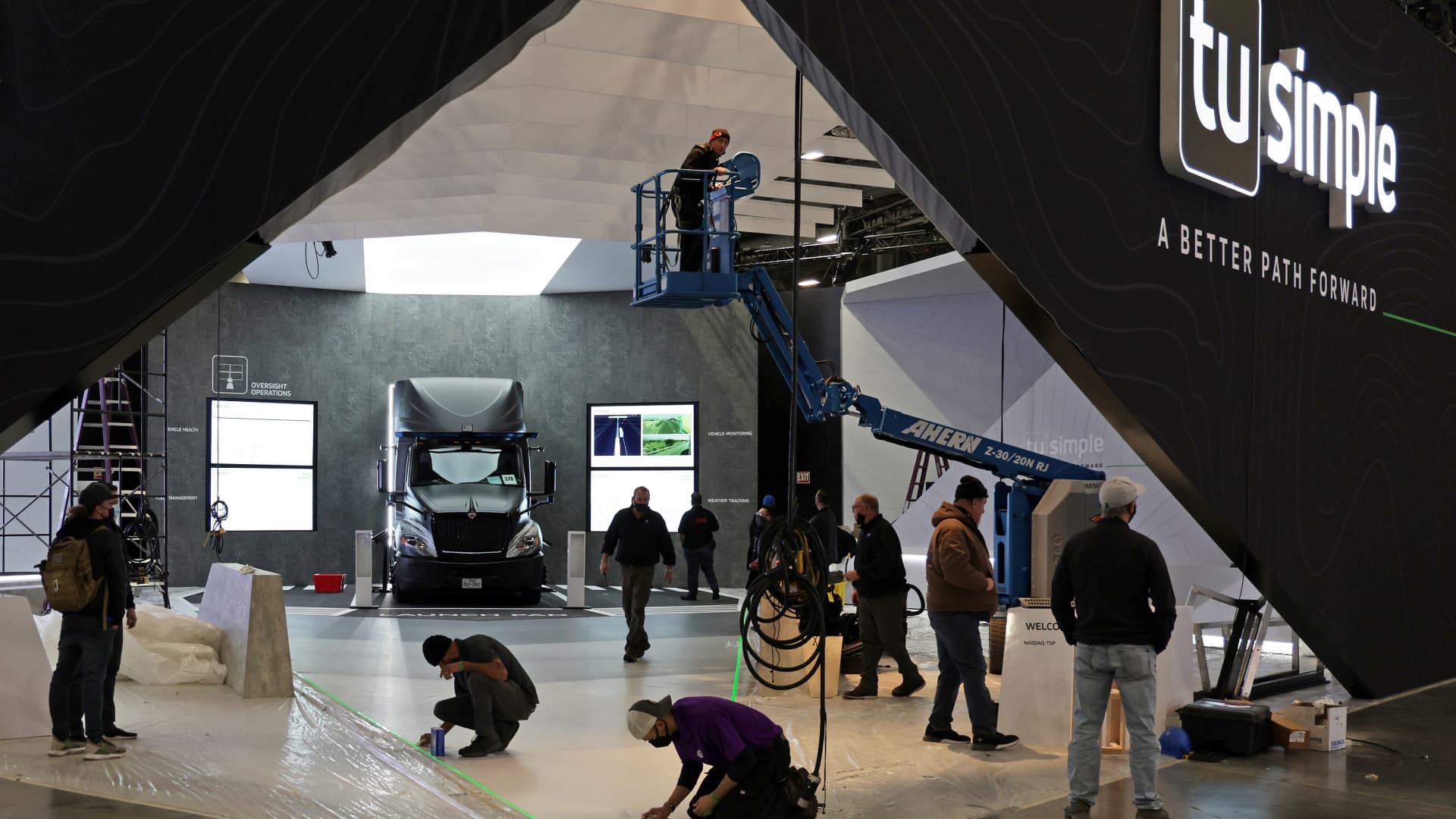
Employees prepare the TuSimple booth for CES 2022 at the Las Vegas Convention Center on January 3, 2022.
Alex Wong | Getty Images News | Getty Images
Embattled Chinese self-driving truck company TuSimple has rebranded to CreateAI to focus on video games and animation, the company announced Thursday.
The news comes as GM exits its cruise robo-taxi business this month and the once-popular self-driving startup sector begins weeding out losers. TuSimple, which spans the U.S. and Chinese markets, has had its own challenges, including vehicle safety concerns, a $189 million settlement in a securities fraud lawsuit and delisting from the Nasdaq in February.
Now, just over two years after CEO Chen Lu returned to the company after his ouster, he expects the business to break even in 2026.
That’s thanks to a video game based on Jin Yong’s blockbuster martial arts novel, with the first version expected to be released in the same year, Chen said. He expects it to generate “hundreds of millions” in revenue by the time the full version is released in 2027.
Before its delisting, TuSimple had announced a loss of $500,000 in the first three quarters of 2023, during which it spent $164.4 million on research and development.
Mo Chen, the company’s co-founder, has a “long history” with Jin Yongjia, and the company began working on developing story-based animation works in 2021, Chen said.
The company claims that its artificial intelligence capabilities in self-driving software development will be the foundation for generative AI development. This is a next-level technology that powers OpenAI’s ChatGPT to generate human-like responses to user prompts.
With CreateAI’s rebrand, the company debuted its first major AI model called Ruyi. This is an open source model for visual work available via the Hugging Face platform.
“It’s clear that our shareholders see value in this transformation and want to move forward in this direction,” Chen said. “Our management team and board of directors received overwhelming support from our shareholders at our annual general meeting.”
He said the company plans to increase the number of employees from 300 to about 500 next year.
Reduce production costs by 70%
The company, still called TuSimple, announced in August that it would partner with Shanghai Three-Body Animation to develop its first animated feature film and video game based on the science fiction series “The Three-Body Problem.”
At the time, the company announced it was launching a new business unit to develop generative AI applications for video games and animation.
CreateAI expects to reduce the cost of producing top-level, so-called triple-A games by 70% over the next five to six years, Cheng said. He did not say whether the company was in talks with gaming giant Tencent.
Asked about the impact of U.S. regulations, Chen insisted there was no problem and said the company uses a mix of Chinese and non-Chinese cloud computing providers.
The United States under the Biden administration is tightening restrictions on Chinese companies’ access to advanced semiconductors used to generate AI.
