


Chinese EV company Xpeng unveiled its latest humanoid robot in Guangzhou on November 5, 2025.
CNBC | Evelyn Chen
GUANGZHOU, China — Chinese electric car company Xpeng plans to launch a robotaxi next year after unpacking its latest humanoid robot model, having previously claimed it would not be a serious business in the near future.
Guangzhou, China-based Xpeng’s technology push mirrors that of one of its main rivals, Tesla, as it seeks to position itself as more than just an electric car company.
The company announced Wednesday that it will launch three robotaxis models as part of “AI Day.” These vehicles will use four of Xpeng’s self-developed “Turing” AI chips. Xpeng claims the chip reaches an industry standard of 3,000 TOPS, making it the world’s highest total in-vehicle computing power.
The semiconductor powers Xpeng’s Vision-Language-Action (VLA) model, now in its second iteration. This type of AI model considers inputs such as visual cues, which are useful for applications such as driverless cars and robotics.
Alibaba on Wednesday announced a partnership with AutoNavi, the e-commerce company’s digital mapping subsidiary, and Xpeng on robotaxis through its Amaps app, which also includes a ride-hailing portal.
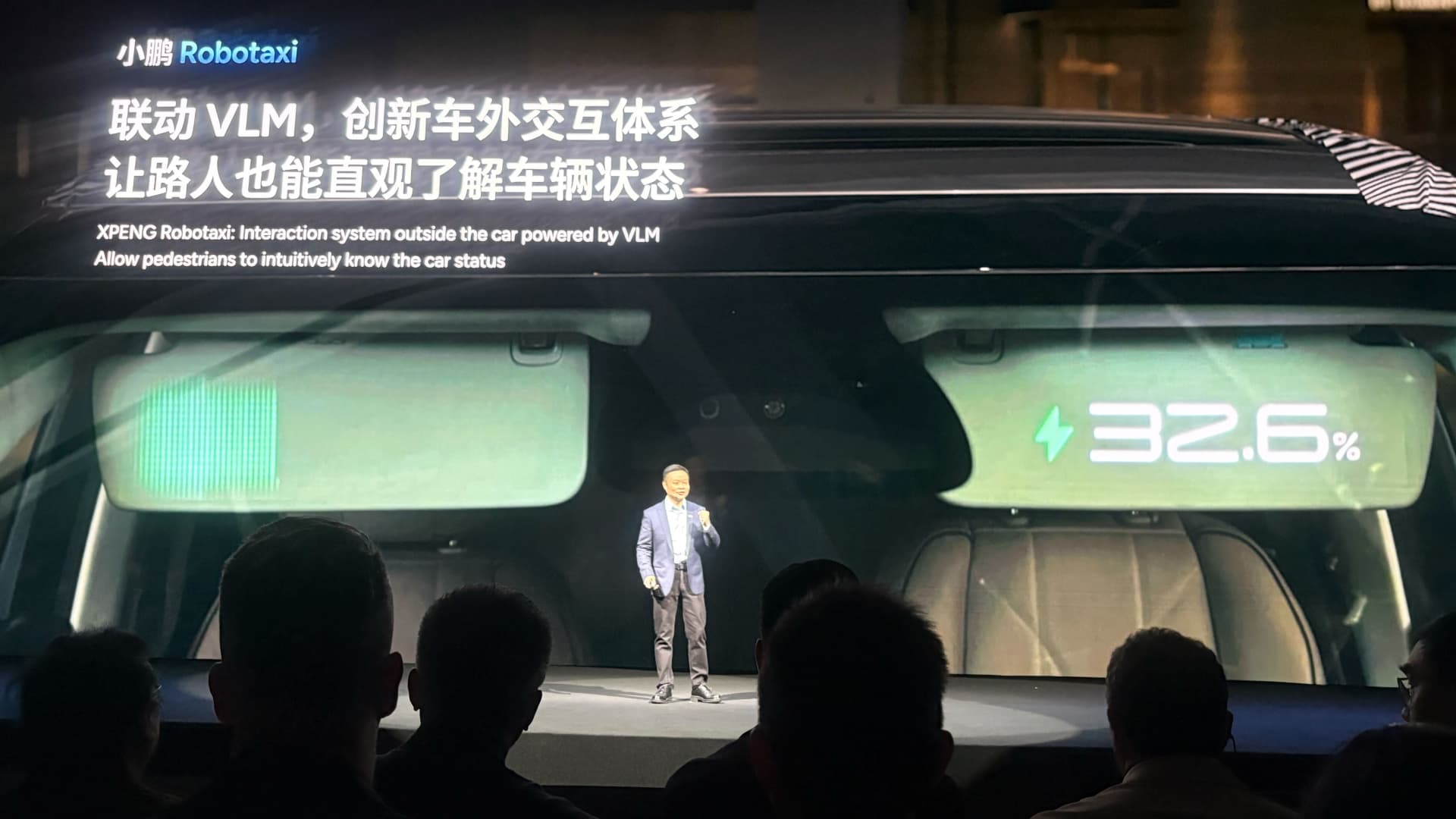
The Xpeng robotaxi includes an external display of speed and other information on the vehicle’s sun visor.
Xpeng said it plans to start testing robotaxis in Guangzhou and other Chinese cities next year.
Co-president Brian Gu told CNBC last week that robotaxis “will eventually become a global phenomenon,” but it will take time to get there, especially given regulations. Back in April 2024, he warned that self-driving taxis would not be a significant business for at least five years.
In a group interview with reporters on Wednesday, Goo talked about the change in tone regarding robotaxis since last year.
“Technology is moving faster than we expected,” Gu said.
He said advances in AI and significant increases in computing power give robotaxis “confidence that we are nearing an inflection point.”
Xpeng’s robotaxis strategy is to create two categories of cars. One is a commercial self-driving shared vehicle, and the other is a fully autonomous personal vehicle that can only be shared between family members.
The announcement of Xpeng’s robotaxi comes as Chinese companies such as Pony.ai, WeRide and Baidu ramp up their global expansion plans after publicly rolling out self-driving taxis in parts of China. Tesla launched its long-awaited robotaxi program in parts of Texas this year.
humanoid robot
Similar to Tesla’s push into humanoid robots, Xpeng also announced Wednesday its own version of the second-generation Iron robot. Chinese companies plan to start mass production of robots next year.
In a presentation Wednesday, CEO He Xiaopeng downplayed the possibility that humanoids could be used in homes soon, saying they would be too costly to use in factories given China’s low labor costs. Instead, the robots will initially be used from Xpeng facilities as tour guides, sales assistants and office building guides, he said.
He doesn’t know how many robots Xpeng will sell over the next 10 years, but said it will exceed the number of cars.
The humanoid robot uses three of Xpeng’s Turing AI chips and a solid-state battery, and will offer customization options for aspects of the product such as body shape and hairstyle.
Xpeng CEO Xiaopeng He unveiled the company’s robotaxi plans at an event in Guangzhou, China on November 5, 2025.
CNBC | Evelyn Chen
Xpeng co-president Gu said Wednesday that the company had developed some technologies before Tesla, but had not been as aggressive in promoting them.
“What we’re pursuing from a technology and product standpoint has some similarities with Tesla…There are some areas where we probably started earlier than Tesla,” Gu said, referring to flying cars and humanoid robots.
Xpeng has developed a flying car product.
But Gu acknowledged that Tesla has done a better and more high-profile job of sharing its commercialization plans, whereas Xpeng has done less of that to date.
