


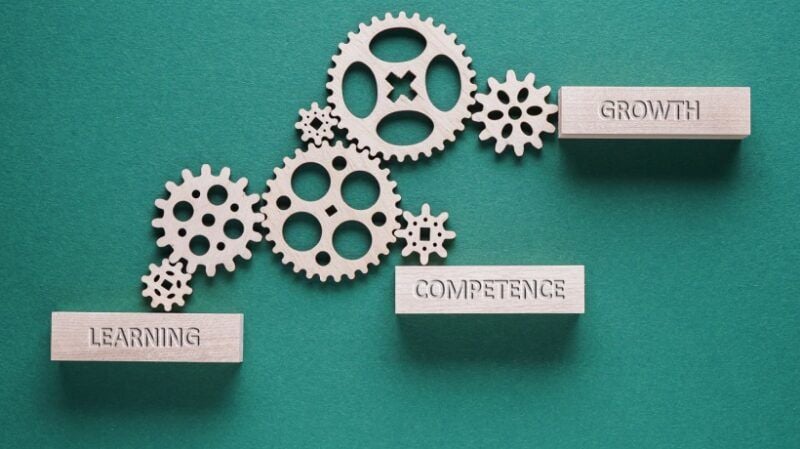
Competence: the engine of change
Every organization today is talking about digital skills, agility, and AI readiness. But beneath the dashboards and platforms lies a harsh reality. Many dashboards and platforms digitize content rather than functionality. I’ve seen this pattern repeatedly in my previous consulting work helping implement digital learning systems. Learning portals were launched, courses were uploaded, and completion rates were praised, but there was little tangible change in what people could do differently.
The fantasy of digital transformation
True digital transformation doesn’t start with technology. It starts with people, or more precisely, their ability to confidently navigate change. That’s where competency-based learning (CBL) comes in. This moves learning from counting training hours to measuring actual skill acquisition. Instead of a static course catalog, build a living capability engine that grows with your business needs.
According to a recent OECD report, the shift to a ‘skills-first’ approach across industries highlights the importance of investing in workforce capabilities, not just qualifications and technology, for sustainable growth and competitiveness in the digital age.
What you really need in digital transformation
Digital transformation is not just about deploying a platform. It’s about reimagining how people think, collaborate and deliver value. We are looking for employees who can:
Think critically in a complex and rapidly changing environment. Collaborate across digital tools and global teams. Continuously adapt while staying aligned with business objectives.
Traditional training models tell people what they need to know. They don’t build a method of performance. CBL bridges this gap by directly tying all learning experiences, including data literacy, digital collaboration, and design thinking, to measurable outcomes.
example
In one of my previous projects, a business unit implemented a new analytical tool. Training focused on “how to use the platform” was conducted. By redesigning around competencies, interpreting dashboards to make business decisions, and collaborating on insights, we saw faster adoption, better engagement, and measurable performance gains.
From course to ability
For decades, L&D teams have celebrated course completion and “smile sheets.” However, these metrics do not prove readiness for digital transformation. CBL begins with one question. “What will this person be able to do differently after learning?”
That one question changes everything about how learning is designed, delivered, and measured. Instead of a broad “Leadership 101” course, it focuses on micro-competencies like fostering virtual collaboration and overcoming ambiguity. Three steps for organizations to build functional maturity:
Define your digital competency architecture
Map critical skills, both behavioral and technical, that align with your transformation goals. Design by counting backwards from mastery
Build learning paths, simulations, and feedback loops that lead to real-world performance. Measure proficiency, not time
Replace “time spent” with “demonstrated competency” through applied tasks, peer feedback, or manager validation.
When learning is structured this way, employees not only know more, but also perform better.
Data benefits from competency-based learning
Modern learning platforms generate data, but not all data generates insights. Completion rates alone cannot determine whether a person is ready for future work. CBL structures learning data based on competencies to provide a clearer picture of employee capabilities. When combined with AI and learning analytics, organizations can:
Identify skill gaps in real time Automatically personalize development paths Connect learning investments to measurable business outcomes
This ultimately allows L&D teams to close the loop between learning, performance, and results, which is the ultimate goal of digital transformation initiatives.
Human side: Competence breeds confidence.
Behind every dashboard is a human. People rarely resist change because they dislike technology. They feel unprepared and resist. Competency-based learning restores that sense of readiness. When employees understand what is expected of them, see a clear path forward, and receive personalized feedback, anxiety is replaced with confidence.
In my work designing and facilitating digital leadership programs, I have witnessed this shift over and over again. Engagement increases when learners understand why they are learning something and how it relates to their career growth. In the age of AI, this human aspect is extremely important. As routine tasks are handled by automation, the most valuable competencies are:
Adaptability. emotional intelligence. Judgment and creativity. Self-leadership and resilience.
Organizations need to communicate this clearly. AI won’t replace you. It’s about rebuilding what you need to master. Competency-based learning makes that transition transparent and empowering.
Looking to the future: From digital to adaptive
As AI continues to redefine the future of work, CBL will evolve into an adaptive learning ecosystem, a system that not only assesses what learners know but predicts what they will need next. To stay ahead, organizations must:
Continuously update competencies as new technologies and business models emerge. Integrate human and machine insights, use analytics to guide learning, and managers to guide learning. Build a culture of continuous competency where learning is not a one-time event but a lifelong cycle of growth.
This evolution transforms digital transformation itself from a technology project to a movement of human capabilities.
lastly
Leadership and learning are mutually essential.
— John F. Kennedy
Digital transformation without competency transformation is like upgrading hardware without updating the operating system. Competency-based learning provides organizations with a blueprint for scaling human capabilities to match the speed of technological change. In the future, we will explore how to design adaptive and personalized learning ecosystems that make competency acquisition practical, measurable, and exciting. stay tuned!
