


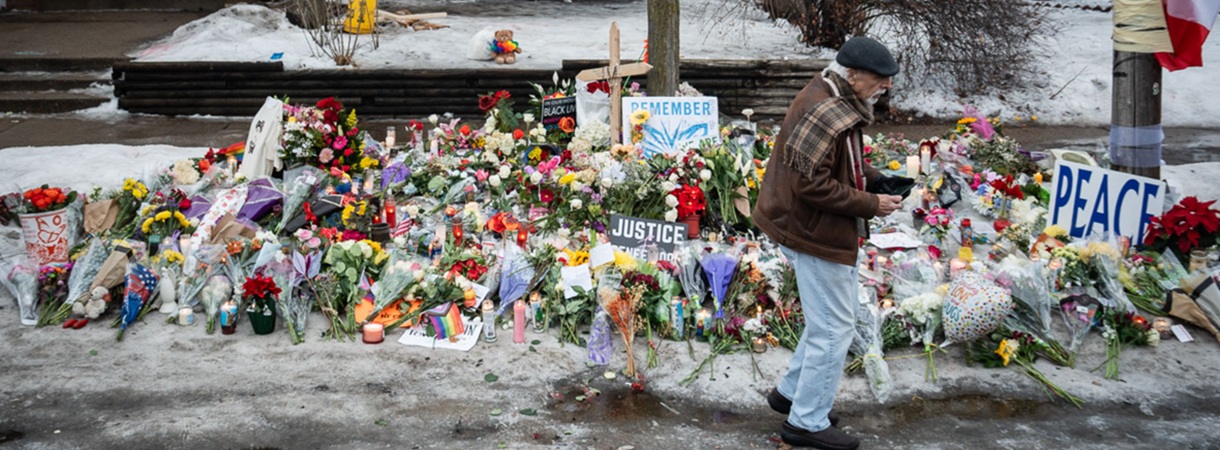
In early January 2026, an ICE officer shot and killed 37-year-old Renee Nicole Good on a snowy street in Minneapolis. The woman is a U.S. citizen and mother who was driving a Honda Pilot with a stuffed animal hanging from the glove compartment. She had reportedly just dropped off her six-year-old child at school. Multiple bystander videos captured the shooting and horrific aftermath, including ICE officers blocking doctors from reaching Good. These images further complicate what the United States has been experiencing since the beginning of the second Trump administration. Social media feeds are filled with footage of ICE and Border Patrol agents breaking car windows during immigration raids, and firing pepper spray and tear gas canisters at people who show up to witness the human toll of immigration enforcement in their communities.
In the wake of Ms. Good’s murder, many understandably asked how her family could hold individual officials or the federal government accountable for her death. The answer is complex, and the legal battle is fraught with pitfalls.
The well-known legal defense of qualified immunity would prevent law enforcement officers from having to defend themselves against civil rights lawsuits seeking monetary compensation (known as “damages”) unless the rights are “clearly established” such that a “reasonable police officer” would understand that their actions violated the law.
What is less understood is that, thanks to the Supreme Court, there is virtually no way to sue individual federal employees for monetary damages for violating their constitutional rights. Local and state law enforcement agencies that violate people’s rights can be prosecuted under a Reconstruction-era law, 42 U.S.C. 1983. No similar law exists for federal employees. Instead, the Supreme Court ruled in 1971 in a case called Bivens v. Six Anonymous Known Agents of the Federal Bureau of Narcotics that individuals could sue federal drug enforcement agents for violating their Fourth Amendment rights by conducting illegal searches and arrests.
But since then, the Supreme Court has watered down Bivens, particularly under the Roberts court. From the Border Patrol agent who shot and killed a Mexican teenager while crossing the U.S.-Mexico border to the officer who allegedly threw a B&B owner to the ground at the U.S.-Canada border and later retaliated, the Supreme Court has made clear that it will not allow lawsuits against federal officials under any circumstances beyond the facts of Bivens itself and two additional (now very old) cases. Although the court has not overturned the Bivens decision, its usefulness has been significantly weakened.
Vice President J.D. Vance falsely claimed that the ICE agent who shot and killed Renee Goode was entitled to “absolute immunity.” That’s clearly wrong. Federal agents acting under the law can be criminally prosecuted for intentionally depriving individuals of their civil rights. In theory, prosecution by the state is also possible.
Additionally, individuals can sue the federal government under the Federal Tort Claims Act (FTCA) for injuries sustained at the hands of federal employees. In fact, the federal government paid nearly $5 million to settle an FTCA lawsuit brought by the family of Ashli Babbitt, a woman who was killed by a Capitol Police officer during the storming of the Capitol on January 6, 2021.
But the reality is that it is difficult by design to pursue legal responsibility for acts like Renee Good’s murder through civil litigation.
DHS employees have used excessive force before this administration. When ICE/IRS raided a meat processing plant in East Tennessee in 2018, surveillance footage showed an ICE officer pressing his boot against the neck of a worker who was face down on the floor for 25 seconds. This was a dangerous act that could result in serious injury or death. That same employee was accused of punching another worker in the face during the raid. The only reason the “boot on the neck” case came to light was because of civil lawsuits against individual agents.
If a court rules that individuals cannot sue federal officials for rights violations, or if DHS officials are successful in asserting qualified immunity in such cases, such evidence may never be revealed. The proliferation of smartphone cameras and the growing brazenness of DHS violence on the streets of American cities is raising public awareness of abuses by law enforcement and potentially leading to policy changes. Efforts to enact federal legislation codifying Bivens have not progressed in Congress, but could gain momentum as people of various ideologies push back against federal law enforcement overreach.
Although no amount of money can bring back those killed by federal agents, monetary damages are an important part of the U.S. legal system, promoting accountability and acting as a deterrent against future rights violations. Rights without remedies are empty promises that do nothing but ensure that federal agents continue to endanger and kill people.
Photo credit: Chad Davis
