


Written by science journalist Hilary Rosner. His work has been published in the New York Times and National Geographic. Roam is her first book. Originally published in Undark.
While the habitats of so many animals are shrinking on our human-made planet, some species are actually expanding their ranges and managing to thrive despite or because of human activity. Coyote is one of them.
In 2004, researchers compared the modern and historical ranges of 43 North American carnivores (such as foxes, badgers, and lynx) and ungulates (such as pronghorns, elk, and mountain goats). They found that bears, wolves, cougars, and wolverines have lost significant portions of their ranges, and that both in general have lost a lot of habitat. But raccoons and coyotes were thriving in contrast. Raccoons expanded their territory by nearly 20 percent, and coyotes by a whopping 40 percent.
Scientists debate the exact range of coyotes throughout history, but new research, based on museum specimens, sighting records, and fossils, bones and other artifacts found in archaeological digs, shows that from 10,000 years ago until the late 1800s, coyotes inhabited about two-thirds of North America, from California to the Mississippi River in the United States. It may also have lived as far south as northern Costa Rica and as far north as southern Canada. However, coyotes have never been found in the eastern United States. But since the 1900s, coyotes have gained new territory every decade, spreading east across the United States, south to Panama, and northwest across Canada and into Alaska.
The explosion of coyotes across the continent was made possible by the very clearing and fragmentation of forests that made life difficult for other species, and by the genocide of wolves by European settlers. Wolves compete with coyotes for food and sometimes kill coyotes in the competition. With top predators removed from the food chain, coyotes thrived.
The coyotes currently found east of the Mississippi River are a recent creation. The eastern coyote, now found from Florida to Newfoundland, is actually a hybrid of a coyote, a wolf, and a domestic dog, and the northeastern coyote has the most wolf and dog DNA, with 8 to 25 percent wolf and about 10 percent dog, according to research by zoologist Roland Kays of North Carolina State University.
Kayes estimates that these coyote and wolf kills occurred about 100 years ago. “A century ago, the Great Lakes wolf population was at its lowest ebb, living in such low densities that some reproductive animals likely couldn’t find another wolf mate and had to settle with coyotes,” Kayes wrote in 2015.
The wolf genes likely made coyotes slightly larger, allowing them to make dinner from ready-to-eat deer in eastern forests, allowing the hybrid coyote to expand its historic range. “These animals flourished, dispersed east, and flourished again to become the eastern coyotes,” Kayes wrote.
Kayes estimates that dog breeding is more recent, about 50 years ago. “Eastern coyotes now have no trouble finding coyote mates; their populations continue to grow throughout their new woodlands, and they appear more likely to kill dogs than breed with them,” he wrote.
Unlike other animals that have established themselves in new areas over the past 100 years or so (such as the emerald ash and feral hogs, both of which were introduced by humans and wreaked havoc on the ecosystem), coyotes have evolved and adapted to take advantage of human-altered landscapes, exploiting new opportunities, and using their wits to survive.
In the 1980s, they moved south to southern Panama, and now only the jungles of the Darien Gap separate them from Colombia and South America, where they never existed.
***
Coyotes are generalists. In other words, we are not particular about food or accommodation. This has led them to expand from grasslands to forests, suburbs, and cities. But they also benefit from a special relationship with humans. Scientists use the term commensal to refer to the types of animals that thrive in urban landscapes, such as rats and pigeons, geese and foxes, raccoons and coyotes. Commensal species may choose to actively hang out in areas dominated by humans and move into new habitats, or they may simply be better equipped to survive in cities than other animals. Species that prefer to avoid humans or are harmed by urbanization are called misanthropes.
Most land-dwelling carnivores hate humans. Less than 15 percent are gay. But scientists who have been studying coyotes in the Chicago metropolitan area for more than 20 years believe they are a strange mixture of both. In one study, researchers fitted 181 coyotes with radio collars over a six-year period and wrote that they ultimately completed “a portrait of an animal that strongly avoids humans spatially and temporally, while appearing to benefit from urban landscapes through improved survival and perhaps increased population density.”
The animals avoided more developed areas of the city and also became nocturnal. This is a smart strategy. It’s about thriving in crowded cities while completely avoiding people. Scientists call this condition “misanthropic brotherhood,” and it helps both individual animals and the species as a whole.
The same goes for New York City. Coyotes breed there, and scientists track them. Since 2009, a collaboration of researchers called the Gotham Coyote Project (CGP) has been studying the ecology of coyotes in the city.
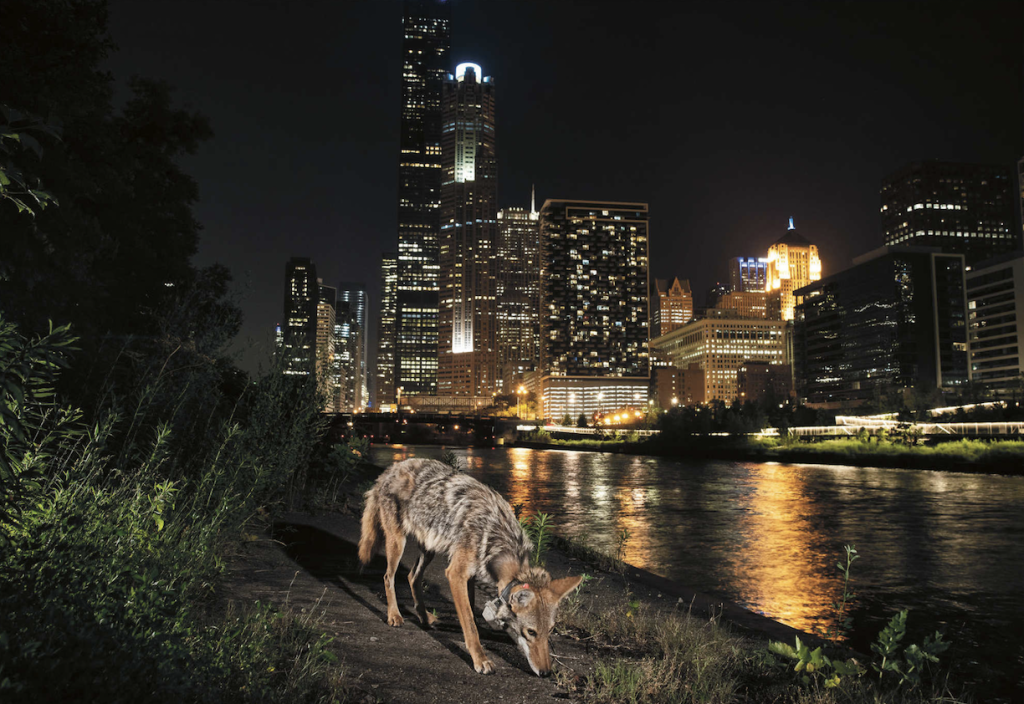
A radio-collared juvenile male coyote whose Urban Coyote Research Program has been studying animals in Chicago since 2000. This coyote roamed the city trying to find its own territory, but was hit by a car a few months after the photo was taken. Visual: Corey Arnold
I called Anthony Caragiulo, a geneticist who worked on the project and was also the associate director of genome engineering at the Comparative Genomics Laboratory at the American Museum of Natural History. At the time, Caragiulo was analyzing DNA from coyote scat collected by volunteers from parks in and around the city. “I don’t go out and collect anything,” he said when we spoke by phone. “People just send me trash cans in the mail.”
Like many New Yorkers, Coyote occasionally visited Manhattan, but he actually lived in the outer boroughs. In fact, they thrived in the Bronx and continued to expand their territory, crossing the East River into Queens and moving toward the suburbs and rural areas of eastern Long Island. Researchers were trying to build a “genetic connectivity map” of all coyotes to understand who is related to whom and where they came from.
Caragiulo’s role in creating the map was to extract DNA from coyote scat he received in the mail. It was difficult to imagine poop at the post office. “So people just put it in a box and write their address on it?” I asked him. “I put it in a brown paper bag,” he answered. “Sometimes they have silica beads in them, like the ones that come with shoes when you buy them.”
“So, it just arrived in the museum’s mailbox?” I spent most of my childhood in that building, and I still looked at it with childlike awe. If you had asked me what I thought would arrive in the museum’s venerable scientist’s mailbox, I would have said exotic jewelry and a perfectly preserved plesiosaur vertebrae. This is definitely not Bronx coyote poop.
Caragiulo was kind enough to invite me to take a look at his inbox for myself, and I met him one morning at the museum’s basement entrance. It was a Tuesday in fall 2021, but the museum was closed on Tuesdays due to pandemic-related staffing shortages. The building was completely empty, except for security guards, a few staff members working on exhibit maintenance, and a public vaccination clinic taking place in a lower-floor lobby.
We headed to the giant elevator and went all the way up to the 8th floor. There was no one in the hallway, giving it a somewhat apocalyptic feel. Because of the pandemic, most people are still working from home and only do so when necessary and permitted, he said. The pandemic has also created supply chain issues in the lab. Generous items such as pipette tips and DNA sequencing kits typically took up to three months to arrive. This delayed Mr. Caragiulo’s work on the coyote. His laboratory was full of poop. “I’m the bottleneck,” he said.
He led me to an area of the lab where shelves and surfaces were lined with piles of cardboard boxes and precarious envelopes. When he opened the box at the station labeled “Bench 3 – Scat Bench,” he found that it was filled with small paper bags. One bag from a scat collector named J. Murray, picked up on January 8, had handwritten information reading “Cedars Golf Course in Cutchogue.” “There may have been vomit of goose feathers and bones near the goose carcass,” the memo said.
I can now see why Mr. Caragiulo preferred the laboratory to the field. Other bags had the names of various people, including scientists and volunteers, as well as the names of various green spaces across Long Island, including Quogue Wildlife Refuge and Kings Point Park. Everything had GPS coordinates.
Mr. Caragiulo put on blue latex gloves, spread tissues on the table and opened a paper bag. I collected some dried manure. There was no noticeable odor and it looked like nothing more than a lump of mud. I shrugged. “This could be anything. I don’t know.”
But most of the samples he’s analyzed over the past year have clearly been coyotes. (A few domestic dogs and the odd fox.) By extracting and analyzing DNA from the feces, they were first able to quickly determine whether it actually came from a coyote. Then, using so-called microsatellites (short, repeated segments of an individual’s unique genetic code), they were able to determine which samples came from the same individual coyote and which samples came from closely related coyotes.
You can also determine how closely related they are. “The goal is to look at this series of movements, which are snapshots in time, to find out which clans were successful and where they established colonies over five, 10, 15 years.”
Carol Henger, a molecular biologist who studied coyote DNA for her PhD research in collaboration with GCP, said each park in the Bronx has its own distinct family group. DNA from the faeces of each individual and each family can now tell us who is moving where. For example, “this coyote at the New York Botanical Garden is also a relative of the Pelham Bay coyote,” she said. “They were scattered all over the city.”
The genetic connectivity map also allowed Henger and the Gotham team to hypothesize about how coyotes settled in New York City in the first place. A likely story is that “they first settled in parks north of the city,” coming down from the suburbs of Westchester, “and then their descendants settled in other parks and had their own family groups. The Queens coyotes, the newly arrived coyotes, were related to the Bronx coyotes,” Henger said.
Like many New York stories, it was a story of immigration and survival.
Scientists are interested in this particular snapshot because it allows them to observe coyotes migrating into a landscape they have never existed before: Long Island, a 190-mile-long, vaguely alligator-shaped sandbar that juts into the Atlantic Ocean east of Manhattan, anchored in Brooklyn and Queens at its western tip.
Chris Nagy, co-founder of the Gotham Coyote Project, spoke of species that are recovering in numbers where they lived before humans decimated their numbers. “But the coyotes showed up for the first time.”
Nagi is surprised by this. “When I talk to people about this, I say the urban ones are cool, but they live all the way from Alaska to the rainforests of Central America. They’re figuring out how to make a living anywhere they can.”
