


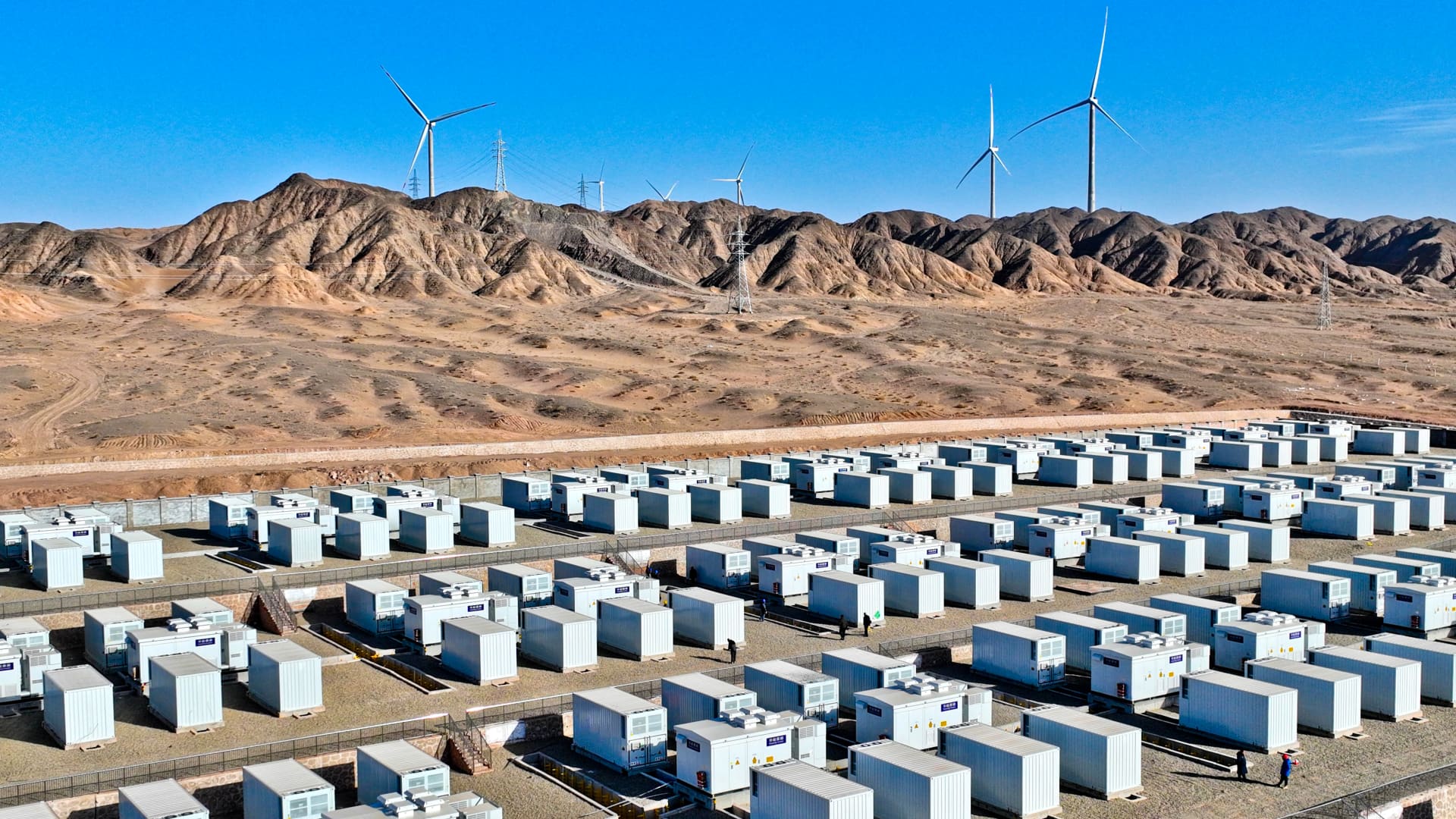
As China and the United States vie for supremacy in artificial intelligence, Bernstein found that computing power will be a key factor in determining the winner. The company also named several stocks to ride the trend. “China will need to invest heavily in semiconductors and power infrastructure to catch up with the US, creating clear upside for related stocks,” the analysts said, noting this is a step back from the market’s current focus on access to semiconductors. The US is restricting China’s ability to buy advanced chips to train AI models. Chinese companies have responded by using more chips, albeit with less power, while introducing AI models that are much cheaper to use than their American rivals. Just as chips are essential to the AI race, so is the electricity required to power them. “Computing power depends not only on advanced semiconductors, but also on the power supply to run hyperscalers, and China is leading here,” Bernstein’s Hong Kong-based analysts said in a March 17 report. They predict that by 2035, the United States will be using 511 zetta floating point operations per second (ZFLOPS) of AI calculations. This compares to the current level of 35 ZFLOPs, the report said, referring to a measure of computing speed. China currently only has 5 ZFLOPs of AI computing, but last year the country added more than 500 gigawatts of power capacity. At this pace, China could acquire 1,936 ZFLOPs by 2035, analysts said. That’s more than three times the amount in the United States Fueling electricity needs Energy security has long been a focus for the Chinese government, as evidenced by efforts to stockpile crude oil and diversify into renewable energy. The country’s push for electric vehicles, while supporting battery development, has also reduced oil demand. “China will need more batteries and grid infrastructure to support rapid growth in power generation and renewable energy,” Bernstein analysts said, “so CATL and Sungrow remain our top picks.” Analysts rate both companies as outperforming mainland China-listed stocks. The target price is 530 yuan (approximately $76.96) for CATL and 260 yuan for Sungrow. CATL (Contemporary Amperex Technology) is a leading Chinese battery supplier to China’s rapidly growing electric vehicle manufacturers. Sungrow is a leading solar power and energy storage company. Bernstein analysts said electricity accounts for about 30% of China’s total energy mix, higher than the global average of 21%, and China’s renewable energy costs could be one-third that of the United States. They noted that while solar power has allowed China to rapidly increase electricity generation, China’s continued push into nuclear power and expansion of battery-based energy storage could help improve the stability of power supply. Bernstein analysts predict that China’s domestic AI chips will also become more powerful, increasing the efficiency of U.S. chips to more than 50% by 2035, up from about 25% today. Chinese semiconductor stocks that they rate as outperforming include Cambricon and Hygon, with price targets of 2,000 yuan and 280 yuan, respectively. Both stocks are listed on Shanghai’s high-tech STAR board. Overall, Bernstein estimates that China will increase AI-related spending, primarily in data centers, by 32% annually through 2035, while U.S. capital spending in this area will only increase by 8% annually, albeit from a higher base. —CNBC’s Michael Bloom contributed to this report
