


Connor: Beavers are ecological wonders:
Ecological reconstructions suggest that beaver-created wetlands may once have affected about 100 million acres of North American floodplains.
They were constantly reengineering the way water moved between regions. pic.twitter.com/8obm6qvbnL
— Mound Lore (@MoundLore) February 12, 2026
As cycles of drought, fire and flood intensify, watershed restoration teams across the continent are rediscovering what previous generations already lived. ⁰
Before humans designed North America, beavers already had it. pic.twitter.com/4L0RTs0ejs
— Mound Lore (@MoundLore) February 12, 2026
Written by Joshua Larsen, Annegret Larsen, and Lukas Hallberg. Joshua is Associate Professor of Water Science at the University of Birmingham, Annegret is Assistant Professor of Geography at Wageningen University, and Hallberg is a Watershed Research Fellow in the School of Geography and Earth and Environmental Sciences at the University of Birmingham. Originally published on The Conversation.
Across Europe, beaver numbers are increasing after a long period of decline. As these aquatic mammals recolonize rivers, they are gradually rebuilding the wetlands that once existed in many river valleys.
As geographers, we have investigated how these changes may affect the movement of carbon through river systems.
To find out, we measured the complete carbon balance of wetlands created by beaver dams. Our new research shows that wetlands formed by beaver damming can store carbon at up to 10 times higher rates than comparable rivers and floodplains without beavers.
The wetlands we studied in northern Switzerland trapped more than 1,100 tonnes of carbon in just 13 years. That’s the equivalent of two Olympic swimming pools filled with charcoal.
Therefore, when beavers dam a river, the way carbon is stored in the river landscape can also fundamentally change.
Our team investigated wetlands where beavers have been active for more than a decade.
We spent a year intensively monitoring the site to measure water flow, the amount of carbon dissolved in the water, greenhouse gases released (such as carbon dioxide and methane), and plant growth throughout the wetland. They also sampled and analyzed sediment and dead wood that had accumulated since the beavers arrived.
By combining these measurements, we constructed one of the most complete carbon budgets for European beaver landscapes.
The results surprised us.
Wetlands acted as strong carbon sinks, although carbon was released seasonally in the summer. Each year, about 98 tons of carbon is stored that would otherwise flow downstream or return to the atmosphere.
However, this annual carbon budget is strongly related to water flow and flood intensity, and can vary from year to year. What really determines long-term benefits is how much carbon ends up being buried and stored underground for decades.
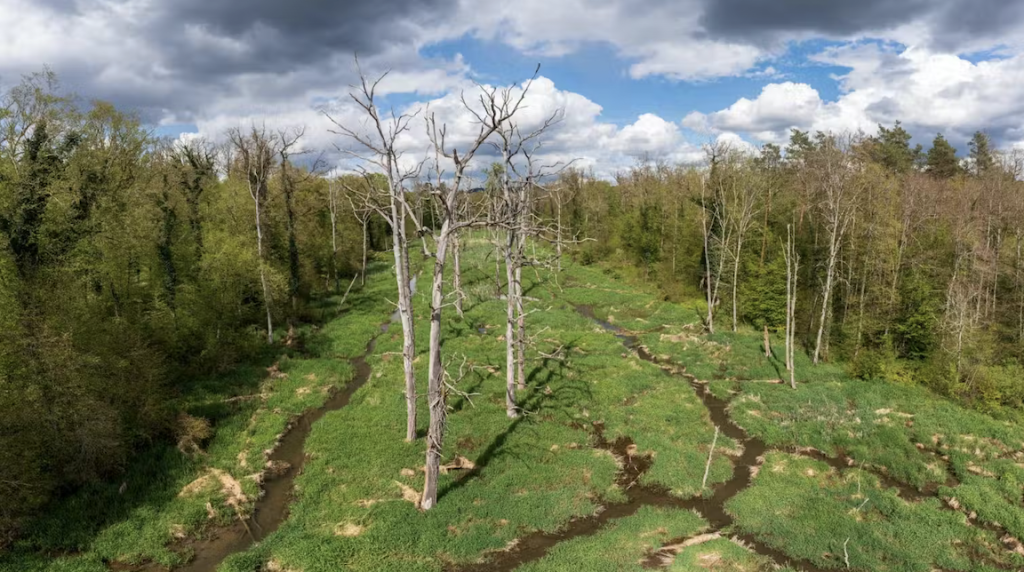
Researchers investigated a beaver swamp in Switzerland. Christoph Angst, CC BY-NC-ND
When dams slow the flow of water, sediment begins to settle. These deposits contain organic materials such as leaves, soil, and plant debris that contain carbon. This material is buried in the wetland soil rather than being washed downstream.
Beaver dams can also raise water levels and flood existing vegetation. Some trees die and fall into the water, adding large amounts of dead wood that slowly stores carbon over a long period of time.
Meanwhile, new plants and algae that grow in wetlands absorb carbon from the atmosphere.
Over time, wetlands become natural storage systems. Sediment, wood, and vegetation build up layer by layer. This traps carbon in the landscape and eventually fills the wetlands.
In the wetlands we studied, sediments contained up to eight times more organic carbon than nearby forest soils.
Researchers collecting water samples to analyze dissolved carbon concentrations. Annegret Larsen, CC BY-NC-ND
Wetlands typically produce methane, a powerful greenhouse gas. This has led to concerns that beaver ponds may actually worsen climate warming.
However, in our study, methane emissions were very low, less than 0.1% of the total carbon budget.
Most greenhouse gas emissions come from carbon dioxide released from exposed sediments during the dry summer months. Still, these emissions were less than the amount of carbon stored in sediment and wood.
Over the course of a year, the wetlands stored more carbon than they released.
With beaver and without beaver
To understand the role of the animals themselves, we compared beaver swamps to a scenario in which the same river remained normal flow with a forested floodplain.
Forests are already important carbon stores. As trees grow, they absorb carbon, and some of that carbon remains locked up in the soil and dead trees.
Without beaver dams, rivers would remain largely confined within their channels. Water would move rapidly downstream, carrying away sediment and carbon rather than trapping it throughout the floodplain.
Our calculations show that this forested river corridor stores only a small fraction of the carbon held in beaver wetlands. In other words, the presence of beavers increased carbon stocks by about an order of magnitude over a 10-year period.
Expanding beaver populations across Europe could improve carbon storage in river landscapes. When the results were scaled up to floodplain areas in Switzerland suitable for beaver recolonization, it was estimated that potential carbon storage could offset around 1-2% of the country’s annual emissions.
It may sound small. But it happens without expensive technology, infrastructure, or active intervention. It will simply come about by allowing native species to rebuild the wetlands that once existed along many of these rivers.
While beavers won’t solve climate change, our research shows that these natural engineers can quietly help store more carbon in river landscapes for decades to come.
