


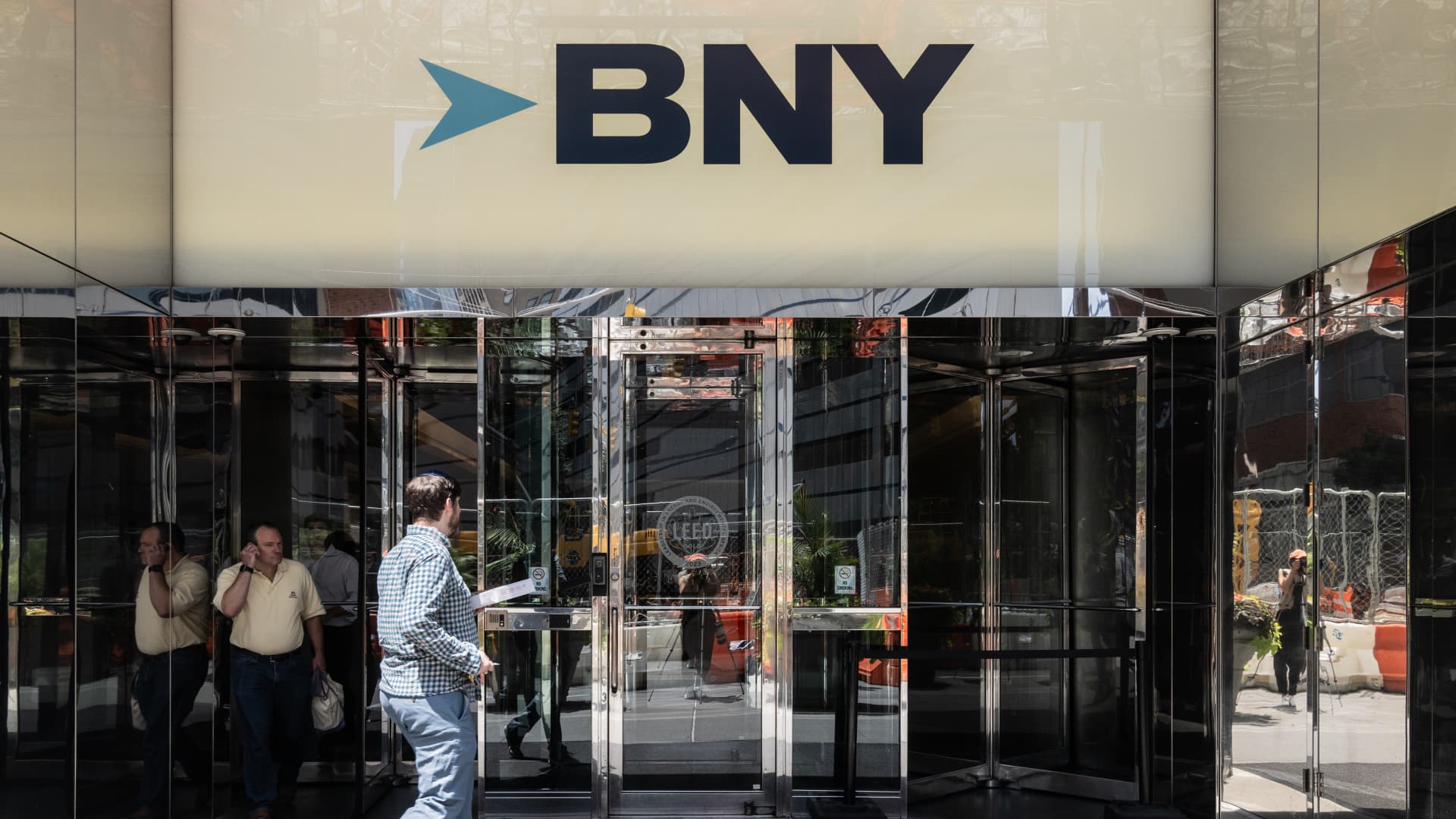
Wednesday, July 10, 2024, BNY headquarters in New York, USA.
Gina Moon | Bloomberg | Getty Images
At America’s oldest bank, 134 new employees don’t sleep or take sick leave. They don’t even have names.
They are what BNY calls “digital employees.” They work hand in hand with humans. They have a unique role and are judged on how well they carry it out. Some of their work was done by people last year.
“Digital employees work 24/7 and are obviously very different from human employees,” said Rachel Lewis, BNY’s head of payments operations, who oversees nine digital employees in addition to thousands of humans. “It focuses on very specific, repetitive tasks and allows human employees to perform more human, intensive and interesting types of roles.”
BNY has 48,100 employees, down from about 53,400 in 2023, according to its most recent financial results. CFO Dermot McDonough was asked on the company’s fourth-quarter analyst call last month what 134 digital employees would mean for the company’s cost savings.
“Our headcount is trending down a little bit, but that has nothing to do with AI yet,” McDonough said. “We talk internally that AI is unlocking capabilities. We don’t think about it narrowly in terms of efficiency. It’s all about growing with our clients, increasing revenue, and optimizing the potential of our people.”
Across Wall Street, analysts and investors are starting to ask more questions about how industry spending on AI can lead to greater efficiency and greater profits. BNY spent $3.8 billion on technology in 2025, representing about 19% of its revenue. That percentage is the highest among its large banks, according to data compiled by CNBC.
Arrow pointing outside zoom in icon
JP Morgan, Goldman Sachs, Bank of America, Wells Fargo, Citigroup, BNY
“There’s an AI arms race going on, and banks are participating in it,” said Mike Mayo, an analyst at Wells Fargo. “But you can’t define success by who spends the most money. You define success by who gets the best results.”
“In general, there’s a lot of ‘spray and pray’ involved when it comes to technology spending,” he said.
But BNY has been identified as one of the companies that could benefit the most from AI. Goldman Sachs researchers screened the Russell 1000 for potential productivity gains based on labor costs and wage exposure to AI automation. The company ranked BNY at the top of its list, and the bank said earnings per share could increase by 19%.
But in several conversations CNBC had with BNY executives, they were adamant that many of the technology investments will not come at the expense of human employees.
“I wouldn’t think of it that way,” said Michelle O’Reilly, head of global talent at BNY. “I think of it as unlocking productivity, enabling every employee to be productive.”
As the company grows its digital workforce, it also improves its human skills. Shortly after ChatGPT was released in late 2022, BNY set up an AI hub.
“That’s when we really pulled together and realized this was going to be transformational for the bank,” said Lee Ann Russell, BNY’s chief information officer and head of global engineering. “Initially, our biggest focus was on enablement and rolling out training to all employees at the bank.”
BNY has built a platform called Eliza. The platform ingests a variety of open source commercial models integrated with a company’s internal data and compliance. Nearly all BNY employees have completed the 10-hour training for Eliza, and thousands more are taking it a step further through a multi-day AI bootcamp that helps non-engineers find creative ways to automate parts of their jobs.
The name “Eliza” was given in honor of Elizabeth Schuyler Hamilton, the wife of Alexander Hamilton, the bank’s founder and America’s first Secretary of the Treasury.
“This democratization of technology is one of our sweet spots in terms of how we feel about our success so far,” Russell said. “We’re juxtaposing the 241-year history of this amazing institution with being at the forefront of AI. I think it’s a great reminder of centuries of technology.”
