


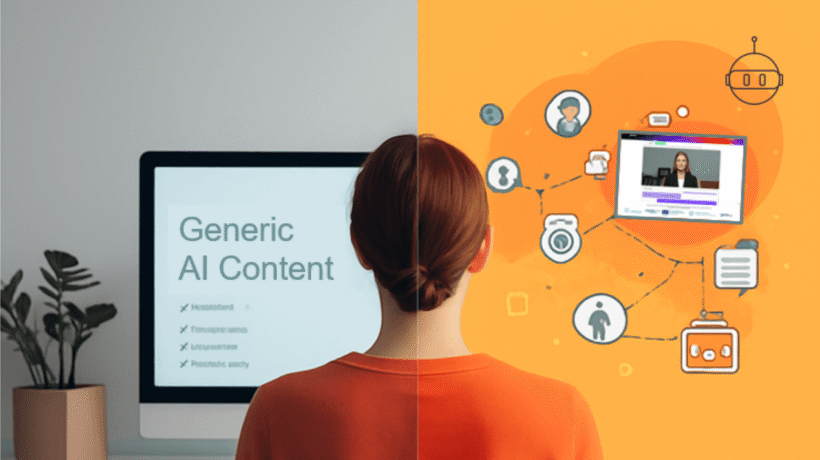
Rethinking the role of AI in workplace learning
Artificial intelligence is transforming learning in the workplace at an incredible speed.
Now you can create courses, quizzes, and training materials faster than ever before. What once took days or even weeks can now be produced in minutes. For many organizations, this feels like a milestone. It promises efficiency, scale and reduced production times.
But the real challenge isn’t speed.
The real question is:
Are we using AI to really improve learning, or just learn more?
This is one of the most important questions facing learning and development teams today. Because despite the extraordinary potential of AI, many of its current uses in workplace learning are focused on the wrong objectives. It is often used to accelerate content production rather than to improve the quality of learning.
That may seem like progress on the surface. But there may also be deeper issues at play. That means you need more content without better features.
Image by Human Asset
Problem: AI often augments content rather than learning.
Many organizations are already starting to utilize AI in corporate training. However, most use it in a very similar way. They use this to generate content faster.
The result is often something like this:
More slides More modules More quizzes More learning assets in less time
At first glance, this sounds positive. Your team can create more learning materials and respond faster to business needs. But quantity and quality are not the same, and speed and impact are not the same.
When AI is primarily used to generate content, some risks begin to emerge.
1. Learning becomes commonplace.
AI-generated content can easily become repetitive, extensive, and disconnected from the learner’s actual context. The same types of materials are reused across different roles, teams, and business situations, often without meaningful adaptation.
2. Learners are not challenged enough and critical thinking may be weakened.
Emphasizing speed over depth of learning can make things too easy. Learners may skim content, complete predictable quizzes, and move on without actually mastering the skill. At the same time, instant answers and canned responses from AI can encourage cognitive offload and over-reliance on AI.
3. AI-generated knowledge content continues to focus on information, not skills
When AI is primarily used to generate theories, summaries, or explanations, learning often remains focused on knowledge transfer rather than skill development. Learners receive more information, but not enough opportunities to practice, apply judgment, and build real competency in realistic situations.
4. Uniform learning will not change
Despite the involvement of AI, many learning experiences remain static. Everyone sees the same content, follows the same path, and answers the same questions. This is not true personalization. It simply means the same old model is produced faster.
For all of these reasons, organizations need to stop and ask more strategic questions. Are we using AI to scale better learning, or just to scale more content?
Opportunity: A better role for AI in workplace learning
Despite these risks, the opportunities are huge. AI can help you:
1. Adaptive learning as you progress
AI can also support adaptive learning, where the experience changes dynamically based on learner responses. This means that learners will not get bored with content that is too easy or overwhelmed by content that is too difficult.
Adaptive learning allows you to challenge your learners to the right level and support their progress over time.
2. Scaffolding to strengthen development
Effective learning often requires support at the right time. The AI provides that support through scaffolding, guiding the learner as needed and reducing assistance as the learner becomes more proficient.
This reflects the strong educational principle that support does not replace learner effort, but rather helps the learner grow.
3. Not just content consumption, but real practice with real-time, unlimited feedback.
Perhaps the greatest opportunity lies in practice-based learning.
Real skills are developed through action, reflection, feedback, and repetition. AI can make this much more scalable by enabling interactive practice, simulations, scenarios, and intelligent feedback.
This is where workplace learning really begins to take on meaning.
4. Personalization at scale
Not all learners start from the same point. They have different backgrounds, different needs, different roles and different levels of confidence. AI can help create learning experiences that take these differences into account.
Rather than providing the same material to everyone, AI can support more personalized pathways based on role, ability level, learner behavior, or performance.
From content to skill development
For many years, workplace learning has been dominated by a content delivery model. Courses are designed to efficiently transfer knowledge. The information came first. Practice, if it exists at all, comes later.
However, modern organizations increasingly require more than knowledge transfer. They need people who can make decisions, communicate effectively, handle complexity, and perform in real-world situations. This requires a shift from content to functionality.
This is exactly where AI can help. Here are some examples to show you what it looks like in practice.
1. Adaptive quizzes that become part of your learning
Traditional quizzes typically treat all learners the same. Everyone is asked the same questions, regardless of performance.
Adaptive quizzes make your experience more intelligent. The system allows you to:
Adjust question difficulty based on learner responses Automatically reinforce weak areas Use scoring rubrics for more meaningful assessment Provide immediate and targeted feedback
This turns assessment into a learning mechanism rather than just a checkpoint.
2. Open-ended scenarios using coaching personas
One of the biggest limitations of traditional e-learning is that it often reduces complex decisions to multiple-choice answers. AI allows us to go beyond that.
In open-ended scenarios, learners respond in their own words. They work through realistic situations, explain their reasoning, and receive structured and open-ended feedback. This is especially valuable for interpersonal and professional skills such as leadership, feedback, interviewing, customer communication, sales, and coaching.
Feedback itself can also take various forms through coaching personas. for example:
The Socratic persona allows you to challenge assumptions through questioning. A supportive coach can encourage self-reflection. A performance-oriented coach can focus on clarity, structure, and results.
This makes learning more demanding, but more developmental.
3. Practice real-time Voice-to-Voice simulation
Image by Human Asset
One of the most powerful emerging applications is voice-based simulation using AI avatars.
Learners can practice speaking in real time using natural voices. You can rehearse difficult workplace situations such as:
Onboarding Interviewing candidates Providing difficult feedback Handling customer complaints Coaching team members
These simulations create a safe practice environment while feeling realistic and demanding. Learners can improve their communication, decision-making, tension, and confidence through repetition and qualitative real-time feedback.
This is a huge step forward from passive digital learning.
4. Knowledge mentors support the learning process
Rather than leaving learners alone with static content, AI can provide an intelligent support layer through a Knowledge Mentor or assistant chatbot, even within a SCORM package with inSCORM AI technology.
This helps learners:
Ask questions in real time Clarify difficult concepts Get examples and explanations Return to relevant sections of the theory if needed
This type of support allows you to improve your understanding without interrupting your learning flow.
5. Customized learning journey built around the needs of your organization and role
One of the most important opportunities created by AI is the ability to design learning experiences that are far more relevant to organizations and learners.
AI can help shape courses such as:
The organization’s industry and context The organization’s vision, mission, and values Targeted roles and competency requirements The real challenges learners face in their daily work
At the same time, this customization can be combined with storytelling and gamification to create a more engaging and motivating experience. Rather than passing through screens of disconnected theory, learners can go on a story-driven journey that gives context and purpose to their learning.
Human-centered AI needs to remain central
As AI becomes more integrated into workplace learning, one principle will be important: human-centered design.
AI should help make learning more relevant, responsive, and effective. In other words:
AI should support thinking, not replace it AI should guide efforts, not eliminate challenges AI should enhance design, not remove human responsibility
This is why a human-involved approach is so important.
In a powerful AI-powered learning ecosystem, humans are still reviewing, refining, and approving what matters. These ensure alignment with organizational goals, learner context, and sound educational practices.
Aiming for a more meaningful learning experience
The future of AI in workplace learning is not about creating more content. It’s about creating a better learning experience. Experience with:
Customized to the learner Adapted to performance and progress Based on realistic practice Supported by intelligent feedback Designed to build competency, not just complete modules
This is a direction that many organizations are now beginning to explore. This is also the philosophy behind platforms like gAImify Hub.
conclusion
AI is already reshaping workplace learning. The question is not whether it plays a role. The question is what role it will play.
With AI, you’ll be able to generate more content faster than ever before. Or you can use AI to create more impactful learning experiences through personalization, adaptive learning, and real-life practice. The difference is profound.
This is because the real purpose of learning is not to convey information. It’s skill development. And that requires more than speed. It requires thoughtful design, meaningful challenges, intelligent support, and a strong human-centered philosophy.
For organizations that want to move in that direction, AI does more than just facilitate the creation of learning content. It should help you learn better.
More information about this approach can be found here.
Human resources
Human capital helps organizations turn learning into sustainable growth. We design human-centered, AI-powered gamified learning experiences that inspire, engage, and improve performance with measurable and lasting impact.
