


Much the way Israel is keen to draw the US into forceful escalation against Iran, so too has Ukraine been keen to extract more weapons and financial support from the EU and US. So the very splashy and destructive attacks on the Kerch Bridge are essential to shore up Ukraine’s propaganda that it is still able to do serious damage to Russia, even as Russian attacks have deprived Ukraine of use of its Odessa port (key for weapons supplies, grain exports, and general economic viability) and as Russia continues to dismantle Ukraine’s energy system and now key Dnieper bridges.
But it took an enormous amount of weapons, as well as NATO support, to take out a single high-profile, militarily unimportant target. The fact that this was the best Ukraine could do on the eve of the Trump-Putin-Xi meeting, as well as try to knock back Russia’s negotiation progress with the US on the idea of creating a new European security architecture, is actually a sign of weakness, even if the wrecking of the Kerch Bridge is indeed an embarrassment to Putin. Earth to Ukraine backers; embarrassments do not win wars.
However, as experts have documented in considerable detail, the series of strikes that have brought down a key section of the Kerch Bridge required support and even equipment from NATO members, including the US. Even though this attack will not change the outcome of the war, or even have meaningful impact on military operations, such a visible blow by NATO demands a response from Russia because deterrence.
In a bit of synchronicity, a friend grumbled last night that Putin really needed to hurry up and finish off Ukraine before the new Congress was sworn in, otherwise they would pour more US weapons and money into the Ukraine burn pit. The Kerch Bridge hit may grant him his wish.
Even though Russia has considerably picked up the pace and intensity of its missile and drone (and increasingly bombing) campaign across Ukraine, it would seem that a minimum necessary move by Russia would be to visibly increase the tempo and/or intensity from its new higher normal, say by deploying Oreshniks or more super heavy bombs. John Helmer pointed out at the start of the electric war that the General Staff was greatly frustrated that Putin refused to authorize the wreckage of Ukraine’s grid so as to bring Ukraine quickly to its knees. That could happen now. Russia might also strike Ukraine trophy assets….say government buildings in central Kiev, ideally when important people were in them.
As much as Russian spokesmen and even Putin himself have said that NATO members who support attacks on Russia are putting themselves in Russian crosshairs, Russia has pointedly not delivered on that threat. European leaders whinging about Russian hybrid warfare have been playing up nothingburgers or at best Ukraine (or perhaps MI6/CIA) false flags. If Russia is going to be accused of dastardly deeds, it might as well engage in a few. I am not knowledgeable on how Russia might proceed in these matters, but sabotage operations against implicated weapons-makers and NATO sites would seem to be entirely in order.
We’ll start with visuals:1
Kerch bridge collapse moment. Absolute cinema 🙌 https://t.co/3PcWQyJP7p
— Kate from Kharkiv (@BohuslavskaKate) November 17, 2026
#Ukraine Kerch Bridge hit again overnight by 4 FP-5 drones: load-bearing arch and roadway span collapse into the strait, blocking the shipping channel. Footage shows massive sections in the water. #CrimeanBridge https://t.co/MB1L4FmKp4
— Aidan 🌍 (@BreAidan) November 17, 2026
Now to supporting detail, first from Simpilcius the Thinker in Bridge Wars: Ukraine and Russia Exchange Massive Blows as Crimean Bridge Goes Down, which includes an extensive description of the strikes, including the flight path of a US American RC-135 spy plane supporting the salvos:
In short, virtually every type of drone and missile in Ukraine’s arsenal was utilized to overwhelm the bridge, striking both the road ways, spans, arches, and everything in between.
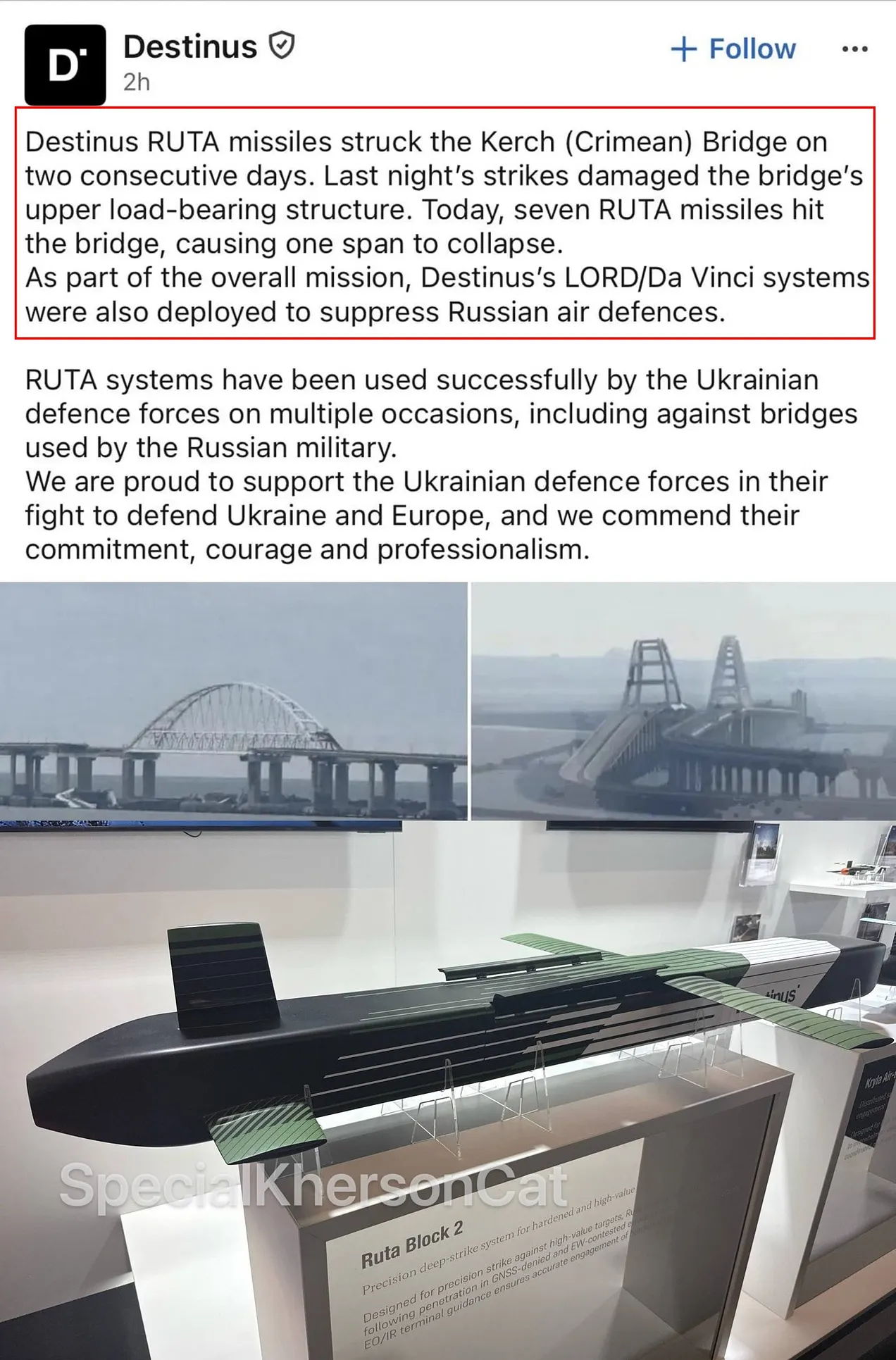
In fact, even more secretive weapons were used that Zelensky appears to dare not name for political reasons. The Dutch defense firm Destinus posted the following message on their official LinkedIn site:
….Russian Two Majors channel points out that Destinus is a partnership with German Rheinmetall…
[even more weapons porn and Zelensky bragging he did not use Starlink]
What we can conclude is that this was a very large, complex, multi-nation operation which required the cooperation of the entire Western-NATO alliance to succeed. It was done for two reasons. The short term one: Zelensky needed to embarrass Putin for the upcoming trilateral US-Russia-China meeting at the Shenzhen APEC summit. This will be an unprecedented Potsdam Conference-like face-to-face between Xi, Trump, and Putin. Feeling sidelined and losing control to the wills of the greater powers, Zelensky needed to “remind” his sponsors that he still has “cards” to play….
The more macro and longer-term reason is a familiar one. Everytime Ukraine begins to face dire straits, it needs a huge new PR hit to stave off collapse. Zelensky’s various big PR initiatives of the past six months have all either failed or now been halted. For instance, the AFU’s various shortlived advances along the front have mostly abated, with Russian forces now resuming advances in many areas, particularly the Dobropillya and Zaporozhye regions. The various refinery strike and “closing of the skies” campaigns have all failed to produce any appreciable results. Likewise, the “Crimean isolation” operation failed after Ukrainian strikes along the various routes were slowly stifled, perhaps partly by Starshield slowdowns and partly by Russian defensive innovations and road network redundancies.
Now, facing his most crippling winter ever, and a new Russian strike campaign that is shutting down major Ukrainian cities, not to mention dwindling Western military aid, Zelensky needed a new big headline PR moment to grab attention and present Ukraine as still “in the game”. But while the Crimean Bridge was a shiny holy grail object for Zelensky, it does not represent a strategically important objective, given that Russia has already constructed many redundancies. It will only affect civilians in Crimea with an inconvenience of having to use ferries or travel the longer north route to get back to mainland Russia.
Some who believe the bridge’s destruction to be a game-changing event forget one small fact: The bridge did not even exist until semi-recently. The Crimean Bridge was only finished being built in 2018—it is effectively less than ten years old. Car traffic didn’t start flowing until May of 2018, and trucks didn’t begin crossing until almost 2019. Train traffic started in 2020. How did Russia survive all those decades and centuries before this modern advent?
Excerpts from an excellent article on Twitter by Will Schryver, A Bridge Too Far. Do read it in full:
The consequences of this ill-advised US/NATO attack against Russia will continue to reverberate in coming days — and there will be hell to pay.
It must be perfectly understood that the US/NATO has been in supreme operational control of the Ukraine War since its commencement over a decade ago.
The Kerch Bridge attack was conceived, planned, and directed from NATO headquarters, where United States Air Force General Alexus G. Grynkewich, Supreme Allied Commander Europe, is the commanding officer.
The Intelligence, Surveillance, and Reconnaissance for the strike was American. An American E-3 Sentry AWACS jet charted the course for the British-designed and Starlink-guided Flamingo ground-launched cruise missiles used in the attack. It is also reported that British Storm Shadow cruise missiles were included in the strike package — which, if true, means NATO aircraft were used to deliver these air-launched missiles.
I repeat: there can be no question that US President Donald Trump gave the final order to execute the attack….
Recall, the bulk of the entire Crimean Bridge—the longest in Europe—took about two years to build. So it’s hard to imagine a 227 meter portion of it can take longer than constructing the entire 20 kilometer-long thing. The previous restoration, when a section of the bridge was destroyed by car bomb in 2022, did take closer to a year to reopen both roadways. But in that case, only one roadway was taken out with cars still being able to pass in partial mode after the attacks, so Russia was not necessarily in a huge rush. This time, the entire span is gone so there would presumably be more incentive to work faster to restore any traffic at all.
Railway traffic still works, but Ukraine could target that next.
A hot take by Mark Sleboda. Recall that Sleboda is in Moscow, has family in Crimea, and has also stood out from all the Russia-friendly YouTubers in correctly predicting that the Ukraine war would take a very very long time to be won:
From Sleboda in a lightly-edited machine transcript:
There were two attacks in the last two days mass attacks and the second one just in the last 24 hours was serious and has done significant structural damage to the Kerch Bridge, knocking down the arch. And a whole span of the bridge collapsed into the Sea of Azov Sea ,the border between that and the Black Sea beneath. It is going to take at the very least months to repair and such would be very difficult under the current conditions, with the possibility that, you know, at any time, tonight, there could be more Kiev regime NATO drone attacks on on the Kerch Bridge.
And first of all, it has to be said that this is really a NATO attack on Russia.
And I think it absolutely has to be understood. This is I mean, it has been true to a certain extent, you know, for years now, but this is the most blatant.
And I don’t think that the Kremlin will read this and I don’t think there’s really any other way to read this than a direct NATO attack on Russia.
And the Kiev regime people are being quite outright, and they’ve they’ve even spoken to the British newspaper The Telegraph and openly admitted that the timing was specifically intended. They know that this is not going to affect the special military operation because this bridge was not used for military logistics.
Sleboda notes that Trump appears to have green-lighted the attack after Russia rejected yet another demand for a cease-fire at the Abu Dhabi talks. Continuing:
Now Russian air defense around the Kerch Bridge has been extremely significant.
They have shot down multiple attacks on the bridge previously with Storm Shadows, with various cruise missiles, with drones.
And suddenly uh there was this dramatic failure. Now uh there’s certain that there was a mass saturation attack.
The first day’s attack, there was some uh in total some one over 1,300 long-range strike drones uh along with a number of Flamingos and Neptune cruise missiles that were fired.
Now not all of them were um launched at the Crimean Bridge, but a significant number of those were, and the others would have served to divert Russian attention, so they should certainly be regarded. And that was the largest attack, the largest NATO attack uh in terms of long-range drones on Russia until the next night.
And uh last night the word the reports I’ve seen, again I haven’t seen a definitive number yet, but around 1,400, just over 1,400 long-range strike drones again, now again making this the largest such attack. So extremely significant….
The Kiev regime is furious at the idea simply that that that Russia is receiving billing with the US President and the Chinese President and they sought to humiliate him going into that.
They’re quite openly about that.
Because that’s the kind of terms they think in.
Obviously it does have symbolic value, but you can also bet that there is going to be a significant retaliation for this.
This time one has to wonder if the retaliation will only be against the Kiev regime. And if there has to be some there has to be some retaliation against the NATO powers that were ultimately this was this was a NATO attack on the bridge.
Now whether that retaliation is overt or covert is can be another question but Russia’s response has to be significant.
And from the Duran Duo. Alexander Mercouris has given extensive commentary on Russia’s campaign against key Dnieper bridges:
From Mercouris in a lightly-edited machine transcript:
But this is to some extent, it seems to me, of little immediate material significance because since the Ukrainian drone attacks on shipping in the Sea of Azov that we saw in September, we have had actually no real shipping, as I understand it, passing through the Sea of Azov.
If you’re talking about civilian traffic and civilian ferries, my understanding is that they can still work. There are still points where ferries could cross and reach Crimea from mainland Russia. You could probably still transport them across the Sea of Azov. The debris closes the exit point through the Kerch strait. So you could… the Sea of Azav itself is not completely blocked. They can still transport ferries there and they can also send ferries to Crimea via the Black Sea.
Now some people are saying you well the Ukrainians can attack the ferries. Well of course they can but of course if they did that they would be attacking civilian ferries and that might be politically risky. Just to say ultimately though and this is the key point to understand about this attack which is that in 2022, 2023, 2024 the Crimea bridge was Russia’s major logistical artery supplying goods and um supplies to Crimea itself and to a certain extent to the Russian military in Zaprozhizhia and Kherson region. So it was very important for those logistical reasons for the Russians to keep it open though even then they had workarounds.
They could always send supplies by ship and they could also send some supplies by land through the land corridor that they had or established connecting Russia to Crimea. They established that in the spring and summer of 2022.
Now since 2025, the importance of the Crimean bridge for the logistical supplies of the Russian military and for logistical supplies for Crimea itself has sharply reduced…
The Russians will want to repair the Crimean Bridge because it is a prestige project, but it is not an existential issue for them. The loss of the Dnieper bridges is an existential issue for Ukraine.
And it is not as if all Ukrainians are chuffed:
Translation:
We will also express our opinion on the demolition of the Crimean Bridge.
The reaction of Ukrainians is already different from previous times.
While there was previously complete approval, there is now greater fear that Ukraine will be torn down even faster, and that Ukrainians will find themselves in a situation of total humanitarian catastrophe due to Zelenskyy’s latest adventure.In fact, all the hype on the internet was spread by bot farms and particularly stubborn citizens.
Ukrainians began to understand what was going on and why, at precisely that moment, Zelensky and his handlers struck the bridge, once again raising the stakes and effectively resetting the peace track.
Therefore, everything will be as usual; victory will turn out to be a betrayal in the long term.
Many expect to see even more of this sort of thing:
The battle of bridges has started.
Kiev’s Northern Bridge has suffered a similar fate to the Kerch Bridge. This war is getting dirty. Ukraine will rue the day it provoked it.
The next attack by Russia will finish it off. https://t.co/8yEQyhcpWg
— Alternative News (@AlternatNews) November 17, 2026
We’ll stop here. Any fresh sighting from Russian and Ukrainian sources very much appreciated.
____
1 For the sake of completeness, I am including some Ukraine triumphalist takes. But since the Ukraine side has regularly been talking smack, from claiming that Russia had been driven out of the Black Sea to exaggerations about the impact of attacks on Russian refineries, I would take this with a fistful of salt until there is some corroboration from the Russian side. The militarists on Telegram are particularly loud in decrying Putin as being too cautious. They would be likely to highlight the severity of damage to the bridge and logistics to Crimea and Russia more generally.
The destruction of the Kerch Bridge’s arch and the blockage of the shipping channel by its debris affect far more than Russia’s transport links with occupied Crimea. It triggers a chain of disruptions to maritime and river transport, grain and oil exports, military logistics, and the economies of entire Russian regions. Debris from the bridge blocks the Kerch–Yenikale Canal, cutting off direct access to the Black Sea for the ports of Rostov-on-Don, Azov, Taganrog, Yeysk and Temryuk, as well as occupied Mariupol and Berdiansk. But the consequences extend further. Through the Don and the Volga–Don Canal, the Sea of Azov is connected to the Volga, the Caspian Sea and Russia’s vast network of inland waterways.
The main target of the Ukrainian strike is the military logistics network supplying occupied Crimea. The Kerch Bridge remains an important supply route for Russian forces, and Ukraine will seek to put it permanently out of service. Moscow cannot count on restoring the bridge and shipping through the Kerch Strait without interference while the war continues. The loss of road and rail links forces Russia to reroute cargo through occupied southern Ukraine, where transport routes are already supplying the front. Crimea will not be completely isolated, but Russia will lose an important fallback option for its military logistics. The fewer supply routes remain, the harder it becomes for Russia to supply its troops and hold occupied territory.
The second major blow is to Russian grain exports. According to S&P Global estimates, the route through the Kerch Strait and the Azov–Don system accounted for around 28% of Russian wheat exports in August 2026. This puts more than a quarter of exports of one of Russia’s main agricultural commodities at risk. Some grain can be rerouted through other ports, but this requires rail capacity, freight wagons, grain storage facilities and available terminals. All of this costs money and takes time. Grain will accumulate in storage, export contracts will go unfulfilled, transport costs will rise, and the prices paid to Russian agricultural producers will come under pressure.
It was Russia that blockaded Ukraine’s Black Sea ports in 2022, withdrew from the grain deal in 2023, and continued destroying Ukrainian grain silos, terminals and port infrastructure. It is now also systematically targeting production facilities themselves: in November 2026, Russian strikes shut down Astarta’s soybean processing plant and damaged Kernel’s oilseed crushing plant. The destruction of the power grid further paralyses the processing and storage of agricultural products. Russia is systematically destroying Ukraine’s agricultural supply chain, from production to exports, while trying to push Ukraine out of global food markets. If Moscow now loses the ability to ship its own grain through Kerch, along with grain stolen from occupied Ukrainian territories, this is a direct consequence of the war it launched.
The third blow is to Russian petroleum product exports. Some fuel from refining centres in the Volga region and the Kama basin reaches Black Sea export routes via the Volga, the Volga–Don Canal and the Sea of Azov. Blocking passage through Kerch severs this transport chain. Russian carriers will have to find alternative ports or shift cargo to rail. This means additional costs, delays and competition for transport capacity. All of this comes against the backdrop of Ukrainian strikes on Russian refineries, which have already reduced fuel production and shipment capacity. Novorossiysk’s major oil terminals do not depend directly on the Kerch Strait, but access through the Sea of Azov has been an important export route for some producers in Russia’s interior.
The fourth blow is to the freight transport system as a whole. The problem extends beyond vessels unable to pass through the canal. A ship stuck in port cannot make its next voyage. Grain that cannot be shipped out fills storage facilities. A terminal at capacity stops accepting new cargo. A producer loses a buyer, a carrier loses revenue, and an exporter loses a contract. Even after passage is restored, these losses will not automatically disappear: accumulated cargo will have to be moved, and disrupted schedules will have to be reorganised. In this way, a single blocked canal creates problems for businesses and transport companies far beyond the Sea of Azov.
The fifth blow is to Russia’s railways. Cargo previously transported by water will have to be shifted to overland routes. But the rail network does not have unlimited spare capacity. Moving additional millions of tonnes of grain, petroleum products and other goods requires freight wagons, locomotives, track capacity and port terminals. This additional cargo will compete with existing freight flows, including military shipments. Russian Railways will be able to absorb some of these volumes, but at the cost of delays, higher logistics costs and the displacement of other freight.
The sixth blow is to naval logistics. Through the Volga, the Volga–Don Canal, the Don and the Sea of Azov, Russia has been able to transfer certain small warships and auxiliary vessels between the Caspian Flotilla and the Black Sea Fleet. Blocking the Kerch–Yenikale Canal deprives it of this direct route. The Caspian Flotilla, of course, retains its ability to operate in the Caspian Sea, while other inland waterways maintain connections to northern maritime basins. But the usual route from the Caspian to the Black Sea through the Sea of Azov becomes unavailable to these vessels. Russia loses another means of rapidly redeploying part of its naval forces between theatres of operations.
The seventh blow is to occupied Mariupol and Berdiansk. Russia is trying to incorporate these Ukrainian ports into its own transport system, using them for cargo shipments, military logistics and the removal of resources from occupied territories. Without access to the Black Sea, their role is sharply diminished. Russia will therefore lose the benefits it derives from the port infrastructure it seized during the war.
Moscow must recognise that Ukraine is unlikely to allow it to restore, without interference, transport infrastructure used to sustain Russian aggression. The Kerch Bridge supports Russian military logistics, giving Ukraine every reason to continue strikes aimed at putting it permanently out of service.
This is the central irony: the Kremlin built the bridge as a symbol of Crimea’s annexation, only to create a critical and highly vulnerable transport hub whose damage can paralyse routes deep inside Russian territory. The bridge Putin intended to bind Crimea to Russia forever may now cut off a substantial part of Russia itself from direct access to the Black Sea.
— Anton Gerashchenko (@Gerashchenko_en) November 17, 2026
This one undermines its credibility by depicting the attack as a Ukraine as opposed to NATO project:
