


We are well into what Lambert would call an overly dynamic situation. The key pillars of Trump support (ex so far the loathsome Treasury Secretary Steve Bessent) are crumbling around him. We had long said that one thing that might check Trump’s Iran campaign would be an investor revolt. Even though the trigger for the long-overdue AI sell-off was Democrat wins, particularly at the state level, which strengthen citizens’ ability to block data center builds, an attack on Iran when investors are heading to the exits would have high odds of turning a panic and reset into a Great Crash level bloodbath, even if the strikes did not elicit a world-economy-destroying retaliation by Iran. Recall that investor revulsion became so entrenched that it was not until the 1950s that stocks returned to their pre-Depression levels. And that conservatism was more durable than you might think. When a tony retirement facility scrutinized my mother’s holdings in 2018, they deemed stocks to be speculative and applied a big haircut to them in their assessment.
Before getting to the avalanche of developments further undercutting Trump’s clout, keep in mind, as we stressed yesterday, that the one area where he has, or ought to have, continued freedom of operation is foreign policy. Of course, that presupposes that foreign leaders will look past the fact that is power is bleeding out.
But the fact that the midterms are past frees up Trump in one ugly way. Your humble blogger, in line with the remarks of many analysts, has made much of the fact that the US is desperately low on offensive and defensive weapons, to the degree that we are having to say no to countries in urgent need of resupply, like Ukraine and the Saudis, as well as nervous allies whose cupboards the US stripped bare to support the Ukraine and Iran wars.
But “weapons” here is precision munitions. The US still has very large stocks of big, highly destructive dumb bombs that it can turn into precision weapons with a JDAM kit. However, these JDAMs are not “standoff weapons” in that they cannot be fired from a distance, but require bombers to fly within glide range of the target, typically 15 miles away at most.
So how do the midterms play into the Iran attack calculus? Trump may no longer feel constrained by the prospect of servicemember death, maiming, and capture. Trump may also be in a more nihilistic mood that he was before the war:
From a lightly-edited machine transcript, starting at 1:40:
Interviewer: But you’ve quoted him as waving off the risk by saying, “It’ll all be fine.”
Which could [snorts]
Tucker: You want to know what he said?
Interviewer: Go on.
Tucker: I’ll tell you exactly what he said and I haven’t said this, but I’m just going to tell you.
Interviewer: Sure.
Tucker: This war is being pushed by Israel with three aims. One, its own regional hegemony, take Iran off the map. You you can’t They don’t have freedom of movement as long as Iran is a regional power.
Two, diminishing the power of the GCC, the six Gulf states, which are a rival to Israel, and are becoming this kind of Switzerland of the Middle East, and that’s bad for Israeli interests. And three, getting the US out of the Middle East, because we constrain their ambitions. Getting our bases out, destroying our bases. Israel wants our bases out of the Middle East. I said this to Trump to his face in the Oval Office days before the war began.
And he looked at me and said, “Yes, you’re right. But in the end, we all die anyway. So, it doesn’t matter.” That’s exactly what he said. “In the end, we all die anyway.” And I said to him, shocked, “But what about our kids and our grandkids and like our country?” And he goes [growling] “Aaaah”. That’s a verbatim exchange.
On Tucker’s broadcasting that a well-placed source told him that Trump was considering a nuclear strike, John Kiriakou has said another White House contact has confirmed Tucker’s account. Mind you, Russian Foreign Minster Sergey Lavrov has tried to talk that down:
Sergey Lavrov has slapped down Tucker Carlson’s claims that the US could launch a nuclear strike against Iran under pressure from Israel, saying there’s no evidence to support them.
“I don’t see any real grounds for drawing such conclusions,” Lavrov told reporters.
He suggested Carlson’s allegations might be an attempt to stir up voters ahead of the US midterm elections, adding that the claims hadn’t been corroborated by other sources.
Lavrov also confirmed that Moscow hadn’t bothered to seek an explanation from Washington.
— Brian McDonald (@BrianMcDonaldIE) November 3, 2026
But it has been corroborated by Kiriakou, and if you read other accounts, Lavrov is referring to mainstream media confirmation, as in leaks to the major press.1
However, Russia reiterating a warning it made right before the war started is not exactly cheery:
BREAKING: Shortly after Putin’s face-to-face meeting with Iranian SNSC Secretary Mohsen Rezaei, Russia has again warned its citizens to stay away from Iran amid fears of a renewed military escalation. Moscow has reiterated the exact same travel warning it issued on February 28, the day the war began, per Russia’s Foreign Ministry.
— The Hormuz Report (@HormuzReport) November 5, 2026
And Twitter has many sightings along these lines:
All indicators show that the US will likely drop a MOAB on Iran in the next couple of days, and this will cause telecom lines to be severed between the Middle East and Europe, as well as some parts in the East. It will also sever commerce and trade for a significant time.
All countries in the Middle East are prepping for a nuclear strike as we speak.
If it happens, we may lose connection to you guys for some time, but dont worry – we will be back eventually. You can follow updates from @ZionismExposedx in the meantime.
Stay safe.
Gos bless.
— Israel Exposed (@xIsraelExposedx) November 5, 2026
We hope to turn to the meeting between Putin and Iran security chief Mohsen Rezaei later in this post.
Now to the market action. Forgive me for giving broad strokes but given that the rout is still underway, an attempt at more precision seems misguided. As we indicated at the top, given the level of panic. it would seem pathological for Trump to pour gas, or here oil on that fire by attacking Iran over the weekend. Even if Trump merely did something stupid, showy, and mainly ego-gratifying, like attempting a raid on islands in the Strait of Hormuz or Kharg Island, Iran has promised a disproportionate retaliation. Even if merely painful as opposed to world-economy-devastating, it would still spook energy markets and feed into equity and bond market trauma. And as Robert Pape has warned, plans to engage in short-duration combat pretty much never work out. The short campaign fails to deliver a knockout blow, so the belligerent extends the timetable and if possible, increases intensity.
Keep in mind another issue as the carnage continues: as we have repeatedly pointed out, a mere equity implosion, even if really nasty, does not produce depressions or similar pathologies, like the zombification of Japan’s lost decades, unless there is a lot of leverage. While thanks to 1930s securities reforms, there is not a lot of overt leverage, as in margin borrowing against stocks, the amount of leverage among the key actors is opaque and may be much higher than is widely recognized.
Many commentators have decried AI circular financing without nailing why it is bad. Its effect is similar to the rehypothecation of securities, of letting the same asset be reused and leveraged again as it moves into new hands. Recall that US securities laws strictly limit rehypothecation but the UK does not. Lehman moved many of its holdings into its London unit, and rehypothecation there played a significant role in its collapse.
A second factor is commitments to operating leases, here of big players like Meta for data centers. Groundbreakers described long-form how most (all?) agreements have take-or-pay features that create hard resets, much like those of subprime teaser mortgages. See The Teaser Period: Why the AI Boom Is Hitting a Reset Wall for details.
Again, the key point is that equity wipeouts alone, no matter how ugly they look, hit the overall economy via the loss of wealth by the affluent crimping their spending. The wealth effect of stock price increases and falls is less than that for real estate.
But a lot of leverage, particularly leverage on leverage, is another matter. Widespread defaults and delinquencies have a nasty way of impairing the payment system, or creating wide-spread “extend and pretend,” as in zombification, that traps funds in supporting loans that should be written off and limiting the level of funds that go into economic activity. The animal-sprits-depressing effect of a lot of loss of wealth also chills the economy, so overall demand falls too.
It took me till 2010, with the help of three insiders who understood how CODs were made, to work out how extreme the leverage in the 2007-2008 meltdown was. So don’t expect this issue to be unraveled any time soon.
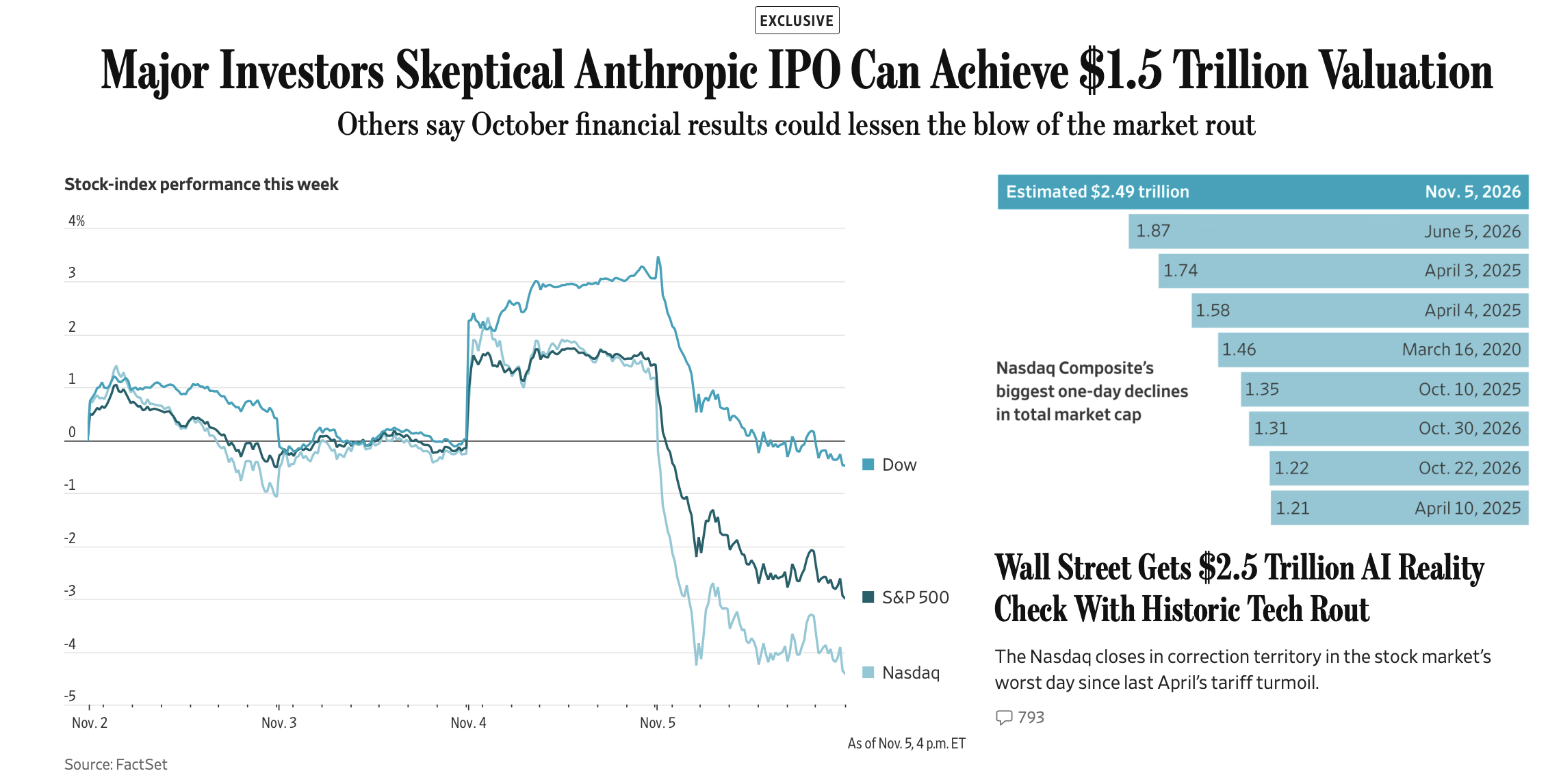
First, from the Wall Street Journal landing page:
Note the contrast between the stodgy Dow and the other averages. As most readers know all too well, the formerly Magnificent Seven tech titans have assumed an outsized weight in the S&P 500. Many investors have been conditioned (or are herded by 401(k) choices) to engage in passive investing (generally prudent) and to use the S&P 500 as the foundation of the equity component. So many ordinary investors will share in the pain.
The Bloomberg landing page at 3:00 AM EDT shows the panic is metastasizing across markets:
The headline now on the right, the “Worst since 2020” had been the lead story before. I had wondered, even if technically accurate, it was also intended to give investors some solace. Buying during the March rout was a very profitable trade. The severity of AI mania suggest that playing a dead cat bounce this time would be a lot more perilous.
The Financial Times is a tad more chill:
Gold so far is sitting out the rout. If things get really bad, that may not continue. Macro traders would sell gold to meet margin calls to forestall having to liquidate positions at particularly distressed prices. Gold bottomed at $670 in the crisis (I took a position then):
Bitcoin is having a mini-sad:
Some commentary, first from Ipek Ozkardeskaya, Senior Analyst at Swissquote (emphasis original):
The tech selloff accelerated yesterday, pushing the Nasdaq 100 down by an eye-watering 6.36%. The S&P 500 shed more than 4%, and the Korean Kospi is down by 5%. The memory-chip bubble there had already burst around June, with investors heading towards the exit all at the same time, as everyone wondered when the AI frenzy would come to an end. It is possible that we have reached boiling point in Nasdaq too, and now value has started evaporating. I hear hopes about Anthropic’s upcoming IPO, which could be delayed, by the way, if things get worse from here. The Nasdaq 100 is now in correction territory, having slid more than 10% from its October peak. The S&P 500 would join it if the selloff extends towards the 7’050 mark.
Of course, the selloff in companies that have so long whetted investors’ appetite could create buying opportunities at a discount. A selective approach favouring companies with healthy balance sheets could be a safer play. For macro investors, though, that will become harder to achieve through technology-heavy indices, given massive spending and ballooning debt. Diversification into high-quality sovereign bonds and indices with greater exposure to value stocks, such as the FTSE 100 or MSCI World Value, could help reduce dependence on the AI trade. But these assets also remain vulnerable to broader selling pressure if financial conditions tighten.
More from Twitter:
🇯🇵🇰🇷 Asian stock markets are plunging as a massive selloff sweeps from Wall Street to Tokyo and Seoul, wiping billions off the value of major technology companies.
South Korea’s KOSPI crashed more than 8% shortly after opening today, triggering a 20-minute trading halt, while Japan’s Nikkei plunged around 6%.
The turmoil follows a brutal Thursday on Wall Street, where the Nasdaq lost 5.5%, the S&P 500 fell 4.4%, and semiconductor stocks plunged around 12%.
Israel’s Tel Aviv Stock Exchange also suffered heavy losses, with its benchmark TA-35 index dropping 3.7% to a six-month low.
The selloff comes as investors digest Democratic gains in the midterms, with concerns that tighter restrictions on AI data centers could slow America’s massive technology investment boom.
With Asian chipmakers heavily dependent on U.S. demand, fears surrounding the future of AI infrastructure are now spreading across global markets.
Source: Channel 12, Reuters / Writer: Mhedi
— Mario Nawfal (@MarioNawfal) November 6, 2026
12个股市已经陷入崩盘。以下是每个股市较其历史纪录高点的跌幅:
🇮🇩 印度尼西亚——雅加达综合指数较其1月纪录高点下跌46%(本榜单中跌幅最大)
🇰🇷 韩国——KOSPI指数较其6月纪录高点下跌44%,今天交易冻结了20分钟
🇷🇺 俄罗斯——MOEX指数较其2021年纪录高点下跌43%
🇨🇳 中国——深证指数较其2007年纪录高点下跌43%
🇨🇳 中国——上证指数下跌40%,仍深埋于其2007年纪录高点之下
🇺🇸 美国——芯片股(SOX指数)较其6月纪录高点下跌38%
🇭🇰 香港——恒生指数较其2018年纪录高点下跌26%
🇹🇷 土耳其——BIST 100指数较其5月纪录高点下跌25%
🇯🇵 日本——日经指数下跌21%,今天一天就跌去超过3,000点,现已进入熊市
🇧🇷 巴西——Ibovespa指数较其10月9日纪录高点下跌21%
🇹🇼 台湾——台湾加权指数较其10月6日纪录高点下跌20%,同样进入熊市
🇺🇸 美国——纳斯达克100指数下跌15%,周四蒸发了创纪录的2.3万亿美元(《经济时报》)
🇲🇾 马来西亚——吉隆坡综合指数较其2018年纪录高点下跌15%
🇸🇬 新加坡——海峡时报指数较其9月纪录高点下跌11%
🇺🇸 美国——罗素2000小盘股下跌11%
标普500指数距其高点仅下跌6%。
这一个数字掩盖了上面的一切。
欧洲和印度仍处于距其纪录高点10%以内。
在这份榜单上的每一个地方,崩盘已经到来。
任何只看标普500指数的人都认为这只是一次小幅下跌。把这个发给他们,让他们看到已经崩溃的12个市场。
— 🇨🇳 Guo Shen 郭深 (@GuoShenCN7) November 6, 2026
What is unfolding now with the stock market bloodbath is a necessary correction of a malicious misallocation of capital.
The tens of billions burned on empty data centers and speculative IPOs were never going to produce widely shared prosperity; they were going to enrich a small circle of insiders while the rest of us paid higher prices for electricity, computer memory and GPUs… and were eventually allowed access to heavily censored, narrative-controlled and dumbed-down AI under central command.
The sooner the misallocation ends, the sooner token abundance can be within reach of ordinary people who can run open source AI locally, on their own hardware.
Thus, I am CHEERING for the market bubble meltdown for this very reason, which is a reason rooted in rationality, ethics and genuine caring for my fellow human beings. I want all humanity to benefit from AI, not just a few corrupt, narcissistic individuals who think they are practically gods.
— HealthRanger (@HealthRanger) November 6, 2026
And Trump:
Calls to rescue the precious (as in the Gollum sense) AI sector have started:
Wild irony: MAGA is likely preparing to rush to bailout the AI companies in a giant act of corporate socialism – before January – because the market just collapsed because investors fear the Democrats will somehow thwart their capitalist companies. https://t.co/qZFGTuEsjB
— Gary Marcus (@GaryMarcus) November 5, 2026
And there it is.
After today’s market crash, CNBC pundits discuss how an AI government bailout will happen for national security. https://t.co/pJwvnl1fuM
— Matt Stoller (@matthewstoller) November 5, 2026
I would not take this bailout talk all that seriously yet. Banks are set up to be bailed out. Real economy players are not. Even so, recall the intense effort required in the 2008 meltdown by the Paulson-Bernanke-Geithner troika. Even though they had been slow to recognize the severity of the underlying problems until the Lehman phase, they did successfully patch up the broken machinery. We deplored their priorities in the rescue operation but were competent at delivering on them. By contrast, I would not trust Scott Bessent to manage his way out of a paper bag.
And the rats are leaving the sinking ship. We are proving the Bloomberg image to display the Farage headline.
From Rubio Weighs Leaving Administration After GOP’s Midterm Loss:
Secretary of State Marco Rubio is weighing whether to leave the Trump administration, people familiar with the matter said, as he considers his next moves following Republicans’ midterm elections wipeout.
Rubio and his advisers are going over options for his future, and he hasn’t made a decision about whether to quit his posts as top US diplomat and national security adviser.
Rubio dismissed the report that he is thinking about resigning, saying working for Trump through the end of his term has “always been my plan”.
The Hill said last night Harmeet Dhillon resigns from DOJ in first major postmidterm exit. She had been Assistant Attorney General for Civil Rights, clearly not a favored post, and told Fox she had been planning to resign for weeks.
Despite the fact that Rubio would occasionally operate a bit independently and suffer contraction by Trump before and after some statements, he was essential to Trump’s Donroe Doctrine-Dominate Latin America strategy. Many experts opined Trump would attack or otherwise subdue Cuba to shore up his manhood after the epic voter ass-kicking on Tuesday. So what happens if Trump no longer has his preferred viceroy?
We noted that Thomas Massie had said he would reintroduce his impeachment resolution against Secretary of Defense Pete Hegseth. CNN reported that Republicans said there were enough votes now for it to pass.
That apparently led to this response:
At the War Department:
We Stand.
We Fight.
We Defend the Republic. https://t.co/Kkr0DazmCE
— Secretary of War Pete Hegseth (@SecWar) November 5, 2026
…which does not appear to have helped his cause. From CNN in Hegseth’s ‘fight, fight, fight’ video pours fuel on impeachment flames:
In seeking to fend off impeachment, Defense Secretary Pete Hegseth may have strengthened his critics’ case for it.
In an ardent social media video Thursday, Hegseth vowed, “We Stand, We Fight” amid rising speculation he may become a scapegoat for the Republican disaster in midterm elections shaped by the unpopular Iran war …
The defense secretary tapped into Trump’s anger at his own impeachments in his first term, apparently positioning himself as a fellow victim of what the president sees as political chicanery. “It’s all about the politics of personal destruction. Didn’t work against President Trump, and it won’t work with me. You can rest assured of that,” Hegseth said…
Turmoil in the administration underscored a wider point: It’s now clear that Trump lost the political front of the Iran war, whatever the strategic and military score. The Islamic Republic’s endurance after the initial US and Israeli onslaught inflicted a huge political cost on Trump, which was transmitted through soaring gasoline prices….
Republican criticism of Hegseth on Capitol Hill may reach a crescendo when angry GOP lawmakers return to Washington after the electoral rout. What incentive will there be for defeated representatives or survivors who now face life in the minority to stand up for the architect of a war that doomed their careers?…
Democratic House Minority leader Hakeem Jeffries on Thursday asked on social media, “Why is Pete Hegseth still around?” Last week, this would have been easy to put down to partisan sniping. But Jeffries now speaks as a future speaker of the House. Administration funding requests from next January will run through a Democratic Congress, and the Pentagon will need to play nice with the new majority party.
Even before then, Hegseth may be an impediment to the passage of the administration’s $1.5 trillion defense budget.
The latter is an outcome sorely to be wished. The sovereignity-wrecking provision to significantly integrate the US and Israeli militaries is in the so-called NDAA, IIRC as Section 219.
We had said old-school Republicans would abandon Trump, making Barnes’ call that Trump could be removed if Democrats got 55 Senate seats possible. Last I checked, Scott Colom’s thin lead in the Mississippi Senate race was widening.2 The repudiation is starting:
BREAKING: In a stunning moment, Republican Senator Bill Cassidy just BETRAYED Donald Trump and made clear that Trump’s behavior was so corrupt even Republicans need to speak up against it. Holy smokes. https://t.co/KNK4tt82BG
— Democratic Wins Media (@DemocraticWins) November 6, 2026
Back to the Israel front. From the Times of Israel landing page. Is the era of Netanyahu finally over?
And
🚨It appears that Netanyahu has been ousted as Prime Minister of Israel.
The Arab parties made the painful decision to side with Eisenkot, even though he is a Zionist, because he is a less cruel Zionist than Netanyahu, Ben Givr, and Smotrich.
They now have a strong majority.
— Shaun King (@shaunking) November 5, 2026
Sadly due to having competing obligations, I am giving short shrift to the Putin-Rezaei meeting. Keep in mind that Russia and Iran already have a defense pact, although some experts contend that as written, it is not all that strong. But it no secret that Russia is backing Iran, as demonstrated repeatedly in Security Council votes and Russia receiving other important Iran officials, notably Foreign Minister Abbas Araghchi, after the war started.
A few quick takes from Twitter:
Major General Rezaei: Mr. Putin stated that he will do everything possible to end the war.
Statement by the Secretary of the Supreme National Security Council of Iran after a meeting with Putin in Moscow:
Mr. Putin condemned the bombing of Iran’s nuclear facilities and stated that the war against Iran is unjust.
— Sprinter Report (@SprinterReport) November 5, 2026
Iranian sources say Mohsen Rezaei’s meeting with Vladimir Putin lasted two hours, during which he personally delivered a message from Iran’s Supreme Leader.
– Much of the discussion reportedly focused on developments in the Persian Gulf and the wider Middle East.
– Rezaei told Putin that Western responses to Iran’s demands had been unsatisfactory, reiterating that Tehran expects its conditions to be explicitly met.
– The meeting is significant not only because of the message from Iran’s Supreme Leader, whose contents remain undisclosed, but also because of its timing, as diplomatic efforts to prevent a resumption of hostilities continue.
– There is no indication that Moscow has endorsed Tehran’s conditions. However, the meeting suggests that Iran considers consultations with Russia an important part of its diplomatic positioning in the current crisis.
#Iran
— Babak Vahdad (@BabakVahdad) November 5, 2026
🇮🇷🇷🇺 Rezaei after meeting Putin: Russian gas pipelines to Iran and the Rasht–Astara railway
Following his Kremlin meeting with Putin, Mohsen Rezaei, secretary of Iran’s Supreme National Security Council, said the two sides discussed building gas pipelines from Russia to Iran, both to cover Iran’s own gas shortages and to sell Russian gas on to neighboring countries.
Rezaei also said Iran’s Supreme National Security Council has approved the Rasht–Astara corridor, and that Iran’s roads minister will soon sign and implement the contract.
Russian Deputy Prime Minister Andrey Nikitin said the two sides signed a package of documents in Tehran on the Rasht–Astara railway, including a protocol granting Russian engineers access to land along the entire route for surveys. The line will link the Russian and Iranian rail networks into a single system and open a seamless route to the Persian Gulf and South Asia.
The 162 km line, financed by Russia with around €1.6 billion under a 2023 agreement, is the missing link of the International North–South Transport Corridor, connecting Russia to the Indian Ocean through Iran and bypassing Western-controlled routes.
— DD Geopolitics (@DD_Geopolitics) November 5, 2026
Done for today! Hope that things do not go kinetic and I therefore do not see you tomorrow!
____
1 This is what I call the WMD in Iraq fallacy. I got into an argument with a McKinsey partner (who had become a friend of Kissinger) in the runup to the Iraq. He said the WMD claims had to be true because if they were not, someone would have leaked that to the New York Times. Mind you, I was not persuaded.
2 Colom deserves to win based on this ad alone:
She done lost her damn mind. https://t.co/wHPt4PSAob
— Scott Colom (@scott_colom) October 13, 2026
