


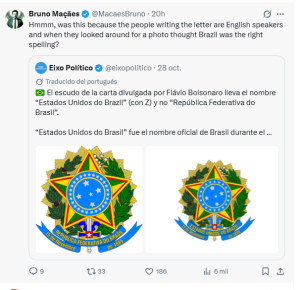
The farce is strong with this one.
As readers will no doubt be aware, Flavio Bolsonaro is now ensconced in the bosom of Florida’s gusano industrial complex, having first fled across Brazil’s southern border into Argentina, where he and his family boarded a charter plane for Miami, with a brief refuelling in Daniel Noboa’s Ecuador. Once on US soil, the Bolsonaros were quickly granted US Visas by the Trump administration.
One of Flavio’s first acts was to publish a letter in which he proclaimed himself the “true president elect” of Brazil. Its letterhead was a coat of arms with the words, “the United States of Brazil”, which was the official name of Brazil… from 1889 to 1967. Perhaps Flavio and his stateside handlers had got AI to do the letterhead, and it had got things a little mixed up.
The weird thing, as Bruno Maçães points out below, is that the name “Brazil” is spelt with a “z” rather than with the native “s”, which has prompted speculation that the letter was actually written by an English speaker, rather than Bolsonaro himself. Given where the letter was written, that’s probably a fair assumption.
Needless to say, 13 minutes later Bolsonaro sent a corrected copy to Paulo Figueiredo, an ally of Flavio’s who also resides in the US. Figueiredo forwarded that copy to journalists in an email titled: “Version with the correct shield.” Minutes later, a third version was sent out in which Bolsonaro’s title of “true president elect of Brazil” had been changed to “true leader of Brazil.”
Presumably, few people, including within the Trump administration, are actually taking this farce seriously. Even Trump himself has sought to distance himself from Flavio’s self-proclamation, saying he does not want to comment on the matter, before adding that the Brazilian elections in which Lula came from behind to secure a historic victory were “very strange.”
Like so many failed Latin American politicians and coup leaders before him, Flavio may have found a sunny bolthole in Florida, alongside his brother Eduardo, but this world is not big enough for two Juan Guaidós.
One of the few people who apparently begs to differ is Flavio himself, who in the letter (he apparently didn’t write himself) compares his political exile to those of Charles de Gaulle, who led the French resistance in WW2 from London; José Martí, the Cuban politician, diplomat, poet, essayist, journalist and philosopher who helped liberate Cuba as an emigré in New York and died fighting for his country; and more recent “Venezuelan opposition leaders”…
China’s state-owned media outlet Global Times has a much more grounded perspective of what is actually happening here:
For politicians like Flavio Bolsonaro, participating in elections was never about serving Brazil within an established political framework, but rather treating elections as a high-stakes political gamble – staying in power to deliver on interest promises made to Washington if they win, and dusting off their hands to flee to the US if they lose.
That said, it’s no surprise that Flavio made such a quick exit after his defeat to Lula on Sunday. Having failed to secure the presidency, Bolsonaro lost the judicial immunity he had enjoyed as a long-standing member of Brazil’s Congress. Given he faces three separate Supreme Court inquiries involving money laundering, currency evasion, and corruption, this was a problem.
Flavio is also under investigation for allegedly receiving illicit campaign funding from Rockbridge Network, a US conservative political advocacy group co-founded by current Vice President J.D. Vance. Brazil’s federal constitution prohibits political parties from receiving financial resources from foreign entities or governments — something the US could probably learn from.
Founded in 2019, the Rockbridge Network describes itself as an “investment manager, a kind of political venture capital firm”. Reported funders include Palantir co-founder Peter Thiel, who believes that freedom is not compatible with democracy, and Rebekah Mercer, who together with her father, Robert, provided the initial financial backing — roughly $15 million to $20 million — to help launch the political data analytics firm Cambridge Analytica..
On Monday, Brazil’s controversial Supreme Court Justice Alexandre de Moraes, who oversaw the conviction of Flavio’s father, Jair, for organising an attempted coup d’état and an alleged assassination plot against Lula and who himself is suspected of serious financial irregularities, instructed the Federal Police (PF) to seize Flavio’s Brazilian passport due to a possible flight risk — a flight risk that was clearly very real.
While the whole world was trying to pin down Flavio’s whereabouts, with many reports suggesting he was already in the US, or up in the air, the presidential candidate snuck into Argentina with his wife and two daughters late Tuesday night, allegedly using his Italian passport. The family crossed into Argentina over the Tancredo Neves International Bridge, about 19 hours by road from their residence in Brasilia.
According to the Argentine journalist Lorena Maciel, Flavio’s escape plan was coordinated between the CIA and Argentina’s State Intelligence Secretariat (SIDE), and executed by Santiago Caputo, Milei’s chief of staff, with the knowledge and collaboration of both Milei and Daniel Noboa. Milei’s involvement in Bolsonaro’s escape from justice has thrust Brazilian-Argentine relations into their worst crisis in decades.
No less controversial was the means of transport chosen for Bolsonaros’ escape. The charter plane they boarded at Iguazu airport was a Gulfstream G400, registration LV-JQW. According to reporting by Revista Forum, said aircraft belongs to the charter firm Baires Fly SA, which in turn belongs to Sergio Daniel Mastropietro, a close associate of President Milei and former business partner of Federico “Fred” Machado, who faces drug trafficking charges in the United States.
From Pan American Dispatch:
Fred Machado, an Argentine businessman in the aviation industry who was accused of participating in an international organization tied to cocaine trafficking and money laundering in the United States.
Machado was business partners with Sergio Mastropietro at SO VAIN S.A., a company founded in 2010 for aviation related ventures. Argentine investigations have also documented joint trips, business ties and a shared address between the two men in Buenos Aires.
In February 2021, the U.S. Department of Justice announced indictments against eight people for taking part in an international scheme involving drug trafficking, money laundering and financial fraud.
Machado was among those charged, identified as an operator in buying and selling aircraft through his company, South Aviation. The investigation involved a network that used U.S. registered planes, some of which were seized in other countries carrying large shipments of cocaine.
Machado was extradited from Argentina in November 2025 and later negotiated a plea bargain with U.S. prosecutors. In August 2026, a federal court in Texas found him guilty of conspiracy to commit money laundering and wire fraud. The original drug trafficking charge was dropped as part of that plea deal.
Machado’s business relationship is with Mastropietro, not directly with Baires Fly. The company’s formal owner is Luis Grande, who has worked in Argentina’s executive aviation industry for decades.
Machado gained notoriety in Argentina last year for having contributed funds to the presidential campaign of former Milei colleague, José Luis Espert, in 2019. According to Espert’s former press chief, Clara Montero Barré, Machado was much more than just a campaign donor:
“When I came [to work with Espert] Fred Machado was the financial contributor and he was the boss, the one who managed and chose candidates, he had a fundamental role, he was the one who pushed Espert into politics.”
When all these details emerged late last year, the resulting scandal put paid to Espert’s political career. The former associate of Milei was indicted on money laundering charges just last week.
As for Baires Fly, it gained prominence after the 2023 Argentine elections. Following his electoral victory, Javier Milei used one of the company’s jets for his first international trip to the US, where he paid homage at the tomb of Rabbi Menachem Mendel Schneerson in Queens. Schneerson is famous for transforming Chabad Lubavitch from an insular European group into a global Jewish outreach network with thousands of centres worldwide.
Mastropietro is also under investigation for suspected contract steering, overbilling, bribery and laundering funds allegedly pilfered by Milei, his sister and other senior officials from ANDIS, the agency responsible for assistance to people with disabilities in Argentina.
On October 16, federal judge Ariel Lijo ordered formal charges against Mastropietro on suspicion of aggravated money laundering and criminal association. The ruling also expanded charges against Diego Spagnuolo, ANDIS’ former director and a former Milei ally, along with other alleged participants in the scheme.
Argentina’s Federal Prosecutor’s Office said the investigation uncovered suspected fraud in contracts for medication, prosthetics and equipment intended for beneficiaries of assistance programs…
This case brings together a company that transported Bolsonaro after a court order barred him from leaving Brazil, financial transactions under investigation in the Milei government’s corruption scandal, and the business history of an intermediary linked to a man previously accused of drug trafficking in the United States.
The documents do not show that Bolsonaro was involved in the ANDIS scheme or in any drug trafficking activity. Nor is there evidence that Fred Machado had any role in arranging the flight.
It may come as little surprise to regular readers that the Argentine plane on which Flavio Bolsonaro fled to Florida is also allegedly tied to drug traffickers and money launderers. As we have reported over the past two years, many of the US lackies that have recently come to power in Latin America appear to be either literal cartel bosses (Ecuador’s Daniel Noboa) or are in the pay of cartel bosses (Bolivia’s Rodrigo Paz, Colombia’s Abelardo de la Espriella).
At the same time, the Trump administration is constantly escalating its so-called “war” on narco-terrorists. As we reported last week, the Pentagon has mobilised hundreds of troops to Latin America while in Ecuador, a country that voted overwhelmingly against the reintroduction of US military bases two years ago, fears are rising about the frenetic US military activity taking place at Taura Air Base, just an hour from Guayaquil, the hub of Ecuador’s massive drug trade.
Meanwhile, Nadia Beller, the Bolivian whistle-blower who blew the lid on the drug trafficking links of Fernando Cerimedo, aka “MAGA’s man in Latin America”, among many other things, told Camila Lourdes Galarza that authorities are seeking to arrest her as soon as Friday:
As Maureen Tkacik argues in her December 2025 article for the The American Prospect, “The Narco Terrorist Elite”, Marco Rubio, whose approval ratings are the highest in the Republican Party, “is the architect of what is arguably Trump’s single most cynical policy: the scheme to appoint drug cartel bosses and their cronies atop the governments of every Latin American country, in the name of fighting drug cartels.”
In the case of Brazil, however, it didn’t quite work out. Now, Bolsonaro is Trump’s problem — and he is a problem. The last thing the Trump administration needed in the week leading up to the midterm elections is to be seen granting asylum to an immigrant who is under criminal investigation in his native country. The memes write themselves…
Suffice to say, this is not a good look for a government that prides itself on its zero tolerance towards immigrants. For the past 22 months, hundreds of thousands of legal immigrants in the US have been hounded, abducted, stripped of their legal status, and deported. And suddenly here is an illegal immigrant arriving at the airport without the right papers, but with all the right connections.
And what do the ICE agents do?
They use umbrellas to help shield his identity from the journalists awaiting his arrival as they usher him and his family into a waiting vehicle. The contrast could not be starker.
Indeed, it’s quite possible, as some have suggested, that the Lula government actually allowed Bolsonaro to abscond, knowing full well that having another Bolsonaro in jail — or like his father, on house arrest — shortly after contesting a presidential election against Lula was going to be far more problematic than letting him run off to the US with his tail between his legs.
Back in Brasilia, Bolsonaro’s letter proclaiming his “leadership in exile” has been roundly rejected, including by his own Liberal Party. Even his closest associates were apparently unaware of Flavio’s plans to abandon ship. Rogerio Marinho, Flavio’s campaign coordinator, said “there is no evidence that there was electoral fraud.” The Liberal Party’s coalition members have published statements of support for Brazil’s electoral system and in defence of democracy.
As I said before, the world is not ready for another Guaidó experiment, especially one led by a figure as tarnished as Flavio Bolsonaro. When Guaidó declared himself “interim president” of Venezuela in January 2019, 50 countries, many of them in Latin America and Europe, recognised his absurd claim. For almost four years, Venezuela’s National Assembly recognised Guaidó as “interim president” — until the day it didn’t. By then huge sums of money had been squandered.
Today, as far as I can tell, only three countries have so far refused to recognise Lula’s electoral victory over Bolsonaro: the US, Argentina and Israel, where Lula is considered “persona non grata”. Make of that what you will.
