


Reporting Highlights
Toxic Legacy: Workers got sick cleaning up radioactive waste at a former federal nuclear weapons site in Washington, and the state passed a law to make it easier to claim benefits.
Litigating Workers’ Claims: The Department of Energy denies responsibility and has filed more than 500 legal appeals seeking to block state benefits being given to workers and their survivors.
Millions Go to Lawyers: DOE has spent nearly $12 million on outside lawyers and expert testimony to fight state compensation claims.
These highlights were written by the reporters and editors who worked on this story.
Lonnie Rouse shuffled into a wood-paneled conference room at the Washington state Capitol in March 2018. It had been nearly a decade since medical experts diagnosed him with a neurological disease they attributed to his exposure to chemicals at work. In the time since, he had acquired a stutter, begun limping and lost several teeth biting into a banana.
For nearly 20 years, Rouse had packaged plutonium and monitored radioactive waste at the Hanford Site, a now-decommissioned Department of Energy nuclear weapons production plant in south-central Washington and one of the most contaminated nuclear sites in the country. Tanks full of radioactive sludge exposed him to at least 48 potentially hazardous chemicals. The worksite was so toxic, he said, that the floor once melted the rubber off his boots.
Rouse was among the thousands of workers responsible for the ongoing environmental cleanup at Hanford, which has been underway since the DOE shut down the last reactor in the late 1980s. Congress has acknowledged, based on voluminous studies, that radiation at DOE sites poses health risks to workers.
Over time, some people at Hanford became so sick they could no longer work. Like Rouse, they filed for workers’ compensation. The DOE consistently challenged their claims and tried to shift the blame onto the workers themselves.
By the time Rouse took his place behind then-Gov. Jay Inslee, he was desperate. His 2009 workers’ compensation claim had been denied. He had burned through his retirement savings and declared bankruptcy.
As he watched, the governor signed a bill that was supposed to change his life.
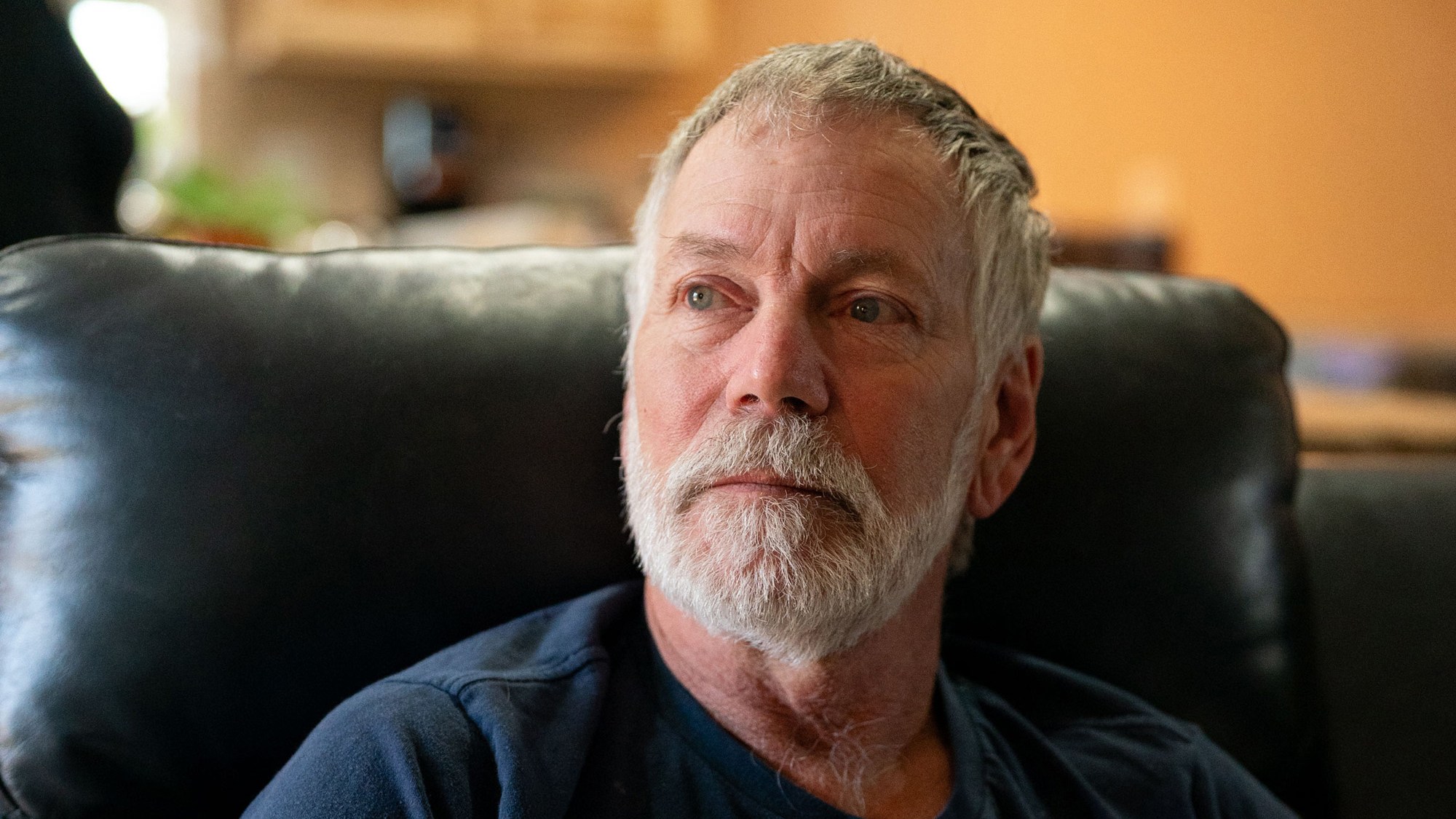
Rouse hung onto an old photo of himself cleaning rodent feces while working at the Hanford Site. Rouse packaged plutonium and monitored radioactive waste at the site for almost 20 years. Image photographed by Margaret Albaugh for ProPublica
For years, Hanford employees filing workers’ compensation claims had to prove the chemicals they were exposed to on the job made them sick. The new law Inslee signed flipped that burden of proof. Under the law, agencies were instructed to presume that working at Hanford had caused certain cancers, neurological diseases and respiratory illnesses. Now the Department of Energy would have to prove to the state that something other than the job had made the workers sick if it wanted to deny their claims.
Rouse thought the presumption law would speed up his claim for benefits. State lawmakers and the former governor thought it would force the DOE to take responsibility for the harm Hanford workers were experiencing.
But despite the law, the DOE continues to fight new and existing claims, Cascade PBS and ProPublica found. We asked the state for claims records going back to the presumption law’s passage in 2018, but the state only provided records going back three and a half years, to 2023. In that period, workers filed 102 new claims for benefits, state data shows. The DOE did not recommend approving a single one.
The state, which has final say, overruled the DOE and approved 75% of those claims. The DOE appealed all but seven of those approvals.
Cascade PBS and ProPublica spoke to workers, surviving family members, lawyers representing workers and state officials. They all pointed to a pattern: The DOE systematically challenges and then drags out workers’ compensation claims for years with recommended denials and subsequent legal appeals. Along the way, it has spent millions on outside lawyers and expert testimony, including doctor evaluations that point to other causes for workers’ illnesses.
The DOE has paid out benefits to Hanford workers in some cases, lawyers and families said, but it has done so while still actively appealing the claims. It warns workers that they may have to pay the money back.
Our reporting found that not even death ends the cycle of appeals. About 152 workers’ claims remain stranded in this legal limbo — approved by the state but still under appeal by the DOE. Half of those workers are dead. The DOE continues to fight to deny their families survivors’ benefits.
“It seems pretty coldhearted, calculated, that they’re trying to save money on the back of sick workers who they made sick,” said Gerry Pollet, one of the Washington state representatives who sponsored the 2018 presumption law, who is also a co-founder of the Hanford cleanup watchdog group Heart of America Northwest. “That’s why we needed a state law.”
After Cascade PBS and ProPublica raised questions about the DOE’s pattern of litigating claims, regulators at the Washington State Department of Labor and Industries met twice with DOE staff, state agency spokesperson Carrie McCausland said. But she could not point to any other actions the agency has taken beyond the two meetings.
“Agency staff are concerned and are right now assessing the severity of patterns we’ve seen,” McCausland wrote in an email.
The DOE did not answer detailed questions or respond to the newsrooms’ findings. In a statement, a spokesperson wrote that the DOE is following “all applicable local, state, and federal laws” and “has a long and successful record of accomplishment of protecting human health and the environment.”
The DOE has the right to file multiple appeals against a claim. According to court records, its appeals have sought to overturn claims approved by the state, narrow the period of back wages, or block survivors’ benefits, among other things. In appeals filings, the DOE’s lawyers have argued that factors other than work at Hanford played a role in the workers’ illnesses, including smoking, drinking, obesity or genetics.
In Rouse’s case, the energy department blamed alcoholism and family conflicts. The state agency that handles appeals did not find those arguments persuasive. DOE awarded Rouse most of his back pay in 2024, his lawyer said. Rouse declined to say how much that was, but said he is not touching the money until the legal process concludes.
Rouse’s wife, Melinda, takes his vital signs. Margaret Albaugh for ProPublica
In the nearly eight years it has been fighting his claim, the DOE has filed more than 20 appeals contesting different aspects of his claim.
“We were always told that nothing is out here that’s going to harm you — you do what you are supposed to do, and you do what you are trained to do, and you’re going to be fine,” said Rouse, who now receives 24-hour care.
“But that’s not what happens.”
“Depleted and Disgusted”
The smell of ammonia serves as a warning, workers say, that the underground tanks holding a mix of radioactive sludge have burped chemical vapors into the air above. From 1998 to 2008, it was Rouse’s job to monitor the toxic waste held in the “tank farms.” The containers together hold more than 50 million gallons of liquid waste. Rouse says he lost count of how many times tanks released toxic vapor that took his breath away, sometimes knocking him to the ground and making him vomit and bleed from his nose. According to a 2014 report funded by the federal government, tank farm workers exposed to chemical vapors commonly reported nausea, headaches and nosebleeds.
The liquid sloshing around in those tanks represented the radioactive byproducts of the Cold War. Hanford produced two-thirds of the plutonium for the nation’s nuclear arsenal and fueled the atomic bomb dropped on Nagasaki, Japan, in 1945.
The Columbia River flows by nuclear reactors at the Hanford Site in Washington state in 1960. Department of Energy
The end of production in the late 1980s launched a cleanup effort that is expected to continue until at least 2086. As of January 2025, more than 13,000 people were working at Hanford, nearly all of them for private companies contracted by the DOE. It is one of the largest and most expensive efforts to remediate toxic waste in the nation’s history.
In 2000, Congress passed the Energy Employees Occupational Illness Compensation Program Act, which provides medical care and one-time payouts to workers at DOE sites across the country. It was an acknowledgement that the nation’s nuclear weapons workers had been exposed to radioactive substances known to cause cancer. In it, lawmakers referred to a DOE policy “to litigate occupational illness claims, which has deterred workers from filing workers’ compensation claims and has imposed major financial burdens for such employees who have sought compensation.”
But the benefits of the federal program were limited: It capped payouts at $400,000.
Washington’s workers’ compensation system, by contrast, can provide steady wage replacement or a pension benefit, in some cases, for the rest of an injured employee’s life. It’s a program that can easily surpass the maximum federal benefit.
The state went further with its 2018 presumption law. Such laws generally protect firefighters who are regularly exposed to smoke, burned plastics and extreme heat. The National Council on Compensation Insurance, the Washington state attorney general and Pollet all said they were unaware of any other state that has extended that protection for radiological workers.
The federal government challenged Washington’s state law later that year in court, arguing it was discriminatory because it only applied to Hanford and the DOE.
Anticipating a Supreme Court decision that ultimately agreed, lawmakers passed an expanded version that covered all workers at “radiological hazardous waste facilities” in the state, including the state’s only functioning nuclear power plant and a French-owned facility that manufactures nuclear fuel rods. Nonetheless, roughly 75% of the 428 claims filed since 2018 have come from the DOE’s Hanford workers, according to the state Department of Labor and Industries.
Kathleen Kersey spent 10 years at Hanford, during both the production and cleanup stages. Much of her work involved measuring radiation around the site and making sure levels were safe. She says her safety training covered radiation, but not other hazards like chemical vapors burping from the waste tanks.
Kersey struggles to walk, has short-term memory problems and at one point lost vision in her right eye for three months. A doctor diagnosed her with multiple sclerosis, which is a neurological disorder, one of the categories of illnesses the state’s presumption law recognizes as related to chemical exposure at Hanford. In 2019 she filed a claim, which the state approved.
The DOE has appealed, arguing that something other than her time at Hanford caused her multiple sclerosis.
Kersey is one of the 152 workers still awaiting a resolution on her workers’ compensation claim. The DOE has not paid her any back wages, she said. The DOE declined to comment on her case.
“I feel depleted and disgusted,” Kersey said of the appeals process. “It makes me feel like I’m worthless. I have no value.”
“When Does This End?”
State records show that the DOE has filed more than 500 appeals since the presumption law passed in 2018. In 20 cases, as it did with Rouse, the DOE has appealed a single worker’s claim half a dozen times or more.
“We have seen tremendous pushback from DOE on essentially almost every single case that’s been brought,” said Washington State Attorney General Nick Brown.
Rouse’s wife, Melinda, said she knew something was wrong when he could not remember how to cut an orange. His vision started to blur, he stumbled often, and suddenly he felt irritable all the time. His primary care physician first thought he might have had a brain tumor. The physician referred him to a neurologist who noted cognitive impairment, possibly due to exposure to multiple toxins at the Hanford Site. The neurologist then referred him to a neuropsychologist, who diagnosed him with “toxic encephalopathy” in 2009, saying it was “more likely than not” that chemical exposure damaged his brain, according to court records.
Rouse at home with his wife, Melinda, and their dogs. After working at Hanford, he developed a neurological disorder that medical experts attributed to exposure to chemicals on the job. Lizz Giordano/Cascade PBS
The U.S. Department of Labor agreed too, approving him in 2010 for benefits under the Energy Employees Occupational Illness Compensation Program Act, saying it was “at least as likely as not” that Hanford contributed to his illness. A federal medical consultant even praised the neuropsychologist who assessed Rouse for his “unusually thorough analysis of causation.”
Rouse refiled his 2009 state workers’ compensation claim under the new law in 2018. Washington state approved it later that year.
The DOE appealed. It hired a medical toxicologist, who reviewed Rouse’s medical records and testified that he did not have the disease he claimed, and brought in an industrial hygienist, who downplayed the exposure risks at Hanford. The DOE’s toxicologist testified that Rouse’s drinking was “the most significant, what we might term, ‘toxic exposure’ that’s described in the medical record.”
A group of three physicians and an industrial hygienist have collectively earned over $1.7 million testifying against Hanford workers since the presumption law’s passage, according to DOE invoices the newsrooms obtained by a federal records request. One of the DOE’s go-to expert witness doctors earned more than $200,000 from the DOE last year alone. He did not respond to multiple emails seeking comment.
A single law firm, Wallace, Mann, Capener, Bishop & Debney, handles all of the DOE’s appeals. In addition to the fees paid to expert witnesses, the department paid the firm nearly $10 million between 2018 and 2025. The law firm did not reply to multiple requests for comment.
In cases where the DOE has appealed the state’s approval of a claim since 2018, the agency that handles appeals has sided with workers nearly 9 times out of 10, according to state data.
Pollet, the state representative who sponsored the 2018 presumption bill, acknowledged that the law has fallen short of his expectation.
“This was supposed to have ended a decade ago,” he said about sick Hanford workers still awaiting back wages and medical care. “It’s even worse than it was 10 years ago.”
“I think their actions are not only despicable, but they are criminal,” he said of the DOE.
The state Department of Labor and Industries said it expected “to engage further with the DOE,” which could include putting the department on an improvement plan and monitoring its progress.
Another option state regulators have is to revoke the DOE’s ability to accept and pay out claims directly. According to the state Department of Labor and Industries, the contractors that employ Hanford workers on behalf of the DOE would then decide whether to join the state-managed fund or seek state approval to manage claims themselves. Doing so could limit the DOE’s power to appeal, but contractors would still have that right.
Brown, the state attorney general, said he wants to wait and see how the DOE’s appeals of claims play out in higher courts. He hopes that once the DOE’s losses start stacking up, it will slow the volume of its litigation.
Attorney Charlynn Hull said she thought the DOE’s approach might soften during the Biden administration. But Hull said she observed no change in the DOE’s behavior. Her firm, Smart Law, represents the majority of Hanford workers’ compensation claimants, including Rouse and Kersey.
One of the hardest things about the DOE’s appeals, Hull said, is the testifying that the children and spouses of dead workers must do.
“I think that it’s just, it’s tormenting to them, in many ways, to relive how awful that experience was, especially with the cancer-related death,” Hull said. “When does this end?”
A view of the Hanford Site, which is undergoing one of the largest and most expensive toxic waste remediation efforts in the nation’s history. Margaret Albaugh for ProPublica
Dying While Under Appeal
For Isidoro Mata Jr., it ended with his children draining fluid from his lungs through a tube doctors had surgically inserted into his chest.
Mata demolished buildings at Hanford for nearly 30 years. Court records show he was diagnosed in 2015 with thyroid cancer, one of the illnesses that Washington’s law ties to work at Hanford. Sara Chilcoat, his daughter, said he kept working as long as he could.
State claims managers approved Mata’s claim in 2019. The DOE appealed, arguing that “medical opinion supports denial of this claim as not related to the distinctive conditions of employment.” The appeal did not elaborate further. The state forced the DOE to pay his wages and the cost of his medications, Chilcoat said. But the DOE filed a separate motion to stop his benefits while the appeal was adjudicated.
In its motion, the DOE argued that it was likely to prevail in its appeal because a doctor who examined Mata in 2019 believed his cancer was unrelated to his work at Hanford, according to court records. The state found the doctor’s examination “lacking in objective findings.”
“He was fighting for his life while they were trying to do that,” Chilcoat said. “That makes me mad.”
Mata’s case file notes that he missed three meetings with DOE lawyers in 2020. The state attorney general’s office sent the appeals judge a letter in July explaining that Mata was unable to participate because of his chemotherapy treatments. The DOE, which did not respond to questions about Mata’s case, dropped its appeal in December.
Less than three months later, Mata died.
