


A fetish is an object invested with powers or significance beyond its actual properties. In its original anthropological sense, the term describes an object believed to possess supernatural powers. More generally, fetishism occurs when the value attributed to an object becomes detached from its utility. The object acquires a significance independent of what it actually accomplishes.
Military institutions are particularly susceptible to this distortion. Weapons are developed to serve operational and strategic objectives, but successful weapons acquire reputations that transcend their practical effectiveness. The battleship became a symbol of naval supremacy, the tank an embodiment of battlefield dominance, and the fighter aircraft an expression of technological superiority and martial prowess. Their prestige becomes embedded in military traditions, professional identities, and national culture.
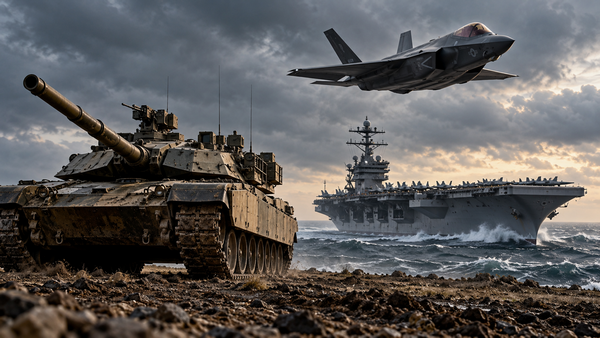
Enduring icons of U.S. military power: tanks, combat aircraft, and aircraft carriers
Weapons fetishism occurs when the perceived value of a weapon becomes detached from its demonstrated utility and is treated as an inherent property of the weapon itself. Yet military effectiveness is not an intrinsic property. It depends on the operational environment, adversary capabilities, available alternatives, and the objectives military force is intended to achieve. A weapon that once conferred decisive advantages may become progressively less useful as these circumstances change. Technological sophistication and destructive power do not necessarily translate into strategic effectiveness.
Perceptions of military utility do not automatically adjust to changing realities. Weapons acquire reputations through demonstrated achievements or the promise of future capabilities, while military organizations develop doctrines, professional communities, procurement programs, and industrial relationships around them. Cultural, reputational, and institutional inertia can sustain investment in established weapons even as their relative effectiveness declines. Their preservation may become an institutional objective in its own right.
This process need not involve irrational enthusiasm or deliberate deception. Military professionals may sincerely believe in the continuing value of familiar weapons, while organizations seek to protect investments and expertise accumulated over decades. The distortion arises when these commitments impede reassessment of military effectiveness under changing conditions.
Nor is weapons fetishism confined to established armaments. New weapons can acquire exaggerated reputations through the promise of capabilities they have yet to demonstrate. An appealing technological aspiration may generate substantial institutional commitments before its operational effectiveness or strategic utility has been established.
The underlying error is the same in both cases: the instrument of warfare is elevated above the purposes it is supposed to serve. This article examines how weapons fetishism develops, why it persists, and how it distorts contemporary American military priorities in what has come to resemble a cult of weaponry.
The Recurring Cycle of Weapons Fetishism
Military history is punctuated by dramatic reversals in which established weapons and methods of warfare proved inadequate against changing technologies and tactics. Weapons that once conferred military superiority can retain their reputations even as the conditions responsible for their effectiveness disappear. The resulting divergence between perceived and demonstrated utility is often exposed through costly battlefield experience.
At the Battle of Crécy in 1346, French armored knights, representing the prestige and striking power of medieval mounted warfare, suffered a devastating defeat against an English army employing longbowmen, dismounted men-at-arms, and advantageous defensive positions. The battle did not render armored cavalry obsolete, but it demonstrated that its traditional superiority could no longer be assumed under all battlefield conditions. Military prestige had outrun tactical effectiveness.
The Ottoman conquest of Constantinople in 1453 demonstrated another transformation. The massive walls of the Byzantine capital had resisted repeated sieges for centuries, sustaining their reputation as nearly impregnable fortifications. Ottoman heavy artillery helped breach these defenses, revealing the growing vulnerability of medieval masonry to gunpowder weapons. Fortifications remained essential to warfare, but their design and construction would have to adapt.
The industrialization of warfare produced an even more destructive confrontation between inherited expectations and military reality. At the Battle of the Somme in 1916, British infantry advanced against German defenses protected by machine guns, artillery, barbed wire, and fortified positions. The British Army suffered approximately 57,000 casualties on the first day alone. The catastrophe demonstrated the difficulty of conducting offensive operations against industrialized defensive firepower, undermining expectations that determined infantry assaults could achieve decisive breakthroughs.
The Second World War provided a comparable transformation at sea. Battleships had long embodied naval power, their massive guns and armor representing the culmination of centuries of surface warfare. Yet carrier-based aircraft demonstrated the ability to destroy capital ships at distances far beyond the reach of naval artillery. The British attack on the Italian fleet at Taranto in 1940, the Japanese attack on Pearl Harbor in 1941, and the decisive role of carrier aviation at Midway in 1942 established the growing primacy of naval aviation. Battleships did not disappear immediately, but their position as the principal instruments of naval supremacy was decisively ended.
These episodes illustrate a recurring cycle. New weapons and tactics establish their effectiveness and acquire prestige, encouraging military institutions to organize doctrines, professional communities, and procurement priorities around them. Subsequent technological developments alter the conditions of warfare, diminishing the relative utility of established weapons. Their accumulated reputations and institutional commitments impede adaptation until military reversals compel reassessment. The successful replacements then acquire their own prestige, creating the conditions for another cycle.
Historically, battlefield experience frequently supplied the corrective evidence needed to overcome entrenched military assumptions. Modern military institutions possess analytical methods that should permit them to anticipate such reversals without suffering catastrophic defeats. Nevertheless, the persistence of weapons fetishism demonstrates the difficulty of translating changing military realities into institutional adaptation.
The Three Mechanisms of Weapons Fetishism
The persistence of established weapons despite evidence of declining utility results from three mutually reinforcing forces: cultural, reputational, and institutional inertia. Each operates through a different mechanism, but together they can sustain weapons programs long after their strategic justification has weakened.
Cultural inertia arises from the symbolic significance that weapons acquire within military organizations and the societies they serve. Weapons become embodiments of national power, technological achievement, and martial virtue. The battleship symbolizes command of the seas, the tank represents armored might, and the fighter aircraft evokes the heroic image of the individual warrior. These associations are reinforced through military traditions, popular entertainment, and historical narratives.
The assignment of extraordinary power to a weapon has deep historical and behavioral roots. It is a form of cognitive compression that reduces the complex causes of military victory to the supposedly extraordinary power of a single weapon, often a magical sword.
Military professional identities are especially susceptible to such attachments. Fighter pilots, naval aviators, submariners, and armored warfare specialists belong to communities whose prestige and traditions are closely associated with particular weapons and methods of combat. Their commitment to mastering these instruments is understandable, but it can foster resistance to technologies or operational concepts that diminish the importance of established specialties. The displacement of a weapon may threaten not only an operational capability but also a professional identity.
Reputational inertia concerns the persistence of beliefs about a weapon’s effectiveness. Weapons acquire reputations through demonstrated achievements or expectations of future capabilities. Both sources can generate confidence that becomes embedded in military doctrine, procurement planning, and expectations of future performance. Yet operational circumstances may change, and anticipated capabilities may prove difficult or impossible to realize. Improvements in technical performance can reinforce confidence in a weapon without demonstrating that it remains the most effective means of accomplishing its mission. Over time, its reputation may become increasingly detached from operational reality.
The war in Ukraine has repeatedly demonstrated the limitations of supposedly game-changing weapons. Javelin antitank missiles, HIMARS rocket artillery, Excalibur precision-guided shells, advanced Western tanks, and F-16 fighters have all been heralded as potentially transformative. Some achieved substantial tactical successes, but none independently produced a decisive strategic breakthrough. Russian countermeasures, electronic warfare, battlefield adaptation, and the persistent demands of logistics and force concentration have constrained their effectiveness. Yet the prestige of these advanced weapons has often survived the disappointment of expectations, with shortcomings attributed to inadequate numbers or supporting capabilities. Although such explanations may be justified, they can also preserve confidence in a weapon without adequately reassessing its strategic utility.
The recurring belief that a superior weapon can transform the outcome of a complex military struggle recalls the ancient faith in magical swords. Military success depends on interacting systems and circumstances, not the supposedly transcendent qualities of individual weapons.
Reputational inertia is not confined to weapons with distinguished records of battlefield success. Aspirational expectations can generate confidence and prestige before a proposed technology has demonstrated its operational effectiveness. Once institutionalized, these expectations may persist despite disappointing results. Strategic missile defense provides a revealing example.
Institutional inertia arises from the organizational and economic structures built around established weapons. Major programs support networks of military commands, research establishments, defense contractors, congressional constituencies, training facilities, and maintenance organizations. Military careers, organizational budgets, industrial investments, and political interests become dependent on their continuation, making termination difficult even when superior alternatives emerge.
Institutional inertia is particularly resistant to correction because it does not require continued confidence in a weapon’s superiority. Organizations may recognize deficiencies while opposing replacement because the transition threatens budgets, employment, authority, or accumulated investments. The argument that too much has already been invested to abandon a program can transform unrecoverable expenditures into a justification for further commitments.
The three forms of inertia reinforce one another. Cultural prestige legitimizes continued investment, reputational confidence sustains expectations of effectiveness, and institutional commitments provide the resources and political influence needed to perpetuate weapons programs. Conversely, continued investment reinforces a weapon’s cultural significance and apparent credibility. The scale of institutional commitment may itself be interpreted as evidence of indispensability.
These forces also shape the evaluation of alternatives. Military organizations often assess new technologies through requirements and operational concepts derived from existing force structures. An unmanned aircraft may be judged against the capabilities of a crewed fighter rather than evaluated as part of a fundamentally different system of warfare. Similarly, distributed naval forces may be measured against the concentrated striking power of an aircraft carrier rather than assessed for their ability to achieve strategic objectives through different operational methods.
Established weapons thus become the standards against which their potential replacements are judged, even when innovation should involve reconsidering the standards themselves. Technological development may be directed toward preserving familiar capabilities rather than exploring more effective alternatives.
Weapons fetishism therefore emerges not from a single irrational preference but from the interaction of beliefs, reputations, and organizational interests. Its contemporary manifestations are particularly visible in the continued development of tanks, crewed combat aircraft, major surface warships, and strategic missile defense systems.
The Main Battle Tank
The main battle tank has occupied a central position in modern land warfare since World War II. Combining mobility, armor protection, and heavy firepower, tanks became principal instruments of mechanized offensive operations. Their battlefield achievements established an enduring reputation for decisive combat power, reinforced by the prestige of armored formations and the institutional influence of their commanders.
The tank’s historical advantages depended on its ability to concentrate protected firepower at decisive points. Armored formations could penetrate defensive positions and exploit breakthroughs with extraordinary speed. Even against well-equipped adversaries, tanks offered a combination of tactical mobility, direct firepower, and survivability that other ground combat systems could not readily match.
The proliferation of precision-guided antitank weapons began to erode these advantages. Relatively inexpensive guided missiles enabled infantry to destroy armored vehicles at considerable distances, while top-attack munitions exploited vulnerabilities in comparatively thin roof armor. These developments increased the cost and complexity of tank protection without eliminating their exposure to attack.
The war in Ukraine has accelerated this transformation. Persistent aerial surveillance, reconnaissance and attack drones, precision artillery, and extensive minefields have made concentrated armored maneuver increasingly hazardous. First-person-view drones have introduced relatively inexpensive weapons capable of damaging or destroying vehicles costing millions of dollars. More importantly, pervasive surveillance and precision attack threaten the assembly, movement, supply, and coordination of armored formations. A tank may survive an attack yet become immobilized, isolated, or unable to operate effectively without extensive supporting measures.
Military organizations have responded with additional armor, electronic countermeasures, active protection systems, improvised anti-drone structures, and revised tactics. These adaptations can improve survivability, but they also increase cost, complexity, and logistical demands. The progressive accumulation of protective equipment raises a fundamental question: how much additional investment is justified to preserve the battlefield utility of a weapon whose operating environment has become increasingly hostile?
None of this establishes that tanks have become useless. They retain valuable capabilities for direct fire support, protected movement, and operations against fortified positions. Their continued employment in Ukraine demonstrates that armored vehicles still fulfill important battlefield functions, although their effectiveness depends heavily on supporting forces, terrain, and tactical conditions.
The issue is therefore not whether tanks retain some utility, but whether their historical reputation continues to justify their privileged position in force structures and procurement priorities. A weapon can remain useful while becoming less cost-effective than emerging alternatives for particular missions. Cultural attachment to armored power, institutional commitments to mechanized formations, and confidence derived from historical achievements can impede recognition of this changing relationship. The danger is not necessarily the continued procurement of tanks, but the assumption that their traditional battlefield importance establishes their future indispensability.
Manned Combat Aircraft
Military aviation provides a revealing example of the interaction between cultural prestige and institutional inertia. The combat pilot occupies a celebrated position in military history and popular culture, embodying individual skill, courage, and technological mastery. Fighter pilots in particular have acquired an almost mythological status, reinforced by military traditions and popular portrayals of aerial combat.
Yet the technological foundations of military aviation have changed profoundly. Modern aircraft depend on computerized flight controls, sophisticated sensors, automated navigation, and increasingly autonomous mission systems. Unmanned aircraft have demonstrated the ability to conduct surveillance, reconnaissance, and precision strikes without exposing flight crews to enemy action. Advances in computing, communications, and artificial intelligence are expanding the range of missions that can be performed without onboard pilots. The growing importance of beyond-visual-range missile combat has also reduced the centrality of traditional dogfighting skills.
The Navy’s experience with unmanned carrier aviation is instructive. The Northrop Grumman X-47B demonstrated autonomous carrier takeoffs and landings, aerial refueling, and other capabilities essential to operating unmanned aircraft from aircraft carriers. These achievements suggested the possibility of extending carrier aviation into missions previously reserved for crewed aircraft, including long-range strikes in heavily defended environments.
Nevertheless, the Navy’s subsequent carrier-based unmanned aircraft program emphasized aerial refueling rather than penetrating strike. The resulting MQ-25 Stingray was designed primarily to extend the operational range of crewed carrier aircraft. This decision reflected legitimate operational priorities, but it also preserved the centrality of manned combat aviation. Rather than developing an unmanned aircraft to replace existing strike platforms, the Navy selected a mission that would enhance their effectiveness.
An unmanned strike aircraft could potentially exploit design freedoms unavailable to crewed aircraft. Eliminating the cockpit, life-support systems, ejection equipment, and associated safety requirements permits alternative configurations and advantageous tradeoffs in weight, volume, endurance, and payload. Aircraft without onboard pilots can also undertake missions involving personnel risks that might be unacceptable for crewed platforms.
The Air Force’s continued investment in manned strategic bombers raises related questions. The B-21 Raider incorporates advanced stealth technology and is intended to penetrate sophisticated air defenses, yet retains an onboard crew. Strategic bombing missions generally do not require the rapid maneuvering associated with fighter combat, while flight control, navigation, mission planning, and weapons employment already depend extensively on computerized systems. Retaining a crew imposes requirements for cockpit space, environmental control, life support, crew protection, and emergency systems, while exposing highly trained personnel to the hazards of defended airspace.
There are legitimate reasons for retaining human crews, including communications resilience, mission flexibility, authorization of weapons employment, and responses to unforeseen circumstances. Particularly in nuclear operations, command authority and positive control are indispensable. These considerations must be weighed against the potential advantages of unmanned alternatives rather than treated as establishing the permanent necessity of onboard crews.
The relevant question is whether crewed aircraft remain the most effective means of accomplishing particular missions, considering their full life-cycle costs, operational risks, and available alternatives. Comparisons confined to individual aircraft performance may obscure the advantages of distributed unmanned systems, including greater numbers, potentially lower unit costs, and the ability to accept higher attrition.
Manned combat aviation illustrates how professional identities and organizational commitments can shape technological development. The prestige of the combat pilot reinforces the cultural legitimacy of crewed aircraft, while institutions organized around pilot training, career progression, and established procurement programs have powerful incentives to preserve their central role.
The challenge is not to eliminate human judgment from military operations, but to determine where that judgment must be exercised. The continued presence of a human decision-maker need not imply the continued presence of a human occupant in every combat aircraft.
Aircraft Carriers and Major Surface Combatants
The aircraft carrier occupies a position in modern naval warfare comparable to that once held by the battleship. Its enormous size, technological sophistication, and capacity to project military power make it an imposing symbol of national power. The United States has organized much of its naval forces around carrier strike groups, treating these formations as indispensable instruments of maritime dominance and global military intervention.
The carrier’s reputation rests on substantial historical achievements. During World War II, naval aviation displaced battleships as the principal striking arm of major fleets. In subsequent decades, American carriers provided mobile air bases for operations in Korea, Vietnam, Iraq, Afghanistan, and numerous smaller conflicts. Their ability to deliver sustained airpower without relying entirely on foreign airfields made them exceptionally valuable instruments of military policy.
Yet the circumstances responsible for these successes have changed. American carriers have generally operated against adversaries possessing limited capacity to locate and attack them at sea. Confrontation with a technologically sophisticated naval power presents a different problem. Long-range antiship missiles, capable submarines, persistent surveillance systems, and unmanned reconnaissance and attack platforms threaten the freedom of maneuver on which carrier operations depend.
China’s development of extensive anti-access and area-denial capabilities illustrates this transformation. Land-based ballistic and cruise missiles, supported by satellites, aircraft, ships, and other sensors, create overlapping threats to surface forces operating within range of the Chinese mainland. Although detecting, tracking, and successfully attacking a maneuvering carrier remains a demanding operational challenge, long-range precision weapons have made the survivability of concentrated naval formations increasingly uncertain.
The carrier’s concentration of military value compounds this problem. A nuclear-powered supercarrier represents an investment of many billions of dollars, carries thousands of personnel, and supports an air wing of sophisticated aircraft. Its loss or serious disablement would constitute an extraordinary military and political setback. Commanders may consequently be compelled to operate carriers at greater distances from hostile territory, reducing the effectiveness of their embarked aircraft.
This creates a strategic paradox. The greater the value attributed to the carrier, the more reluctant commanders may become to expose it to danger. A weapon designed to project military power can become so valuable that its preservation constrains its employment. The threat of long-range antiship weapons can therefore diminish a carrier’s operational contribution even without an enemy successfully attacking it.
The Navy has responded with longer-range aircraft, improved defenses, distributed maritime operations, and new unmanned capabilities. Yet these measures generally preserve the carrier strike group as a centerpiece of American naval power. The question is whether incremental improvements can adequately compensate for the changing relationship between concentrated surface forces and increasingly dispersed systems of surveillance and attack.
The dilemma extends to major surface combatants. Modern destroyers and cruisers possess capable radar systems, sophisticated combat management equipment, and substantial missile batteries. Nevertheless, their effectiveness depends on finite missile inventories, vulnerable sensors, and the ability to withstand coordinated attacks involving multiple types of weapons. Relatively inexpensive unmanned aircraft and surface vessels can impose substantial defensive burdens on warships equipped with costly interceptors. Repeated attacks may exhaust defensive magazines or compel withdrawal for replenishment, even when individual attacks are defeated.
These developments suggest alternatives to concentrating naval power in a limited number of exceptionally capable platforms. Distributed networks of unmanned surface vessels, underwater vehicles, autonomous sensors, and remotely operated weapons could provide persistent surveillance and offensive capabilities across extensive maritime areas. Such systems would disperse military value, complicate enemy targeting, and reduce dependence on the survival of individual capital ships. Their operational effectiveness, however, must be demonstrated rather than presumed.
Naval warfare is especially susceptible to weapons fetishism because its principal platforms combine cultural prestige, historical reputation, and immense institutional investment. The question is not whether aircraft carriers and major surface combatants retain military utility, but whether their accumulated prestige and institutional importance have become disproportionate to their prospective contribution to naval warfare. The displacement of the battleship by the aircraft carrier demonstrates that even the most formidable instruments of maritime power can lose their primacy. There is no reason to assume that the historical cycle has ended with the present generation of capital ships.
Strategic Missile Defense
Strategic missile defense illustrates a different manifestation of weapons fetishism. Unlike tanks, combat aircraft, and capital ships, whose reputations derive from historical achievements, comprehensive missile defense has acquired prestige primarily through the promise of a capability it has yet to demonstrate. The aspiration to protect a nation against nuclear attack is so compelling that the desirability of the objective can become confused with its feasibility and strategic utility.
This confusion is evident in President Trump’s Golden Dome initiative, which drew inspiration from Israel’s Iron Dome defense system. Iron Dome has demonstrated substantial effectiveness against short-range rockets, but protecting the continental United States against sophisticated intercontinental ballistic missiles presents a fundamentally different technical and operational challenge. Successful interception of individual missiles under particular conditions does not establish the feasibility of a comprehensive national shield.
Israel’s experience defending against Iranian ballistic missiles illustrates the limitations of this extrapolation. Despite sophisticated multilayered defenses, Iranian missiles penetrated and struck Israeli territory during the June 2025 conflict. Interception performance considered highly successful against conventional attacks could be catastrophically inadequate against nuclear weapons. Even a defense capable of intercepting 99 percent of an incoming salvo of 100 nuclear warheads would permit an average of one warhead to penetrate, potentially sufficient to destroy a major city.
Moreover, missile defense cannot be evaluated through interception performance alone. A shield perceived as threatening an adversary’s retaliatory capability may encourage offensive expansion, countermeasures, or preemptive action. The pursuit of greater protection could therefore stimulate developments that diminish national security.
Strategic missile defense exemplifies prospective weapons fetishism, in which technological promise acquires institutional momentum before strategic utility has been established. The aspiration to achieve national invulnerability can sustain enormous investments even when technical achievements fall far short of demonstrating that the ultimate objective is attainable or strategically beneficial.
The underlying error is the substitution of technological promise for demonstrated strategic effectiveness. A weapon need not possess a distinguished record of military success to become an object of fetishistic attachment. The promise of future success may be sufficient.
The Consequences of Weapons Fetishism
The consequences of weapons fetishism extend beyond the procurement of expensive or increasingly ineffective armaments. The fundamental problem is the distortion of military priorities. When established weapons acquire importance independent of their demonstrated utility, preserving and improving existing capabilities can displace the search for more effective means of achieving strategic objectives.
The most immediate consequence is the misallocation of resources. Modern weapons programs require enormous investments in development, production, personnel, infrastructure, and maintenance. These commitments can extend over decades, even as changing circumstances undermine their justification. The F-35 fighter program, for example, is projected to cost more than $2 trillion in acquisition and sustainment expenditures over its lifetime, according to the U.S. Government Accountability Office.
The proposed Golden Dome missile defense system would also require extraordinary expenditures because of the demanding requirement for near-perfect interception and the necessity of elaborate orbital components. Even a 99 percent interception rate could permit catastrophic destruction in a nuclear attack, creating pressure for additional defensive layers, sensors, and interceptors. In May 2026, the Congressional Budget Office estimated that a national missile defense architecture broadly consistent with Golden Dome’s stated objectives would cost approximately $1.2 trillion over 20 years. This illustrative system was not designed to defeat a large-scale nuclear attack by a major power, and its estimated cost is not a projection of the actual Golden Dome program. The pursuit of national invulnerability thus creates a potentially open-ended financial commitment, with no inherent limit to the expenditures that might be justified in pursuit of an unattainable standard of protection.
The opportunity costs are equally consequential. Resources devoted to established programs are unavailable for alternatives. Continued investment in expensive crewed aircraft may constrain development of unmanned systems. Capital ship construction can limit resources available for distributed naval forces, while investments in heavily armored vehicles compete with reconnaissance, electronic warfare, and unmanned weapons. The relevant comparison is not between an established weapon and its absence, but between alternative means of accomplishing the same military objectives.
The escalating cost of advanced weapons creates another strategic problem: the tradeoff between technological sophistication and force size. As individual weapons become more elaborate and expensive, procurement budgets support fewer units, reducing the numerical strength, geographic coverage, and attrition tolerance of military forces. The contrast with World War II is striking. Modern fighters, tanks, warships, and bombers offer capabilities far exceeding those of their predecessors, but their much higher unit costs constrain the quantities that can be produced and replaced. Superior performance by individual weapons does not necessarily compensate for reduced numbers, particularly in prolonged conflicts where losses must be replaced and military operations sustained. The following table illustrates the enormous growth in weapon costs and the corresponding differences in production scale.
Weapons fetishism can also distort the structure of military forces. Organizations built around established platforms tend to formulate requirements that preserve their centrality. New technologies are incorporated as supplements rather than evaluated as potential replacements. The result may be a technologically sophisticated force whose organization reflects increasingly outdated assumptions about warfare.
These distortions become particularly dangerous when weapons reputations encourage exaggerated expectations of military effectiveness. A force that appears formidable in firepower, technological sophistication, or aggregate expenditure may prove poorly adapted to actual combat conditions. The discrepancy between anticipated and demonstrated performance can produce operational failures, strategic miscalculations, and pressures for escalation.
The nuclear era magnifies these dangers. Historically, battlefield reversals compelled military institutions to abandon outdated assumptions and adopt more effective weapons. Although the human costs could be appalling, defeated societies often survived to learn from their mistakes. Confrontation between nuclear-armed powers offers no assurance of such an opportunity. Miscalculations concerning military capabilities or the feasibility of achieving decisive advantages could initiate escalation whose consequences would overwhelm any conceivable benefits of victory.
Weapons fetishism is therefore more than an expensive form of institutional conservatism. It can undermine national security by diverting resources, delaying adaptation, exaggerating confidence in military capabilities, and encouraging strategic decisions based on mistaken assessments of effectiveness. A nation may possess increasingly sophisticated and expensive weapons while becoming less capable of achieving its strategic objectives—and more vulnerable to the consequences of attempting to employ them.
Breaking the Weapons Fetish Cycle
Breaking the cycle of weapons fetishism requires more than replacing obsolete weapons with newer technologies. Successful innovations can themselves become objects of exaggerated prestige and institutional attachment. Unmanned aircraft, autonomous warships, and artificial intelligence are no more inherently valuable than the weapons they may displace. Their utility must be demonstrated, not assumed from their technological novelty.
The fundamental remedy is to subordinate weapons development to a hierarchy of strategic objectives, operational requirements, and comparative evaluation of alternatives. Rather than beginning with an established weapons category and seeking improvements in its capabilities, military planners should ask what combination of capabilities can most effectively accomplish a specified mission. The answer may involve improving an existing weapon, adopting a different technology, reorganizing forces, or abandoning a mission whose contribution to national security no longer justifies its costs and risks.
Such evaluations must extend beyond technical performance to encompass survivability, logistical requirements, production capacity, operating costs, vulnerability to countermeasures, and adversarial adaptation. Strategic utility demands a broader assessment of consequences for deterrence, escalation, and international security. Technical superiority is not sufficient if the resulting military posture undermines the objectives it is intended to serve.
Continuous reassessment is essential because weapons programs extend over periods during which the character of warfare may change substantially. Independent evaluation, realistic operational testing, comparative analysis, and explicit consideration of opportunity costs should accompany programs throughout their development and service lives. Evidence of declining relative utility must be allowed to challenge established commitments rather than merely stimulate another round of costly modifications.
Institutional reform must also address the incentives that perpetuate weapons programs. Military organizations should be rewarded for identifying superior alternatives and adapting to changing circumstances, not simply for preserving established capabilities. Terminating an outdated program should be recognized as a potentially valuable strategic decision rather than an institutional defeat. Intellectual independence and willingness to challenge professional orthodoxies are as important to military effectiveness as technical expertise.
The historical cycle of weapons fetishism cannot be eliminated entirely. Military institutions will always depend on accumulated experience and judgments made under uncertainty. Nevertheless, the true measure of military progress is not the perceived impressiveness of weapons, but their demonstrated efficacy. Breaking the cycle requires the intellectual courage to abandon familiar instruments of warfare when their continued preservation no longer serves their intended purpose: national defense.
