


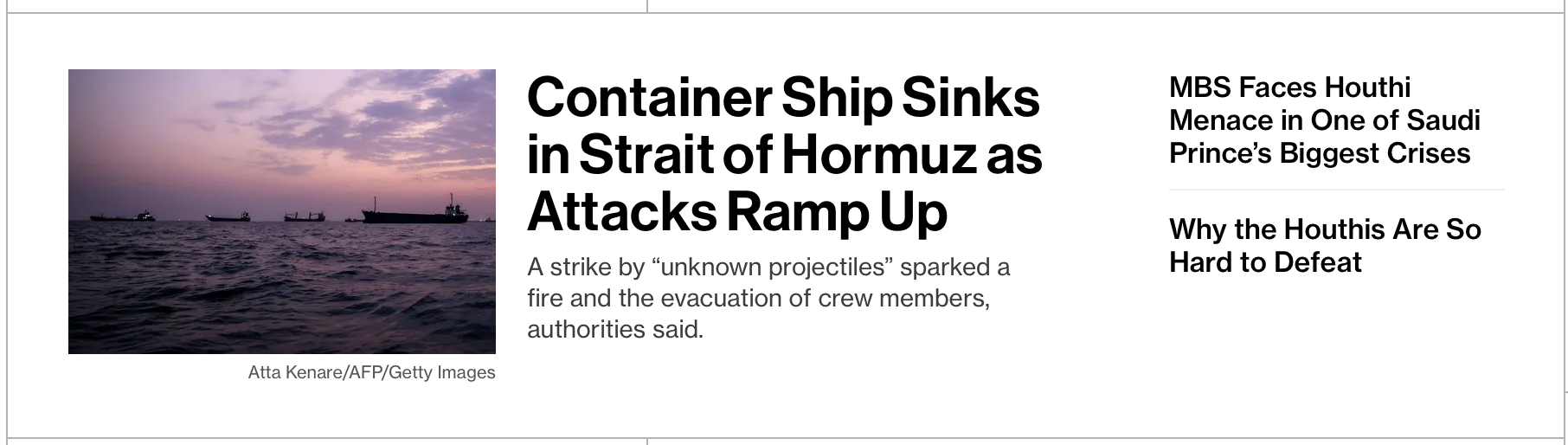
Iran and Ansar Allah have greatly intensified their attacks on their respective opponents, with Iran damaging two more vessels in the Strait of Hormuz environs, one via missile, the other by a mine. In the past week, Iran has considerably increased the range of its strikes, by hitting a tanker roughly 500 kilometers west of the Strait of Hormuz, off Qatar, and has also upped the frequency and severity of attacks, by hitting engine rooms which results in them lengthy repair times, and even sinking a cargo ship. From Lloyd’s List in Containership sinks in Strait of Hormuz as attacks on shipping intensify:
AD Ports-operated containership GFS Pride reportedly sank after a projectile strike and onboard fire during a Hormuz transit
Bulk carrier Cape Dao, attacked in September, is now reportedly sinking after salvage efforts failed, underlining the long-tail consequences of recent attacks
Containerships, bulk carriers and tankers have all been targeted in recent weeks, prompting fresh warnings over the deteriorating security environment in the strait
Some visuals:
BREAKING: Iran announces a large UAE-owned container ship carrying more than 2,500 containers hit a naval mine, exploded and sank this morning in the US-backed southern Omani corridor of the Strait of Hormuz.
It is the first vessel sunk by a mine in the war.
Initial reports indicate the cargo ship was carrying luxury perfumes and iPhones from Dubai.
— The Hormuz Letter (@HormuzLetter) October 14, 2026
And from Aljazeera’s live feed:
Strait of Hormuz attacks surge as Iran steps up surveillance, disrupting oil flows
Iran has deployed new naval units to expand surveillance of the Strait of Hormuz as attacks on commercial vessels reach their highest levels since the US-Israeli war began in February.
The navy said the new deployment would allow “real time surveillance of enemy activities and maritime traffic” across the strait, the Sea of Oman and the Arabian Sea, according to Iranian state media.
According to maritime tracking firm Kpler, 10 tankers were struck in the strait between September 28 and October 4, followed by another strike on October 5.
The UK Maritime Trade Operations (UKMTO) centre has separately recorded 15 other attacks between October 6 and October 14, with 11 of them occurring in just the past four days.
The escalation has disrupted oil shipments through the strategic waterway. Kpler data showed that just 2.9 million barrels passed through Hormuz on October 11, down from nearly 20.8 million barrels on October 8.
And this level of attacks looks set to continue:
BREAKING: Iran is reportedly launching multiple anti-ship missiles from southern Iran toward US Navy-escorted vessels in the Strait of Hormuz, with loud explosions reported in the waterway, per initial reports.
This comes after 26 UKMTO-confirmed attacks between September 30 and October 14. Reuters also reported at least five maritime incidents around Hormuz in the past 48 hours.
Two senior Iranian officials told Reuters that Tehran’s shipping attacks are aimed at keeping oil prices high and influencing the US midterm elections. One said the goal is to “frustrate efforts by the United States and its allies to bring down global oil prices,” while another said: “Just when they think they are getting close to the point where prices will fall, we will push them away from it. This is a game of chess.”
— The Hormuz Report (@HormuzReport) October 14, 2026
Iran officials are taunting the US:
🎥 IRGC Navy Commander General Azmaei: If Americans want to test whether the Strait of Hormuz is open or closed, they should enter the field. IRGC Navy fighters, armed forces, and mobilized people are positioned and ready to deal with offenders. https://t.co/r5w8bxknTm
— Middle East Observer (@ME_Observer_) October 14, 2026
The US responses so far do not amount to much. Per Aljazeera’s live feed, CENTCOM reported today that it destroyed a dhow engaged in surveillance in the Gulf of Oman on October 6, plus there are unconfirmed reports of explosions in southern Iran…which the US has hit how many times already?
But more may be in the offing:
BREAKING: The U.S. is now again preparing for the possibility of another major wave of attacks against Iran, with a massive surge in C-17 military cargo flights over the past 36 hours — an unusually sharp increase compared with previous weeks, according to flight-tracking data.
Most of the flights are reportedly landing in Israel, as Iranian strikes have damaged American-linked facilities across the region.
The buildup comes as the Pentagon moves a third carrier strike group and an estimated 9,000–10,000 additional troops toward the Middle East. The USS Theodore Roosevelt and Makin Island Amphibious Ready Group are expected to join the regional deployment.
Iranian officials also believe a joint U.S. and Israeli attack is very likely.
— The Hormuz Report (@HormuzReport) October 14, 2026
But then again, these force buildups under Trump are the military version of the negative yield curve predicting 9 of the past 5 recessions. But there are several media reports with similar findings, that the US is weighing a three day-ish campaign:
The possibility of a renewed war against Iran must be taken seriously. Three media reports indicate that the United States is preparing operational scenarios for a new phase of attacks.
Axios reports that the Pentagon has ordered U.S. Central Command (CENTCOM) to complete preparations for a possible operation.
The Israeli publication *Kipa*, citing *The New York Times*, reports on a plan for an intensive military operation lasting approximately three days. The publication *Srugim*, citing unnamed Arab sources, claims that U.S. regional partners have been given a signal that Washington is ready to resume the war immediately.
Taken together, these reports serve as a warning about the possibility of American and Israeli strikes against Iran in the coming days.
However, the phrase “short and destructive war” reflects only the scenario the attacking side hopes to achieve.
The United States may be planning a three-day operation, but the duration and scale of the war will also depend on Iran’s response. No operational plan can guarantee that the conflict will end within the timeframe and boundaries set by Washington.
Washington is planning a three-day war. Unfortunately, wars rarely bother to check the calendar before they start.
— 𝕊𝕡𝕣𝕚𝕟𝕥𝕖𝕣 𝕻𝕣𝕖𝕤𝕤 (@SprinterPress) October 14, 2026
Erm, the US attacked Iran for 40 days and Iran is not only still standing but also has escalation dominance. The only thing that the US could do in three day that it has not done before (ex nukes) is hit Iran’s energy infrastructure and/or critical civilian infrastructure. Iran has repeatedly and loudly arned that it would wreck Gulf energy production were that to happen.
Perhaps with the benefit of time, Iran has come up with retaliation plans that would hurt the US and petrostates more than the rest of the global economy, say by hitting US businesses in theater, data centers and communications. Iran has cleared its throat with respect to cables apparently in its waters and is making noises about hitting US and Gulf state tech assets:
BREAKING: Iran is moving to force Google, Meta, Microsoft and Amazon to obtain passage permits, undergo technical inspections and pay sovereignty fees for the undersea internet cables running through its territorial waters in the Strait of Hormuz, per Tasnim.
At least two major cable systems, FALCON and Gulf Bridge International, run directly through Iranian territorial waters in the Strait. Iran says their physical placement on Iran’s seabed creates a legal basis to apply its own regulations, requiring the owning companies to meet environmental and seabed monitoring standards and to pay for Iranian supervisory services.
More than 99% of international data traffic travels through undersea cables.
The move comes as Iran said yesterday that if the war restarts, the region’s undersea cables, data centers and AI facilities “will be destroyed,” putting their total value at more than $2 trillion.
— The Hormuz Letter (@HormuzLetter) October 12, 2026
Middle East Eye includes this update in Houthi strikes mark the end of Saudi Arabia’s Yemen ‘containment strategy’:
Saudi Arabia’s bid to “contain” the Houthis in Yemen while doubling down on economic growth at home is collapsing, posing one of the most serious tests for Crown Prince Mohammed bin Salman since he rose to power, according to analysts and diplomats….
In the last week alone, the Houthis struck Riyadh’s international airport three days in a row. A strike on Saturday killed at least 13 people and injured 300. The group’s targeting capabilities were underscored again on Tuesday when they hit the headquarters of Saudi Arabia’s state oil giant, Aramco, in the eastern city of Dhahran.
The strikes have caused some to question the capabilities of Saudi Arabia’s military.
The kingdom is a major buyer of American weaponry, including Patriot and Thaad air defence systems. According to the Stockholm International Peace Research Institute, the kingdom spends 6.5 percent of its GDP on military gear, one of the highest ratios in the world.
“It’s quite striking, literally, that the Houthis can hit, at will, these incredibly important facilities in Saudi Arabia and the Saudis can’t defend them,” Gregory Gause, an expert on the Gulf at the Middle East Institute, told MEE.
The markets are under-reacting to this spate of news. Oil has risen to $106 a barrel before falling back to a bit over $104. Bloomberg, even in its Middle East edition, has given AI and other news lead placement. Admittedly, there is a bit of a rout underway. From the Financial Times in Global tech sell-off deepens as Asian markets tumble:
Asian markets tumbled on Thursday following sharp falls for US chip stocks on Wall Street overnight as investors continued to fret about rising inflation and the future earnings of AI groups.
In Seoul the semiconductor-heavy Kospi fell 7.7 per cent, with bellwethers SK Hynix declining almost 11 per cent and Samsung Electronics down 9.3 per cent.
In Tokyo the Nikkei 225 sank 4.5 per cent, with OpenAI investor SoftBank sliding almost 10 per cent and semiconductor and memory maker Kioxia losing 11 per cent.
“People are just getting a little bit panicked at the moment,” said Song Zhe at BNP Paribas Asset Management.
Bloomberg’s Middle East conflict news, below the fold, is not happy:
To the Ansar Allah-Saudi conflict, see CBS in Live Updates: Houthis launch new attack on Saudi capital as Trump mulls U.S. role in Mideast war’s new front:
Explosions were heard over Saudi Arabia’s capital Wednesday morning as fighting intensified between Saudi-backed forces in Yemen and Iran’s Houthi rebel allies. A Saudi military spokesman said a ballistic missile launched by the Houthis was intercepted over Riyadh.
The Houthis vowed Wednesday to continue targeting Saudi Arabia’s international airport and oil infrastructure in the coming days in response to “Saudi aggression” against Yemen’s capital Sanaa.
President Trump has said he’s considering joining attacks on the Houthis as the rebels attack Saudi Arabia and threaten global energy supplies. The Houthis have threatened to target U.S. personnel and interests across the Middle East if Mr. Trump does order strikes, which could drag the U.S. deeper into the wider war sparked by the joint U.S.-Israeli strikes on Iran seven and a half months ago.
Olivier Boyd-Barrett provided more color:
The Saudi-led coalition conducted retaliatory airstrikes targeting Houthi-backed military and oil facilities across western Yemen (including Sanaa, Dhamar, and Saada) to curb supplies fueling attacks on waterways. Saudi air defenses and regional partners intercepted incoming Houthi ballistic missiles and drones targeting Riyadh and eastern infrastructure (what took them so long?), including King Fahd International Airport in Dammam and King Khalid International Airport (which have been considerably damaged by Houthi strikes in recent days – hence there are no flights). Yemeni government forces backed by Saudi Arabia continued a counter-offensive in southwestern Yemen near the Bab el-Mandeb Strait, inflicting heavy casualties and attempting to claw back territory seized by the Houthis….
Sustained Houthi resilience and asymmetric strikes have complicated U.S. and Gulf calculations, splitting opinions on whether direct large-scale ground intervention in Yemen would over-extend Western and regional military assets away from the Strait of Hormuz.
There is more and more evidence of the disintegration of the MBS-dominated Riyadh regime in favor of rival princes and tribes. As for help from MECCA allies, Turkiye and Pakistan, these are limiting their assistance to the cities of Mecca and Medina (which the Houthis will never attack anyway). They have no troops close to the critical Yemeni border. Saudi’s opening of channels for the delivery of advice from Israel will successfully enflame the Muslim world, destroy Saudi legitimacy as a keeper of Islamic faith and boot out MBS if he hasn’t already scarpered…
The Houthis have launched a systematic air campaign that effectively crippled Saudi commercial aviation. The King Khalid International Airport (Riyadh) has been repeatedly hit by Houthi ballistic missiles, cruise missiles, and drones. Over a single week of escalation, the strikes killed at least 20 people (including a U.S. citizen and a Pakistani national) and wounded over 300, shattering terminal structures, igniting major fires, and forcing the total suspension of airport operations. Structural damage and projectile strikes were also recorded at King Fahd International Airport in Dammam and Abha Airport.
On a world’s tiniest violin sighting, from Bloomberg in MBS Faces Houthi Menace in One of Saudi Prince’s Biggest Crises:
Saudi Crown Prince Mohammed bin Salman is facing one of the biggest crises of his tenure as the Houthis, who he tried to crush a decade ago, attack the kingdom while his allies hold back.
The Houthi drone and missile campaign has killed at least 18 people and shut the country’s main airport, stretching the kingdom’s defenses. Hundreds of Saudi flights remain grounded, schools have moved online and the capital’s financial district has shifted to remote work – less than two weeks before Riyadh hosts its flagship gathering of global investors.
That leaves the crown prince, who has spent years and billions of dollars courting world leaders and financiers, in need of allies more than at any time since he became de facto ruler in 2017. But with the Houthis hitting deep inside the kingdom from their base in Yemen, MBS — as he’s known — may find Saudi Arabia has few options.
Courting US President Donald Trump has thus far failed to secure direct military intervention, while a new defense pact with Turkey and Pakistan has brought limited assistance. Gulf states have issued statements supporting the kingdom, but stopped short of joining the war against the Houthis.
“He is in a terrible situation,” said Karen Young, senior research scholar at Columbia University’s Center on Global Energy Policy. “He has to answer to the attacks but solve the situation as soon as possible to get back to the focus on the economy.”
One notices the failure to consider that MBS might decide to cut his losses and make some concessions to Ansar Allah to stop the fighting. Forgive me for not running down the provenance, but yesterday, Brandon Weichert cited a snippet from a talk early in the day with a Saudi-connected guest who said that MBS was not only not considering kissing and making up with Ansar Allah but was determined to retake the territory they had occupied and then some.
Not surprisingly, Ansar Allah plans to carry on:
Yemen’s Iran-backed Houthis targeted Saudi Aramco facilities, the Ras Tanura refinery and King Khalid International Airport with ballistic and cruise missiles and drones, its military spokesperson Yahya Saree said on Wednesday.
Saree said the group would continue attacks on Saudi airports and oil facilities in the coming days.
— Iran International English (@IranIntl_En) October 14, 2026
And from the peanut gallery:
What a goat rope. Not often you see a panoramic video of a failed attack in flat open terrain. Note the use of smoke to conceal pro-Saudi force movement, the textbook execution of fire & maneuver, and the use of indirect fires to suppress the Houthis. Just kidding.
— Robert Clark (@RobertClark62) October 14, 2026
Apologies for stopping here. Your humble blogger is overloaded (you will soon learn about a big contributor, probably the week after next) and hopes to give a more comprehensive take, but we will not get back to more or less daily Iran war coverage until next week.
