


In medicine, a phantom limb is the persistent sensation of an amputated arm or leg. The missing limb may still seem to occupy its accustomed position, move, or experience pain. These sensations arise because the nervous system retains representations of a body that no longer exists in its former configuration. The physical limb is gone, but its neurological presence persists.
Modern military strategy suffers from a comparable affliction. The nuclear revolution fundamentally altered the conditions under which major powers can wage war, yet the ideal of decisive conventional victory remains embedded in military institutions, political thinking, and popular culture. The strategic environment has changed beyond recognition, but inherited conceptions of military victory endure.
The analogy has an important qualification. Conventional warfare remains a reality, and conventional military capabilities retain considerable value. What has become phantom-like is the expectation that a major war between nuclear powers can culminate in decisive victory, with one side imposing its will upon the other. That expectation persists despite the existence of weapons capable of transforming conventional defeat into mutual catastrophe.
WWII, the Last Great U.S. Victory
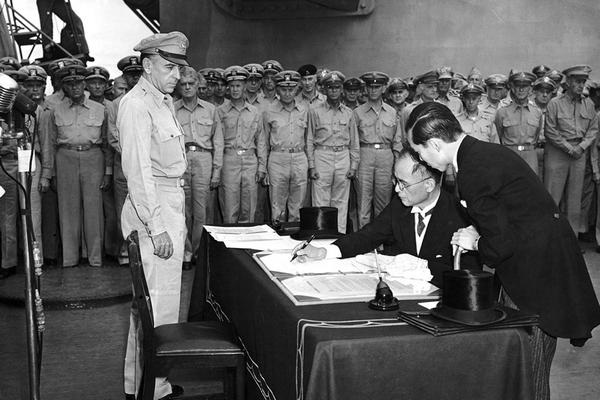
The last great demonstration of decisive victory in a war among major powers occurred in 1945. After six years of global warfare, Germany and Japan were defeated, occupied, disarmed, and subjected to fundamental political reconstruction. Their governments were dismantled or subordinated, their military establishments destroyed, and their capacity for organized resistance eliminated. The victorious powers dictated the terms of peace and established a new international order.
Japanese official signing surrender document in 1945
This outcome reinforced a model of warfare that had dominated military thinking for centuries. Superior military capability, supported by industrial production, technological innovation, operational skill, and national determination, could compel an adversary to accept political demands. However costly the struggle, decisive victory promised strategic advantages that justified the sacrifices required to achieve it.
World War II embedded this model deeply in military institutions, political thinking, and national memory. Military planners emphasized industrial mobilization, technological superiority, and sustained offensive operations. Political leaders inherited a compelling example of the successful application of overwhelming force. Popular culture celebrated the courage, sacrifice, and ultimate triumph of the victorious nations.
Yet the war that so powerfully affirmed the ideal of decisive victory also produced the invention that would undermine its future application. On July 16, 1945, the first nuclear explosion illuminated the desert at Trinity, New Mexico. The test marked the culmination of an unprecedented technological undertaking, but it also revealed the destructive potential of a fundamentally new form of warfare.
Some Manhattan Project scientists had already recognized the implications. The Franck Report, submitted in June 1945, warned that the United States could not expect to preserve a permanent nuclear monopoly and urged international arrangements to prevent an atomic arms race. J. Robert Oppenheimer later recalled the words of the Bhagavad Gita: “Now I am become Death, the destroyer of worlds.”
The contradiction was extraordinary. The Allied powers were completing the most decisive military victory in modern history at the very moment when a new technology was undermining the strategic assumptions that had made such victories possible. The capacity to defeat an adversary was approaching a point at which the adversary might be able to destroy the victor even while suffering defeat.
The development of thermonuclear weapons, intercontinental delivery systems, and survivable retaliatory forces would make this discontinuity unmistakable. Military superiority could no longer be assumed to guarantee national security, and the pursuit of decisive victory could no longer be separated from the possibility of catastrophic retaliation.
The nuclear revolution was not a transformation that humanity failed to recognize. Its implications were anticipated by some of the scientists who created the first atomic weapons and subsequently became central concerns of strategic theory. What failed to follow was a corresponding transformation of the cultural, political, and institutional structures that continued to regard military victory as the ultimate measure of national power. The phantom limb of decisive conventional warfare survived the event that had made it strategically obsolete in its traditional form.
Anatomy of the Phantom Limb
The phantom limb of conventional warfare has two complementary components. Martial courage gives it muscle; military proficiency and the prospect of victory give it dexterity. The first supplies the emotional and moral power of warfare. The second gives military force its apparent purpose and practical effectiveness. Together, they sustain the conviction that armed conflict can resolve political disputes through the successful application of organized violence.
The Muscle: Martial Courage
Courage, sacrifice, endurance, loyalty, and comradeship are among the most admired human virtues. Warfare provides a dramatic setting for their expression. Soldiers confront mortal danger and risk their lives for their comrades, displaying qualities that can command admiration independently of the justice of their cause or the outcome of the conflict.
This distinction is evident in cultural representations of warfare. Films such as Das Boot, Cross of Iron, and Letters from Iwo Jima portray German and Japanese combatants whose courage remains compelling despite their countries’ eventual defeat. The Deer Hunter explores the psychological devastation of Vietnam, while The Hurt Locker depicts the dangers and tensions of military service in Iraq. The documentary Restrepo portrays American soldiers’ endurance in Afghanistan without establishing that their sacrifices could produce a successful strategic outcome.
These works differ in perspective, but they illustrate a common distinction: admiration for soldiers need not imply approval of the war or confidence in its purpose. Bravery can remain extraordinary even when the cause is lost. This gives the phantom limb its enduring muscle. The prestige of martial valor survives strategic disappointment because the courage of soldiers and the wisdom of employing them are fundamentally different questions.
Das Boot (1981) and The Deer Hunter (1978) are representative of films portraying heroic courage, endurance, and suffering in warfare, irrespective of the strategic purposes of the war.
The Dexterity: Military Proficiency and the Prospect of Victory
The second component is the ability to employ military force effectively. Warfare rewards organization, discipline, ingenuity, technological innovation, and operational skill. Military institutions develop increasingly sophisticated means of maneuvering forces, identifying targets, concentrating firepower, and defeating enemy formations.
These capabilities give the phantom limb its dexterity. Unlike martial courage, which possesses an intrinsic moral appeal, military proficiency is instrumental: its value depends upon what it enables a nation to accomplish. But an army may defeat opposing formations without securing a favorable peace. A navy may destroy an adversary’s fleet without compelling political submission. An air force may devastate military infrastructure without eliminating the enemy’s determination to resist.
Nevertheless, improvements in weapons, intelligence, training, and command systems generate a compelling narrative of progress. Greater operational effectiveness can create the impression that decisive victory itself is becoming more attainable. Here the phantom limb acquires its most dangerous characteristic. Military capabilities can continue to improve even as the political utility of employing them declines. Against a nuclear-armed adversary, conventional superiority may inflict devastating losses while increasing the incentive for catastrophic nuclear retaliation.
The Persistence of the Phantom Limb
The phantom limb of conventional warfare survives because cultural and institutional forces reinforce one another. National memory, education, literature, cinema, and patriotic traditions preserve admiration for martial courage and sacrifice, even in unsuccessful wars. Military institutions reinforce these values through professional education, doctrine, procurement, and technological development, perpetuating the expectation that superior military force can produce decisive political outcomes.
These influences extend across generations and throughout society, from ordinary citizens to the highest levels of political and military leadership. They require neither deliberate deception nor conscious militarism. Citizens honor sacrifice, soldiers cultivate professional excellence, defense industries develop more capable weapons, and governments seek national security. Each activity serves an intelligible purpose, yet their combined effects can perpetuate strategic assumptions that none has independently validated.
The resulting system resists correction because its internal measures of performance differ from its ultimate purpose. Improvements in weapons accuracy, operational readiness, and destructive power are measurable achievements. But military capability ultimately serves political and security objectives, not combat performance for its own sake. Armed forces can therefore become increasingly effective at fighting wars without becoming more effective at achieving their intended outcomes.
Operational setbacks invite improvements in weapons, training, and doctrine, while political failures can be attributed to inadequate resources, faulty execution, or insufficient resolve. The expectation of decisive victory survives because the institutions sustaining it can continue to succeed by their own standards, even as the strategic assumptions underlying their activities become increasingly questionable.
Lessons Not Learned
The limitations of conventional military superiority have been demonstrated repeatedly since World War II. The United States and its allies have conducted campaigns in which substantial advantages in weapons, technology, logistics, and operational proficiency failed to produce the intended political outcomes. Yet these experiences have not displaced the conviction that further improvements in military capability can deliver decisive results. The disparity between military accomplishment and strategic success is evident in multiple major U.S. armed conflicts.
These conflicts differed greatly in their circumstances and objectives. They do not demonstrate that conventional force is inherently ineffective. The liberation of Kuwait in 1991 illustrates how military superiority can achieve a clearly defined and attainable objective. The preservation of South Korea provides another example of limited but consequential strategic success. The problem arises when military accomplishment fails to accomplish strategic political objectives. Destroying armed forces, occupying territory, or overthrowing a government does not necessarily compel political submission or establish a durable strategic advantage.
Repeated disappointments might have encouraged reconsideration of the relationship between military superiority and strategic success. Instead, unsuccessful campaigns have often been explained by deficiencies in execution: inadequate resources, flawed intelligence, political interference, restrictive rules of engagement, or insufficient resolve. Some explanations have merit in particular cases. Their institutional appeal, however, is that they preserve the assumption that victory remained attainable if the war had been conducted differently.
Technological innovation reinforces this tendency. Precision weapons, stealth aircraft, advanced surveillance, unmanned systems, and sophisticated command networks promise to overcome earlier operational limitations. Each generation improves the capacity to locate, attack, and destroy enemy forces without necessarily resolving the political problems that frustrated earlier campaigns. The essential lesson is not that conventional force cannot succeed. It is that military superiority does not guarantee strategic success. That distinction becomes far more consequential when the adversary possesses nuclear weapons capable of imposing catastrophic costs even in the face of conventional defeat.
When the Phantom Limb Writes the Doctrine
The persistence of the phantom limb is particularly evident when the pursuit of military superiority becomes an organizing principle of strategic doctrine. Operational dominance, originally a means of achieving political objectives, can acquire the status of an objective in itself. An instructive example is Joint Vision 2020, published by the U.S. Joint Chiefs of Staff in 2000. Its central concept, Full Spectrum Dominance, envisioned American forces capable of defeating any adversary and controlling military operations across the full range of conflict. The doctrine emphasized information superiority, precision engagement, dominant maneuver, and focused logistics as foundations of overwhelming operational effectiveness.
These ambitions were understandable responses to advances in military technology and the demonstrated capabilities of American forces. But the ability to dominate a battlespace does not establish the ability to dictate an acceptable political settlement. Military superiority may determine the course of combat without resolving the adversary’s willingness to resist or the consequences of its defeat. The distinction becomes critical when the adversary possesses nuclear weapons. Conventional dominance may threaten capabilities that a nuclear power considers essential to its survival, making escalation more attractive precisely as its conventional position deteriorates.
Joint Vision 2020 did not prescribe nuclear war or explicitly advocate the unconditional defeat of nuclear-armed states. Its significance lies elsewhere: it illustrates how a military institution can define its aspirations in terms of progressively greater operational dominance while leaving the ultimate political utility of that dominance dependent upon circumstances beyond military control. The phantom limb writes the doctrine when the capacity to prevail in combat is mistaken for the capacity to secure strategic victory.
Conventional Warfare and Nuclear Entanglement
The fundamental problem with conventional warfare between nuclear powers is not that nuclear weapons make conventional combat impossible. It is that the boundary separating conventional from nuclear warfare is neither physically secure nor politically dependable. A conflict may begin with limited objectives, yet develop in ways that threaten the survival of one or more participants. Nuclear escalation is therefore not an external hazard of conventional operations but a danger embedded in the strategic relationship between the belligerents.
Conventional operations seek to overcome enemy resistance and compel political concessions. Nuclear deterrence, by contrast, preserves a state’s capacity to inflict unacceptable damage even when its conventional defenses fail. The more successfully an opponent destroys those defenses, the more consequential the nuclear deterrent may become to the threatened state. The contradiction is fundamental: the conventional attacker seeks to eliminate the adversary’s capacity to resist, while the defender’s nuclear arsenal provides a means of resisting even after conventional defeat appears inevitable.
Modern warfare depends upon integrated networks of surveillance, communications, navigation, command systems, and precision weapons. Many serve both conventional and nuclear purposes. Satellites provide military communications and strategic warning; radar installations track conventional and nuclear threats; command networks may support ordinary operations while sharing infrastructure with nuclear forces.
An attack intended to disrupt conventional operations may consequently threaten capabilities indispensable to nuclear deterrence. Destroying a communications node, disabling an early-warning sensor, or striking a headquarters may have consequences extending far beyond its immediate tactical purpose. The danger is compounded by uncertainty. The attacker may consider its operations limited and carefully calibrated, while the defender interprets the destruction of critical infrastructure as preparation for a disarming nuclear strike. Neither possesses complete information about the other’s intentions or decision-making.
Technological advances intensify these dangers. Long-range precision weapons threaten strategic assets previously accessible mainly to nuclear attack. Cyberwarfare and antisatellite operations can disrupt communications and warning systems. Artificial intelligence and automated decision support may accelerate operations while reducing opportunities for political intervention. Each capability offers operational advantages, but their interaction multiplies the pathways through which conventional conflict can threaten nuclear security.
These risks are not static. As conventional threats accumulate, political pressures intensify and critical military capabilities deteriorate, an endangered state may become increasingly dependent on its nuclear arsenal. A campaign intended to achieve decisive victory can therefore progressively increase the danger of nuclear escalation. The more successful the conventional offensive, the greater the incentive for a desperate defender to employ its most destructive weapons.
The Uncertain Threshold of Nuclear War
Nuclear doctrine has never established an impermeable boundary between conventional and nuclear warfare. During the Cold War, NATO contemplated nuclear first use in response to overwhelming conventional aggression. Contemporary doctrines continue to differ over the circumstances that might justify nuclear employment, leaving adversaries uncertain about the limits of conventional conflict.
Russia provides a particularly explicit example. Its revised nuclear doctrine of November 2024 expanded the stated circumstances under which nuclear use might be considered, including conventional aggression against Russia or Belarus that poses a critical threat to their sovereignty or territorial integrity. The revision also broadened the treatment of attacks involving states supported by nuclear powers.
The United States has likewise retained the possibility of nuclear employment in extreme circumstances involving significant nonnuclear strategic attacks, although its declared policy emphasizes deterrence and restricts the circumstances under which nuclear use would be contemplated. China, by contrast, continues to declare a policy of no first use, illustrating that the doctrinal positions of nuclear powers are not uniform.
These distinctions matter, but they do not restore a dependable boundary between conventional and nuclear war. An attacker must consider not only the adversary’s published doctrine but also how its leadership might interpret a deteriorating military situation. The threshold for nuclear use is consequently neither a fixed operational limit nor a boundary whose location can be reliably inferred from declared policy.
The Asymptote Fallacy
Conventional military planning assumes that increasing superiority improves the prospects for victory. Better weapons, intelligence, logistics, and operational proficiency enable a force to inflict greater losses while sustaining fewer casualties. Continued improvements should bring decisive victory progressively closer. Against a nuclear-armed power, however, this expectation encounters a fundamental discontinuity. The adversary’s willingness to resist does not necessarily diminish as its conventional forces are destroyed. As defeat approaches, its incentive to employ nuclear weapons may increase.
The asymptote fallacy is the unwarranted assumption that conventional military operations can approach the threshold of nuclear escalation indefinitely without crossing it. Improvements in intelligence, precision, and escalation management may encourage confidence that military pressure can be increased without triggering nuclear retaliation. But the threshold is neither fixed nor reliably knowable. It depends upon an adversary’s perceptions and decisions, which may change abruptly as military defeat approaches.
“Understanding when you’re heading for the border, Lord, you’re bound to cross the line.” — Kris Kristofferson
The Vanishing Prospect of Capitulation
Consider a hypothetical war in which American forces destroy much of China’s navy and air force, establish control over critical maritime approaches, and impose a severe blockade. Would China accept American political demands, or would its leadership regard the destruction of its military capabilities and economic security as existential threats warranting escalation? A comparable problem arises in a conventional war between NATO and Russia. Even overwhelming NATO superiority would not establish that Russia would accept the destruction of its military establishment or threats to its territorial integrity without considering nuclear retaliation.
These scenarios do not imply that nuclear escalation is inevitable. They demonstrate that conventional superiority cannot reliably compel the capitulation of a nuclear-armed great power. The more comprehensive the defeat being imposed, the more difficult it may become to offer terms the adversary regards as compatible with its survival. The traditional expectation that overwhelming military superiority makes surrender increasingly attractive can therefore be reversed. Conventional defeat may make nuclear escalation the defender’s only remaining means of avoiding an intolerable outcome.
The Illusion of Escalation Control
Military planners recognize these dangers and employ limited objectives, selective targeting, graduated responses, diplomatic signaling, and communication channels to reduce escalation risks. Such measures are valuable, but escalation control is not a unilateral capability. It depends upon how an adversary interprets events and makes decisions under conditions of uncertainty, fear, and potentially catastrophic loss.
A conventional strike intended as a limited demonstration may be interpreted as preparation for a disarming attack. The destruction of communications infrastructure may appear operationally necessary to one side and existentially threatening to the other. Even when both governments wish to avoid nuclear war, their actions may generate pressures neither anticipated. The assumption that escalation can be controlled is therefore contingent upon adversary decisions that no military planner can command.
Catastrophic Victory
The traditional purpose of military victory is to secure a political outcome favorable to the victor. Territory may be defended, threats eliminated, and concessions extracted. However costly the war, its sacrifices are justified by the expectation that the resulting peace will leave the victorious society more secure. But when the adversary is a nuclear-armed great power, would the resulting strategic gains justify the risk of catastrophe?
The world in which the Allied powers achieved decisive victory in 1945 was far less economically integrated than the world of today. International trade was important, but industrial production, financial systems, energy supplies, and technological capabilities were more heavily organized within national economies and imperial trading blocs. The destruction of an adversary’s economic capacity could therefore be treated more readily as a strategic advantage to the victor.
Modern economic interdependence complicates that calculation. The major powers are linked through international supply chains, financial markets, energy networks, transportation systems, and technological industries. Their economies are not isolated structures competing for advantage, but components of a global system whose functioning depends upon extensive cooperation among political rivals.
A major conventional war between these powers would disrupt this system even if nuclear weapons were never employed. The destruction of ports, industrial facilities, electrical grids, transportation networks, and communications infrastructure would propagate economic damage far beyond the countries directly involved. Trade interruptions, financial instability, shortages of critical materials, and the breakdown of production networks could impose enormous costs upon belligerents and neutral countries alike.
The apparent victor would not be insulated from these consequences. Destroying an adversary’s industrial capacity might simultaneously eliminate important sources of manufactured goods, intermediate components, technological inputs, and commercial demand. The military destruction of an economic rival could therefore damage the victor’s own productive capacity and prosperity.
This is a fundamental departure from the traditional logic of decisive victory. The economic damage inflicted upon an adversary can no longer be assumed to translate into a corresponding strategic advantage. In an interdependent world, destroying an opponent’s economic strength may also destroy part of the economic foundation of one’s own security.
Victory Without Security
The strategic consequences would extend beyond immediate economic losses. A defeated nuclear-armed power would remain a formidable political problem. Its population, national identity, grievances, and capacity for future resistance would not disappear with the destruction of its conventional military forces. Even a successful campaign might therefore leave the victor confronting an impoverished, embittered, and unstable adversary, alongside a damaged international economy. The costs of reconstruction, continuing military commitments, disrupted trade, and prolonged political hostility could overwhelm whatever advantages the victory was intended to secure.
The possibility of nuclear escalation makes this already unfavorable calculation far more dangerous. A state approaching decisive conventional defeat may retain the capacity to inflict destruction vastly exceeding the value of the political objectives being pursued. The victor must therefore accept not only the prospect of immense economic collateral damage, but also the risk that the campaign will cross an uncertain nuclear threshold. The question is no longer whether decisive military victory can be achieved. It is whether the resulting political gains could plausibly compensate for the economic destruction, strategic instability, and risk of nuclear catastrophe incurred in obtaining them.
The Self-Consuming Pursuit of Victory
The ancient symbol of the Ouroboros, a serpent consuming its own tail, provides an apt representation of this predicament. Its relentless self-consumption transforms purposeful activity into an image of self-destruction. The pursuit of decisive military victory between nuclear powers contains a comparable contradiction. Each state seeks security through military superiority. Each improvement encourages countermeasures by potential adversaries. The resulting competition increases destructive capabilities while multiplying the pathways through which confrontation could become catastrophic.
The process does not require leaders to desire destruction. It can arise from their determination to avoid defeat, preserve credibility, maintain superiority, and protect national interests. Individually intelligible decisions can collectively produce an increasingly dangerous strategic environment.
The phantom limb sustains this contradiction. Military institutions continue to perfect their ability to defeat adversaries, political leaders invoke the promise of victory, and technological innovation suggests that remaining obstacles can eventually be overcome. Yet the strategic environment no longer permits the consequences of decisive victory to be reliably separated from the possibility of catastrophe. The pursuit of military supremacy, ostensibly undertaken to secure national survival, can instead place civilization itself in jeopardy.
Conclusion: The Courage to Abandon the Limb
The phantom limb does not mean that conventional military force has become useless. Nations still require the means to defend themselves, deter aggression, and protect legitimate interests. What has become dangerously obsolete is the expectation that military superiority can reliably produce decisive victory over another nuclear-armed great power.
Escaping this predicament requires a different kind of courage. Martial valor has long occupied a privileged place in national culture, but the nuclear age also demands intellectual courage from those who determine national policy. Political and military leaders must be willing to question inherited doctrines, acknowledge the limits of military power, and subordinate operational ambitions to attainable strategic objectives.
This requires a reordering of national priorities. Military effectiveness must be judged by its contribution to enduring security and political stability, not merely by the ability to destroy enemy forces or dominate battlespaces. Diplomacy, arms control, conflict prevention, and the reduction of mutual insecurity must become integral components of national strategy rather than alternatives considered only after military options have failed. The challenge is not to diminish the courage of soldiers, but to demonstrate comparable courage in the councils where decisions about war and peace are made. Refusing an unnecessary confrontation, abandoning an unattainable objective, or negotiating with an adversary may demand more intellectual and political courage than ordering another military operation.
The phantom limb survives because its cultural muscle and institutional dexterity remain powerful, even as the strategic purpose they once served has become increasingly detached from reality. Preserving an obsolete conception of victory is not a demonstration of strength, but a failure to recognize that the conditions governing national survival have fundamentally changed. In medicine, the loss of a limb may be necessary to save a life. In international affairs, relinquishing the phantom limb of decisive conventional warfare may be necessary to preserve something immeasurably more valuable: our global civilization.
