


Yves here. The importance of small donors in both of Bernie Sanders’ presidential campaigns, as well as the intense campaign in the press and political parties against populists, and above all, the socialist sort, right lead one to think that ordinary voters were gaining some ground in the funding game. The reverse is the case. The 2026 races are shaping up to be a big money orgy.
By Matthias Lalisse, who received his Ph.D. in Cognitive Science (Neural Networks) from Johns Hopkins University and works in Machine Learning. Originally published at the Institute for New Economic Thinking website
Republican House Speaker Mike Johnson has referred to this year’s midterms as a “contrast election” between the two parties. The comment invites analysis at many levels. Contrasts between the two parties are clear on, for example, abortion, vaccines, or the rule of law vs. a “unitary executive” and voting rights. But another very important issue is the extent to which big money dominates party financing in a year in which “affordability” has become a major theme in the appeals of both parties. How much do the major parties actually differ in their dependence on major donors?
For all the glib talk about money in politics, reliable empirical studies of the actual size distribution of political contributions are vanishingly rare. Media discussions are almost entirely dominated by counts of small subsets, such as prominent tech executives or, more rarely, members of the Forbes 400. Many academic studies limit coverage to political action committees (PACs), which represent only a slice of the totals. Nearly all are plagued by more data shortcomings than we have time to detail, because reliably aggregating contributions from the same individuals or even firms is excruciatingly difficult and that step is indispensable to avoid producing nonsense.
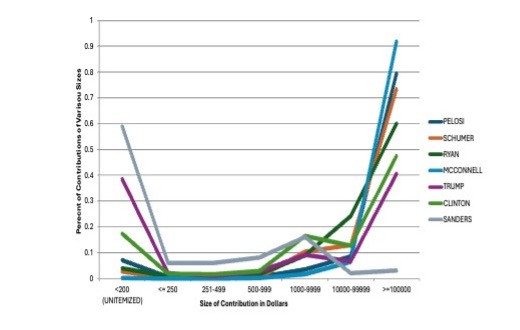
Ferguson, Jorgensen, and Chen (2022) presented an analysis for the 2016 election cycle of contributions to individual political leaders, not to parties as a whole, which avoided the usual data pitfalls. Their results were striking: Congressional leaders of both parties depended heavily on contributions from mega-donors. Small contributions hardly mattered – no chieftain’s contributions below $200 amounted to even 10% of their totals. Topping the list was Mitch McConnell, with over 90% of his campaign receipts coming from donors contributing $100,000 or more. See Figure 1.
Figure 1:
Size distribution of contributions for congressional leaders (Pelosi, Ryan, McConnell, and Schumer) and presidential candidates (Clinton, Trump, and Sanders) in the 2016 election cycle.
Adapted from Ferguson, Jorgensen, and Chen, Structural Change and Economic Dynamics 2022.[1]
Patterns of the presidential candidates were somewhat different. In 2016, the Democrats were torn apart by an intra-party conflict that strongly resembled the current battle for the soul of the Democratic party that some newsrooms now discuss. Senator Bernie Sanders challenged Hillary Clinton, the consensus establishment candidate. He attracted virtually no megadonors, depending instead on small contributions to float his campaign. By contrast, the financial profile of Hillary Clinton’s campaign strongly resembled the pattern of Congressional leaders: it drew massively on big contributions.
On the Republican side Ferguson, Jorgensen, and Chen showed that Trump’s campaign stood out in a different way: The donor patterns in his campaign resembled a “barbell”: 40% of receipts from small donors (those contributing less than $200 to a campaign), matched on the other side by another 40% secured from megadonors contributing more than $100,000. Way different from Sanders, but also far from the norm for Republican presidential candidates.
A Decade Later: From the Rockies to the Himalayas
That was 2016. What is the pattern in the “contrast” election of 2026?
Two charts sum up the situation. Figures 2 and 3 plots the campaign finance receipts of the party leaders in both legislative chambers – the Republican leaders (Mike Johnson in the House and John Thune in the Senate) and their counterparts on the Democratic side (Hakeem Jeffries in the House and Charles Schumer, in the Senate) in 2026.
The totals include the regular campaign accounts for each leader, which are subject to conventional campaign finance limits, as well as their “leadership PACs” (also subject to limits) that many politicians use as slush funds to amplify their political clout with colleagues by spending on other campaigns, and often, to finance a bevy of personal use expenditures that seem to have no political purpose at all.
We also include the network of super PACs aligned with each chamber’s leaders: For the Democrats, the House Majority PAC and Senate Majority PAC; for the Republicans the (House) Congressional Leadership Fund and Senate Leadership Fund. All these now raise hundreds of millions of dollars per election cycle. We include as well for Schumer an affiliate of the Senate Majority PAC called WinSenate, which spends on Senate Democrat hopefuls and is financially tied to the Senate Majority PAC.
Figure 2:
2026 Congressional leaders’ campaign finance receipts by size of the donor’s contribution.
The graph depicts the proportion of receipts from each contribution tier. The $1-200 tier includes all unitemized contributions (contributions summing to less than $200 per PAC) which the FEC requires to be reported only in the aggregate.
The results are once again striking: There is no contrast. The financing of all four leaders is dominated by giant contributions – nearly 80% percent of their receipts come from donors contributing $100,000 or more in the lowest case (Jeffries, at 78%). But the towering peaks at the right end of both figures have jumped from the Rockies to the Himalayas. All four leaders’ receipts are dominated by donors contributing more than not $100,000, but a million dollars. In 2026, the lowest is Jeffries, with 59.7% of his receipts coming from donors above that limit.
Only once does the percentage of small donors rise above single digits (Jeffries, 11%). Among the Republicans, small donors are beaten out in each case by donors whose contributions are, in this rarefied context, “mid-tier” – contributors offering ‘just’ $10,000 to $99,999. Here, in the elephant party, small donors amount to bits of straw.[2]
Since 2026’s receipts are still rolling in, we plot results for 2024 for comparison. One might be inclined to do a double-take, since with minor modifications it is the same graph. Mega-donors account for the bulk of receipts with small donors making up less than 10% in all cases (even less for the Republicans). Jeffries does best with the small donors, but his total from this group is only 8%. The dominance of ultra-donors to Congressional leaders is the law of the land across time.
Figure 3: 2024 Congressional leaders’ campaign finance receipts by size of the donor’s contribution.
Dark Money: US politics’ Untraceable Bête Noire
It is only natural to ask how dark money figures in these totals. Dark money refers to political contributions that flow through organizations that do not disclose their donors to the public. It shows up in our tabulations as contributions to super PACs from non-profit organizations – so-called 501(c)4s or similar entities that are not required to file with the FEC, and thus whose contributions cannot be further traced. Only the multi-million dollar transfers from dark money groups to the super PACs that spend the money on elections are visible; we cannot see the individuals, corporations, or other groups that filled the non-profit’s coffers.
Both parties now rely heavily on dark money, to the extent that each party’s formal super PACs pairs with a non-profit arm of its own to provide the PAC’s donors with the “anonymous option.” Our data are complete only through September 2026, but tens of millions of dollars have already flowed through these conduits to each leader.
The largest share of the dark money on the Democrat side emanated from two organizations, Majority Forward ($61 million) and House Majority Forward ($21.7 million)[3], each specialized in lubricating one of the two chambers. The Republicans have their own dark money organizations affiliated with their super PACs for each chamber. House Speaker Johnson’s dark American Action Network has contributed $43 million to the Congressional Leadership Fund while Thune’s One Nation has contributed $70.7 million to his Senate Leadership Fund in 2026.[4] The two 501(c)(4) organizations are tightly interlocked with their affiliated super PACs and led by close allies of each congressional leader.
Countervailing Power: Labor’s Place in This System
Sizable labor contributions show up in the receipts of the Democrat leaders. By contrast, on the Republican side they are exiguous. For all the talk about warming relations between parts of the Republican Party and a segment of labor, little labor money actually goes to Republicans. Empirical studies covering different periods of time have shown that labor makes a preponderance of its contributions to Democratic candidates, sometimes above 99% (Brunell 2005).[5] But the bigger story is that labor’s role in election finance is waning and small. Ferguson, Jorgenesen, and Chen found that labor’s share of national election financing in 2016 was 7%. Since the returns show a non-negligible amount of labor activity in the Democratic super PACs, the balance of contributions between labor, dark money, and big business is worth a closer look.
To start with the obvious: how do the overall sums from labor compare with money from business or wealthy individuals? The Democratic leaders’ receipts present a macrocosm of the struggle between capital and labor playing out with a twist: labor’s investment is in broader super PACS rather than super PACs of their own. Figure 4 breaks out the largest tiers of receipts for donors contributing at least $100,000 in total into four categories: dark money, unions, business, and other. The business money includes corporations and wealthy individuals whose business affiliations were clear from FEC records, supplemented occasionally by internet searches. Wealthy investors whose fortunes derived from business investments were classified as business. We treated dark money as a separate category. Most of it, however, is likely coming directly or indirectly from either businesses or very rich individual investors. The “other” category includes such entities as non-profit PACs, Native American tribes, and a few individual donors whose source of funds could not be verified to stem from some major business entity.[6]
Disputes of this sort continue in 2026, with the SLF electing to back Texas incumbent Senator John Cornyn over Trump endorsee Ken Paxton in the primaries, a move that Thune (prophetically) characterized as the better “business proposition” with Cornyn the safer candidate, freeing up SLF resources to be spent in other races. The SLF, we note, has ultimately backed Paxton with a glut of spending to defend Texas as a Republican stronghold, and with Trump chipping in through his super PAC MAGA Inc. Notwithstanding the polite disagreement on this single Senate primary, the near-silence of Senate Republicans on tariffs—a contentious election issue that has historically divided the Trump wing from the Republican establishment—is an indicator of the party’s consolidation, with Thune’s fundraising instruments having essentially established the entente that was desired.
Figure 4:
Large labor contributions to the four congressional leaders versus contributions from business, dark money, and other. All contributions from donors contributing more than $100,000.
Labor’s showing is the green slice: 17% of Jeffries’ receipts and 12% of Schumer’s. The labor contributions are largely eclipsed: Jeffries, with the largest share of large labor contributions, has more than 50% of his big receipts from donors with identifiable business affiliations. The amounts are non-negligible, but labor is a small minority shareholder in the Democratic party’s legislative docket.
The dark money share exceeds the labor share in every case, with more than 25% of each leader’s receipts comprising untraceable contributions. Of the money that is traceable (i.e. excluding the dark money chunk), it is clear that the majority of Jeffries and Schumer’s contributions (68% and 77% respectively) flow from business.
On the Republican side, the share of labor money is virtually zero. Business money accounts for essentially all of their receipts. Vanishingly small proportions of the big contributions (.5% and .2% for Johnson and Thune) come from labor (specifically two unions, the firefighters and air traffic controllers, who also contributed to Democrats), with 98.6% and 97.82% of large contributions respectively coming from combined business and dark money. The “Other” category, which captures special interests of the non-business type (e.g. non-profit advocacy organizations) is also essentially absent from the Republican leaders’ returns. The evidence is overwhelming that the GOP is almost exclusively a party financed not just by big contributors, but by contributors stemming from big business.
Table 1 rounds up all of the contributions from labor in amounts above $100,000 to either Schumer or Jeffries. We find each group represented in both congressional leaders in similar amounts, reflecting a dedicated strategy of contributions from unions to electing Democrats. The Teamsters’ political arm D.R.I.V.E. PAC is a noteworthy absence in 2026 (the union contributed $1.5 million to the Democratic leaders in 2024), following a softening of relations between the union’s leadership and the Republican party manifested in 2026-cycle Teamster contributions to nearly two dozen Republican incumbents.[7] The intra-labor divisions are often overstated, though: the amounts are small and Republican campaign super PACs have not benefited from anywhere near the level of union investment (Teamster or otherwise) that Democratic super PACs enjoy.
To summarize: despite labor’s heavy investment in the Democrats, the large amounts they contributed are smaller than the Democrats’ largest contributors from business, and business contributions as a group dwarf labor’s. It is not surprising that labor priorities like the PRO Act are stalled in the Senate or that the $15 minimum wage has now sunk to $10.81 in buying power from when it was first introduced in the 2016 Democratic dust-ups.
Table 1: Labor groups contributing more than $100,000 to Schumer or Jeffries (2026)
Group
Jeffries
Schumer
American Federation of Teachers
$3,765,000
$3,510,000
United Association
$2,755,000
$2,500,000
United Brotherhood of Carpenters and Joiners
$2,000,000
$1,000,000
Laborers’ International Union of North America
$2,015,000
$2,005,000
Union of Operating Engineers
$1,670,000
$1,660,000
AFSCME
$1,570,000
$1,260,000
United Food and Commercial Workers
$1,152,500
$1,385,000
Service Employees International Union
$1,005,000
$500,000
National Association of Letter Carriers
$765,000
$755,000
International Brotherhood of Electrical Workers
$720,000
$2,460,000
Communications Workers of America
$507,500
$355,000
National Education Association
$515,000
$10,000
International Association of Fire Fighters
$412,500
$510,000
Air Line Pilots Association
$385,000
$380,000
United Steelworkers
$0
$250,000
Transport Workers Union
$95,000
$140,000
AFL-CIO
$110,000
$160,000
National Air Traffic Controllers Association
$15,000
$305,000
Total
$19,457,500
$19,145,000
A Democratic Identity Crisis?
Frequent talk of an identity crisis in the Democratic Party points to something real.[8] The party’s post-New Deal brand as the advocate of the working and middle classes through government intervention is laughably out of date. While candidates in the mold of Sanders made gains in the midterm primaries, the congressional leadership remains hostile to the bulk of the policy agenda championed by the progressive camp. Jeffries has repudiated such policies as Medicare For All—reversing his stance from 2019 when he cosponsored the legislation while he was still courting votes to become the Democrat leader in the House—that would offer a clear contrast between Republicans and Democrats on a core affordability issue for Americans. Schumer for his part is conspicuously missing from the bill’s list of 19 Democratic cosponsors.[9] The number two leader in the Democratic House, Massachusetts’s Katherine Clark, recently received more than $100,000 from members of a single health insurance company, UnitedHealth. In 2026, the Democratic focus has also manifestly drifted away from environmental issues, despite considerable persisting activist pressures. The party’s rhetoric has evolved to steady attacks on the Trump Organization/administration for allegedly corrupt misdeeds in the stock market and crypto space while beating the drum of affordability for American families. What the affordability talking points amount to as a policy program is a question largely left to the imagination.
The conclusion has to be that 2026 party financing displays all the signs of an even deeper dominance of big money in congressional politics at the highest level. Labor’s extensive participation in the big money game, with pooled contributions from workers that, while not trivially small, embodies the common complaint that labor is a “junior partner” of a second business party. That party’s financial base is anchored by multimillionaires and billionaires that compose its primary financial constituency.
Data Appendix
Our data are updated through to a September 9, 2026 download of the FEC’s bulk tables for the 2026 election, which are sufficient to provide a representative view of the state of play on the eve of the midterms in terms of receipts, if not the spending that takes place closer to the election. We implement thorough checks, both manual and automated, to guard against double counting, particularly in the case of large contributors constituted as PACs that the super PACs at the center of our analysis often misreport by omitting the FEC identifiers for those PAC contributors. This makes it difficult to match contributions across different reporters by automated means, with the PAC contributions requiring extensive manual review.
Our procedures for dealing with this data are too numerous to enumerate, but a hallmark of our approach consists of merging all records for the same donor across all their contributions to various committees. We process the full-cycle tables, merging across 2024 and 2026, deduplicating records for the same donor using an algorithm honed for this task across several years. This allows us to look at not just the size of an individual check, but to merge contributions from the same individuals and organizations, as many are repeat donors to the same candidate. It is these donor-merged amounts that we report in Figure 2.
We have comprehensively cataloged the committees associated with each congressional leader, including their conventional campaign committees and leadership PACs as well as joint fundraising ventures and, crucially, the network of super PACs constitutive of the campaign finance accounts of the congressional leaders at the center of our analysis. These differ in kind, warranting the amount of attention that the Citizens United Supreme Court case which enshrined them in law has garnered. The former set of PACs, including joint fundraisers that pool the fundraising prowess of multiple candidates and committees into a collective pot, are subject to per-donor limits on the order of thousands, while typical super PACs regularly attract contributions in the millions. The super PACs included in our analysis are as follows:
Super PACs included in the analysis of chamber leader receipts
Jeffries: House Majority PAC/HMP, All For America PAC
Johnson: Congressional Leadership Fund/CLF
Schumer: Senate Majority PAC/SMP, WinSenate
Thune: Senate Leadership Fund/SLF, New Heights for America Action/NHA Action
Each of the main chamber super PACs (HMP, CLF, SMP, and SLF) is paired with an affiliated dark money group that funneled large contributions to it under cover of the eponymous dark. We include the dark money groups and their totals here:
Affiliate dark money groups of the chamber leader super PACs
Jeffries: House Majority Forward: $21.7 million to HMP in 2026, $47 million in 2024
Johnson: American Action Network: $44.3 million to CLF in 2026, $43 million in 2024
Schumer: Majority Forward: $61 million to SMP in 2026, $81.75 million in 2024
Thune: One Nation: $70.7 million to SLF in 2026, $35.58 million in 2024
Three of the super PAC entries, two on the Senate side, warrant special mention, and in one case (Thune) marginally boost the receipts at the top end. In addition to the chamber leader super PACs that have become a conventional part of the congressional leader’s armament, additional accounts sometimes pop up to supplement the chamber mainstays. In the 2024 election, one such super PAC, called WinSenate, appeared as an affiliate of SMP to serve as an additional financing vehicle for the cycle’s Senate contests. The relationship is not ambiguous: WinSenate received $312 million from SMP in 2024, making WinSenate essentially a pure conduit for Schumer’s political expenditures in 2024. The PAC had no other receipts apart from those it received from SMP (note that transfers between a leader’s affiliated PACs are naturally excluded from our tabulation of the totals received by each leader). Thune too has a secondary super PAC, NHA Action, whose activities I have documented previously. NHA Action was founded in 2024, the year that Thune took control of the upper chamber’s Republican caucus and just as he was vying for the position. At the time, NHA functioned as a sort of immersion program for the then Republican whip into the game of big money politics, allowing Thune to dramatically increase his receipts at the top end (with 2024 receipts of $14.5 million) while he stepped into the role of chamber leader. The PAC is on the books for 2026 and continues to receive checks that have no upper limit, but its receipts ($1.1 million) do not rival the towering heights of the SLF ($258 million), the main chamber super PAC. The project of giving Thune an independent fundraising vehicle separate from the extant firehose has apparently fallen by the wayside in 2026. A third super PAC in the special mention category is new in the 2026 cycle, and is affiliated with Jeffries’ likewise new dark money group, “All For America”, the allied 501(c)4 that supplied a reported $940,000 transferred from the non-profit to the super PAC bearing the same name. The contributions from the dark money group are the PAC’s only receipts.
The full list of PACs included in our analysis (super PACs alongside more conventional fundraising instruments as well) is as follows:
PACs included in the analysis:
Jeffries: HMP (C00495028, super PAC), All for America PAC (super PAC, C00932038), Jeffries for Congress (C00503052), Jobs, Education, & Families First PAC (C00617803, leadership PAC), Jeffries Victory Fund (C00768200, joint fundraiser), Jeffries Majority Fund (C00834549, joint fundraiser), Empire State Victory Fund (C00837997, joint fundraiser), Jeffries Battleground Protection Fund (C00916429, joint fundraiser).
Johnson: CLF (C00504530, super PAC), Mike Johnson for Louisiana (C00608695), American Revival PAC (C00639229, leadership PAC), Johnson Leadership Fund (C00771246, joint fundraiser), Grow the Majority (C00858373, joint fundraiser), Defend Our Majority (C00895821, joint fundraiser).
Schumer: SMP (C00484642, super PAC), WinSenate (C00865444, super PAC), Friends of Schumer (C00346312), Impact (C00348607, leadership PAC).
Thune: SLF PAC (C00571703, super PAC), NHA Action (C00876409, super PAC), Friends of John Thune (C00409581), Heartland Values PAC (C00409003, leadership PAC), Commonsense, Conservative Values PAC (C00748186, leadership PAC), Thune Victory Committee (C00673715, joint fundraiser), One Team Senate Majority (C00897918, joint fundraiser).
McConnell: Senate Leadership Fund (C00571703, super PAC), McConnell Senate Committee (C00193342), Bluegrass Committee (C00235655), McConnell for the Majority (C00548651, joint fundraiser), Making Investments Toward Conservative Heroes PAC (C00760348), McConnell Victory Committee (C00638007, joint fundraiser), Team McConnell (C00802876, joint fundraiser).
Note that joint committees included in our tabulation have had their contributions deduplicated from those that show up in the accounts of fundraising affiliates. We count only contributions that end up in the accounts of the affiliate PAC with its affiliation to the candidate. This slightly understates the fundraising that candidates do on behalf of other candidates and of the party, since the purpose of joint fundraising committees is precisely for members to bundle their donors together to send contributions to a number of organizations, including party PACs. As the chain of attribution is usually broken in the reporting (with the final recipient not providing the FEC’s formal identifier for the joint fundraiser in their log of the receipts), there is simply no way around simply excluding joint fundraisers’ direct receipts from our analysis. It is good to be aware, though, that this practice means we perforce undercount some large donor contributions to committees linked to the candidates in our analysis. It is just that those contributions were split among a number of other PACs, subject to contribution limits, and only some of which were political spending accounts controlled by any of the congressional leaders.
See original post for references
