


This is Naked Capitalism fundraising week. 1302 donors have already invested in our efforts to combat corruption and predatory conduct, particularly in the financial realm. Please join us and participate via our donation page, which shows how to give via check, credit card, debit card, PayPal, Clover, or Wise. Read about why we’re doing this fundraiser, what we’ve accomplished in the last year, and our current goal: Karōshi Prevention.
Having cleared the biggest legal hurdle, the Ellison media empire has assumed control of WBD, dumped all over the bond markets, and named its leadership team for the new organization which will be called Skydance after David Ellison’s studio.
Let’s start with legal case closing.
Cases Closed, WBD Goes to the Ellisons
Forbes sums it up:
Judge Araceli Martinez-Olguin ruled Wednesday to approve the agreement, which was reached as part of the states’ antitrust lawsuit seeking to block Paramount and Warner Bros.’ merger.
Her ruling means the settlement agreement can take effect and Paramount and Warner Bros. can close their deal, as the merger had already received government approval from the U.S. and other countries.
Martinez-Olguin ruled the settlement “represents a reasonable factual and legal resolution of the dispute,” is “procedurally sound” and was reached fairly between the parties.
The settlement agreement requires Paramount to produce 30 to 32 films for the next five years, a certain share of which have to be produced in the U.S., and imposes other requirements like mandating Paramount and Warner Bros. negotiate their channels’ cable packages separately and establishing an “independent editorial board” to oversee CNN and CBS News.
And now on to the bond market reaction.
Many Billions in Paramount Debt Hits the Market Hard, Mr Market Cries Out
The Wrap reported on Paramount’s debt offering on September 28:
The debt offering, which was filed with the SEC on Monday, includes $32 billion in investment-grade debt and $12.4 billion in high yield bonds. The proceeds from the debt offering will be combined with equity and term loan financing as well as cash on hand to fund the $110 billion purchase of Warner Bros. Discovery.
By October 1, Bloomberg was reporting on the market reaction:
Just hours after Paramount Skydance Corp. issued $52 billion of debt to fund the biggest Hollywood buyout ever, investors were nursing more than $100 million of losses, triggering a flurry of angry calls from money managers to Wall Street banks that underwrote the debt.
The company’s junk bonds were among the hardest hit in initial trading, with the eight-year US dollar notes changing hands at about 96 cents on the dollar on Thursday after selling for 100 cents on Wednesday. The loans and high-grade bonds broadly weakened as well, and the cost of betting against the company’s credit surged to a 17-year high. The corporate bond market was generally softer.
When trading opened on Thursday morning, the bonds and loans immediately fell, although later in the session, much of the debt had taken back some or even all of the losses. It was an unusual turn on Wall Street, where underwriters try to sell debt at levels that will allow modest, quick gains, to encourage investors to keep buying. The blockbuster debt sale followed by immediate losses recalled a similar debacle in June, when SpaceX sold $25 billion of bonds that soon performed poorly.
In the case of Paramount, some investors were in the rare position of getting most or all the debt they asked for as others balked at the last minute, especially for long-dated portions. That left money managers unexpectedly overloaded — and looking to quickly reduce their exposure, according to people with knowledge of the transaction.
Paramount lost more than half of investor orders for its longest-dated investment-grade bonds
As the selling pressure caused debt prices to plummet in the early morning hours in New York, traders expressed their frustration to underwriters Bank of America and Citigroup through messages and phone calls, said the people, who asked not to be named because the discussions were private.
Many focused their outrage on the high-grade order book being touted as topping $109 billion, only for a significant amount of that demand to vanish as the banks sharply lowered premiums offered on the debt, according to messages seen by Bloomberg. Others pinned blame primarily on the junk-rated portion, which then dragged the investment-grade bonds lower.
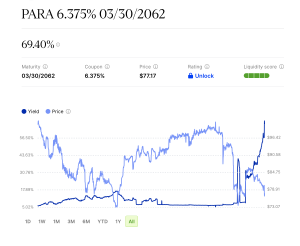
As of Monday October 5, this is how Paramount’s bonds are looking:
Financial Time’s Alphaville puzzled about the bond ratings, pointed out that Larry Ellison’s Oracle holdings were backing the debt and did some analysis:
We checked in on how investors are pricing the global AI hyperscaler’s creditworthiness. We also threw the new Paramount Skydance bonds, and every other triple-B-rated US corporate bond in the ICE BofA corporate bond index into the chart.
Increasingly, it looks like two large issuers are being priced as having far higher risk credit premia than the rest. Both sit on the lowest rung of the investment-grade ladder, and both are Ellison family companies.
Moreover, as Chris Whittall of IFR noted today, the cost of insuring Paramount debt against default using credit default swaps has skyrocketed. And that Ellison family commitment doesn’t look like it has helped (h/t to Dec Mullarkey, who also flagged this correlation):
Who’s Backing This Play?
Skydance’s roughly $80 billion of debt is now spread across thousands of bond and loan investors. Apollo Global, which committed a $54 billion bridge loan in December, might be happy they never had to fund that loan and appears to have only served as an underwriter and agent of the latest round of bond sales and as of now, we don’t know how much of the final debt it, or any other private credit fund, kept.
But we do know a little bit about who has the controlling stakes in the Ellison Media Empire — remember Larry Ellison’s stake in American TikTok (TikTok USDS) is separate from Skydance.
The Ellison family holds 77.5% of the voting Class A stock and Gerry Cardinale’s RedBird Capital holds the other 22.5%. Most of the money comes from Larry Ellison’s family trust, which committed up to $46.72 billion of new equity. He had personally backstopped the bid with a $40 billion guarantee in December. RedBird’s Fund IV put in just $250 million for the Warner deal, on top of the roughly $2 billion it invested in the 2025 Skydance-Paramount merger.
Cardinale stays on the board, and his former RedBird partner Andy Gordon is president of Skydance.
About $24 billion of the Ellison commitment was passed on to three Gulf sovereign wealth funds. Saudi Arabia’s PIF gets 15.1% of the company, Abu Dhabi’s L’imad 12.8% and the Qatar Investment Authority 10.6%. That is 38.5% in all, held as non-voting shares, and each fund is cleared to go to 20%.
The Gulf funds gave up board seats and other governance rights to keep the deal outside a national-security review. They provide the money and get no vote.
The Ellison trust and RedBird remain liable for the full commitment even after selling pieces of it on. That ties the deal to Larry Ellison’s own balance sheet, which depends heavily on Oracle stock. In September, he filed to sell up to $7.5 billion of Oracle shares, then cancelled the sale a day later. Bloomberg reports that investors treat Paramount and Oracle as one Larry Ellison credit risk.
Now, let’s learn about the new Skydance leadership team.
Bari Weiss Tops Out, Ynon Kreiz to Run the Show
Much to the relief of many critics who have been alarmed at Bari Weiss’ actions at CBS News (and their plummeting ratings), she won’t be taking over CNN. Instead, Mark Thompson will stay on as Chairman and Editor-in-Chief of CNN Worldwide, and both will report directly to David Ellison and co-CEO Ynon Kreiz.
Rumors continue to swirl that Weiss is doomed via the NY Post and Radar Online.
Let’s learn more about Ynon Kreiz.
Barbie’s Old Boss Co-Taking Over The Ellison Media Empire
Puck titled their piece on Kreiz’ hiring “Ynon Sequitur“:
On Wednesday, minutes after a judge approved the consent decree for his long-gestating merger, David Ellison announced that he had tapped Ynon Kreiz to serve as co-C.E.O. of the combined Paramount–Warner Bros. Discovery—an advanced iteration of the old Jeff Shell role, this time with real authority and direct reports. Ynon, a veteran Israeli-American media executive and fixture among the Polo Lounge crowd, has spent the past eight years as C.E.O. of toy-making giant Mattel, and his transfer set off a chain reaction of executive moves: Condé Nast C.E.O. Roger Lynch will take the Mattel job, leaving the Newhouses to identify a new leader for that shrinking business.
Ynon had a mixed tenure at Mattel: He leveraged its I.P. for film and TV deals with varying success—Warner’s Barbie was a hit, Masters of the Universe flopped—but never made good on a promise to diversify into higher-margin businesses, like games. Mattel’s sales have been flat or declining for years, suggesting a failure to capitalize on Barbie’s success. Most importantly, the stock largely traded downward during his tenure despite relentless belt-tightening, underperforming a 200 percent gain in the S&P. “He was great at cutting costs—he cut costs to the bone,” one Mattel veteran told me. “But there was zero innovation.”
…David has been disciplined about surrounding himself with seasoned C.E.O.s. One of the running myths in the creative community is that David’s youth and inexperience will wreak havoc on these storied studios, resulting in 30 Flyboys a year. In reality, he has so far been diligent about delegating management of the business to long-tenured professionals, and his decision to appoint a co-C.E.O. rather than a more amorphous chief strategy officer or president—Shell’s own title—evidences a whiff of sangfroid.
…David has been formally assembling a team and providing some much-needed clarity to the org chart. Surprising no one, HBO C.E.O. Casey Bloys will run the combined entity’s streaming business, which is why Paramount streaming chief Cindy Holland vacated the building earlier this week. “They are both great executives, but you really can’t let Casey walk out the door,” one veteran media executive said. Of course, David Zaslav had the same philosophy when he inherited Bloys in the Discovery–WarnerMedia merger. Indeed, Casey’s untouchable status in Hollywood is one of the great, underexamined subplots of the Warner story.
The Paramount-WBD merger combined with his many recent moves at Oracle has increased media scrutiny of Ellison’s father Larry, let’s check in on that.
Calling Vanity Fair
Any titan of industry who’s been getting bad press knows to tell their PR team to contact Vanity Fair for one of those patented celebrity profiles, and Larry’s no exception. The piece, titled “Inside Larry Ellison’s Wide Web of Power, Money and Politics” hit on October 1st:
VF’s Tom Dotan notes Ellison’s identification with the octopus and decribes two of his tentacles as Oracle and Skydance before discussing Ellison’s political portfolio:
A third appendage winds toward political power. As Silicon Valley staged its noisy migration to Trumpism, Ellison worked quietly to influence the president, establishing an effective if not always close relationship. Outside America, he bankrolls his friend Tony Blair’s nonprofit organization, which pushes governments to adopt new technologies like AI. And he has been a steadfast supporter of Benjamin Netanyahu, hosting the prime minister on Lanai while the Israeli leader faced corruption charges at home.
I’ve argued previously that Ellison’s closeness to Trump is much overstated and that he and David had to rely on Trump’s former agent Ari Emanuel to gain Trump’s support for Skydance’s 2025 acquisition of Paramount. Note also that Ellison was not included in the recent White House meeting where top tech executives signed “an accord” on AI safety.
The VF piece also delves into Ellison’s decision to massively increase Oracle’s capex spending — and with it corporate debt:
…unlike Amazon, Google, and the other cloud giants that are otherwise money machines, Uncle Larry did not have the cash. Instead Oracle turned to debt, and in a terrifying way. In its last fiscal year, the company raised $43 billion through bond offerings, pushing total borrowings toward $130 billion. Capital expenditures more than doubled, and its long-healthy free cash flow cratered to -$23.7 billion.
The deeper the red on the balance sheet, the more uneasy the bondholders grew. In July, S&P cut the company’s credit rating to a notch above junk. Lenders started to balk at some Oracle projects; the company backed out of a planned expansion of the Abilene campus. In September, it sent a force majeure notice on its New Mexico site, seeking to defer payments if the project slips, though Oracle insists it’s on schedule. Some loans tied to the project now trade around 90 cents on the dollar, the Financial Times reported.
Mounting worries caused the company’s stock to give back all its gains—and then some. Since peak, Oracle shares have fallen by more than half; Ellison’s own net worth has dropped some $200 billion, from a high of $400 billion to about $217 billion in September.
“Ellison has really put it all on red,” says John Hempton of Bronte Capital, a global hedge fund. “I can’t tell if he did it because he’s a gambling man or out of weakness.”
Many leaders in the tech industry have looked at how much the company has borrowed with an amused sense of awe. “Imagine if you put in all that capex and it all fizzles out?” wondered one former Oracle executive. But the optimistic case is simpler than it looks: It would take OpenAI going to zero for Oracle’s data center bet to fully blow up. And Oracle is already touting returns, boasting that OpenAI’s latest model, Astra, was trained in Abilene.
“Go back to last year and everyone thought Sam was certifiable with how much capacity it would take to run AI,” says Stifel analyst Reback. “But at this point, to some extent, OpenAI is too big to fail.”
Related Links
Anthropic OpenAI, Meta, SpaceX Sign Trump ‘Self-Policing’ AI Accords Amidst Financial Follies While Oracle Is Left Out (Sep 2026)
AI Credit and Credibility Collapsing or Will the AI Booster/Doomers Power Through? (Sep 2026)
OpenAI Is Sinking Fast, Who Will It Pull Down With It? (Sep 2026)
Stressed Oligarchs at Meta, OpenAI, and the Ellison Empire (Aug 2026)
Ellison Empire Besieged On All Fronts (Jul 2026)
Oracle’s Exploding Debt and Plummeting Stock Price Threaten Paramount Media Empire? (Jul 2026)
Has the Ellison Infotainment Empire Peaked? (Apr 2026)
Weak Links Oracle, OpenAI, UAE Are Hammered by Iran War (Apr 2026)
OpenAI, Sora, Iran, the Ellison Empire, and Maybe a Recognition Event? (Mar 2026)
Mask-Off Moment as Paramount at Nexus of AI, Gulf State Financing, and Private Equity (Mar 2026)
Paramount Still Reaching for WBD as CBS Misplays Colbert-Talarico Interview (Feb 2026)
Oracle Debt and TikTok Transition Troubles Vex the Ellison Media Empire (Jan 2026)
Bari Weiss’ CBS Not an Auspicious Beginning to Total Info Control (Jan 2026)
What Are They Thinking? Son, Altman, Ellison Edition (Dec 2025)
Informational Force-Feeding Divides and Distracts (Dec 2025)
Hasbara Ain’t Cheap, Musk, Ellison, Saudis, All Tapped (Nov 2025)
Pyrrhic Victory Drives Dystopian High Tech Drive for Control (Oct 2025)
Bari Weiss, CBS News, Meet the New Boss, Same as the Same Old (Oct 2025)
Larry Ellison + Oracle + AI + Paramount + Trump = Total Info Control (Aug 2025)
Trump Makes an Example Out of Paramount (Jul 2025)
