


This is Naked Capitalism fundraising week. 928 donors have already invested in our efforts to combat corruption and predatory conduct, particularly in the financial realm. Please join us and participate via our donation page, which shows how to give via check, credit card, debit card, PayPal. Clover, or Wise. Read about why we’re doing this fundraiser, what we’ve accomplished in the last year,, and our current goal, funding bonuses for our terrific writers.
During the recent conflict involving Iran and the United States, rumors began circulating that Iran possessed electromagnetic weapons capable of disabling American warships, and some accounts went further, alleging that such weapons had been used. Public evidence supporting these reports was thin. No independently verified account established that an Iranian electromagnetic weapon had disabled a U.S. warship. But the underlying technological question is considerably more interesting than the particular claim. Could a nation such as Iran build a conventional weapon capable of generating a sufficiently powerful electromagnetic pulse to disrupt the electronics of a modern warship? And how would such a weapon affect future warfare?
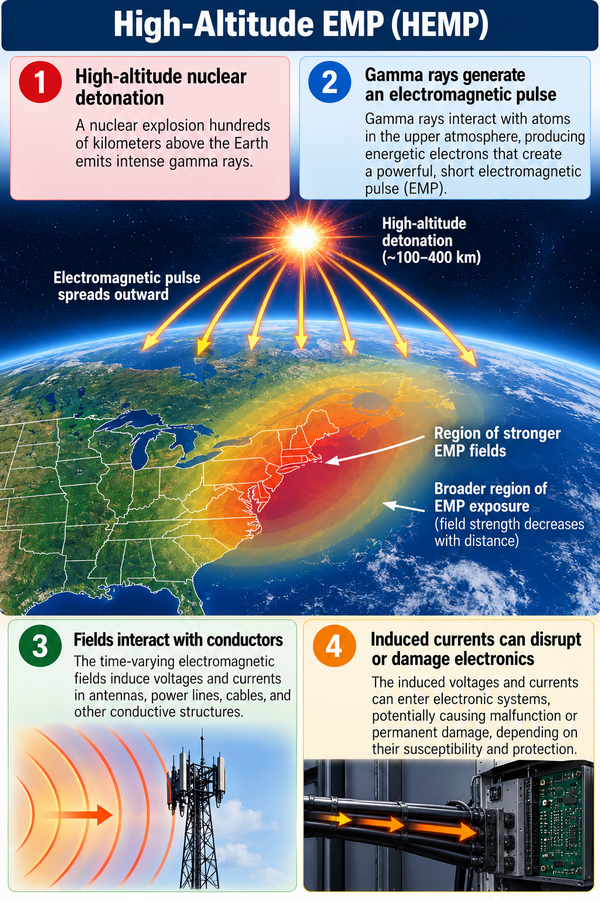
The popular conception of EMP derives largely from nuclear weapons. A nuclear explosion at high altitude can produce powerful electromagnetic effects across an enormous geographical area. But a weapon intended to attack a ship, radar installation, communications node, or other localized target need not reproduce anything remotely comparable. Instead of blanketing hundreds or thousands of kilometers, it can concentrate electromagnetic energy against a target at relatively close range.
This brings the problem into the realm of conventional high-power microwave and related electromagnetic weapons. The method is straightforward: generate a large electrical pulse, convert some of that energy into electromagnetic radiation, direct it toward the target, and induce disruptive or damaging voltages and currents in electronic systems. Antennas, cables, power connections, apertures, sensors, and conductive structures can provide pathways into the target.
Modern warships present an inviting target because their combat power depends upon elaborate electronic systems: phased-array radars, computers, communications networks, electronic-warfare equipment, missile guidance and fire-control systems, and automated defensive weapons. At the same time, warships are designed with electromagnetic interference, nuclear EMP, electronic warfare, lightning, and other electrical hazards in mind. They are hardly unprotected consumer electronics floating at sea.
The feasibility of an anti-ship EMP weapon therefore depends on several engineering questions. How much electromagnetic energy can a practical weapon deliver at useful range? Can it penetrate a hardened system? And can defensive engineering reliably protect a warship containing thousands of interconnected electronic components against an attacker deliberately searching for weaknesses?
If such weapons become operationally useful, a larger question emerges: what effect would another electromagnetic attack capability have on military competition and strategic stability? This article examines EMP technology not merely as a prospective weapon, but as another addition to an increasingly complex and interconnected arms race.
How EMP Works
The term electromagnetic pulse can make the phenomenon sound more exotic than it is. At its foundation lies basic physics. When an electromagnetic wave interacts with a conductor, its time-varying field can induce a voltage that drives current through the conductor. This is how a radio wave creates a corresponding electrical signal in an antenna. If those effects remain within the tolerances of connected equipment, nothing damaging happens. If they exceed those tolerances, they can interfere with operation, corrupt signals, reset electronics, or damage components.
The electromagnetic energy need not strike a sensitive component directly. A wire, cable, antenna, circuit-board trace, power line, or other conductive structure can collect energy and carry it elsewhere. A pulse entering through one part of a system can therefore appear as an electrical transient deep inside it.
The problem becomes more complicated as we move from an individual device to an integrated system. A semiconductor component may tolerate a particular electromagnetic environment by itself. Put thousands of components into computers, connect them through cables and networks, attach antennas and sensors, and distribute electrical power among them, and the relevant question becomes the susceptibility of the system rather than any particular microchip.
Modern microelectronics compound the problem. Transistors operate at very small dimensions and low voltages, while military systems increasingly depend upon elaborate digital electronics. The energy required to disrupt a system can therefore be much smaller than that required to physically destroy a component. Effects can range from a momentary glitch through corrupted data, processor resets, communications failures, and equipment shutdowns to permanent electrical damage.
This distinction matters because an electromagnetic weapon need not produce spectacular physical destruction to have military value. A radar that stops functioning for thirty seconds during a missile attack may endanger a ship as much as one that is destroyed.
Several phenomena are commonly lumped together under the EMP label. Nuclear high-altitude EMP, or HEMP, is the most familiar. A nuclear detonation at high altitude can produce electromagnetic effects over a vast area, potentially affecting electrical and communications infrastructure far beyond a specific military target.
A conventional EMP weapon presents a different engineering problem. Instead of using a nuclear explosion to create an enormous electromagnetic environment, it generates a powerful electrical pulse by nonnuclear means and radiates electromagnetic energy against a much smaller area. A weapon intended to affect only a ship, radar installation, command post, or communications site can sacrifice geographical coverage for greater field strength near the target.
But generating a powerful electromagnetic pulse does not demonstrate that it can disable a particular military system. Between source and effect lies a chain of pulse generation, radiation, propagation, target geometry, coupling, penetration, component susceptibility, system response, and recovery. A formidable pulse that couples poorly into its target may accomplish little; a smaller pulse entering through an unexpectedly vulnerable pathway may accomplish considerably more.
The physics therefore establishes possibility, not effectiveness. The next question is whether a practical conventional weapon can generate and deliver enough electromagnetic energy to produce a useful effect.
Can You Build the Weapon?
A conventional electromagnetic weapon begins with a mundane problem: where does the energy come from? Unlike nuclear EMP, there is no nuclear explosion supplying an enormous initial energy source. A conventional weapon must carry its energy or generate it immediately before use. The engineering chain runs from stored chemical or electrical energy to a brief pulse of extremely high electrical power, then to radio-frequency or microwave energy radiated toward the target.
The distinction between energy and power is important. A weapon does not necessarily require an enormous quantity of energy if it can release that energy extremely rapidly. One joule delivered over one second represents one watt of power. The same joule delivered in a billionth of a second corresponds, during that instant, to a gigawatt. Pulsed-power engineering exploits precisely this relationship: accumulate energy comparatively slowly, then release it extraordinarily quickly.
There are several ways to accomplish this. Capacitors can store electrical energy and discharge it rapidly. Pulsed-power systems can compress electrical energy into progressively shorter and more powerful pulses. Explosively driven devices can convert chemical energy into intense transient electrical output. The resulting pulse can then drive a microwave source or other radiating structure.
None of this is speculative physics. Laboratories have produced extremely high-power electrical and microwave pulses for decades. Open research at institutions such as Texas Tech University’s Center for Pulsed Power and Power Electronics has explored pulsed-power and high-power microwave technologies for numerous applications. The publicly visible equipment ranges from enormous laboratory installations to progressively smaller systems. Miniaturization is what makes the subject militarily interesting.
But a laboratory apparatus proves little about whether the same effect can be packaged into a missile or bomb. An operational weapon faces severe constraints on size, mass, efficiency, thermal management, mechanical robustness, antenna dimensions, and power supply. It must survive launch and flight. A stand-off weapon must produce a useful electromagnetic field after propagation losses; a short-range weapon must approach closely enough to expose itself to the target’s defenses.
Generating an impressive pulse in free space is also not the same as delivering damaging or disruptive energy into electronics. The weapon’s output has a frequency spectrum, polarization, direction, pulse duration, and field strength. The target has its own geometry, shielding, apertures, antennas, cables, filters, and resonances. Much of the incident energy may simply be reflected, absorbed harmlessly, or coupled into pathways capable of tolerating it.
Distance therefore matters enormously. Electromagnetic field strength generally falls as the wave propagates and its energy spreads. A weapon ineffective from tens of kilometers might conceivably be effective from hundreds of meters. Precision guidance can therefore substitute to some extent for radiated power: the closer the weapon approaches its target, the less power may be required to achieve a given field strength.
What does the open literature prove? Less than enthusiasts sometimes claim, but more than skeptics might find comfortable. It establishes that powerful electromagnetic pulses can be generated without nuclear weapons, that pulsed-power systems can be made increasingly compact, and that sufficiently intense electromagnetic energy can disrupt or damage electronic equipment. It does not establish the field strength required to disable a modern Aegis destroyer, the susceptibility of its systems, the effectiveness of its protective measures, or the performance of any classified nation-state weapon.
That uncertainty cuts both ways. Public experiments do not prove the existence of an operational ship-killing EMP weapon, but neither do they establish an upper limit on what a major state weapons program might have achieved behind secrecy barriers. The appropriate conclusion is modest but consequential: the physics does not rule the weapon out. The remaining question is whether military engineering can keep its energy out of the target.
Can You Harden the Target Against EMP?
EMP energy can enter electronic equipment through conductive pathways, so the obvious defensive strategy is to close those pathways. In principle, electromagnetic hardening is straightforward. In practice, protecting a modern warship is anything but.
The first line of defense is shielding. A conductive enclosure can prevent much of an external electromagnetic field from reaching the electronics inside it—the Faraday-cage principle. Military electronics can therefore be installed within shielded cabinets, compartments, and structures designed to attenuate electromagnetic fields before they reach sensitive components.
But a perfectly sealed metal box is not a useful combat system. Electronics require power. Computers communicate with other computers. Sensors must observe the outside world. Radios and radars must transmit and receive. Cables, waveguides, cooling systems, maintenance connections, doors, seams, and ventilation openings all penetrate the theoretical shield.
These penetrations can be protected in various ways. Power and signal lines can be filtered, surge suppressors and limiters can clamp transient voltages, cables can be shielded, and careful bonding and grounding can control unwanted electrical paths. Optical fiber can provide electrical isolation because, unlike copper cable, the fiber itself does not provide a conductive pathway through which an electromagnetic pulse can couple into connected equipment.
Military designers have an extensive repertoire of such techniques because EMP is hardly the only electromagnetic hazard they face. Lightning produces enormous electrical transients. Powerful transmitters aboard a ship can interfere with its own electronics. Radar and communications systems operate simultaneously across numerous frequencies. Nuclear EMP has been a recognized military threat for generations. Electromagnetic compatibility and electromagnetic environmental effects are therefore basic considerations in warship design.
The problem becomes more difficult at the boundary between protection and function. Consider the naval Phalanx Close-In Weapon System. Phalanx combines radar, computers, fire control, and a rapid-fire gun into a compact defensive installation. Much of its electronics can be enclosed, filtered, and shielded. But the radar cannot perform its function while electromagnetically isolated from the outside world. Its antenna exists precisely to receive electromagnetic energy.
That does not mean an EMP weapon can simply transmit on the radar’s frequency and destroy it. A receiver designed to detect extremely weak signals can incorporate limiters, filters, and other protective circuits against powerful unwanted inputs. The larger point is that some of the most important electromagnetic pathways into a combat system cannot simply be eliminated because they are necessary for the system to function.
Now scale the problem from Phalanx to Aegis. An Aegis-equipped warship is not one electronic device but an integrated combat system. Phased-array radar faces connect to transmit/receive electronics, signal processors, computers, power supplies, cooling equipment, weapons-control systems, communications networks, navigation equipment, and other sensors.
Phased arrays present a mixture of resilience and exposure. Modern arrays distribute functionality across many elements or modules, so failure of an individual module need not disable the radar. But redundancy is not immunity. If nominally independent modules share an electromagnetic environment, power infrastructure, processing chain, cooling system, network connection, or other supporting element, a broad disturbance can create common-mode failure. A hundred redundant components provide little protection against a mechanism that affects all of them simultaneously.
The U.S. Navy has operated specialized electromagnetic test facilities for decades. EMPRESS—Electromagnetic Pulse Radiation Environment Simulation for Ships—was developed to expose ships and ship systems to simulated electromagnetic environments without nuclear weapons. Its successor, EMPRESS II, allowed engineers to investigate how electromagnetic energy coupled into actual naval platforms and their interconnected equipment. Ships including the cruiser USS Anzio underwent electromagnetic-pulse-related testing as part of this broader effort.
Such testing highlights a distinction easily lost in discussions of EMP: survival is not the same as continued combat operation. A system may survive without permanent damage yet still reset, shut down, lose data, generate false indications, or require operator intervention. It may recover in milliseconds, reboot in seconds, require minutes of troubleshooting, or need hardware replacement. Each outcome has different military significance.
For a warship under missile attack, even temporary effects can matter. Losing a radar for thirty seconds in port is an inconvenience. Losing it during the terminal phase of an incoming missile engagement could be catastrophic. Conversely, an EMP weapon that causes a harmless transient or disrupts equipment that immediately recovers may accomplish almost nothing.
Electromagnetic hardening therefore cannot be evaluated with a binary question: Did the equipment survive? The operational questions are more demanding. Did the sensors continue tracking? Did communications remain available? Did the combat system preserve its tactical picture? Did defensive weapons remain controllable? If equipment stopped functioning, how quickly did it recover? Could the crew determine which information remained trustworthy?
Modern warships can unquestionably be hardened against electromagnetic effects, and the United States has been designing and testing military systems against such environments for decades. It would be a mistake to imagine Aegis destroyers as collections of fragile commercial electronics waiting to be switched off by an EMP pulse.
But the opposite conclusion would be equally unwarranted. Hardening is not a magical property conferred upon a ship. It is an engineered protection envelope constructed around assumptions about field strength, frequency, coupling paths, pulse characteristics, and acceptable system response. An intelligent adversary will attempt to find the boundaries of that envelope.
Sword Versus Shield
A ship can be designed and tested against a specified electromagnetic environment. Engineers establish expected field strengths, frequency ranges, pulse characteristics, and coupling mechanisms, then design protection sufficient to keep critical equipment operating within those conditions. An enemy has a different objective. It does not need to reproduce the environment against which the ship was qualified. It wants to find an electromagnetic attack for which the protection is least effective.
This is an important difference between nuclear EMP and a deliberately engineered conventional electromagnetic weapon. High-altitude nuclear EMP produces a broad electromagnetic environment determined largely by nuclear physics, atmospheric interactions, altitude, weapon characteristics, and geometry. A conventional high-power microwave weapon potentially gives the attacker more freedom to manipulate frequency, bandwidth, pulse duration, repetition rate, polarization, antenna characteristics, and other variables. Instead of asking, “How do we generate the largest possible electromagnetic pulse?” the designer can ask, “What kind of pulse couples most effectively into this particular target?”
This does not mean an attacker can simply discover the operating frequency of an Aegis radar, tune a microwave weapon to it, and switch the radar off. Frequency matching is only one link in a much longer chain. The field must reach the target at sufficient strength, arrive with useful geometry and polarization, couple through an available pathway, penetrate whatever protection exists, and create a consequential effect in the electronics behind it.
But a weapon developer can research the problem. Radar frequencies, antenna locations, ship geometry, communications bands, external sensors, and other characteristics are observable or inferable. Testing against representative equipment, intelligence, and computer modeling can identify promising coupling mechanisms. The attacker does not need to defeat every protective measure. It needs to find one useful pathway to an operationally important effect.
The defense is not static either. Filters can be improved, limiters added, shielding strengthened, vulnerable components replaced, software modified to recover more rapidly, and critical functions given greater redundancy. This creates the familiar contest between sword and shield, but with an important asymmetry: the attacker seeks selected weaknesses, while the defender must maintain protection across an installed ecosystem containing numerous systems, interfaces, penetrations, and generations of equipment.
The attacker’s objective may also be much less demanding than permanently damaging electronics. Suppose a destroyer’s radar picture disappears for twenty seconds, several networked systems reboot, communications become unreliable, and operators temporarily cannot determine which tracks remain valid. If an antiship missile salvo arrives during that interval, the electromagnetic weapon may have accomplished its mission without destroying a single component.
Temporary sensor blindness, communications interruption, computer upset, corrupted data, or forced system reset can therefore have military value when coordinated with kinetic attack. Integrated defensive systems depend upon timing: detection, classification, tracking, weapon assignment, launch, guidance, and interception form a sequence. Briefly disrupting one part may compromise the engagement.
Conversely, transient electromagnetic effects are not automatically significant. A processor that resets and recovers almost immediately may be irrelevant. A radar that loses one scan but reconstructs its tracks may suffer little degradation. Redundant sensors may fill the gap. The relevant measure is not whether electromagnetic interference occurred, but whether it created an exploitable interruption in combat capability.
This makes testing considerably harder. Qualification can demonstrate that equipment meets established standards, but not necessarily that every combination of frequency, pulse structure, orientation, coupling pathway, and system state has been explored. Nor can testing components independently establish how an integrated combat system will behave when several interconnected components experience transient effects simultaneously.
If a new weapon substantially defeats the protection for which an existing fleet was designed, the defensive response could also become expensive. Retrofitting one piece of equipment may be straightforward. Requalifying an integrated combat system after modifying antennas, cables, power distribution, sensors, network interfaces, and numerous electronic subsystems is another matter.
None of this establishes that a conventional electromagnetic weapon can defeat Aegis, Phalanx, or any other specific hardened military system. Their actual susceptibility is not available in the public record. What can be established is the structure of the competition. Once useful electromagnetic attack becomes technically possible, hardening does not end the problem. It begins an iterative contest in which attack generates protection and protection generates new attack techniques.
Eventually that competition affects force architecture itself. Modern naval power concentrates enormous capability aboard a small number of sophisticated platforms, creating the possibility of concentrated vulnerability. Distribution offers one response: if sensing, communications, weapons, and battle-management functions are spread among geographically separated nodes, disabling one need not disable the system. But distribution does not eliminate vulnerability. It relocates it. The contest between electromagnetic sword and shield therefore escapes the boundaries of the ship altogether. It reaches into space.
From Ocean to Orbit
A destroyer may carry powerful radars, communications systems, and weapons, but increasingly it operates inside a much larger information architecture. Satellites provide communications, navigation, timing, weather information, surveillance, and other services that allow geographically dispersed forces to function as a coherent system.
This creates an architectural tradeoff. Dispersing sensors and weapons among many platforms reduces the danger that disruption or destruction of one platform will eliminate a large fraction of the force. But those platforms must still find targets, exchange information, coordinate actions, and receive data from beyond their own sensor horizons. Some of the concentration removed from the fleet can therefore reappear higher in the system, and orbital space is an obvious place to locate it.
Satellites combine extraordinary technological capability with physical vulnerability. They are densely packed with electronics, operate under severe mass and power constraints, and communicate through antennas that necessarily interact with the electromagnetic environment. Unlike a warship, a satellite cannot easily return to port for repairs or receive a protective upgrade after an unexpected vulnerability is discovered. Hardening, redundancy, and recovery therefore have to be designed in before launch.
This makes satellites potentially attractive electromagnetic weapon targets for reasons independent of the fleet’s growing reliance upon them. The same logic that makes a conventional EMP weapon conceivable against a warship applies against a satellite: proximity can substitute for high radiated power. A weapon need not reproduce the vast geographical effects of nuclear EMP if it can approach a particular high-value spacecraft closely enough to expose it to an intense localized electromagnetic field. Satellites can be electromagnetically hardened, but mass, power, volume, thermal, and design constraints limit the protection and redundancy that can practically be added, while antennas and sensors cannot simply be sealed inside an electromagnetic enclosure. An attacker able to exploit those unavoidable interfaces might therefore seek a temporary upset or mission kill rather than physical destruction.
Whether any existing conventional electromagnetic weapon can accomplish this against a hardened military satellite is not established by the public record. But the possibility creates a path by which naval warfare may extend into space. The fleet increasingly depends upon satellites, making them more valuable targets; electromagnetic weapon technology potentially provides another means of attacking them. The architectural and technological arms races converge.
There are several methods of electromagnetic attack on satellites. Radio-frequency jamming can interfere with signals traveling to or from a satellite without physically damaging it. A localized high-power microwave weapon might attempt to disrupt or damage electronics aboard a particular spacecraft. Other directed-energy systems could interfere with or damage sensors or electronic subsystems. At the opposite extreme, a high-altitude nuclear detonation can inject energetic charged particles into the magnetosphere, creating artificial radiation belts that may persist long after the detonation and progressively damage satellites passing through them. These mechanisms differ enormously in physics, scale, reversibility, and strategic consequence.
The progression from vulnerability to weaponization is no longer hypothetical. In September 2026, U.S. officials publicly acknowledged for the first time that the United States has deployed what Air Force Secretary Troy Meink called “on-orbit space control weapons.” The Space Force has not disclosed how these systems operate, but its published warfighting framework encompasses counterspace operations in the orbital, electromagnetic, and cyber domains. Whatever capabilities remain classified, orbital space has crossed the boundary from military support infrastructure to an actively contested weapons domain.
Nor is the satellite itself the only target. A satellite network includes ground stations, control facilities, communications links, data-processing centers, user terminals, software, networks, and terrestrial power supplies. An adversary seeking to disrupt a space-enabled military function may find attacking one of these elements easier than attacking the spacecraft.
This illustrates a larger systems problem. Redundancy in one layer does not necessarily produce redundancy in the system as a whole. A constellation containing hundreds or thousands of satellites may appear extraordinarily resilient because destroying individual spacecraft accomplishes little. But if those satellites depend upon a smaller number of ground facilities, common communications protocols, shared software, timing references, or vulnerable user terminals, the architecture may contain concentrations that are not visible from simply counting satellites. Conversely, a well-designed distributed constellation can make physical attack inefficient by forcing an adversary to engage large numbers of replaceable nodes.
The relevant question is therefore the same one that arose aboard the warship: where are the common dependencies? A vulnerability removed from the ship may reappear in the communications link. Protect the link and dependence may move to the satellite. Proliferate the satellites and the critical dependency may move to the ground network, software architecture, or battle-management system.
The electromagnetic problem has now escaped the weapon that started our inquiry. Protecting the warship led toward dispersion; dispersion increased dependence upon networking and remote sensing; those dependencies led into space. At the same time, conventional electromagnetic weapons themselves suggest another means of attacking the orbital systems on which the distributed force increasingly depends. Distributed warfare increases the military value of orbital systems just as electromagnetic weapons potentially create new means of attacking them.
Nothing about this progression requires any individual decision to be mistaken. Each step can be a sensible engineering response to the vulnerability immediately before it. The difficulty is that solving one problem keeps creating another somewhere else in the system. At this point, the arms race begins to resemble a game of whack-a-mole played against a Hydra.
The Hydra Problem
The danger posed by this arms-race proliferation is not simply that warfare is becoming more complicated. Every new capability interacts with capabilities already present, creating an expanding set of possible system states. Add an electromagnetic weapon to a battlespace containing missiles and radar, and there are several new interactions to consider. Add electronic warfare, cyberattack, satellite communications, autonomous drones, decoys, distributed sensors, artificial intelligence, and counterspace weapons, and the number of possible interactions grows far faster than the number of technologies.
This is the deeper Hydra problem. Each new head does not merely present another threat. It interacts with the other heads. Consider a missile attack on a modern naval force. The outcome may depend upon radar performance, electronic countermeasures, communications, satellite data, interceptor availability, sensor fusion, decoys, cyber integrity, and automated combat systems. Introduce an electromagnetic attack and its significance depends upon when it occurs, what it affects, how long the effect lasts, which redundant systems remain available, and what else is happening at that moment.
Sequence matters as much as capability. Jamming a communications link may accomplish little under ordinary conditions. Jam it after a satellite has been disabled and while an electromagnetic attack has forced a radar to reset, and the effect may be entirely different. A cyber intrusion that remains dormant for months may become important only after battle damage forces a network into an alternate configuration. An autonomous system that performs correctly under each tested disturbance individually may behave differently when several occur simultaneously.
This creates a fundamental problem for military testing. Components and weapons can be tested. Networks can be subjected to simulated attack. War games and computer models can explore enormous numbers of scenarios. But none can exhaustively test an open-ended system in which adaptive technologies interact in different combinations and sequences while an intelligent adversary deliberately searches for conditions that have not been anticipated.
Engineering normally seeks to establish that a system will behave within acceptable bounds under a defined range of conditions. But the modern battlespace is increasingly constructed from systems whose operating conditions are partly determined by hostile systems designed specifically to push them outside those bounds.
This is where fractional rationality becomes dangerous. Each addition can be justified by the problem it solves. Electromagnetic hardening increases survivability. Dispersion reduces concentration. Networking restores coordination. Autonomy permits operation when communications fail. Artificial intelligence helps manage the resulting volume and speed of information.
Yet every addition also changes the behavior of the whole. The resulting instability is cumulative. It arises not from any particular technology failing catastrophically, but from the growing difficulty of knowing how the complete system will behave when several things go wrong at once. And war is an environment in which several things often go wrong at once.
The paradox is that capabilities intended to make individual military systems more effective, survivable, and controllable can simultaneously make the behavior of the whole weapons complex more difficult to predict and validate.
The House of Cards
In peacetime, unexpected system behavior can be investigated. Networks can be reconfigured, software patched, procedures changed, and equipment repaired. In combat, anomalies occur under extreme pressure, and decisions must often be made before anyone fully understands what is happening.
The obvious response is greater automation. No human command structure can readily process the torrents of information generated by satellites, radars, passive sensors, drones, electronic-warfare systems, intelligence networks, cyber defenses, and dispersed weapons. As warfare becomes faster and more distributed, artificial intelligence will increasingly be asked to correlate data, identify threats, allocate resources, recommend responses, and perhaps eventually execute some of them.
AI can reduce complexity for the operator. It cannot eliminate complexity from the underlying system. Indeed, it introduces another interacting layer. AI receives information from sensors and networks whose reliability may themselves be under attack. It must distinguish real targets from decoys, equipment failures from enemy action, communications loss from deliberate jamming, and corrupted information from genuine changes in the battlespace. Its recommendations then alter that battlespace, causing friendly and enemy systems to respond in turn.
The problem is not simply whether the AI is “intelligent” enough. It is whether the environment in which it must operate can be adequately characterized in advance. A battle-management system might perform superbly in millions of simulated engagements and still encounter a combination never represented in its testing. Perhaps a satellite outage forces traffic onto an alternate network while electronic warfare corrupts several sensor feeds. An electromagnetic attack resets part of the air-defense system just as autonomous drones generate hundreds of additional tracks. A cyber intrusion planted months earlier becomes active when the network changes configuration. Each event may have been anticipated individually. Their interaction may not have been.
Sequence multiplies the problem. A followed by B followed by C need not produce the same system state as C followed by A followed by B. Damage, software responses, operator decisions, network rerouting, autonomous behavior, and enemy adaptation continuously change the conditions under which the next event occurs. No realistic test program can reproduce every permutation.
The danger is not that the system must collapse like a literal house of cards. Modern military systems contain extensive redundancy and may prove remarkably resilient. The danger is that no one can know in advance which combinations will be resilient and which will produce cascading effects. That uncertainty has strategic consequences.
Commanders confronted with incomplete or contradictory information still have to act. Communications failures may be interpreted as attack. Sensor anomalies may appear to be incoming weapons. The loss of one system may force another to assume unfamiliar functions. Automated defenses may compress the time available for human review. Actions taken defensively by one side may be interpreted offensively by the other. The faster the system operates, the less time exists to determine whether an apparent attack is real or an adversary’s action has been correctly understood. Events can outrun the management of the conflict.
There is a historical analogue, not in the technology but in the structure of the problem. Before the First World War, the major European powers developed elaborate mobilization systems built around railroads, timetables, deployment plans, and assumptions about how quickly adversaries could mobilize. Each element had a rational purpose. Railways allowed enormous armies to be assembled and supplied efficiently; detailed timetables made the machinery function.
But efficiency created rigidity. Once mobilization began, changing the plan became increasingly difficult. Because governments knew their adversaries faced similar constraints, delay itself could appear dangerous. The machinery intended to improve military preparedness helped compress political decision time during the July Crisis of 1914. Railway timetables did not cause the First World War. Political decisions did. But mobilization systems altered the environment in which those decisions were made, converting time into a strategic resource and making hesitation potentially costly.
The modern technological arms race risks constructing a vastly more elaborate version of the same problem. Missile warning systems, cyber networks, satellites, electronic warfare, autonomous weapons, electromagnetic attack, artificial intelligence, and precision strike each have their own logic. Their interaction can create pressures none was individually designed to produce. A defensive system may require rapid response because the incoming weapon is fast. Automation follows because humans cannot respond quickly enough. The adversary, knowing that automation exists, adjusts its own posture. Both sides then confront a system in which delay can appear increasingly dangerous because the other side has also accelerated.
The danger is not irrational machines replacing rational humans. Humans built every layer of this structure for reasons that can be defended. The danger is that rational pieces can assemble themselves into an irrational whole. This is the strategic house of cards: not a military system certain to collapse, but an increasingly elaborate structure whose collective behavior cannot be comprehensively tested before the moment when failure matters most.
Conclusion: EMP Adds Another Card
We began with a narrow question: could a conventional electromagnetic weapon disable a modern warship? The answer remains uncertain. High-power electromagnetic effects can be generated without nuclear weapons, and electronics can be disrupted or damaged by them. But modern warships are hardened military systems, and the public record does not tell us whether any existing conventional electromagnetic weapon can produce operationally significant effects against Aegis or other protected combat systems.
Perhaps electromagnetic weapons will prove formidable. Perhaps improved hardening will keep them at the margins of warfare. Their effectiveness would depend upon the target, circumstances, tactics, and countermeasures. But following the question outward reveals something more important than the answer. EMP is another card being added to an already elaborate house of interacting military systems.
This is the central paradox of the modern arms race. Technological sophistication can make individual components more capable while making the behavior of the complete system less knowable. No central architect designs this structure. States respond to adversaries, services solve immediate vulnerabilities, engineers meet requirements, contractors optimize components, and commanders demand greater speed and resilience. Each participant acts rationally upon a fraction of the problem.
The resulting system emerges from their interaction. Unlike an aircraft, missile, radar, or computer program, it cannot be taken to a test range and validated as a whole. Its ultimate test requires opposing militaries to activate their weapons, defenses, networks, electronic warfare, cyber capabilities, satellites, autonomous systems, and decision machinery against one another simultaneously. That test is war.
EMP may therefore prove neither a revolutionary superweapon nor a technological curiosity. Its greater significance is what happens when we follow its consequences outward: from a pulse of electromagnetic energy to a warship, from the warship to the fleet, from the fleet to space and communications networks, and from those networks to automated systems attempting to manage proliferating interactions.
Another weapon has been added. Another defense will follow. Other interactions will emerge. Another card goes onto the high-tech weaponry house of cards.
