


This is Naked Capitalism fundraising week. 851 donors have already invested in our efforts to combat corruption and predatory conduct, particularly in the financial realm. Please join us and participate via our donation page, which shows how to give via check, credit card, debit card, PayPal. Clover, or Wise. Read about why we’re doing this fundraiser, what we’ve accomplished in the last year,, and our current goal, funding bonuses for our terrific writers.
Desperate times call for desperate measures amid Brazil’s burgeoning consumer debt crisis.
In the last weeks of his presidential campaign, Brazil’s incumbent President Luiz Inácio Lula da Silva has launched a raft of genuinely populist economic measures. This is testament not only to how much is riding on the election — from the extent of US-Israeli domination of Latin America to the future of Brazil’s “Pix” payments system and possibly even the BRICS alliance itself — but also to how close the contest is likely to be, with Lula statistically tied with his opponent, Flavio Bolsonaro, in most polls.
Last Friday (Sept 26), just over a week before the first round of the elections, on October 4, Lula signed a presidential order banning all forms of online gambling in a move designed to tackle the pervasive problem of families falling into debt. The ban extends not only to online casino gaming, as was expected, but also fixed-odds sports betting. In taking this action, Brazil has pulled the plug on its regulated online gambling market less than two years after its launch.
“I made the decision to take a hard, drastic and necessary measure,” he told journalists in São Paulo. “It’s like cancer, you take out the tumour, or the tumour will kill us.”
As we noted in our article on the proposed gambling ban, the policy appears to enjoy broad public support. Brazil, like the US, has developed a serious gambling problem since legalising fixed-odds sports betting in 2018. Like the US, it has emerged from nowhere to become one of the world’s biggest betting markets (#1 in the case of the US, #5 in the case of Brazil). As in the US, the spectacular growth has come at a heavy price for many Brazilian households:
In 2025, $68 billion was wagered via Pix, the country’s digital payments system, just one year after online gambling was fully legalised, reports Agência Publica. Of that money approximately $12 billion was lost, which is apparently equivalent to 0.68% of the gross national disposable income of Brazilian families. Many of those families are in Brazil’s poor and working classes — one of Lula’s core constituencies.
Lula’s provisional executive order went into force more or less straight away. New customer deposits were prohibited immediately, while betting websites and apps must go offline by October 6. That said, the order will need congressional approval within 120 days to remain in effect. For that to happen, not only will Lula have to hold on to the presidency but his Workers’ Party (PT) will have to command majorities, or at least strong positions, in both legislative chambers.
That is far from guaranteed. To improve his chances, Lula has announced a number of populist economic policies, or what his oppenents may call “vote-buying measures”. They include an increase to the Bolsa Família welfare payments as well as measures aimed at reducing the cost of fuel.
At the tail end of last week, Lula launched his coup de grace: a multi-billion dollar debt cancellation program to ease the financial pressures on low-income households after years of high borrowing costs. Perhaps the Brazilian president, or some of his advisors, have been reading Michael Hudson’s essays on how debt jubilees serve as a necessary tool for keeping rentiers from eating the entire economy (e.g., here, here and here).
The idea is quite simple: the government will buy up defaulted debts of up to 10,000 reais (c. $1900 USD) of working-class households, most of it resulting from unpaid credit card bills and personal loans not directly deducted from salaries. These debts are already in default, meaning that banks have zero chance of clawing their money back anyway. Instead, the government will use its financial muscle to buy up the debt for huge discounts of as much as 90%, which will be passed in their entirety to the households affected.
As Benjamin Norton noes, some critics are portraying the move as an indirect bailout of banks, but that does not seem to be the case here. Unlike with most bailouts of Western banks since 2008, the government is not planning to pay anywhere near face value of the debt, which is what the banks would ultimately want. At most, they will benefit from the deal by being able to get the debt off their books.
From Bloomberg:
Brazil’s government plans to spend 15 billion reais to buy as much as 150 billion reais ($28 billion) of delinquent consumer debt from banks, part of President Luiz Inácio Lula da Silva’s push to ease the financial strain on households and bolster his bid for a fourth term.
The government will hold an auction in November to acquire bank debt portfolios covering individual obligations of as much as 10,000 reais that are between two and four-and-a-half years old, Planning Minister Bruno Moretti told reporters on Friday.
Lula is signing a provisional measure authorizing the debt purchases and another banning online gambling in all of its forms.
According to Brazil’s Planning Minister Bruno Moretti, the idea is for the Brazilian state to intervene in the market by buying up to 50% of delinquent debts — around R$150 billion ($28 billion) — and pass on to families the discounts obtained at auctions. The debts in question will be overdue by between two and four and a half years – before the statute of limitations kick in – and for amounts of up to 10,000 reais.
An article in Argentina’s Clarin fleshes out some of the details:
The mechanism, according to Moretti, would replace the model in which “each person goes to the bank to try to renegotiate their own debt” with a centralised operation. In other words, the government would buy portfolios from financial institutions and carry out the restructuring with debtors.
The minister pointed out that this market already operates at steep discounts, because portfolios considered difficult to recover are usually sold with haircuts of between 90% and 95%. According to the estimate presented, the purchase of 150,000 million reais at a discount of 90% would have a fiscal cost of around 15,000 million reais.
Currently, he said, these private operations add up to approximately 50,000 million reais per year; with the program, the government would seek to triple that scale…
[T]he provisional measure includes guidelines for regulatory bodies, especially the Central Bank, with the aim of curbing abuses in the granting of credit and preventing families from falling back into situations of over-indebtedness.
It’s not hard to see why Lula feels the need to do this, though one could certainly question his choice of timing — i.e., nine days before the election. Despite relatively strong macroeconomic indicators — moderate economic growth, record low unemployment (just over 5%), rising average income levels, relatively low inflation (all things considered) — Brazil is facing a very serious household debt crisis.
The numbers speak for themselves.
The proportion of Brazilian households in debt stands at over 80%. Many, of course, are keeping up with instalments. However, according to credit research company Serasa, as of March this year the number of people in arrears had reached 82.8 million. That is slightly more than half of the entire adult population.
Total personal debt, including mortgage debt, now exceeds 900 billion dollars, which is equivalent to 35% of Brazil’s GDP, according to data from Brazil’s Central Bank. That compares to 29% in Colombia and 17% in Mexico but is still relatively low compared to the levels registered in North America and Western Europe. But the big difference is that most Brazilians pay a lot more in interest (the benchmark rate is currently 13.75%).
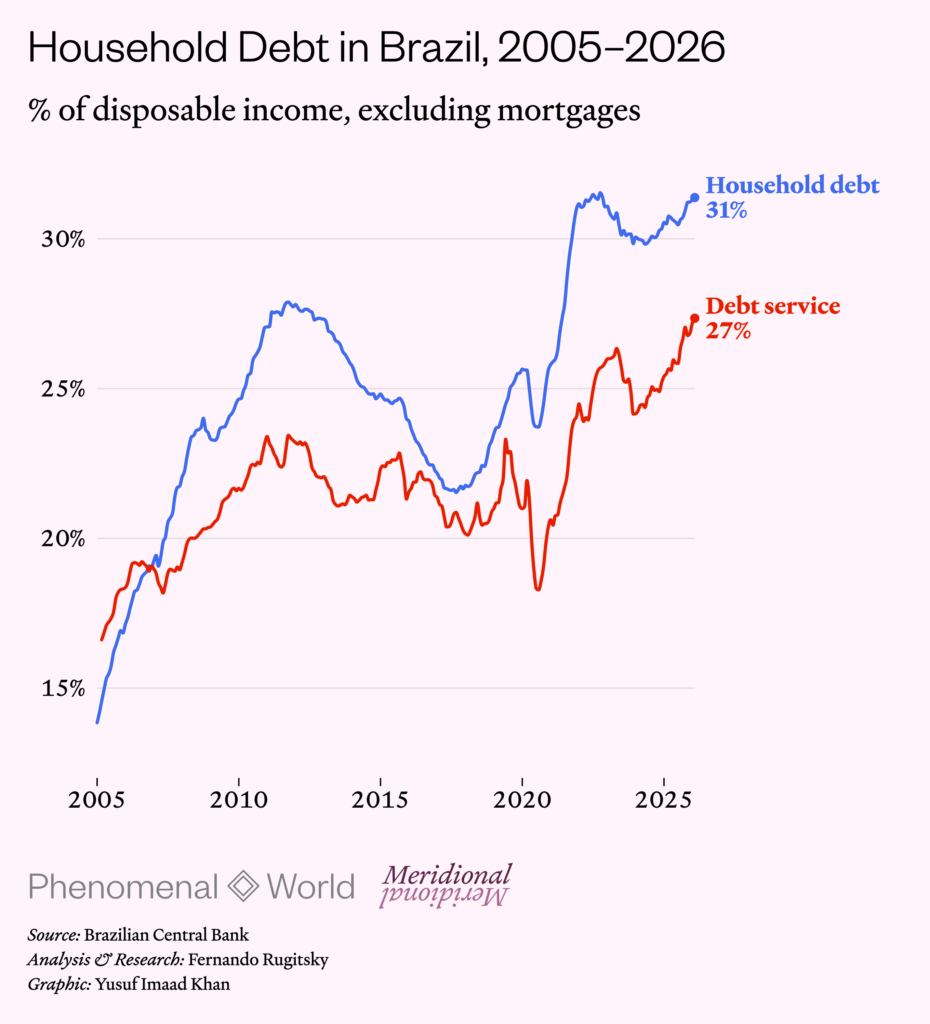
On average, almost a third of average disposable income now goes towards paying debt. As the graph below shows, courtesy of Phenomenal World, consumer debt as a proportion of disposable income, excluding mortgages, has more than doubled since 2003, the second year of Lula’s first term in office. Debt service costs meanwhile have surged from 17% to 27%.
There are many reasons why Brazil has seen this explosion in consumer debt over the past two decades. They include chronic high interest rates (currently at 13.75%, more than triple the official rate of inflation); the sharp rise in the cost of living since the COVID-19 pandemic; widespread job precariousness; the rapid digitalisation of finance, largely through the success of Pix, which has democratised access to credit; and the recent explosion of online gambling.
Meanwhile, the massive growth in personal debt fuelled a massive boom in consumer spending that was unmatched by productive economic activity. Nonetheless, Brazil is still seen as one of the world’s great success stories of financial inclusion. Some 60 million Brazilians have been “banked” in the past decade thanks to the expansion of the Internet, mobile phones and the unbridled popularity of Pix, the instant payments system created by the Central Bank of Brazil.
Now, many of the country’s households are paying the price of that success. As Fernando Rugitsky explains in an article for Phenomenal World, Brazil is drowning in debt as “financial inclusion” gives way to “financial expropriation”. And Lula’s three terms in government, particularly the first two ones (2002-10), have played a key role in making all of that happen:
Hoping to bring down the actual borrowing rates faced by workers, the government authorized in 2003 the crédito consignado, that is, credit lines with automatic deduction from the paycheck. This entailed significantly lower credit risk to lenders, especially in the case of public servants and pensioners, who, up to 2025, responded for more than 90 percent of total outstanding credit in this modality. In many ways, crédito consignado fits perfectly with the weak reformism that characterizes lulismo. It widened the access to basic consumption goods, reducing inequalities in living standards, but it avoided confronting the interests of the ruling classes, circumventing deeper redistributive efforts. It boosted financial institutions’ profits at the same time as it stimulated consumption and economic growth, increasing tax revenues and opening the way to increasing social transfers (mainly conditional cash transfers and pensions). It was an expansionary policy that could complement more conventional fiscal policy measures, which were constrained by fiscal targets.
The effect was clear. Between 2005 and 2011, household debt as a share of disposable income, excluding mortgages, doubled from 15 to just under 30… One of the celebrated achievements of the Workers’ Party in the 2000s was an increase in the wage share of income, that is, the share of GDP appropriated by workers. Between 2005 and 2011, it rose from 46.2 to 48.1 percent, on the back of labor market formalization and minimum wage increases. However, once this share is adjusted for interest payments, the trend is inverted: the wage share net of interest actually fell from 44.1 to 42.2. Financial expropriation more than compensated for the labor market improvements…
As the share of the population with bank accounts increased from 43 to 86 percent (between 2005 and 2017), the share owning a washing machine almost doubled (from 33.7 to 66.1 between 2001 and 2019) and the share owning computers more than tripled (from 12.6 to 40.6, in the same period). Meanwhile, ownership of fridges and TVs was effectively universalized (increasing from 85 and 89 to 98 and 99 percent, respectively).
A decade and a half later, the costs of worker indebtedness seem to have gained salience, overwhelming the earlier benefits. As interest payments surpassed a quarter of income, on average, the reality of financial expropriation as the other side of financial inclusion came to the fore.
One of Lula’s first acts on his return as president, in 2023, was to launch a debt renegotiation program titled Desenrola, which may have reduced some of the pressures on the most indebted households, but only temporarily. In May this year, Lula launched a new phase of the debt-relief program, allowing borrowers in default earning up to five times the minimum wage to renegotiate debts.
We are now seeing the third phase of that program, involving the proposed cancellation of close to $30 billion of consumer debt. But will it be enough to tip the electoral balance in Lula’s favour?
With high household debt and sky-high interest rates eroding people’s standard of living despite the solid macroeconomic backdrop, current-day Brazil is fertile ground for a right-wing demagogue like Flavio Bolsonaro, who can already tap into his father’s massive groundswell of public support.
In what looks likely to be a very tight contest, Bolsonaro can also count on the full support of both the US and Israel, whose preferred candidates in Latin American elections have had a near-perfect track record of winning over the past two years. As is becoming increasingly clear, that success is built primarily on election interference, using bot farms, social media and AI manipulation, and other kinds of tools.
We are already seeing this play out in Brazil. Just 10 days before the election, Mark Zuckerberg’s Meta, which is still being investigated for its role in the Cambridge Analytica scandal of the 2010s, disabled, without explanation, Lula’s Instagram and Facebook profiles’ ability to run ads.
The US trying to stage yet another Brazil coup https://t.co/hWJ7tF4Pmz
— Mark Ames (@MarkAmesExiled) September 25, 2026
As Anthony Loewenstein explains in the clip below, what has happened in Latin America over the past two years should serve as a warning for democratic nations across the West and elsewhere:
“When you are trying to manipulate elections, push certain candidates forward or get massive narco leaders released from US prison, this is… on a whole other level of concern. Election systems in the West and elsewhere are actually quite vulnerable to this kind of manipulation.”
Israel Election Interference
10 days before Brazil’s election, Meta disabled President Lulu’s ability to run ads in FB & IG.
Now watch journalist @antloewenstein explain Israel has successfully interfered in elections of countries that cut ties with Israel & got the Pro-Israel… https://t.co/CfvffYthJx pic.twitter.com/3DUVKvR86X
— GenXGirl (@GenXGirl1994) September 26, 2026
Here is Benjamin Netanyahu himself explaining on 60 Minutes how Israel is manipulating people’s perception of reality.
Netanyahu:
“I can penetrate this machine (a smartphone) and make you out to be a monster. And if I say it enough people believe it.”
He doest even hide it. A global Zionist network of espionage, sabotage and lies to keep killing kids and stealing lands. pic.twitter.com/hFZAZc0Z7c
— Daniel Lambert (@dlLambo) September 29, 2026
Lastly, in the latest plot twist of the US and Israel’s attempted joint hostile takeover of Latin America, the US government just sanctioned Bolivia’s Attorney General Roger Mariaca for daring to prosecute Fernando Cerimedo, an Argentinian State Department asset who was in charge of disinformation operations in multiple Latin American elections.
It’s worth noting that Bolivia’s Rodrigo Paz government is closely aligned to the US but its judicial institutions are still relatively independent. As for Cermido, he is being prosecuted for the attempted murder of his ex-girlfriend (which we covered here). As Ollie Vargas notes in a tweet, he is also being investigated for collusion in drug trafficking and other activities during his time as a presidential advisor to Rodrigo Paz Bolivia.
