


[This Iran war post launched before complete because some of the usual reasons. Please return or refresh this page at 8:00 AM EDT for the final version. Please forgive the fact that more so than usual, I have to pick and choose among many developments which to highlight below. So feel free to add more information and fresh developments in comments]
Even by the overly-dynamic standards of the conflict, a lot has happened in a very few days, so first a quick recap of the Ansar Allah’s lighting blitz, as covered freshly by Nat last week, and subsequent developments. Ansar Allah’s seized roughly 2,000 square kilometers of territory: most of the Yemen coast facing the Bab el-Mandeb strait, including the port city of Mokha, plus the strategically valuable Perim island. On top of that, Ansar Allah strikes sufficiently damaged the Saudi east-west pipeline oil pipeline so as to force its closure, with repairs taking as long as six weeks. Keep in mind that pipelines have critical above-ground components, such as pumping stations and that looks to be what Ansar Allah hit:
‼️ High-resolution images of Saudi pipeline pumping station damage are beginning to appear.
Looks like comprehensive destruction to me. https://t.co/ZJE8vY464b
— Will Schryver (@imetatronink) September 14, 2026
There is every reason to think that Ansar Allah can quickly disable the pipeline again when it is restored to service. Recall the Saudis were using for domestic supply and even more so to bypass the Strait of Hormuz and restore their oil exports to an estimated 70% of their pre-war levels.
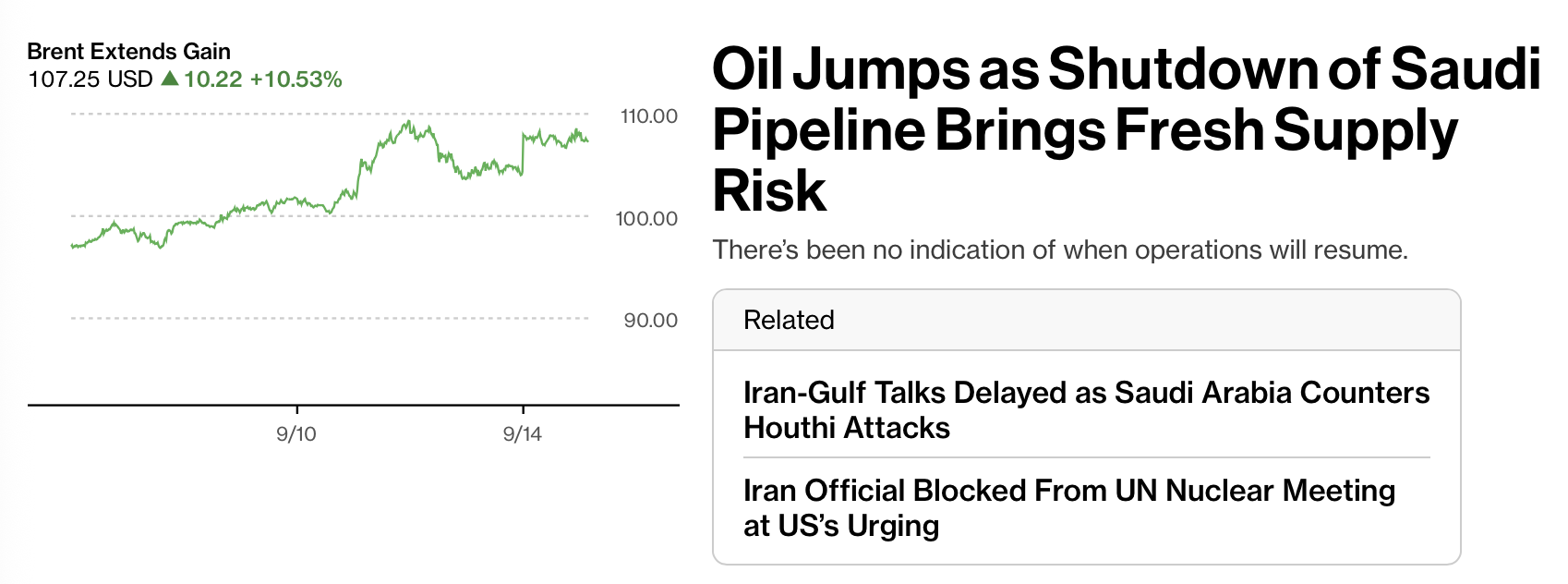
Mr. Market has taken note. From the Bloomberg landing page:
From Oil Jumps as Shutdown of Saudi Pipeline Brings Fresh Supply Risk:
Oil prices rose after Saudi Arabia closed a major crude pipeline following attacks, disrupting a key route that bypasses the Strait of Hormuz.
The halt of the East-West pipeline means one of Saudi Arabia’s most important workarounds for the Iran war is out of action, and the impact on the market will depend on the volumes the kingdom can ship from storage.
A prolonged shutdown of the pipeline could force output cuts, according to June Goh, senior oil market analyst at Sparta Commodities SA, who said the duration of the shutdown will determine the impact on the market….
Saudis Shut Down the East-West Pipeline After Attacks
Note: Attacks reported on Sept. 10
Sources: Bloomberg, IMF Portwatch, OpenStreetMap, Saudi Ministry of Energy
The Middle East crisis has delivered an inflationary jolt to the global economy, with prices of crude, natural gas and petroleum products including diesel rallying. After US data showed the pace of price gains marched higher in August, the Federal Reserve is widely expected to raise rates this week.
Even before the assault on the East-West conduit, oil output from the kingdom had been under pressure. Riyadh recently reported to the OPEC cartel that its crude production last month sank to the lowest level since 1990…..
In Saudi Arabia, the storage at Yanbu could support exports for five to seven days, but beyond that would cause “huge disruption,” said Suvro Sarkar, head of energy research at DBS Bank Ltd. Pending clarity on repairs, the near-term path pointed toward a test of $120 a barrel, he said.
More on repair and transit times:
Repairs on East West Pipeline could take more than 6 weeks!! Yanbu has about 5-7 days of Stocks to maintain oil exports! ( maybe lower as yanbu may be hit) It also looks like Saudi VLCCs are now headed to US rather than Eastern Med going around Africa given East med is useless https://t.co/F9IPxQ6SwX
— Ali (@MerruX) September 13, 2026
If Saudi say it will take a month you should at least double that timeframe considering how long previous repair took like the damages to Jizan (that has been knocked out again afterwards)
— JustDario (@DarioCpx) September 13, 2026
Saudi retaliations so far have only led to more, and it looks like more effective, Ansar Allah responses. From the Aljazeera landing page:
From the live feed:
Yemen’s Houthis say they launched a large-scale ballistic missile and drone attack on Saudi Arabia’s King Khalid Air Base in Khamis Mushait and claimed “direct hits”. There was no immediate response from Riyadh.
The Iran-backed rebels say they captured more strategic islands in the southern Red Sea, strengthening their control of a crucial Bab al-Mandeb shipping route.
More on the fresh exchanges:
⚡️ Saudi Arabia is said to have used DF-15 series surface-to-surface ballistic missiles against Ansar Allah positions in Yemen.
This missile is made in China and has a range of up to 1,000 kilometers.
For decades, Saudi Arabia has had a huge arsenal of Chinese-made…
— Middle East Observer (@ME_Observer_) September 14, 2026
Per Axios, Saudi Crown Prince Mohammed bin Salman called Trump twice for help when the attacks started last week, and Trump demurred. The justification so far is that Ansar Allah is not threatening US shipping:
WASHINGTON TURNS DOWN RIYADH 🇸🇦
President Donald Trump has made the position plain. The United States will not step in to fight the Houthis on Saudi Arabia’s behalf. 🇸🇦
He told reporters that the Houthis themselves had contacted Washington and made clear they do not want a war… https://t.co/9Wc1cCIupX pic.twitter.com/7tEVHmIWIP
— 𝐃𝐚𝐯𝐢𝐝 𝐙 🇷🇺 🇷🇸🇮🇪 (@SMO_VZ) September 12, 2026
Admittedly, Hindustan Times reported that the US did send 200 troops and 100 advisers.
A pertinent new entry from the Aljazeera live feed:
Saudi crown prince meets CENTCOM chief in Jeddah during regional escalation
Saudi Crown Prince Mohammed bin Salman has met with US Central Command chief Admiral Brad Cooper in Jeddah.
According to Saudi state television, the latest “regional developments” were reviewed during the meeting.
Saudi Arabia has intensified air strikes on Yemen after the Houthis made rapid territorial advances along the Red Sea coast, including the strategic Bab al-Mandeb shipping route.
I would love to have been a fly on the wall.
By contrast, the over-extended Israel had put up its hand quickly, albeit before the pipeline closure. From Jerusalem Post in Netanyahu offered to join strikes against Houthis, stop advance, US source claim – report:
Prime Minister Benjamin Netanyahu expressed that Israel may join a broader campaign against the Iranian-backed Houthi terror group in Yemen, Lebanese newspaper Al Akbar claimed on Friday, citing US sources.
According to the report, Israel would be joining a larger regional effort to combat the threat to shipping routes in the Red Sea and the Bab al-Mandab Strait.
US diplomatic sources claimed that Netanyahu offered Israeli aid to countries in the Arabian Peninsula, Al Akbar wrote, signaling that Israel may be willing to join a broader war.
Saudi efforts to get Iran to lean on Ansar Allah did not get off the ground:
🇮🇷🇸🇦 Iran says Saudi Arabia has POSTPONED a planned meeting with Tehran over developments in Yemen, with Iranian FM spokesman Esmaeil Baghaei accusing Riyadh of “pointing in the wrong direction.”
“Yemen’s problems are long-standing and Iran has always said, striven, and shown in… pic.twitter.com/lKnE85Qox0
— Mario Nawfal (@MarioNawfal) September 14, 2026
Assuming this account is accurate, Netanyahu may have been posturing to boost his tough-guy bona fides before the October elections in Israel. Trita Parsi argued in a new interview on Young Turks that Trump has held Israel back from more aggressive attacks on Iran. Trita believe that Trump plans to launch a full-scale operation with Israel shortly after the midterms. One has to wonder how much the US and Israel could really do, ex nukes, given the depletion of US weapons stocks and naval power. Trita contends Iran can see this coming. Iran can be expected to continue attacks US operations in Jordan to weaken Israel defenses, and to attack shortly before the midterms, say two weeks prior.
There has also been harrumphing about the fact that the strike on the pipeline apparently came for Iraq, and the Iraqi government must therefore Do Something. As most readers know, that government has been engaged in a losing battle with the Shia, Iran-friendly Iraqi militias. The militias also said they were not behind the pipeline attack. Nevertheless, from the Financial Times in Saudi pipeline attack exposes potent Iraqi militia threat:
Hours after Saudi Arabia confirmed that the drone attack that forced the kingdom to shut down its vital east-west oil pipeline was launched from neighbouring Iraq, the Iraqi prime minister sought to show he was willing to counter the threat from within his nation…
“Iraq renews its affirmation that its territories and airspace will not be a launching point for aggression against any country,” Zaidi’s office said in a statement.
Yet if the premier is to deliver, he would have to do what his predecessors over the past two decades have been either unwilling or unable to do: push back against Iran’s deep influence and take on Iraqi militias linked to Tehran-aligned factions that are among the most powerful political and military actors in Iraq.
Analysts say it is a near-impossible task, at least in the short term, particularly as the US pulls its remaining troops out of Iraq — and as those factions have been emboldened by Iran’s ability to fight back against the US-Israeli war.
Now of course, Saudi Arabia could simply back down. It could even claim the high ground by saying it would stop intervening in Yemen to prevent more damage to the global economy. But if MBS digs in, some analysts (Larry Johnson and Professor Steve Hanke, a former UAE adviser), that Ansar Allah might even be able to topple the Saudi government. They see this as roughly having 15% odds. However, MBS has plenty of opposition from within the Saudi elite. Recall that he extorted members of the royal family by incarcerating them at the Riyadh Ritz Carlton in an open shakedown operation. We may find out soon how loyal his security services really are.
A very informative discussion about Ansar Allah between Patrick Henningsen and Daniel Davis gives more background on how Ansar Allah is on a trajectory of increasing military effectiveness. Henningsen objects vigorously to the depiction of Ansar Allah as rebels. He points out they have the backing of 80% of the population and control the government. By all normal standards, that makes them the government and the Saudi-backed forces the rebels.
From a lightly-edited machine transcript:
The UN backed “recognized” government, the Saudi-bbacked government forces as you as you’ve as we’ve rightly labeled them because that’s kind of what they are. These are not fighters. They don’t have a lot of native Yemen soldiers within those ranks. Saudi Arabia has been outsourcing a lot of their ground troops throughout this war from 2015 forward as well as the UAE. They’ve been buying them from Sudan. They’ve literally been subcontracting off anybody they could suit up and boot up and give a weapon to and pay $500 a month salary. Whether that’s even RSF, former RSF soldiers, but but mainly from Sudan, people who needed money from the Sudan army who were available for mercenary services and then as as well as a collection of other sources and patchworked together to make infantry. Daniel you can’t fight any kind of a war like that. And the other problem Daniel is that the the the public support overwhelmingly I think throughout Yemen is really behind Ansar Allah…
Every time they’re attacked by Israel or the United States, they then reorganize and double up. They they’ve improved their air defense, their anti-ship missiles. I mean, where they are now compared to where they were 10 years ago or even five years ago or even two years ago, where is Ansar Allah going to be in two years time or in five year’s time? Much stronger than they are today….
The big mistake from the United States is to have a protracted campaign against Yemen, Answer Allah. Plenty of time to study the United States, take down uh US Reaper drones. Other aircraft were either hobbled, lost or had problems with regards on the aircraft carriers that were also targeted by Ansar Allah the Houthis. So, they they got a lot of experience there. So, they’ve been able to profile almost every single package in terms of interacting with US forces. That’s hugely valuable. That that was a big mistake by the United States obviously to do that over a two, two plus month period. So there’s that issue. The [CNN] report there speaks to the advancements and capabilities of Ansar Allah and the sophistication.
But the what you’ll notice Daniel and you learn a lot from propaganda and nobody does propaganda better than CNN when it comes to geopolitics. And CNN keeps running reports now, which I find interesting about this hanger that the so-called government forces, they call them the Saudi-backed Yemen government forces, keep this hanger with intercepted shipments of missiles, anti-ship missiles and and machine guns. It’s all very sort of well staged h for the cameras. And what they’re trying to do is push across to the western and to the Trump administration probably to signal to western politicians that Iran is pumping weapons into Yemen. This is not true.
Yemen has a long tradition, a long history of their own indigenous domestic missile programs and technology and engineering. They’re doing all of, a lot of this stuff is homegrown. There is some technology transfer. You can be sure of that. But I would argue that as much is coming from China in terms of components and technology transfer than is coming from Iran. They can put a siege on the port of Hodeidah, but they’re not going to be able to change the fact that this technology has already entered Yemen years ago years ago. And the Yemenies are master engineers. Anybody who doesn’t believe that or is not gonna is not willing to admit that these aren’t just a bunch of Arabs in sandals and sarongs firing Kalashnikovs at Saudi fighters.
And keep in mind that the Ansar Allah’s impressive gains also make the prospect of an end to the conflicts even more remote if the Saudis refuse to climb down. From Danny (Dennis) Citrinowicz on Twitter:
One important point to add to the valuable analysis by my good friend @AlexVatanka
Even if Iran and the Gulf states reached an agreement tomorrow that reopened the Strait of Hormuz, the Houthi campaign against Saudi Arabia would not necessarily end. From the Houthi perspective, what would be the strategic value of easing the confrontation in Hormuz if the Saudi blockade against them remained in place?
This is why the Iranian-Houthi objective is more complicated than simply reaching an arrangement over freedom of navigation in Hormuz.
The real endgame is likely a broader understanding, one that addresses not only the maritime confrontation with Iran, but also creates a new reality in Yemen in which the pressure and restrictions on the Houthis are lifted.
That has an important implication: Hormuz cannot be negotiated in isolation from Yemen. And there is another critical point: Iran cannot simply negotiate on behalf of the Houthis and promise their de-escalation without a fundamental change in the situation in Yemen. The Houthis would not accept it.
A comprehensive off-ramp therefore cannot be limited to a U.S.-Iran or Gulf-Iran understanding. It must also address the Saudi-Houthi track.
Otherwise, even if the Hormuz crisis is temporarily defused, one of the central engines of the broader regional escalation will remain firmly in place.
Turning to Iran and Strait of Hormuz developments, a Bloomberg story confirms the observation above, that the Ansar Allah escalation (absent a Saudi climbdown) further complicates a resolution of the Iran conflict. From Iran-Gulf Talks Delayed as Saudi Arabia Counters Houthi Attacks:
A meeting between Iran and several Gulf Arab nations over a temporary shipping lane through the Strait of Hormuz was postponed after a request from Saudi Arabia.
The postponement is partly due to Saudi Arabia’s frustration over continued attacks on its territory by Iran-supported groups such as the Houthis.
The meeting would have discussed a proposal from Oman and Iran that would give Iran the right to determine which ships can enter the Persian Gulf and possibly charge them fees….
The meeting in Salalah would have seen participants discuss a proposal from Oman and Iran. Broadly, that deal would give Iran the right to determine which ships can enter the Persian Gulf and possibly charge them fees of some kind.
While the GCC bloc — a group of six including the United Arab Emirates and Qatar, as well as Saudi Arabia and Oman — have said they want free passage for vessels, they may accept a temporary deal that would fall short of that but still see shipping traffic pick up.
Tehran had indicated any deal wouldn’t amount to a full reopening and it would still decide on which ships could cross the strait. Iranian Foreign Minister Abbas Araghchi had described the proposed meeting as an “important event” and a step toward building trust.
This reading on the sentiment of GCC members, from Aljazeera’s live feed, does not bode well for a GCC-Iran modus vivendi any time soon:
Gulf States fear Iran’s ‘double game’ through proxies, public policy expert says
Sultan Barakat, professor of public policy at Hamad Bin Khalifa University, says Gulf nations are concerned Iran may be playing “a double game” by using its proxies throughout the Middle East to foment turmoil while calling for a peaceful resolution to the conflict.
“Saudi and others know that even if they were not directly involved, they have the facility, the authority for some of those actors – be it in Iraq or in Yemen – and they could have chosen to calm them down,” he told Al Jazeera.
Barakat highlighted the meeting between Gulf states and Iran planned in Oman for Monday that was cancelled after days of Houthi attacks throughout Yemen and Saudi Arabia.
“But I think what makes the Saudis worry is the timing of all this. Suddenly, the Houthis spot this opportunity, they move to the western coast of Yemen threatening the traffic through the Red Sea … and that must have given them the impression that Iran is continuing to play a double game,” he said.
“On one hand they [the Iranians] are inviting them as independent sovereign states to come and sit and talk eye to eye about collective security. On the other hand, they continue to exert pressure on them indirectly through their allies.”
This Gulf state view, even if sincerely held, ignores that Ansar Allah has plenty of agency, and that Ukraine’s repeated defiance of US directives, such as the “deal” proposed to Putin at the Anchorage summit, shows that actual proxies can and do defy their funders.
In addition, some Iran officials have been talking up the idea of exiting the Nuclear Non-Proliferation Treaty:
Bulletin of the Atomic Scientists pointed out last year that withdrawing from the NPT did not mean Iran was developing a nuclear weapon. Frankly, not risking having the IAEA help Israel assassinate Iranian nuclear scientist again is more than enough reason to quit. From What if Iran withdraws from the NPT?:
NPT withdrawal is one of the few actions available to Iran that would have a significant effect. It would facilitate reconstitution of Iran’s bombed nuclear capabilities and enable Tehran to use them to develop nuclear weapons without international oversight.[2] Even with the loss of the 14 nuclear scientists and engineers assassinated by Israel this month, Iran surely retains the knowledge on how to build centrifuges and assemble them into cascades, plus the expertise acquired during the secret work to date on weapons development. Iran may also have taken steps to remove equipment and material from its enrichment facilities before the US attacks against three Iranian nuclear facilities over the weekend.
Given these realities, Iran likely will be able to build and operate a secret underground enrichment plant capable of producing significant quantities of weapons-grade highly enriched uranium (HEU). This process will be sped if Iran was able to protect from Israeli bombing the over 400 kilograms of uranium enriched to 60 percent uranium 235 content the International Atomic Energy Agency (IAEA) says Iran had as of May[3] and, until recently at least, stored in easily transportable cylinders. At a time when much of the world sees Iran as the victim of Israeli aggression, NPT withdrawal could be accomplished with less political blowback than if it were employed in response to economic sanctions.
Iran’s adversaries would see NPT withdrawal as tantamount to a declaration of nuclear weapons intent. There is no such legal connection, however, and the logical case is not airtight. It is conceivable that Iran could withdraw from the treaty and maintain a policy of nuclear hedging, even as it reconstituted its enrichment program in secret. A decision to actually build a nuclear weapon could be made down the road when the capabilities are again in place. Invoking the NPT’s withdrawal clause in the near term would risk military escalation with few immediate benefits, though ending IAEA inspections would reduce the transparency and vulnerability of a reconstituted nuclear program.
Trump is having to do even more to ‘splain high energy prices. Of course, it has nothing to do with his decisions. From RT in Trump blames fuel price spike on Zelensky:
US President Donald Trump has blamed Ukrainian leader Vladimir Zelensky for the ongoing diesel price shock, saying it was a result of Kiev’s attacks on Russian refineries.
The national average price of diesel hit more than $6 per gallon on Friday, up from approximately $5.85 last week. The price has climbed some 60% compared to the same period last year, when diesel fuel cost some $3.71 per gallon. Market experts have mainly linked the hike to the conflict in the Middle East and the reignited hostilities between the US and Iran, which have prompted a renewed rise in crude oil prices.
Trump, however, insisted that this was not the case, telling reporters while on a visit to Ireland that the diesel price spike was actually related to the Russia-Ukraine conflict. The US president said he had already raised the issue with the Ukrainian leader and told him to stop attacking diesel production in Russia.
“Zelensky has to do one thing. He has to stop knocking out diesel fuel in Russia. Let him go after targets, but not diesel fuel, because he’s causing a shortage of diesel,” Trump asserted, adding that “this isn’t done by the Middle East.”
Mr. Market is finally a bit more attentive to how Iran and its Resistance allies are chocking energy and other critical commodities coming out of the Middle East. But it takes time for a reduction in the amount leaving the region to affect supplies on the buyer end, since there are still recently-loaded cargoes still in transit. The lubricants shortages predicted early in the Iran war are starting to manifest:
Costco is now rationing motor oil
“stores are now imposing a two-per-customer, per-week limit.” – Drive https://t.co/sruyQK6axS
— Don Johnson (@DonMiami3) September 13, 2026
And some closing tidbits:
I hope to return to a Larry Johnson post over the weekend on the first day of the BRICS summit. A key section from his write-up:
The economic centerpiece was a commitment to expand trade and investment settled in members’ own national currencies, and to link their domestic payment and messaging systems so that transactions can move without passing through the dollar-denominated SWIFT network. According to the declaration, the bloc’s payment task force had studied cross-border interoperability of those channels and examined using local currencies for trade settlement and investment.
The mechanism drawing the most attention was BRICS Pay, a decentralized payment-messaging framework that stitches together India’s UPI, China’s CIPS, and Russia’s SPFS into a shared interoperability layer — a way to clear payments among members outside SWIFT.
Anti-imperialists too often do not recognize that the push to improve bi-lateral payments infrastructure, while the clearest and fastest path to slipping the noose of the dollar sanction regime, has considerable limits. As long as countries run non-trivial trade imbalances with each other, the surplus side winds up accumulating currency of the trade deficit country well beyond what it can use or wants. We see this now with Russia and India. Russia has complained about its burgeoning stock of rupees, and even worse, that currency has been depreciating. That means even if Russia found a way to use the Indian currency, its value at the time of expenditure would be less that it thought it was getting in real terms when it sold India oil and other goods.
BREAKING | Initial reports of explosions in the Jordanian city of Aqaba, heard from Eilat.
The explosion has reportedty caused an ammonia gas leak, according to reports, prompting the evacuation of the Port of Aqaba. The circumstances surrounding the explosion and the extent of…
— The Cradle (@TheCradleMedia) September 14, 2026
This @60Minutes interview is a colossal PR disaster. After months of claiming U.S. air superiority and that Iran’s air defenses had completely been destroyed, they have now put on national television the story of an F-15 being hit by an Iranian surface-to-air missile and its two…
— Omid Memarian (@Omid_M) September 14, 2026
Done for today! See you tomorrow!
