


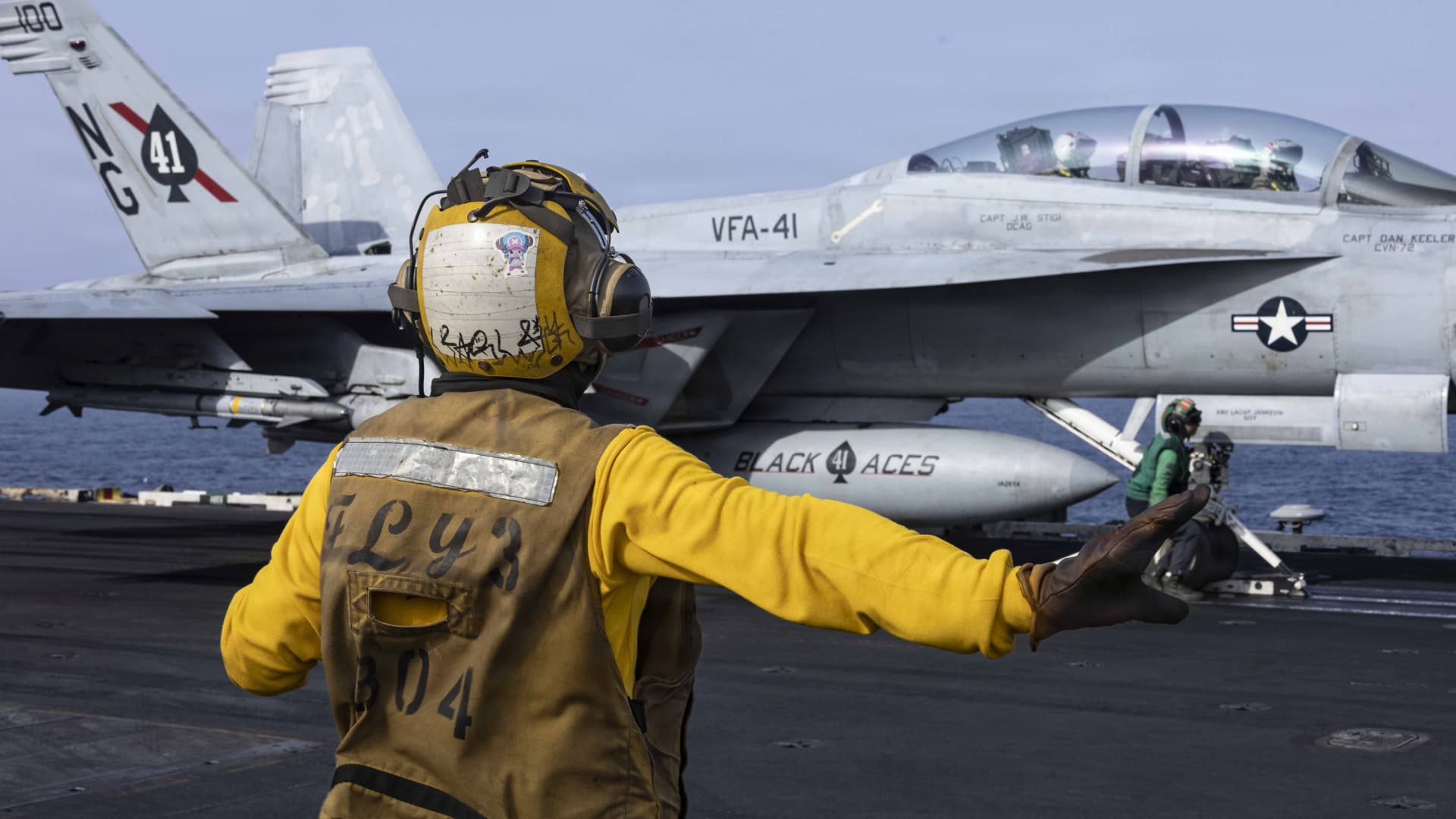
An F/A-18F Super Hornet assigned to Strike Fighter Squadron (VFA) 41 prepares to launch from the flight deck of the Nimitz-class aircraft carrier USS Abraham Lincoln (CVN 72).
Provided by: U.S. Navy
The escalation of fighting between the United States and Iran over the weekend caused Wall Street to reconsider its expectations about the economic impact of the war.
The United States on Monday completed its 10th consecutive night of strikes against Iran after Yemen’s Houthis declared a maritime embargo against Saudi Arabia. This follows the death of a third service member in recent fighting and could mean a longer and more dangerous period of war. “The United States will retaliate,” President Donald Trump said in a post on Truth Social, vowing to retaliate.
Investors appear to continue to ignore the recent flare-up in tensions, with the S&P 500 only marginally lower in Monday trading after a down week. It also remains just 2% below its all-time high reached in June. Still, economists worry that energy prices could rise again, weighing on consumers and the broader economy.
“It’s all about duration.”
As far as the stock market is concerned, the Middle East wars have had little impact. Since falling to a closing low of 6,343.72 in late March, the S&P 500 index has rebounded to record highs. This is largely due to the assumption that neither the United States nor Iran wants to return to full-scale war, an undesirable outcome as both countries could suffer losses if the global economy were to fall into recession.
Investors have instead shifted their focus to fundamentals as the strength of corporate earnings has accelerated since the start of second-quarter earnings season. Softer-than-expected inflation data released last week also added to investors’ optimism.
But investors can’t ignore the recent rise in oil prices and rising bond yields for long. Brent crude oil briefly topped $90 a barrel on Monday, but remained just below that level on Tuesday. The 10-year U.S. Treasury yield traded above 4.6% on Monday, a key level that traders are watching. It remained around that level on Tuesday as well.
If oil prices and 10-year Treasury yields continue to rise, or remain high for longer than investors expected, Wall Street may have to start pricing in inflation expectations and changes in monetary policy that will eventually hurt corporate earnings.
“The issue is duration,” said Art Hogan, chief market strategist at B. Riley Wealth. “If it’s above $85 or $90 by the end of the year, I think this year’s earnings forecasts may need to be revised downward.”
Hogan said the worst-case scenario could send the S&P 500 into a correction. But he also said the broader index would be partially supported by technology, the largest sector and relatively insulated from rising energy prices. According to S&P Global, tech stocks make up 38% of the S&P 500, while energy stocks make up just 3%.
Financials and healthcare are two other sectors that could continue to benefit from long-term tailwinds, regardless of rising oil prices. Fuel-dependent energy sectors and logistics companies are likely to be the biggest laggards. Ryanair, for example, said on Monday that its weak first-quarter profits reflected delays in bookings due to the Middle East crisis.
The area will be closely monitored for any escalation that could impede passage through the Strait of Hormuz.
Marko Papik, macro and geopolitical strategist at BCA Research, said he is watching to see whether Iranian hardliners gain more power or whether the U.S. sends more troops to the Middle East.
However, some remain confident in the market, expecting the geopolitical outlook to only improve in the second half of the year. JPMorgan’s Mislav Matejka said the stock is sticking to its strategy since late March, which is to take advantage of the escalating conflict to continue to widen the decline.
“We continue to believe that investors should take advantage of declines from geopolitical headlines to add exposure,” Matejka wrote earlier this month. “We believe markets are becoming increasingly adept at pricing in geopolitical risks as temporary.”
“Everything is negative”
Economists are concerned about how a potential rebound in fuel prices due to increased fighting could affect U.S. consumers and the companies that serve them.
“There’s only downside here for the U.S. and global economy,” said Mark Zandi, chief economist at Moody’s Analytics. “Obviously, a lot depends on how this plays out and what it means for oil and other commodity prices. But that’s all on the downside.”
Zandi said the average American household has lost about $1,100 to the war so far, a figure that includes increased energy costs and increased military spending. As a result, real disposable income has been negative or nearly flat on an annual basis in recent months, which is common during recessions, Zandi said.
Zandi said consumers are turning to savings to support spending as energy prices rise. But Zandi warned that may not be sustainable as rainy day funds dwindle. The personal savings rate was 3% in May, nearly 2 percentage points lower than a year ago, according to the Bureau of Economic Analysis.
Gasoline prices rose to $4 a gallon on Monday for the first time in more than a month, according to AAA.
Economists expect the revival in oil prices to put upward pressure on the consumer price index. The 12-month CPI data in May was the highest in three years, but fell last month as energy costs eased.
But the value of the “core” CPI, which excludes volatile food and energy prices, may not increase in tandem, which could eliminate the need for the Fed to raise rates. According to CME’s FedWatch tool, federal funds futures are pricing in a more than 83% chance that the central bank will keep rates unchanged at next week’s meeting.
“Inflation will continue to rise due to gas prices,” said Luke Tilley, chief economist at M&T Bank Wilmington Trust. But “the key for the Fed, as everyone has been saying out loud, is whether it spills over into core inflation.”
Michael Gunther, an analyst at Consumer Edge, said companies with value-oriented consumer bases or consumer bases that rely on driving could become more selective if oil prices continue to rise. This could negatively impact businesses ranging from Dollar General to Tractor Supply to Texas Roadhouse, his company found.
Meanwhile, Gunter said warehouse clubs like Costco and Sam’s Club could gain market share as drivers look for value. Costco reported “record volumes” of gasoline at the end of the third quarter as the war drove up prices at the pump.
“Consumers are paying attention,” Gunther said. “And they are changing their wallet management habits.”
Retail sales showed that consumers continued to spend despite war-related cost shocks. But Gunther said there were some unusual boosts, such as event tickets and gambling associated with the World Cup.
Heather Long, chief economist at Navy Federal Credit Union, said consumers were also inflated by high tax returns under President Donald Trump’s “Big and Beautiful Bill” when the war broke out. But Long said similar tailwinds would not emerge even in the face of rising energy prices in the second half of this year.
“The cushion is deflated,” Long said. “There are no other obvious air pumps coming up.”
Make CNBC your preferred source on Google and never miss a moment from the most trusted names in business news.
Source link
