


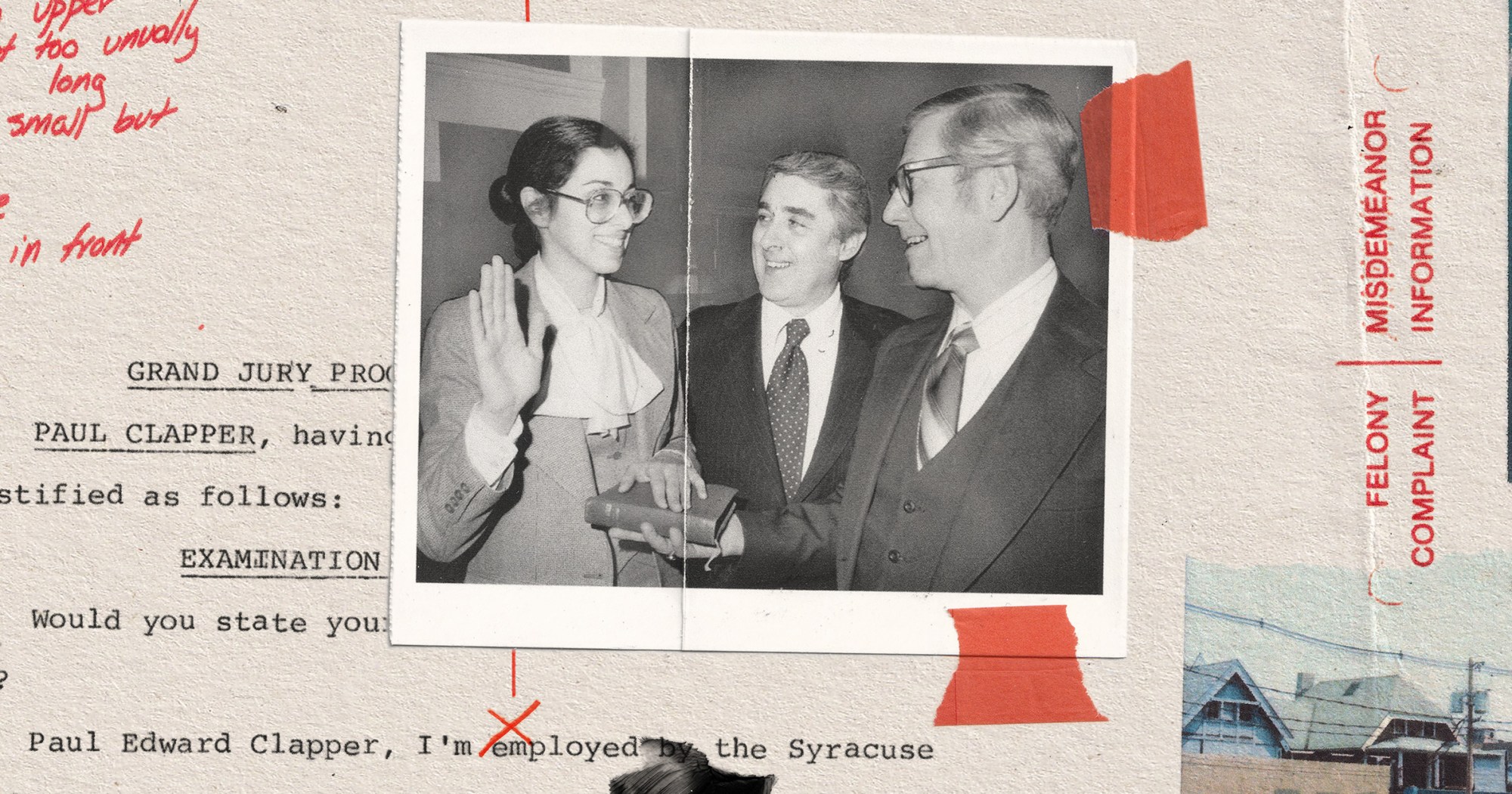
There is one fact that is indisputable about the events of the night of May 8, 1981. Alice Sebold, who had just finished her freshman year at Syracuse University earlier that day, was brutally raped while walking home through the park.
Anthony Broadwater was arrested a few months later and subsequently convicted of assault. He spent 16 years in prison, repeatedly being denied parole because he did not admit his guilt. Upon his release in 1998, he was required to register as a sex offender.
Sebold continued to write and talk about the attack, culminating in the publication of Lucky, a memoir about the rape. The book became a bestseller following the success of Sebold’s first novel, The Lovely Bones.
But 40 years after the assault, the court vacated Broadwater’s conviction after the Syracuse district attorney joined the motion to exonerate him, telling the court that Broadwater should never have been prosecuted. As this acquittal made headlines around the world, we wondered how many other victims were left behind in Syracuse and what else the police had missed.
What we discovered: You couldn’t rely on any part of Syracuse’s system at the time. Police ignored the rape. Prosecutors have botched confessions or lost trials. The judge overlooked the misconduct. And Syracuse University seemed more interested in suppressing the news than in solving the rape epidemic.
Here are some of the key findings from our years of research into what went wrong after that night in May 1981. You can read the full story here about how ProPublica reporter Joaquín Sapien re-examined this infamous incident and surrounding rape decades after the fact.
Police failed to investigate rape cases in Syracuse
When Sebold was raped in the spring of 1981, sexual assaults were on the rise in Syracuse. Her incident was the third such attack in the city’s Thornden Park in about seven months. The fourth occurred a block away. Like the police report of the Sebold assault, these cases were quickly referred to the inactive file.
Across the park, Syracuse women were being sexually assaulted in their dorm rooms and homes. Later, on the same day that her roommate was raped in their shared apartment, a nursing student was also attacked in the same location as Sebold. A freshman student was raped in her sorority dormitory by a man who broke in through a window. The descriptions of the perpetrators were often eerily similar, with many carrying knives. Some of them were about the same height, weight, and race.
Still, there were no obvious signs of urgency from law enforcement.
Syracuse University retracts media coverage of rape and other crimes
In addition to Syracuse police apparently deprioritizing rape cases in the early 1980s (when few survivors reported assaults), documents and testimony show that the city’s namesake university actively suppressed media reports about these assaults.
A former detective in the Sebold case explained in a 2025 deposition that when a police report says “no reporting,” it means the university “has taken a firm stance not to report on any type of rape, robbery, or burglary that occurs around Syracuse University.” He testified that it was not unusual to see this designation in police reports at the time.
A Syracuse University spokesperson said in an email that “we are not in a position to speak to the actions or decisions of the previous administration,” but said the university now has “comprehensive policies, a robust commitment to preventing sexual and relationship violence, and a strong support system to support all survivors who come forward.”
Anthony Broadwater, second from the right, was not identified by Alice Sebold during the line-up. Instead, she chose the man standing on the far right. Onondaga District Attorney/New York Times/Redux
Police and prosecutors botch plan and rush to prosecute case
It wasn’t police activity or media coverage that led authorities to Broadwater. His arrest only took place several months after the assault, after Sebold witnessed him on the street and believed him to be her rapist. Police arrested a 20-year-old man who agreed to join the lineup.
However, during the lineup, Sebold did not identify Broadwater as the attacker. Instead, she chose the man standing to his left.
Police had no evidence linking Broadwater to the assault other than a pubic hair sample that Broadwater volunteered to compare with that found on Sebold. In a world without DNA testing, all investigators could essentially say was that both Broadwater and the rapist were black.
Current prosecutors argue the case should have ended there. “The case is closed,” he told ProPublica. “Stop.”
But rather than release Broadwater and continue gathering evidence, Assistant District Attorney Gail Uebelhall asked Sebold to draft an affidavit on the spot explaining what happened. Sebold wrote in an affidavit that she chose the man for the No. 5 position because he had his eye on her.
In her best-selling memoir about the rape, “Lucky,” Ms. Sebold said Ms. Uebelhall tried to allay concerns about choosing the wrong man by claiming that the man she had chosen and Broadwater were each other’s “destined accomplices,” and tried to imply that the two were coordinating their appearance in the lineup to confuse Sebold. Both men adamantly deny that they have appeared together in different lineups.
Hours after the lineup, Mr. Uebelhall presented his case against Broadwater to a grand jury. In a 2025 deposition, she said she could not remember many key details of the Sebold case, but claimed she had done her job by presenting it to the grand jury without concealing its flaws.
Broadwater’s decision to forego a jury trial backfired
As his case moved forward, Broadwater and his lawyers hoped he would fare better by opting for a courtroom trial in which a judge rather than a jury would decide his fate.
But the judge seemed to have a soft spot for Sebold. In her memoir, she recalled that the judge spoke to her privately during a break in the trial, expressing concern for her well-being and asking about her family. If the jury had asked such questions of the witnesses, they likely would have been removed from the jury and a mistrial could have been declared.
The judge also allowed Ms. Uebelhoer, who was clearly pregnant at the time and was no longer working the case, to take the stand as a witness for the prosecution, although she seemed to imply that Mr. Broadwater was to blame for the failure to identify Mr. Sebold in the lineup.
Immediately after prosecutors finished their closing arguments, the judge found Broadwater guilty without leaving the courtroom for deliberations.
Rape continues even after Broadwater’s conviction, and potential suspects emerge
Broadwater’s conviction did not end Syracuse’s spate of sexual assaults. Just four months after his trial, a high school student named Thomas Weakfall admitted to raping five women, four of them within a mile of Thornden Park. He told police the spree began in late 1981.
There is no evidence that Weakfall attacked Seibold, but he matched the main characteristics Seibold described of her rapist: Black, 16 to 18 years old, approximately 5 feet 7 inches tall, and weighing 150 pounds. Weakfall was described as black, 16 years old, 5 feet 9 inches tall and 140 pounds, according to the police report. Broadwater was 20 years old, 5 feet 6 inches tall and weighed approximately 175 pounds.
However, the rape case against Weakfall collapsed after his confession was deemed inadmissible. Officers did not know Mr. Weakfall was already represented by an attorney on an unrelated theft charge and took his statement without an attorney present. He ultimately pleaded guilty to second-degree robbery and was released on five years’ probation.
Sebold walked this path in Syracuse’s Thornden Park before she was raped in 1981. Benjamin Cleeton/The New York Times/Redux
Weakfall confesses again, but does not admit to raping Sebold.
Police arrested Weakfall in October 1983 on suspicion of attempted rape of a woman in his car, records show. He pleaded guilty to a charge of attempted misdemeanor sexual misconduct after being released from custody for four months. He was sentenced to one year in prison.
During the same four-month period, Sebold’s roommate was raped in her apartment. According to recent news articles, she was one of five women attacked on the same block over a five-month period. Police suspect that one man was responsible for the crime.
Police reports on these assaults suggest an older and taller assailant, but elements of the crime include residential burglary. The woman was held at knifepoint, beaten and raped. Some were bound and gagged, consistent with Weakfall’s methods.
Sebold’s roommate also told police that after the assault, she yelled for her roommate to come home and tried to get her attacker to leave. He replied: “I know her. We have something and we’ve done business before.”
In 1985, after being caught using a stolen ATM card, Weakfall confessed to additional rapes and said he had assaulted at least three women in the previous months. This time, his confession did not move, and he ultimately served 12 years of his 18-year sentence.
Weakfall admitted to raping someone inside the house but denied assaulting anyone outside. In an interview with ProPublica, he admitted to “violence” against women, but said he did not commit all the assaults he confessed to.
Producer who wanted to make a movie about ‘Lucky’ helped unravel Broadwater’s conviction
In 2013, a film producer asked to write a script based on “Lucky” contacted Paul Clapper, a former detective who played a tangential but important role in the Sebold case. According to the producer, he responded, noting that there are many questions surrounding the case, but asking, “Did the right person get arrested?” Was Sebold a good witness? If a DNA test had been available, would the results have been the same? However, the producer said Clapper never elaborated on this list, and that the attempt to make “Lucky” into a film ultimately fell through.
A few years later, a second producer attempted to adapt Sebold’s memoirs into a film. His concerns about this story were so great that he hired a private investigator to dig deeper. Investigator Dan Myers met with Clapper, who gave the impression that he believed Broadwater was innocent and Weakfall was guilty. Myers expressed her concerns to two Syracuse attorneys, who filed a motion in 2021 to vacate Broadwater’s conviction. After more than 40 years since the rape and more than 20 years as a registered sex offender, Broadwater was acquitted.
Broadwater and his wife Elizabeth after being exonerated. He spent 16 years in prison and was a registered sex offender for more than 20 years. Matt Burkhardt/Washington Post/Getty Images
The aftermath: “I can’t write anything good enough anymore.”
Five years after a court vacated Broadwater’s conviction, Seibold told ProPublica that she had no doubt that he was innocent and now questioned her decision to report the rape to police. “This shouldn’t have happened.”
Despite his acquittal, exoneration of his criminal record and a multimillion-dollar settlement from New York State, Broadwater said it is still difficult to shake off the stigma of being a convicted rapist. “I’m still ashamed that I was convicted of rape and sent to prison for 16 and a half years,” he said. The city of Syracuse and Onondaga County dispute Broadwater’s claims. He explained that his life is “still not normal. It will never be normal. How could it ever be normal?”
Mr. Seibold and Mr. Broadwater discussed the possibility of meeting in person through an intermediary. But their shared reluctance to travel makes planning difficult.
Ms. Sebold recently wrote a letter to Ms. Broadwater, saying she would take responsibility for her role in the wrongful conviction. She said the letter expressed “the deep sadness I feel over what happened.”
“You can never write anything good enough,” Seibold said of the three pages, which took four years to write. It’s “probably, in my mind, the most important thing I’m going to write about.”
