


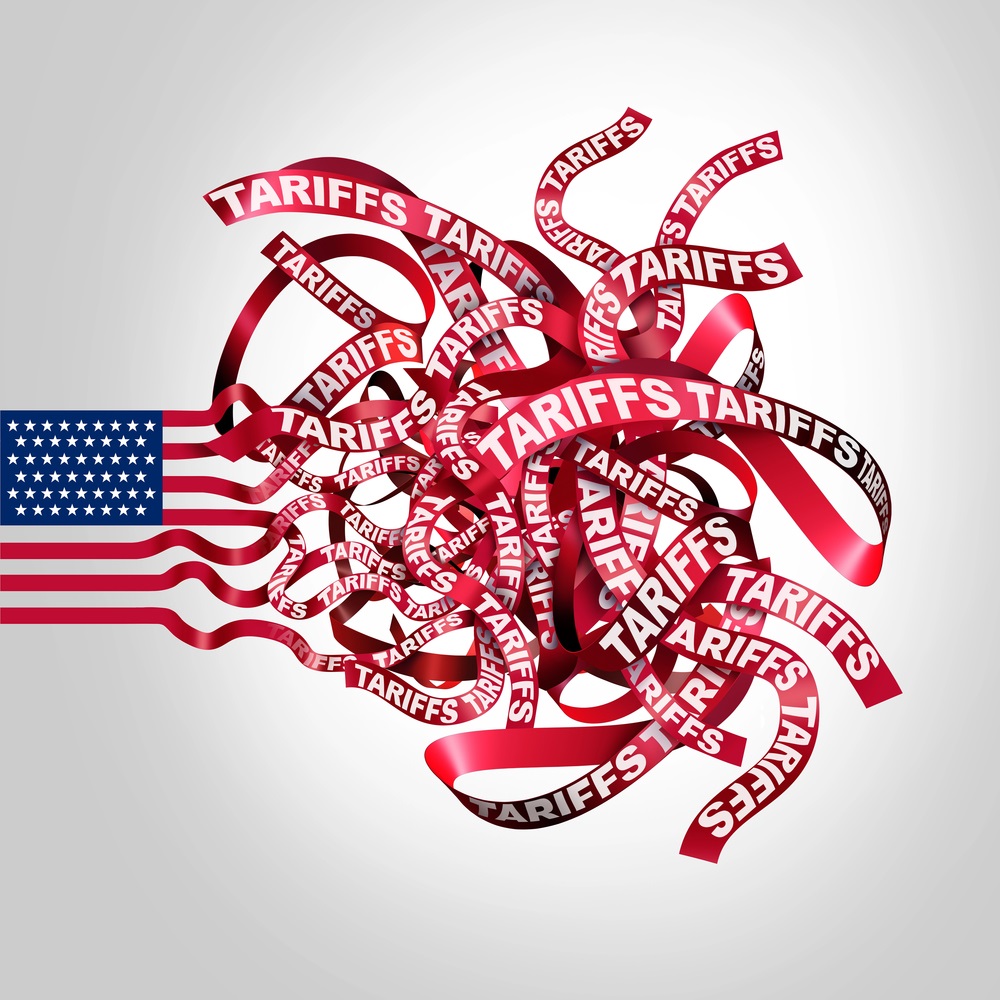
A May 29 article in the IMF’s F&D magazine argues in favor of using U.S. tariffs as a policy tool. It begins by questioning the free trade argument, arguing that economists base U.S. and global trade policy on theoretical models rather than empirical evidence.
“Tariffs were not tried and found unnecessary, but rejected by authoritative economic models and left untested. Fearful of the defiant elite consensus that such models would yield, policymakers closed off a world of options and strategies for solving America’s challenges.”
However, the United States has an extensive history of attempting to use tariffs strategically, particularly from the late 1800s to the mid-1900s. Douglas Irwin discusses this trend in his excellent 2017 book Clashing Over Commerce, from which most of the information in this post is derived. During this period, world trade expanded rapidly as new technologies reduced transportation and communication costs. As now, protectionism was in vogue and there were numerous attempts to “protect” American businesses and workers from various foreign markets.
However, protectionism has always been a difficult policy in American history. In a large country like the United States, sectarian interests will dominate Congress, making it difficult to pass protectionist policies. Some were passed around from time to time, but they tended to be unpopular and quickly repeated.
In the late 1800s, the idea of reciprocal tariffs took root in the political imagination. The idea was as simple as it is now. American companies are being “damaged” by foreign countries playing unfairly. Therefore, if the U.S. government can use tariffs to apply pressure, it could lower tariffs on the United States and support U.S. export markets. In 1890, Congress passed the McKinley Tariff Act, which established different tariff rates for each country. The McKinley Tariff Act also gave the president the power to act as an agent of Congress in foreign tariff negotiations and to threaten to raise tariffs if other countries did not lower them. This resulted in ten agreements, mainly with Latin American countries. However, in 1892, Democrats took control of Congress and repealed the McKinley Tariff Act in favor of universal tariffs, effectively nullifying these ten agreements. Countries with these agreements were furious and raised tariffs on U.S. products.
A few years later, Republicans returned to power and Congress passed the Dingley Tariff Act of 1897. Sections 3 and 4 of the law once again gave the president the power to threaten tariff increases and reduce tariffs on certain items by up to 20% if other countries lower their tariffs. Eleven agreements were made under this authority, all of which were ultimately rejected by the Senate.
In fact, according to Douglas Irwin, only three reciprocal treaties were successfully concluded between 1844 and 1909 (Conflicts over Commerce, Table 6.4, page 309). The rest were vetoed by the Senate or by other countries after the Senate-required changes were incorporated.
During the first decades of the 20th century, the general trend toward trade liberalization was interrupted by World War I. With the onset of the Great Depression in 1930, protectionism returned and the Smoot-Hawley Tariff Act started a global trade war. This trade war was so destructive and unsustainable that countries around the world met in London in 1933 to try and withdraw, but no agreement was reached. In 1934, Congress passed the Reciprocal Trade Agreements Act of 1934 (RTAA), giving the president significant powers to negotiate trade agreements. That means the president can raise or lower tariffs by up to 50% of the Smoot-Hawley level in exchange for tariff concessions from other countries. What is important to note is that the RTAA treated these as executive agreements and required approval by only a simple majority in the Senate, rather than a two-thirds majority. Additionally, any cuts would be extended to countries with which the United States has most-favoured nation status. Under the RTAA (and its extensions), 19 agreements were concluded between 1934 and 1939. By 1945, 32 agreements had been signed. In just 11 years, the Roosevelt administration concluded more than 10 times the number of reciprocal trade agreements than a century earlier.
The RTAA would eventually be replaced internationally by GATT and domestically by the Trade Expansion Act of 1962 and the Trade Act of 1974. However, in neither case was the Mutual Trade Agreement Act successful in terms of strategic use of tariffs. In fact, the bilateral agreement model proved to be far more effective in achieving negotiation goals.
Therefore, contrary to F&D’s claims, the use of tariffs as a strategic tool has a long history and has been met with mixed success. In fact, in a new research paper, I argue that a government’s institutional structure determines the success or failure of strategic tariffs. Strategic tariffs have been most successful when the executive branch was required to reduce tariffs and Congressional approval required a simple majority. In situations where such credible commitments for tariff reductions did not exist, negotiations generally failed.
In the United States, they largely failed because of the way the laws were written. Tariffs are taxes, fall under the exclusive authority of Congress (a point reiterated recently in Learning Resources v. Trump), and therefore require Congressional approval. And if tariffs are used as part of treaty negotiations, the Senate must approve the agreement by a two-thirds vote (Article II, Section 2 of the U.S. Constitution). Sectarian economic interests dominate the Senate vote, making it extremely difficult to achieve that supermajority. These are intentionally set high hurdles to clear. The genius of the Reciprocal Trade Agreements Act was that Congress delegated as much authority as necessary to make the president a reliable negotiator (overcoming the two-thirds barrier) and to bind the president’s words in law (creating executive agreements that required Congressional approval). Other reciprocal trade legislation has failed to achieve this balance, either by restricting the president too much (the McKinley Tariff and the Dingley Tariff) or by giving him too much arbitrary power (the Trade Act of 1974).
More broadly, the conditions under which tariffs can be used strategically are very strict (see John Macmillan, Economics and Politics 2(1), 1990). in short:
A threatened country should face significant harm if cut off from its market A threatened country should not have the ability to significantly retaliate The costs of compliance should be small for a threatened country A threatened country should perceive greater benefits from liberalization than the threat
Such situations are rare at the best of times, and are probably becoming considerably weaker as the world becomes more global. Inclusion in the institutional framework makes it extremely difficult to utilize strategic tariffs effectively.
