


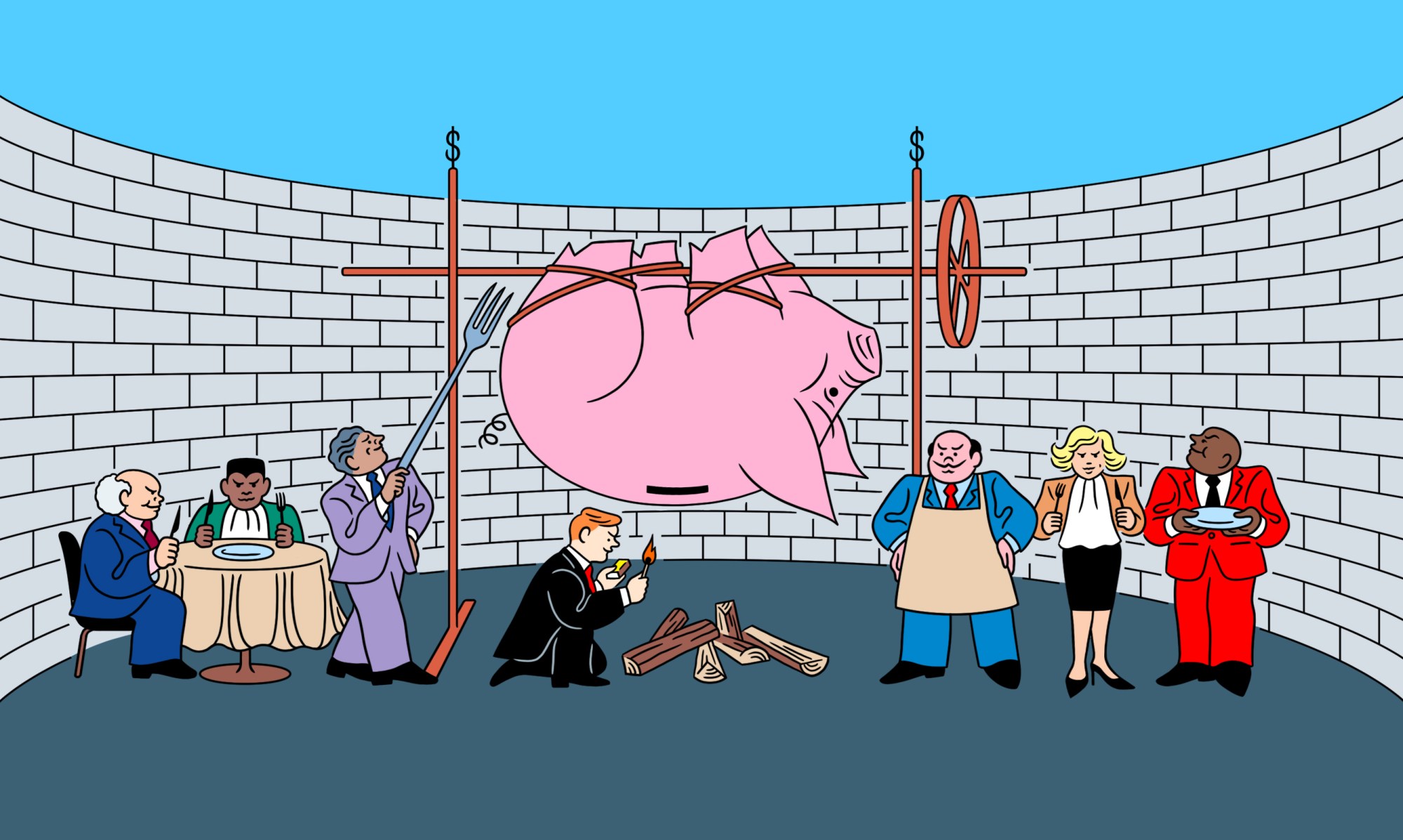
Rather than looking for excitement or experimentation in their 401(k) plans, most Americans rely on the promise that steady savings and sober planning will guarantee security in their golden years. But the Trump administration wants to shake up the worn-out patterns of retirement investing.
To that end, it seeks to weaken key protections for workers’ retirement benefits. The person responsible for deregulation is an industry insider whose former clients include large corporations likely to benefit from his plan.
Since taking office last year, President Donald Trump has touted plans to include less regulated and often risky investments, such as private equity and cryptocurrencies. To achieve this goal, the administration is weakening one of the strongest legal protections American workers have: the right to hold employers accountable when their retirement benefits are mishandled. This change is intended to give employers protection if an employee’s 401(k) is reduced by expensive, opaque, or unproven investments.
“What they’ve done is lowered the standards for everything,” said Ali Khawar, a former senior official at the Labor Department responsible for enforcing the federal laws governing retirement savings.
This push is backed by Wall Street companies who want a bigger slice of the $10 trillion in America’s 401(k) plans and America’s largest employers who want to avoid class-action lawsuits from employees. President Trump has a powerful ally in his selection to lead the Department of Labor’s efforts. Daniel Aronowitz previously ran a company that helped large companies protect themselves from labor lawsuits. Now, Aronowitz is pushing for changes to the rules that apply to those same companies.
When 401(k)s replaced pensions as the primary way Americans financed their retirement, investment risk shifted from employers to employees. In exchange for the promise of a monthly check, 401(k) participants typically get a tax-sheltered account with their employer matching their contributions, but there’s no guarantee how their nest egg will grow. However, vestiges of the old system remain. Employers are responsible for overseeing company planning. They choose all financial service providers and have the final say on the investment options available to employees. But workers typically pay for these services from their 401(k) savings. And when plans have few options, it is the workers who suffer from reduced savings.
401(k) savers are full of pitfalls. The “record keepers” who manage 401(k)s may try to steer employees into their own company funds, whether or not that’s the best option. We may sell advisory services of questionable value. Then there are investment fees, which are the main cost for participants. These are charged as a percentage of each investment. Roughly speaking, a 1% fee on a $10,000 investment will cost you $100 per year. Records managers (companies such as Fidelity, Principal, Vanguard, and Empower) and other service providers often receive a portion of these fees. This means there is an incentive to recommend more expensive options.
If employers have less oversight, workers may find themselves overpaying for investments in underperforming funds. Even small differences in fees and performance can add up over time and make a huge difference in how much you can save for retirement, potentially amounting to tens of thousands of dollars by the end of your career. According to the Department of Labor’s own calculations, an extra 1% can shrink your retirement nest egg by 28%.
Worried that your 401(k) plan is taking money away from you? ProPublica is researching the industry and wants to hear from you.
When overseeing retirement accounts, employers have a fiduciary responsibility to make prudent decisions and put workers’ interests first. If a financial company allows money to be extorted from plan participants, it could be held liable under the Employee Retirement Income Security Act of 1974, the pension-era law that currently governs 401(k)s.
Over the past 15 years, employees have increasingly sued large employers over unnecessarily high fees and poor investment options. Companies such as UnitedHealth, Boeing, Verizon, and General Electric have opted to settle lawsuits for tens of millions of dollars without admitting wrongdoing. Aronowitz labeled the entire enterprise a “fraud,” calling the growing number of lawsuits a “game of fraud” that misleads judges and arguing that such cases should be brought to specialized courts.
In 2025, more than 90 of these class actions were filed against large employers. To Aronowitz, that’s a big number — his former firm tracked and publicized the rise in such lawsuits as part of its underwriting liability coverage for employers — but it’s only a fraction of the more than 700,000 401(k) plans nationwide.
ERISA is silent on what types of investments are prudent. It sets the standard of care, not a list of approved options. The decision is up to employers, but employers are generally wary of incorporating cryptocurrencies, private equity and hedge funds into their plans. That’s because they are more complex, often untested and much more expensive than regular stocks and bonds. Nevertheless, President Trump issued an executive order last year calling for new rules, blaming “regulatory overreach” and limited “litigation brought by opportunistic trial lawyers.”
As head of the Department of Labor’s Employee Benefits Security Administration, which enforces ERISA, Mr. Aronowitz is responsible for ensuring that it is enforced. His most important move was to enact rules that would make it much harder for workers to sue. The proposals, which are likely to be finalized later this year, outline a series of factors for employers to consider before approving an investment. Simply following this process will entitle an employer’s decision to “significant deference” from the court. This provides a “safe harbor” or legal shield designed to protect the decision from challenge. Companies can include high-fee private equity funds in their plans and potentially be protected from lawsuits, as long as they follow the rules and show they take fees into account.
To opponents of the change, like Kawal, who was EBSA’s second-in-command under President Joe Biden, it’s just a “check-the-box approach,” similar to a teacher automatically giving a math student an A for showing their work, even if the answer is wrong.
Mr. Aronowitz vehemently opposed this type of criticism. “Absolutely not,” he said at an industry event in April. “Please read the proposed rule. We must document a fiduciary process that is rigorous, objective, thorough, and analytical.”
At the same time, Mr. Aronowitz is also rescinding investment options for the police program. In April, EBSA released a bulletin updating its enforcement priorities. The agency announced that it will now have to get Aronowitz’s approval before taking major enforcement actions and also set new guidelines for law enforcement agencies. “EBSA must avoid cases that unfairly second-guess process-based fiduciary judgments,” the bulletin said, meaning that regardless of the outcome for the worker, investigators should not challenge an employer’s investment choices if the employer can show that it took appropriate steps.
Tim Hauser, who worked at EBSA for 34 years and held the highest ranking among career employees until he retired last year, said such ideas undermine the core of ERISA. Under both Republican and Democratic administrations, EBSA was “dedicated to protecting plan participants,” but things have changed under Aronowitz, he said. Hauser said the ability for courts and regulators to hold employers accountable for poor decisions in choosing 401(k) investments is “the cornerstone of this entire system.” “They are proposing deprioritization while encouraging investment plans that are more complex and opaque. It’s infuriating.”
The changes in EBSA were also evident in court. Last year, the Department of Labor filed amicus curiae briefs (friend-of-the-court filings that summarize legal arguments for judges) in several class-action lawsuits filed by corporate defendants. Until now, the Ministry of Labor’s brief has largely sided with employees. These court briefs can be influential. The agency recently mediated on behalf of Home Depot in a case pending before the Supreme Court. The plaintiff then withdrew it.
In a statement to ProPublica, a Department of Labor spokesperson said EBSA prioritizes the “highest risk items” to protect participants.
In pushing for less regulation and less enforcement, the Trump administration and Wall Street are aiming to do more than give workers the option to invest in so-called alternative assets. They predict it will become commonplace as part of the new normal.
In recent years, the typical 401(k) plan has settled into a pattern that is popular with investors but less lucrative for the recordkeepers and asset managers who offer the plan. A few decades ago, actively managed mutual funds were the norm, where experts selected investments and charged a fee for their investments. They charged higher fees, often exceeding 1% of the fund amount each year. But over time, passive funds, which often track stock and bond indexes like the S&P 500, have come to lure investors with promises of comparable or better results, often with fees of less than 0.1%.
Investment and management fees for 401(k) plans have been steadily decreasing, on average. Experts say one of the main reasons is the rise of passive funds, but another is the threat of litigation. Large companies may have a hard time explaining to judges why they forced employees to choose funds that cost 10 times more when cheaper options are widely available.
Kai Richter, a lawyer with Cohen Milstein and a longtime specialist in ERISA class actions, said the decline has squeezed the 401(k) industry’s profit margins. “So the financial industry is looking for other ways to make money.”
Private investments, such as private equity, are generally actively managed. This means higher fees. If 401(k) plans begin to commonly include these investments, the long-term trend of lower fees will stop and perhaps be reversed.
Broad adoption of alternative assets is certainly a goal of the administration. One of the most important parts of a 401(k) plan is the default option. This is because most employees simply leave their money there. The default is typically a target-date fund, which based on the investor’s target retirement date, gradually changes its composition from primarily public stocks to primarily bonds as that date approaches, becoming more conservative and less risky as the funds get closer to need. Target-date funds haven’t changed much over the past 20 years, even though their popularity has skyrocketed. They offer all-in-one simplicity and are often passive, so they are low cost. Adding complex investments like private equity and hedge funds as a standard part of the mix will be a big change.
Although the proposed rule claims to be “neutral” on how the new, looser standards will affect investments, it confidently predicts that companies will incorporate more alternative assets into their 401(k)s over time. After all, the purpose of the rule is to expand access to “the potential growth and diversification opportunities associated with alternative asset investments,” as stated in President Trump’s executive order. After the rules are finalized, plans for about 5 million participants would add new or modified target-date funds that include alternative investments, and that number would continue to grow each year, according to the proposal.
The past year has seen a flurry of product announcements in the 401(k) industry, as financial companies have taken cues from the administration and prepared to offer new options for their plans. Major companies that manage private investments, including BlackRock, Apollo, and Goldman Sachs, have announced 401(k) funds that include private assets.
Prior to adoption of the proposed rule, Empower, the No. 2 record holder, is expanding alternative options through managed accounts, where participants choose to have an advisor shape their 401(k) portfolio. Empower’s CEO recently said that about 1,000 companies have agreed to offer these investments to their employees.
However, the ultimate effect of the administration’s efforts will not be limited to alternative assets, and the outcome is by no means certain. The proposed rules appear to ensure legal challenges are addressed, and employers may remain reluctant to review their plans despite Aronowitz’s assurances. Employers may fear backlash from employees without filing a lawsuit, but research shows that employees are satisfied with traditional investment options.
