


We are in yet another low kinetic action period in the Iran conflict where pressures are continuing to build. The massive funeral ceremonies for Ayatollah Ali Khamenei and the other martyrs in the Iran war demonstrated and validated the intensity of desire for revenge on Trump, Netanyahu, and other responsible parties. This intensity of sentiment will strengthen the hand of already-ascendant hardliners and assure that the already-very-likely-to-fail Memorandum of Understanding (MOU) will indeed fail. Trump by adding fuel to those fires is further undermining the very small prospects that the MOU could succeed. And the US, after a brief interruption, is again having some success in contesting Iran’s efforts to limit Strait of Hormuz traffic to the Iran-approved lane on the north side, near its coast.
We will also turn to the mystery of why paper oil prices keep falling when they are at implausibly low levels and inventories are still tightening. Derivatives maven Satyajit Das, in an important Financial Times article that we will discuss soon, explained long form why oil futures markets lack features that force convergence between contract and real world prices. Philip Pilkington also gave a illuminating follow-up talk on his arguments about how the futures markets are seriously misaligned with what he sees in physical markets.
Finally, we will turn to a thorny question: what if, despite conclusively defeating the US on the battlefield, as in administering so much punishment to US forces and allies in the theater that the US and Israel can’t even manage a similar scale (and remember failed) attempt any time soon, that Iran may fall short on important objectives?
Most readers have seen headlines and likely videos or other accounts of the massive turnout in Tehran for the funeral for the Supreme Leader and other martyrs in the US-Israel campaign against Iran, despite the difficulty of getting to the site and daytime temperatures over 32C (90F).1 Some overviews from Westerners at the commemoration:
I’ve just visited the largest funeral in history, where millions mourned Sayyed Ali Khamenei, the Iranian leader who was assassinated by the US-Israeli coalition along with members of his family
It is practically impossible to understand what this scene is like, or what it… pic.twitter.com/37Hzc0NFN8
— Max Blumenthal (@MaxBlumenthal) July 5, 2026
You can scroll though the crowd and site shots to listen to the interviews, starting at about . You will see the depth of attachment to the murdered Supreme Leader.2
If you have been following the Iranian media or Iran-officials and insiders on Twitter, you will see many statements that demand the MOU terms be complied with, in full, as Iran interprets them.3 But the MOU was never an enforceable document, but only a framework for negotiations. That is not to say that Iran is not entirely within its rights to assume a non or barely-negotiable position. But as we pointed out, it seems inconceivable that the negotiators did not recognize that the US could not deliver on some of the MOU provisions, such as getting third parties to pony up $300 billion for Iran reconstruction and full sanctions relief, which the E-3 look set to stymie with respect to European sanctions. Now add to that the strong sentiment among many Iranians, that Iran should not negotiate with the US.
If you listen to the Lascaris interviews, you see some mourners discuss what sounds like a Shia obligation to oppose “arrogant” leaders and governments. Trump doubled down on his domineering tendencies in a fresh interview with Axios (note the main point was to present Trump as immune to Netanyahu’s manipulation in case Trump gives him an audience next week as requested):
Trump told Axios he’s following the funeral of former Iranian Supreme Leader Ali Khamenei, who was assassinated on the first day of the war in a joint U.S.-Israeli operation.
Trump claimed the Iranians “are begging to make a deal,” but said both sides decided to take a week off from the talks until the events around Khamenei’s funeral end. In the meantime, he said, neither side will shoot at the other.
“They are all there. One shot [and we can take them all out], but we are not going to do that because then we would have nobody to negotiate with,” Trump said.
He added that he was surprised to see some Iranians crying at the funeral, saying he thought people hated Khamenei. “Maybe it’s fake tears,” Trump mused.
So the effect of the funerals has been to harden the already pretty firm opposition in Iranian society to a negotiated outcome. Some confirmation from Iran International English on Twitter:
The head of the Iranian parliament’s national security committee said the Islamic Republic’s armed forces had moved from a “deterrent doctrine” to an “offensive, deterrent and regret-inducing doctrine.”
Ebrahim Azizi said the world should know that the Islamic Republic would avenge the killing of Ali Khamenei, military commanders and members of the “resistance front.”
He said Iran would seek revenge for all those killed, including Khamenei and military commanders.
On the Strait of Hormuz front, Iran had been saying for days that the only authorized channel was on its side. But tanker tracking data consistently shows more vessels using the Oman side. So Iran started taking firmer measures. From Bloomberg two days ago in Tankers U-Turn in Hormuz, With Some Taking Iran Route Instead:
At least eight ships attempting to leave the Persian Gulf along the Omani coast turned back between Friday and Saturday…Some of the vessels continued with their transits by switching to a route closer to Iran…
Some had made it as far as the tip of the Musandam Peninsula that sticks out into the chokepoint, before making sharp reversals. One crude tanker, two products tankers, and one bulk carrier then sailed northward to take an outbound route as dictated by Iran…
It’s unknown why the ships have U-turned, though Iran has repeatedly said that vessels should only transit the strait through the authorized route designated by the Islamic Republic.
Transits seem to be back to the recent normal, although that may be the result of Iran holding back from taking action during the funerals and creating competing headlines. To review:
A review of commercial vessel traffic through the Strait of Hormuz, visible via https://t.co/bYX0jXrfTw over the past 24 hours, shows only one merchant vessel completed its transit using the U.S.-supported traffic separation scheme through Omani waters (south). The overwhelming… pic.twitter.com/rshgSLheeX
— OSINTdefender (@sentdefender) July 4, 2026
The IRGC allowed a limited number of ships heavily escorted by the US military to cross the Strait of Hormuz via the Omani route without being bothered (as far as we know) for the whole week.
Today, the 4th of July, the IRGC is tightening its grip shutting the Omani route again https://t.co/cYExW3NXBq pic.twitter.com/yR4gofbaC8
— JustDario (@DarioCpx) July 4, 2026
But see the latest information:
Strait of Hormuz over the last 24 hours.
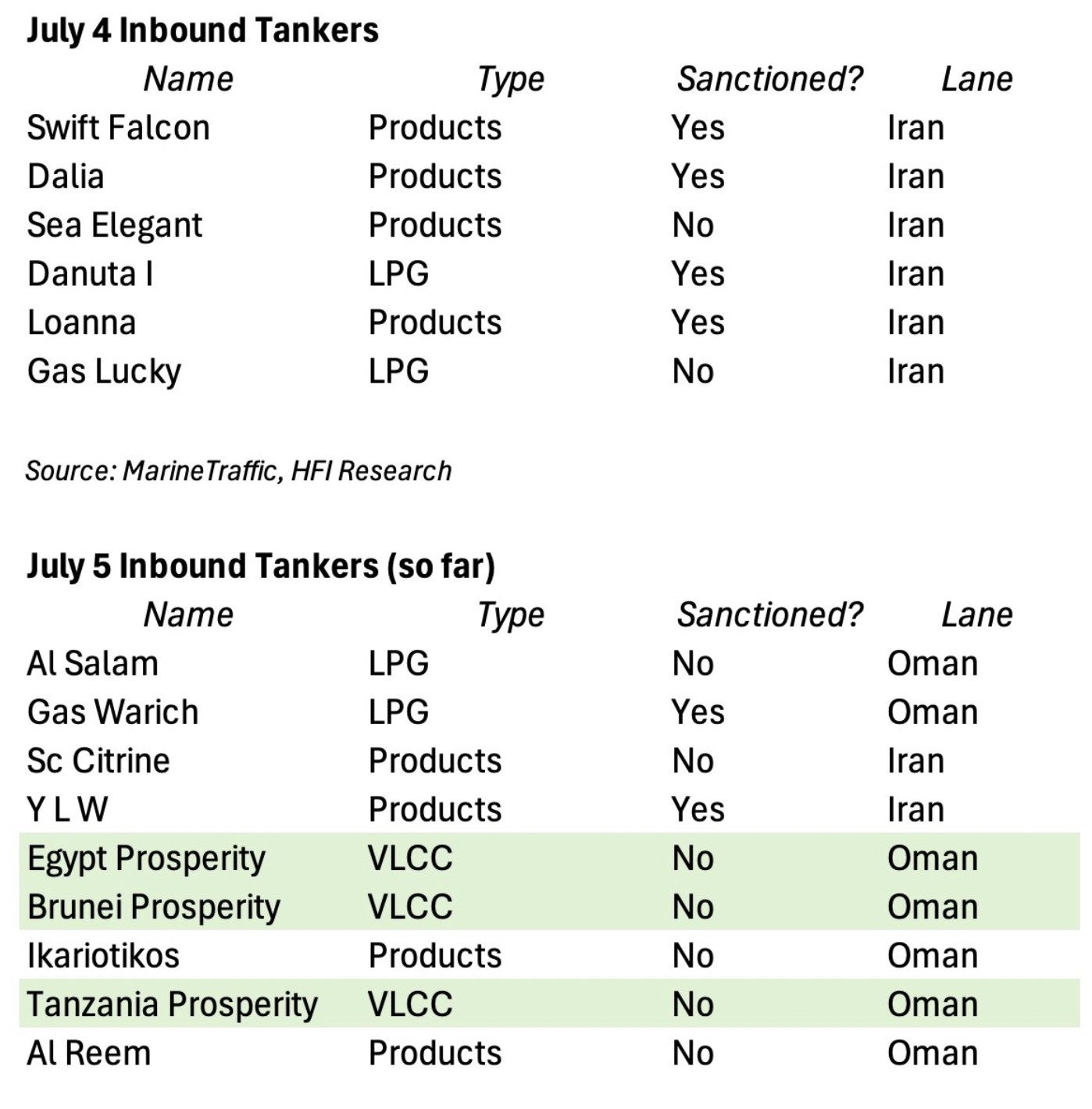
US tanker escort is back with a large group of tankers going out and coming in.
We tracked 3 VLCCs inbound ending with “prosperity”. If you look at the VLCCs waiting in Fujairah, there will be another 3 to 4 Prosperity VLCCs going in.… pic.twitter.com/kZBP2YOfGb
— HFI Research (@HFI_Research) July 6, 2026
Things are hotting up in Yemen:
Iran broke the sanctions on Sanaa, Yemen, for the second day. After 11 years, Iran’s airline Mahan Air landed in Sanaa and transported 200 wounded and a senior Ansar Allah Yemeni delegation to Iran. That is huge because it defies the regional and western procedures against Yemen.
— Elijah J. Magnier 🇪🇺 (@ejmalrai) July 5, 2026
And there is what sure looks like a provocation in the Bab El-Mandib environs:
BREAKING: A cargo vessel was attacked 30 nautical miles southwest of Yemen’s Al Hudaydah port on Sunday, per UKMTO.
The vessel sent a distress alert stating it was “under attack by unknown armed assailants.” A skiff opened fire on the bulk carrier before retreating to a larger… pic.twitter.com/xWZWQT0uAV
— The Hormuz Report (@HormuzReport) July 5, 2026
And Israel keeps up its violations of the MOU and even its “stay in Lebanon” deal. From Aljazeera’s live feed:
Israeli forces launch air strikes on Nabatieh in southern Lebanon despite signing a US-brokered agreement with Lebanon last month to end hostilities.
On the bigger mystery of oil pricing, Satyajit Das provided a very important analysis in Why the ‘oil price’ isn’t always the oil price. Please read it in full. Key sections:
The Iran war has now once again starkly highlighted the differences between physical and paper commodities, the distinction between availability and price, and the real-life complications that can often intrude when handling real stuff rather than purely financial securities.
With limited data about dealings in the spot market for immediate delivery of oil, coverage has focused on the near-month futures contract price. But while the futures price hovered around $100 per barrel during the most intense kinetic action, actual cargoes were changing hands at levels 80 to 100 per cent higher. Diesel and jet fuel prices were at a similar premium, reflecting widening refining spreads and shortages in key locations….
Politicians, eager to downplay rising energy costs, emphasised the lower futures prices rather than actual physical costs….ignoring the fact that futures prices are poor indicators of actual prices.
To be fair, the relationship between spot and futures prices in oil, as for most commodities, is actually quite complex.
Unlike financial assets, such as currencies, interest rates, and equities, oil is physical and not homogenous…
There are storage, insurance and transport costs….
Importantly, the basic arbitrage-based futures pricing model doesn’t hold. As the futures price is agreed today to be paid at a deferred date, a forward seller could (if the future prices are higher than the current spot price) purchase the required quantity of the asset immediately, fund and store it, then deliver on the agreed forward date.
A forward purchaser could replicate the transaction by selling in the spot market and investing the proceeds until the agreed future date, when the maturing investment could be utilised to fund the purchase. The cost of the immediate purchase or sale, funding and storage until delivery determines the futures price.
In theory, this standard model — adjusted for quality differences, insurance and transport costs — could be used for oil. In practice, this is difficult because the institutional structure of oil markets impedes the process where the future price is forced to this equilibrium level through arbitrage.
One problem is that physical oil is difficult to short. Mechanisms common in financial assets, like borrowing the asset for short-selling, are not widely available…
Another is that the participants in the physical and futures market differ….
Another consideration is liquidity. Daily oil derivative trading volumes are up to 60 times physical oil trades.
These factors mean that actual futures prices for commodities don’t follow arbitrage models and are often lower than the spot price — or in “backwardation” in the industry argot.
There’s a lot more in this highly informative article, but these tidbits alone give an idea of how physical oil prices can diverge from the futures markets for extended periods of time.
Mario Nawfal hosted several conversations with oil experts and economists in the wake of the discussion with Philip Pilkington that we showcased.4
Recall that Philip Pilkington argued, in his first interview with Mario Nawfal that we featured over the weekend, that investor trading is significantly driven by “information” like Trump words like “gusher” getting into headlines, and the level of short positions. Momentum trading is very profitable until it isn’t.
Pilkington returned to the crack spreads issue and conceded that the high level could reflect refiner price gouging, as opposed to high prices for oil. But Trump has been jawboning for refiners and retailers to cut prices. Pilkington argued that if the crack spreads were still high in a week or two, that would confirm his analysis.
Pilkington also cleared up official disinformation, that the “10 million barrels out of the Gulf” claim included Saudi oil being shipped via pipeline to Yanbu which are estimated at a bit in excess of 5 million barrels a day. So that means only 5 millionish is coming through the Strait of Hormuz. A bit is being routed over land via Iraq. But with pre-war Strait of Hormuz estimated at over 20 million barrels a day, and demand destruction looking modest at best, the shortfall looks to be on the order of 14 million barrels a day, which is still coming out of inventories.
Nick Wade, in a new post, Local Glut, Global Headline, debunks the oft-flogged claim that there is now an oil surplus:
The market’s “global glut” argument mistakes a localised bottleneck for a global condition, then treats the price fall that it has caused as confirmation.
Two finite mechanisms are pushing prices down: coordinated strategic reserve drawdowns, and the clearing of the Gulf’s wartime backlog. Both are one-off and both are draining.
UAE and Iraq heavily discounted the trapped oil that exited the Gulf to clear the backlog, and China’s teapots opportunistically bought it cheap. Iran didn’t match that temporary discount, leaving its unsold oil floating at sea while it focused on longer-term buyers.
The pattern of a localised, rather than a global, glut is visible across West African crude too. Those prices have fallen unevenly, rather than in lockstep, reflecting a single mechanism unwinding rather than a global surplus.
A global surplus should broaden across grades and regions, and eventually ease product markets too. What we are seeing instead is concentrated distress in the grades and routes tied most closely to China’s absence and the Gulf backlog.
OPEC output in June remained roughly a quarter below February levels, and US crude inventories are near a multi-decade low. That fits a one-off backlog clearance pushing the price down worldwide while the underlying position stays tight – not a global surplus in the making…
If the world did have too much oil, the size of the price fall in each country would be roughly in-sync, adjusting for things like oil quality and shipping cost, not on how much of that country’s recent demand was really just a temporary substitute for Gulf oil. Yet the latter is exactly what we saw: Congo and Angola, which were bought almost entirely as substitutes, have fallen the most. Nigeria, which has other buyers and uses beyond that emergency demand, has fallen by much less. That pattern only makes sense if this is one temporary cause unwinding at different speeds in each country, not evidence of a real global surplus.
We pointed out in comments that Iran was indeed shipping but not selling a lot of oil. From Bloomberg on July 2:
Iran’s Floating Oil Hoard Swells as Major Buyers Stay Away
A hoard of Iranian oil is building up at sea as the Islamic Republic struggles to find buyers before the expiry of a 60-day window granted by Washington.
More than 90% of these cargoes on water have no clear destination, with vessels indicating “for orders” or Singapore as their next port of call.
Tehran faces obstacles in trying to sell the oil, including European Union and UK restrictions, a lack of demand in major Asian markets, and concerns that Washington could reimpose sanctions if negotiations collapse.
More than 20 million barrels of Iranian crude have been idling in Asian waters for at least seven days, up nearly 18% from a week earlier, according to Kpler Ltd. Estimates for the overall volume of the country’s oil on water — either in transit or stationary — have ranged from 58 million to 68 million barrels since the US sanctions waiver kicked in last week, according to data from Vortexa and Bloomberg calculations.
More than 90% of these cargoes on water have no clear destination. The vessels are either indicating “for orders” or Singapore as their next port of call, a sign they may conduct ship-to-ship transfers in the Malacca Strait.
A failure to quickly sell the crude would deprive Tehran of much-needed revenue and could weaken its hand in negotiations with Washington. The Islamic Republic has until mid-August to find buyers after the US lifted sanctions on the oil in June and ended a blockade of Iranian ports, part of an interim peace deal.
But Wade says in light of the temporary gluts that Iran is keeping its supply at sea, waiting for better prices:
The result has shown up in the level of Iran’s oil on the water, the shipping industry’s term for crude that’s loaded and at sea but not yet delivered. It has risen to 58-68 mb, according to Vortexa, with more than 20 mb idling in Asian waters for at least a week and over 90% of cargoes showing no confirmed destination.
Most of that ostensibly stranded oil looks deliberate rather than accidental. TankerTrackers recorded roughly 20 mb leaving Iran in a single day on 19 June. Historically, Iran’s exports to China have been around 1.4 mb/d, with reported short-period peaks around 2.2 mb/d. So this single convoy was the equivalent of nine to fourteen days of Iran’s normal sales to China. That looks less like normal spot selling than pre-positioning: either for pre-arranged buyers, for floating storage near Asia, or for optionality ahead of another possible disruption. This fits the earlier point made in Better Flows more reasonably than an account of Iran being caught out by the market. Iran was positioning ahead of a possible new closure of the strait, not caught out by a market it didn’t see coming.
More on the anomalous pricing:
This is completely insane…or evidence of official use of paper shorts to drive oil prices down. What the chart says is that exactly zero other times in the past 15 years have MM’s been this short oil. Outside of a massive global recession (or manipulation), it’s difficult to… https://t.co/LtRNzIXsAI
— Chris Martenson (@chrismartenson) July 5, 2026
The highest Brent short positioning relative to global onshore crude oil inventories in history. pic.twitter.com/aJqSteQEkU
— HFI Research (@HFI_Research) July 6, 2026
Finally, over the weekend in comments, we noted how some readers seem to reflexively reject information because they are on Team Anti-globalist, so they behave as if they have an emotional investment in Team Anti-globalist doing well.
BettBeat called this tendency out too: The Triumphalism Trap: How Anti-Imperialist Media Manufactures Its Own Consent
At the end, it has a video embedded from Dimitri Lascaris that discusses the same cognitive bias and why it is counter-productive.
In that spirit, and in seeking generally to promote critical thinking, we offer a tweet by Brett Erickson:
I think that many are overstating the DEGREE to which Iran has “won” the U.S./Iran War.
While all but the most deluded see that the United States has been woefully outplayed in this conflict, the extent to which Iran is able to monetize their leverage of the Strait of Hormuz remains to be seen.
Although some may claim that Iran tolling the Strait or receiving their frozen assets constitutes a victory, the reality is far less simplified.
Like many things, the degree to which Iran has a lasting victory comes down to the age old answer of: “it depends”.
Iran has likely seen ~$100B of damage to their economy as a result of this conflict. An economy that was already in poor position to begin with.
If Iran is able to actually extract $40B of revenues from tolling the Strait of Hormuz? Yes, that’s a MASSIVE victory.
But what happens if the far more likely revenue flow amounts to $5B – $10B per year? That’s a very different calculation.
What happens if they only try $12B of frozen assets compared to $100B? That’s a very different calculation.
As is the case with most complex scenarios, the reality of an outcomes significance amounts to:
“It depends”
Now this is clearly too simple a calculus, and puts it in a money frame. Robert Pape keeps pointing out that the real issue is power and Iran establishing itself itself as dominant in the region, as opposed to merely getting a financial recovery. Big sums from fees and tolls would show Iran’s standing cannot be denied, but lesser amounts, if say the US is indeed run out of the region and Israel is severely weakened, would be a major success, if not as comprehensive.
See you tomorrow!
______
1 Professor Marandi, who was not even able to get very close to the prayer hall, said it would take two hours of walking to get in range as he had.
2 I was appalled by former JCPOA negotiator Alan Eyre casting strong doubts the estimates of crowd sizes and even worse, the idea that the mourning was genuine, as opposed to a big bunch of the usual suspects rounded up by the Iran government. If you listen, Eyre often opts for an angry, dismissive tone of voice. From a machine-generated transcript of his talk with Mario Nawfal:
I’m not surprised at all. I mean, again, lots of people like this guy. Lots of people were upset he was killed. So in terms of the numbers, who knows? But he was in power for 40 years. Even if he were hated, which he wasn’t, at least by certain segments of the population, you know, the the government knows how to turn out people for things like this. So you take that the government’s ability to mobilize people and the fact that at least certain segments of the Iranian population generally looked up to this guy. Yeah. You get numbers in the numbers in the street even though it’s what 36 degrees Celsius in Tehran.
Eyre says that the crowd could have been 2 million. Nawfal says the media reports are 9 million. Back to Eyre:
I wouldn’t surprise it doesn’t surprise me. And I’ll wait for the for the you know crowd size estimation is an exact science you know and and you know people inflate it in different directions based on their political leanings. I don’t know the numbers. I read the same things you do. But, you know, I’m willing to take it as a certainty that millions of Iranians are showing their grief by turning out to mourn the assassinated leader and at this and his family. Let’s not forget, you know, the his daughter-in-law, his son-in-law, his 12month-old grandchild. They were all killed also. So, I’m willing to accept all of that. and also the fact that there are large segments of the Iranian population who genuinely are seriously opposed to the Islamic Republic.
3 Readers know I don’t agree with some of these views, as in alternate interpretations are more consistent with the text.
4 The Nawfal talk with Jeff Currie was shocking. Currie had made the bold call that the oil cliff would arrive around July 4; other experts who believes that would come into play were saying mid-July to mid-August. Currie seems to have descended into mumble mumble. Pilkington correctly seemed mystified by his comments, particularly that Ukraine attacks on Russia were doing meaningful harm to its refinery output. Currie seemed unaware that Russia has always imported some refined product and that shortages in Crimea and other “end of route” areas in peak driving season are common in Russia.
