


Important points
Late summer is a great time to buy a home, as listings increase, inventory is fresher, and sellers are more willing to make concessions. The best time to buy depends on your city and your priorities. Whether you’re looking for fresh inventory, a larger selection, or the best deals. At the end of the day, the best time to buy a home is when it makes the most sense for you personally and financially.
The best time to buy a home depends on what’s most important to you. Some buyers prioritize getting the best deal, while others want the most choice of homes and the least amount of competition. Everything from seasonality to local markets to economic forces can influence your purchases, and that’s before you factor in your personal schedule.
Today’s housing market adds another layer to the equation. While affordability remains an issue, buyers have more bargaining power than they have in recent years. Nationwide, there are about 47% more sellers than buyers, and sellers are offering concessions in record time. For financially prepared buyers, now is a great time to take full advantage of these benefits.
Spring is generally considered the best time to sell a home, but when is the best time to buy? We’ll break down the best times to buy in cities across the country, why timing varies by market, what data to look at, and how to decide when it makes sense to take action.
From Redfin’s Chief Economist
“August is prime time for home buyers. Sellers are starting to offer more concessions, inventory is still well stocked from the spring, and there are still enough new listings to keep things fresh. But buying a home is local and personal, and different priorities mean different timelines. Generally speaking, the best time to buy is when you’re financially comfortable, have found the right home, and are ready to move.” – Redfin Chief Economist Darryl Fairweather.
When is the best time to buy a home?
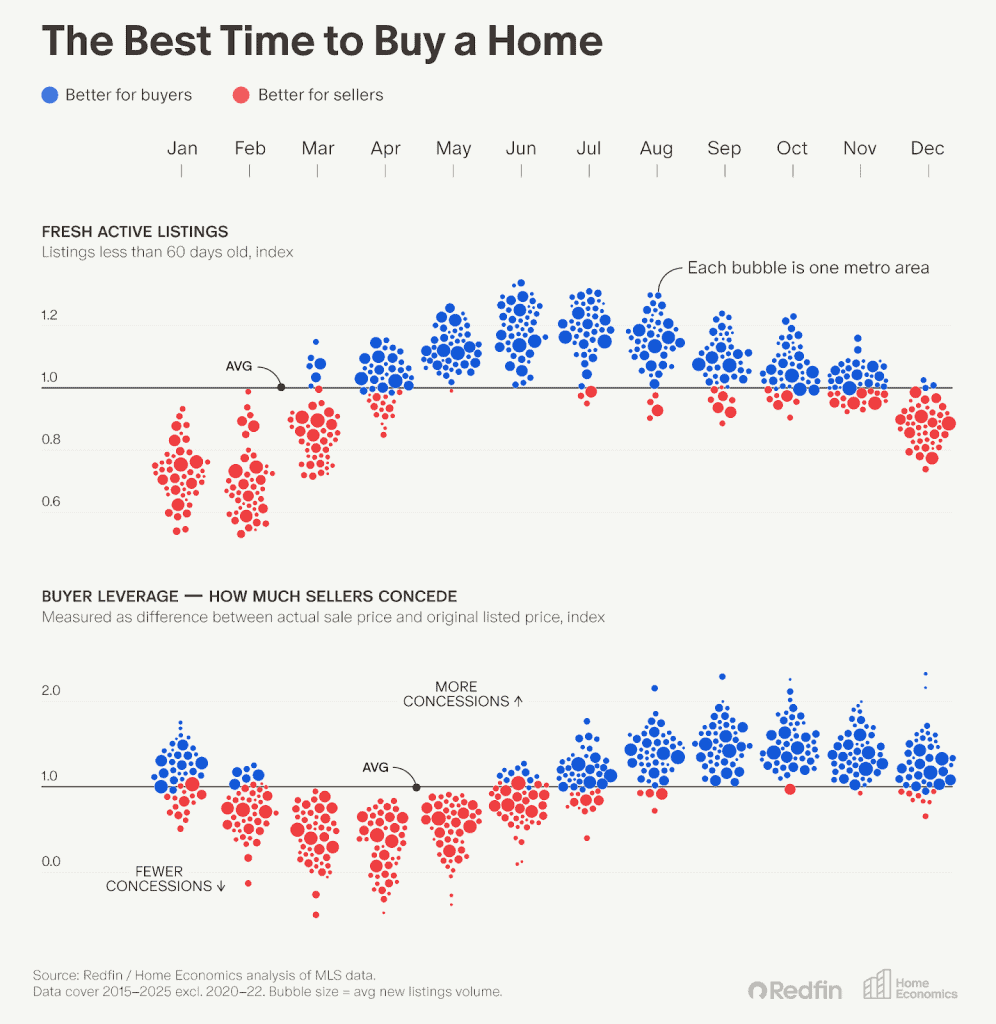
According to a report from Redfin and Home Economies, the best time to buy a home is late summer, specifically August. Listings are fresher, inventory is increasing, and homeowners are beginning to make concessions as the peak sales season passes.
But buying involves trade-offs, and finding the “best” time to make an offer is complicated. For example, more inventory increases your chances of finding the perfect home, but more options means more competition, more urgency, and the need to make a stronger offer to win the home.
To capture this tradeoff, Redfin’s analysis focused on three key moments for homebuyers.
When new listings are increasing When inventory is at its highest When sellers are offering the biggest discounts
Late summer is the time when these trends most often overlap. However, it all depends on whether the time is right for you. Personal considerations such as finances and travel schedule are paramount.
Shop in late spring to get the newest products
The flow of new listings typically peaks in late spring and continues into early summer. This is the time of year when buyers are most likely to find new homes for sale.
However, new listings also intensify competition. Spring is the peak season for the housing market, so bidding wars are expected for prime properties.
Purchase in midsummer when inventory is at its highest.
Housing inventory tends to peak in midsummer as last spring’s losers list their homes and less popular properties remain on the market. Buyers during this time typically have the most options for new homes.
It’s a bargain if you buy it in early autumn.
Price cuts, discounts, and other seller concessions reach their peak in early fall as they try to attract buyers before the onset of winter. Winter is not the best time for bargain hunters. This is because by the onset of winter, sellers are more likely to wait for new buyers in the spring than to make concessions.
Best time to buy a home by city in 2026
Nationally, the best time to buy is late summer, but timing varies widely depending on the city and what the buyer values most. For example, in Atlanta, mid-July is the best time for buyers looking for more inventory, while in San Francisco, inventory peaks in October.
Homebuying is seasonal, regional, and highly personal, and there is no one-size-fits-all strategy that will work for everyone everywhere. But data can still be useful for decision-making.
The peak home buying seasons for 2026 in U.S. cities are as follows:
Why does seasonality matter?
The further south a city is, the less “seasonal” the housing market becomes, with no defined “buying” and “selling” seasons. Markets with warm climates throughout the year tend to have stable inventory and demand throughout the year, while northern cities often see more pronounced fluctuations, with peaks in the spring and slowdowns in the fall.
In Boston, for example, sellers are much more likely to offer discounts at the beginning of fall. In Tampa, sellers are unlikely to offer discounts until November. Talk to a real estate professional to understand your local market and when you can find the best deals.
How to buy a house more cheaply
In today’s depressed market, homebuyers often have the leverage to negotiate concessions, price reductions, and more with sellers. Although there are several markets in the Midwest and Northeast where sellers are responsible and demand is high, consumers are generally held back by high costs and relatively limited inventory.
Here are some tips for home buyers looking to get a better deal on a home in today’s market.
Negotiate seller concessions: Ask the seller to cover closing costs, pay for repairs, reduce the price, or buy out the mortgage interest. Shop when inventory is high: There are often more homes to choose from in the spring, but demand can also be higher. Check out the Redfin Data Center to stay up to date on local housing market trends. Look for homes when demand is low: After the busy spring and summer seasons, sellers are more likely to make concessions. However, once winter arrives, most homeowners expect the market to slow, which is unlikely. Consider fixer-uppers or “sold as is” homes. These properties are often less expensive, but may require some effort to make them livable. Work with a local real estate agent who understands neighborhood trends and can help you negotiate. Work with a local real estate agent: A local real estate agent will have in-depth knowledge of the nearby housing market and recent sales in the area, giving you an advantage when making offers and negotiating. Additionally, agents may have access to private listings that you won’t find anywhere else. Get pre-approved as soon as possible: Getting pre-approved for a mortgage allows you to set a budget, show sellers you’re serious, and help you move quickly when you find the right home.
>> Read: How to find affordable housing
Should I wait until the housing market improves?
Buyers have the power in today’s housing market, but many buyers wait for mortgage rates and home values to decline before making a purchase. Timing the market can be difficult, especially in today’s uncertain economy.
Significantly lower mortgage rates or lower inflation could put more buyers on the sidelines, increasing competition and putting upward pressure on home prices, while also incentivizing more sellers to list. Currently, financially prepared buyers benefit from greater bargaining power, more seller concessions, and less competition than in more active markets.
“My best advice for cost-conscious buyers is to focus on the long term and buy when you are personally and financially ready,” Fairweather added. “Housing is a major investment, and timing the market to capture discounts is difficult and may not make sense for everyone. Housing is expensive, and while affordability is improving, it is unlikely to move materially until economic uncertainty eases and home construction improves. Don’t stretch your budget or rush the process if you don’t have to.”
After all, the best time to buy isn’t necessarily when market conditions are perfect, but when you’re financially ready, have found the right home, and are ready to move.
>> Read: Is Now a Good Time to Buy a Home?
Final thoughts: The best time to buy a home is late summer, but your personal schedule is most important
Buying a home remains difficult for most people. Typical home payments have risen to more than $2,600, the median home price is nearly $400,000, and mortgage rates are volatile.
But the buyer side also has more influence than in recent years. Competition is low, inventory is rising, and sellers are increasingly offering discounts and concessions to attract buyers.
For those who are still hoping to find their dream home, late summer is the perfect time to buy a home. Demand increases, inventory increases, and price reductions become common. But at the end of the day, the best time to buy is the best time for you.
Please refer to the original report for the complete methodology.
