


We will soon go through some of the elements of the rap sheet of former Fed chairman Alan Greenspan, who just died at age 100, that may not be as well known as other misdeeds, the biggest being the Greenspan put, which then became the Bernanke/Yellen/Powell put. But to prove that he was not as well respected even in his heyday as the press in those days would have you believe, a story from a finance professional prominent enough to be regularly invited to Economics Club of New York talks:
One time, when I was on the last shuttle flight from Washington DC to New York, Greenspan was on the same plane. I debated whether I would be willing to die in a crash if it killed Greenspan too. I quickly concluded “yes”.
In other words, during Peak Greenspan, many skeptics held their tongues rather than fight the tape of the media cheerleading.
Reagan replaced Volcker as Fed chairman with Greenspan despite Volcker having implemented Friedmanite (as in neoliberal) monetary policies and explicitly seeking to weaken labor bargaining power during his super-high interest rate experiment attributed with breaking the back of 1970s/early 1980s inflation. In his book on the Federal Reserve, The Secrets of the Temple, Bill Greider recounted that Volcker kept an index card of weekly average construction wages and was looking for them to start falling as proof that his punishment was working. IIRC, Volcker said, “I want unions to get the message.”
Even though Volcker was tough on labor, he was also tough on big finance. He believed banks should stay largely simple and stupid, as in focus on their core role of payments processing, and correctly saw fancy finance as rentierism. Volcker said the only real innovation he had seen in banking was the ATM.1
Volcker was ousted due to his refusal to support bank deregulation. From a 2020 paper by Thomas Ferguson, Paul Jorgensen, and Jie Chen:
For months the suspense built up. By the late Spring of 1987, the initial trickle of anxious conjectures had swollen into a raging torrent of speculation and suspicion. On June 2, 1987, the worldwide guessing game came at last to an end: the White House announced that President Reagan would nominate Alan Greenspan to replace Paul Volcker as Chair of the Federal Reserve Board. Markets reacted with shock: “the news stunned the financial markets, which had come to regard a third term for Mr. Volcker as highly probable. Bonds finished with one of the biggest losses on record, and the dollar tumbled” (Hershey 1987).
At the time, the official story was that Volcker had indicated in a letter that “he did not wish to be reappointed after eight years in the job.” Even then many doubted that was the whole truth: “It appeared that White House efforts to persuade Mr. Volcker to remain were minimal. It is understood that Mr. Volcker would have accepted a reappointment to the post if the President himself had urged
him to do so. But no such effort was made.”
In fact this gloss was an epic understatement, linked closely to a second – and far more profound – misjudgment: “Economists and other analysts said Mr. Greenspan, in taking a job that is sometimes described as the second most
influential in the nation, was unlikely to pursue a policy markedly different from
Mr. Volcker’s.”
The truth, as a few insiders knew, was very different. At a crucial White House meeting of top Republicans convened to discuss Volcker’s fate, the hostility of Treasury Secretary James A. Baker and his Deputy, Richard Darman to the six foot, seven inch cigar chomping Fed Chair spilled out into the open. GOP Senate Leader Robert Dole and Senate Budget Committee Chair Pete Domenici, who came suspecting that Baker and Darman wanted to substitute Greenspan, pressed a case for reappointing Volcker. They questioned whether his experience and knowledge of international economic issues did not make him irreplaceable. Baker flatly rejected this, saying that he and Darman now knew enough to deal with the G7 issues.
Eventually the discussion worked around to the reasons for Baker’s opposition. The Treasury Secretary responded by naming two issues: Volcker’s skepticism about financial deregulation and, in particular, his opposition to repeal of the Glass-Steagall Act, the New Deal measure that severed investment from commercial banking. Asked why that issue was so important, Baker’s answer was startling direct: Possible repeal of Glass-Steagall was the signature issue used by investment bankers, led by Robert Rubin, then of Goldman, Sachs, to raise money from their cohorts on Wall Street for the Democratic Party. Getting rid of Glass- Steagall, Baker explained, would alter the balance of power between the two major parties by depriving the Democrats of a central revenue stream.
Readers might say, that plan did not wark as intended. After all, Glass-Steagall was not repealed until 1999.2
But as we have said, by then Glass-Steagall was so shot full of holes that its repeal was a mere formality, passed mainly to tidy up the legalities of Citigroup acquisition of insurance giant Travelers.3 Glass-Steagall came to an end in a very big way in 1988 (no typo) when very early in Greenspan’s tenure, the European commercial bank Credit Suisse merged with bulge bracket firm and fixed income powerhouse First Boston to rescue First Boston in the wake of the 1987 crash (First Boston had badly wrong-footed some high-risk bond exposures). Both Citibank and JP Morgan were pushing the envelope as hard as they could in the late 1980s and through the 1990s in their investment bank adventurism. Similarly, the Fed allowed an “affiliation” between Citibank and Salomon Smith Barney in 1998 that was effectively a merger.
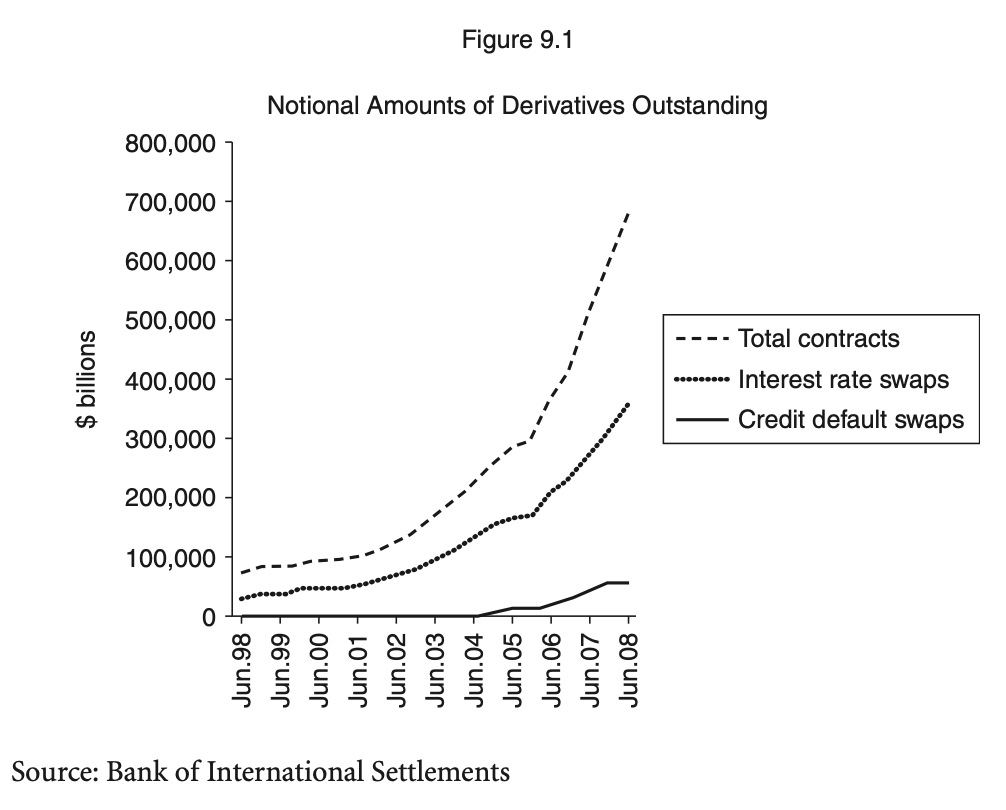
But an even bigger and less well known Volcker sin was allowing unregulated derivatives trading. As we explained long form in ECONNED, the 2008 crisis was not a housing crisis but a derivatives crisis of instruments that referenced particularly risky subprime exposures. The entire subprime market was not big enough to produce more than at worst something a big nastier than the saving & loan crisis, nor a near failure of the global financial system. But credit default swaps and CDO composed heavily of CDS referencing BBB-subprime tranches created exposures of 4 to 6 times the real economy value and concentrated them at systemically important, overleveraged financial institutions.
And Greenspan’s pathological neglect and the systemic effects greatly predate the famed row of Greenspan and Treasury Secretary Bob Rubin against CFTC chair Brooksley Born over regulation of credit default swamps, with Born lost. Greenspan ushered in the widespread use of derivatives which are used almost entirely for speculation, thus diverting resources and “talent” into socially destructive activity. And as we will soon explain, the explosive growth of over-the-counter derivatives markets was a major driver of demand for securitized products.
In the early 1990s, your humble blogger had one of the two top derivatives trading firms, O’Connor & Associates, as a client. Their big competitor was Bankers Trust. My time with O’Connor showed me that it took an extremely high level of sophistication, in staff training, risk modeling, internal organization (as in trader/position management) and IT (where O’Connor was bleeding edge, running the biggest UNIX network in the world ex DARPAnet itself). It was way too easy for mere mortals to blow themselves up; O’Connor did some advising to Fortune 500 companies who had done just that. The idea that a sophisticated multinational like Proctor & Gamble could claim to have been victimized when they should have damned well known what they were doing is a further testament to the high skill level needed to manage derivates operations properly.
I recall gasping out loud, I believe in 1996, when I read in Institutional Investor that Greenspan was adopting a “Let a thousand flowers bloom” approach to regulatory oversight of derivatives risk at banks, as in doing nothing. But Greenspan believe that reputational risk would keep industry participants on good behavior.
In reality, I later learned that JP Morgan was in a big push to get its version of Value at Risk models adopted. I won’t belabor as to how, but JP Morgan clearly thought this would give them competitive advantages.
The result was that regulators came to operate in a close to blind manner, much like a doctor treating blood pressure as a reliable indictor of patient health, when it needs to be included with other measures. And we will skip over how badly VaR models peformed in the crisis.
Forgive us for the deep dive, but ECONNED explained how the free markets approach to derivatives was a, if not the, major driver of the 2008 crisis, to create more AAA rated paper to secure derivatives positions. The AAA tranches in most securitizations account for 70% to 80% of face value. From ECONNED:
Some have argued that the parabolic increase in demand for repos was due in large measure to borrowing by hedge funds. Indeed, Alan Greenspan reportedly used repos as a proxy for the leverage used by hedge funds. Others believe that the greater need for repos resulted from the growth in derivatives. But since hedge funds are also significant derivatives counterparties, the two uses are related.
Brokers and traders often need to post collateral for derivatives as a way of assuring performance on derivatives contracts. Hedge funds must typically put up an amount equal to the current market value of the contract, while large dealers generally have to post collateral only above a threshold level. Con- tracts may also call for extra collateral to be provided if specified events occur, like a downgrade to their own ratings. (Recall that it was ratings downgrades that led AIG to have to post collateral, which was the proximate cause of its bailout.) Cash is the most important form of collateral. Repos can be used to raise cash. Many counterparties also allow securities eligible for repo to serve as collateral.
Due to the strength of this demand, as early as 2001, there was evidence of a shortage of collateral. The Bank for International Settlements warned that the scarcity was likely to result in “appreciable substitution into collateral having relatively higher issuer and liquidity risk.”
That is code for “dealers will probably start accepting lower-quality collateral for repos.” And they did, with that collateral including complex securitized products that banks were obligingly creating.
We were too polite in ECONNED. Another way to tell the story is “Greenspan’s ‘Let a thousand flowers bloom’ approach to derivatives led to a kudzu-like proliferation and excessive risk-taking.”
Unnecessary complexity, since it enables structurers to pull out more fees than for plain vanilla products, can support the general tendency towards overdiversification as a bizarre counter to a fondness for unduly tailored exposures (basically fund manager busywork which again adds to false perceptions of value added and too many fees), and is often useful in getting chumps to eat too much risk for too little return.
But press commentary seldom addresses the big system-wide drag of fostering yet more unproductive financialization. Instead they focus on the public’s hot buttons and in the process, often help perpetuate financial services industry information fogging.
As much as readers might not like hearing it, most of the structured credit products in the chart above were tested in the crisis and got through unscathed, such as collateralized loan obligations (a pretty conservative structure) and commercial real estate MBS (which unlike subprime, have loans big enough that services can work out if they go back, and thus servicers are paid to do modifications).
By contrast, subprime mortgage backed securities had always been trouble. There had been a much smaller subprime market in the 1990s which hit the wall for essentially the same reasons as the 2000s versions. The structured paper didn’t pay enough to cover the risks and provide enough in fees to the intermediaries for putting them together to sell them. The “solution” had been to shortchange the lowest rated tranche, the BBB/BBB- tranche, in terms of yield and other protections. That was only a small part of the total face value, 3% to 4%. But there weren’t enough stuffees for this paper. So like making sausage out of less desired pig bits, they were rolled into CDOs, with enough better-looking assets to make them minimally appetizing. Again, the top tranche of CDOs was rated AAA but traded at more like AA yields (as in investors recognized the AAA ratings were a stretch).
So to truncate a much fuller telling of this tale, the problem was not asset backed securities per se but picking assets to securitize in bulk that were really not well suited to the exercise, and then “solving” that problem with a leverage-on-leverage scheme, the asset-backed-securities CDO, colloquially called the subprime CDO. Leverage on leverage on any scale is a ticking time bomb. Similarly highly leveraged trust of trusts (and trusts of trusts of trust) precipitated the Great Crash of 1929.
But Greenspan was far too much a free markets true believer to even consider that markets have a propensity to generate bubbles and manias since they are highly profitable to the intermediaries as they build up, plus the insiders often manage to escape losses when they implode, or at least believe they can.
We could go on and on and on, but it gives Greenspan more dignity than he deserves to expend too many pixels on him.
____
1 After the crisis, Bank of England governor Mervyn King pushed hard for what was called ring-fencing, as in a rollback to the separation of investment banking, with the intent of also subjecting traditional banks to stricter regulation. King and his allies lost to Treasury.
2 I hate to pull rank, but this is terrain I know particularly well. When I joined McKinsey in 1983, I was assigned almost entirely to studies to help commercial banks get into investment banking. For instance in the early 1980s, I was in the room when a Citibank manager proudly told us how Citi had moved an entire commercial company on and off their books, almost as a financial engineering stunt. We were quietly aghast since this was clearly illegal under the rules at that time.
3 We will skip over how Greenspan largely got the Fed out of taking its job as the regulatory supervisor seriously, although the Fed fiercely insisted on keeping that role when Gramm–Leach–Bliley Act was being finalized.
