


Weakening Breadbasket Buffer
Drought is one of the most obvious ways climate change is weakening breadbaskets. Major crop producing regions rely on predictable rainfall, stable soil moisture, and reliable growing seasons. If one region experiences a drought, other regions may be able to fill the gap. However, if several granaries are depleted at the same time, the system has fewer alternatives.
A recent study of global breadbasket drought found that the probability of simultaneous drought across corn-growing regions this century is between 52 and 60 percent, depending on the magnitude of greenhouse gas emissions. The authors show that this risk is particularly posed by prolonged dryness in Brazil, Europe and the United States, and that even if multiple regions experience moderate to extreme drought at the same time, a global shock can occur.
The danger is not only that climate change will reduce yields. It means undermining the geographical logic on which modern food systems depend. Global trade works best when shocks are spread out. If all the places that are supposed to balance each other are under pressure at the same time, their function will be much worse. What appears to be a resilient system under isolated stress can become a fragile system under synchronous stress. In other words, interconnectivity can be a risk in itself.
The evolving fragility of the global food system suggests that shocks will not simply pass through the system as trade networks deepen and more countries become dependent on imports. They can intensify in it. Harvest failure in one region could trigger export restrictions, precautionary purchases, and widespread instability elsewhere.
The “evolving” part refers to how the system has become more interconnected over time. Trade connections are import and export links between countries, such as one country supplying wheat or rice to another. As these connections increase, there are more channels for shocks to spread.
During periods of food scarcity, food producers tend to reduce exports. In other words, when food becomes scarce, the same trade links that normally transport grain efficiently can become channels for disruption, as countries protect their own supplies and those that rely on imports are further put at risk.
This is important because food systems are more than just farms. These include the production and distribution of seeds, animal feed, fertilizers and pest control, as well as storage, transportation, processing and retail.
Events like drought are more than just production shocks. These can have shockwaves throughout the supply chain. And the more a system relies on low inventory supplies at tight times, the more it is at risk when the weather does not behave as predicted.
Risks of corporate consolidation
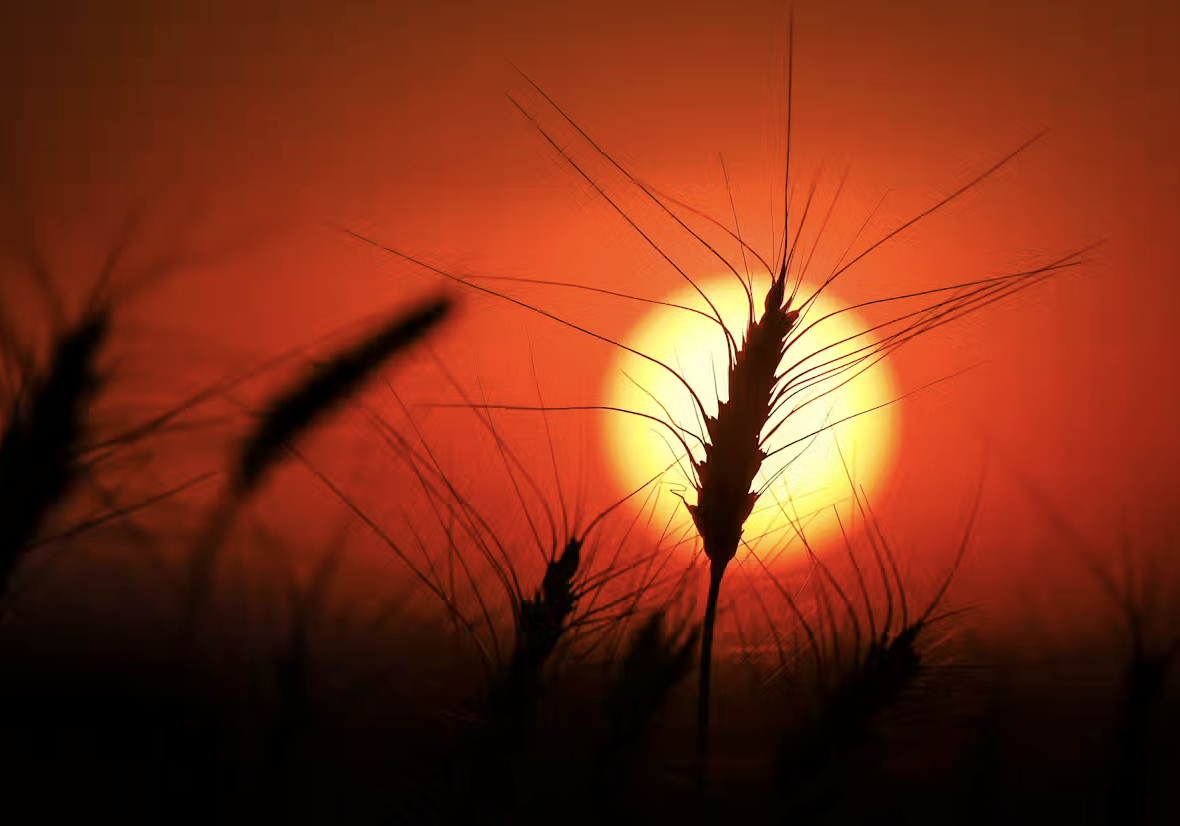
Silhouettes of wheat heads illuminated by the sun in a wheat field near Cremona, Alta. Canadian Press/Jeff McIntosh
Modern agriculture does not simply rely on favorable climatic conditions. It also depends on a continuous, coordinated flow of manufacturing inputs that arrive at the right place, at the right time, and at the right price.
The flow is not organized through a wide open market with infinite choices. Move through highly focused corporate channels.
Corporate concentration and power in the food system shapes choice, flexibility, and control. The world’s top four agricultural companies control approximately 50-60% of the commercial seed market, and the same four companies control approximately 70% of the global pesticide market.
Mergers between seed companies and agrochemical companies, and consolidation between fertilizer companies and retailers only deepen that pattern.
In periods of stability, this may seem like strength. Large companies can move vast quantities of seeds and chemicals, coordinate supplies across borders, standardize products, and reduce transaction costs. Producing at scale makes systems faster, cheaper, and more readable. However, scale and resilience are not the same.
Fewer suppliers and more dominant suppliers means fewer substitutes. When fewer companies dominate a seed, pesticide, or fertilizer market, a large part of the system relies on fewer decisions and fewer routes.
In a centralized system, disruptions do not remain isolated. It ripples outward through larger parts of the food chain. Vulnerability lies not only in scarcity but also in adjustment. When multiple pressures are reached at once, a concentrated system has much less ability to adjust.
Droughts elsewhere can leave shelves here empty
International food supply shocks show that a country does not need to experience a drought to suffer its effects. If a country or region is highly dependent on imports of staple foods, a harvest shock occurring thousands of kilometers away can increase prices, tighten supplies and limit access to food.
In poor communities, even a small external shock can quickly turn into a crisis. Modern food systems were built on the expectation that climate risks would be held unevenly across geography.
Reliance on a small number of key suppliers appears to be effective as long as shocks are spread out. This system didn’t require much leeway because it assumed someone was still producing it somewhere.
Now, the climate is testing all of that at once.
