


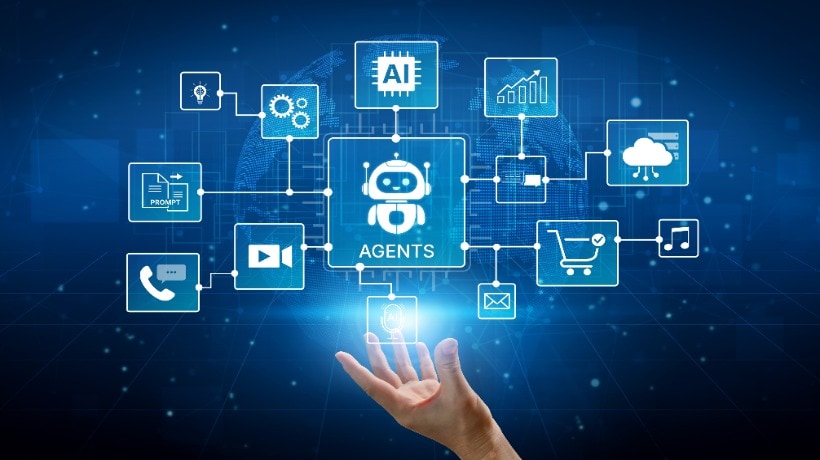
AI agent orchestration and productivity
For decades, the “holy grail” of software engineering has been the pursuit of flow, that elusive state that allows developers to solve complex problems without getting bogged down by administrative friction, fragmented data, or repetitive manual tasks. But as we move deeper into 2026, the complexity of modern cloud-native environments threatens to overwhelm even the most talented teams.
We’re moving beyond a simple “co-pilot” suggesting code snippets. We are entering an era defined by the orchestration of AI agents and rigorous AI productivity metrics. By combining a governance-first orchestration layer with deep engineering visibility, organizations are finally finding a balance between autonomous speed and human-centered management.
Orchestration Layer: Building the Mind, Not Just the Tools
In the early days of generative AI, “agents” were often little more than glorified scripts. If you ask them to perform a multi-step task, they will frequently lose context or hallucinate. This unpredictability is unacceptable in a corporate environment where a single mistake can lead to a security breach or outage.
This is where advanced AI agent orchestration changes the game. It does more than just give developers access to large-scale language models (LLMs). It’s about creating a controlled ecosystem where agents can collaborate.
From silos to ecosystems
Traditional AI implementations are often siled. Developers may use one tool for code generation and another tool for log analysis. Orchestration allows these tools to operate as a coordinated “agent workforce.” Through orchestration, the Security Agent detects vulnerabilities, passes the context to the Remediation Agent to create a patch, and finally notifies the Compliance Agent to document the changes.
Governance and guardrails
The main hurdle in professional AI implementation has always been trust. A robust orchestration layer provides a unified control plane. It integrates directly with your existing infrastructure to ensure that all agents operate within your organization’s security perimeter. It provides a “knowledge graph” that acts as a single source of truth, so agents cannot make guesses. These refer to the actual state of the system and documentation.
Productivity Layer: Measuring what matters
If orchestration is the engine that drives autonomous work, a comprehensive productivity framework is the GPS that makes sure your work is on the right track. The biggest risk in the AI era is “fake productivity.” This is a phenomenon where teams generate more code than ever before, but cycle times remain stagnant and technical debt accumulates. To achieve true AI productivity, leaders must look beyond vanity metrics (such as lines of code) to the health of the entire development lifecycle.
Visualization of cause and effect relationships
Depth of analysis is required to see if your AI investments are actually working. Do assisted pull requests merge faster, or do they end up with longer review cycles due to lower quality code? Modern platforms track these nuances, so engineering managers can see exactly where automation is benefitting and where it’s creating friction.
beyond speed
Standard metrics such as deployment frequency are essential, but a holistic approach that takes into account developer health and cognitive load is required. If your team is burnt out, you won’t be able to maintain high productivity. These frameworks help teams reclaim time for deeper work by visualizing flow and identifying bottleneck meetings and excessive context switching.
Synergy: closing the loop
A truly “humanized” approach to technology is one where tools adapt to people, not the other way around. Combining orchestration and productivity analytics creates a closed-loop system for engineering excellence.
1. Automate your daily routine
Imagine a scenario where an incident occurs in your production environment. In a traditional setup, developers are paged and spend an hour looking through logs, and another hour finding relevant documentation. With a sophisticated orchestration layer, agents can perform initial triage, capture logs, and suggest remediation based on historical data before developers begin investigating.
2. Validating the value
When an incident is resolved, the system records the data. Significantly lower mean time to recovery (MTTR) indicates leadership. It also proves that developers’ “intensive work” time has not been disrupted as severely as before.
3. Continuous improvement
This data is then fed back into the strategy. If data shows that agents are struggling with certain types of legacy codebases, teams can refine the orchestration logic or provide agents with better context. This is not a “set it and forget it” automation. It is an evolving partnership between human intelligence and machine efficiency.
The human element in an AI-first world
Fears that AI will replace developers are quickly being replaced by the reality that AI will liberate developers. By offloading repetitive, low-value tasks to coordinated agents, developers can get back to what they love: creative problem solving and architectural design.
However, this transition requires empathy from leaders. We need to move from managing results to managing outcomes. With the right productivity insights, managers can see if their teams are happy and focused. Powerful orchestration ensures your team is supported by the most effective technology available.
Conclusion: The way forward
Successful engineering teams in the coming years will be those that think of AI as an extension of AI, rather than a replacement for human talent. AI agent orchestration provides the muscle and memory, and AI productivity frameworks provide the vision and heart. By leveraging these systems to address the complexities of modern cloud environments and protect the health of their teams, organizations can finally deliver on the promise of software and solve real-world problems faster and better than ever before.
Share with
