


“We had a war until recently with Venezuela and we are going to have one with Cuba in the coming week.”
The United States could enter a war with Cuba in the next week or so, according to Puerto Rico Governor Jennifer González Colón. During an interview with Molusco TV, González cited the US’ growing list of conflicts, particularly in the Americas, as a reason why Puerto Rico remains an indispensable territory for Washington’s imperial ambitions (translation my own):
JGC: Ronald Reagan said [in the early ’80s] that Puerto Rico was ready and prepared to be part of the United States and that it would also be more beneficial for the United States to have Puerto Rico as a state.
Interviewer: But that was during the Cold War.
JGC: There was a Cold War then, just as there’s a Cold War now. We now have a war with China, we have a war with Iran, we have a war with Russia, we had a war until recently with Venezuela and we are going to have one with Cuba in the coming week.”
It is curious to hear the governor of Puerto Rico, an “unincorporated” US territory with a population of around 3.2 million people who cannot even vote in US elections, speak blithely about being at war with China, Iran, Russia, Venezuela, and soon Cuba. González is not the only Latin American leader to have de facto joined the US’ wars of aggression. In March, Milei declared Iran an “enemy” of Argentina and designated the IRG as a terrorist group.
In the grand scheme of things, González is a relatively bit-time player in the US’ military manoeuvres in the Caribbean. However, Puerto Rico did play its part as a staging post for the US’ moves against Venezuela, as Reuters reported in early November.
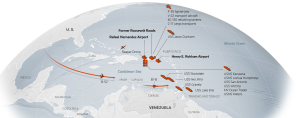
The United States military is upgrading a long-abandoned former Cold War naval base in the Caribbean, a Reuters visual investigation has found, suggesting preparations for sustained operations that could help support possible actions inside Venezuela.
The construction activity at the former Roosevelt Roads naval base in Puerto Rico — shuttered by the Navy more than 20 years ago — was underway on September 17 when crews began clearing and repaving taxiways leading to the runway, according to photos taken by Reuters.
Until the Navy withdrew from the facility in 2004, Roosevelt Roads was one of the biggest U.S. naval stations in the world. The base occupies a strategic location and offers a large amount of space for gathering equipment, one U.S. official said.
In addition to the upgrades of landing and take-off capabilities at Roosevelt Roads, the U.S. is building out facilities at civilian airports in Puerto Rico and St Croix in the U.S. Virgin Islands.
The two U.S. territories sit roughly 500 miles from Venezuela.
Following his abduction on January 3, the plane carrying Nicolás Maduro reportedly made a stop at the Ramey Base in Aguadilla. According to sources cited by Telenoiticias, it was a “very short” stop due to a medical emergency before the US forces continued their march to the high seas, where kidnapped president was transferred to a boat that would take him to New York.
González may have been briefed on aspects of the US’ military plans for Cuba and is letting her mouth run a little. Or maybe she hasn’t and is just engaging in idle speculation. Which is the case, her remarks should be read less as an official announcement or diplomatic warning than as part of a political campaign for Puerto Rican statehood.
In the interview, she said Puerto Rico should no longer be seen as “the ugly duckling” but rather as a key strategic asset for the US’ pharmaceutical and military supply chains.
“Puerto Rico is vital in these areas,” González said. We were key for Venezuela barely six months ago and we are going to be key for US public policy in Latin America”.
González’s comments come at a delicate moment for US foreign policy as whole, with the ceasefire in West Asia hanging by a thread. It is highly unlikely (though not impossible) that the US will attack Cuba if fighting resumes in the Persian Gulf. That said, the Trump administration is desperate for a foreign policy win to distract from its catalogue of hugely costly failures, and may, mistakenly or not, view energy-starved Cuba as a soft target.
The Southern Command reported a few days ago the arrival of the aircraft carrier USS Nimitz to the Caribbean, as part of the Southern Seas 2026 mission, officially aimed at strengthening maritime alliances, interoperability and security in the Caribbean, Central and South America.
Washington has also intensified its judicial offensive against Cuba’s senior leadership. The Justice Department announced on May 20 that it had filed an indictment against 94-year-old Raúl Castro Ruz and five other defendants for their alleged role in the shooting down of two Brothers to the Rescue planes in 1996 that killed four civilians.
It is not yet clear, as the veteran Italian journalist Federico Lampini tells El Mundo, whether the US indictment of Raúl Castro is the prelude to a Maduro-style operation, as González suggests, or simply a negotiating tool for applying additional pressure on the Cuban government:
Rubio knows that the US has a disastrous record in its attempts to promote regime change. When the CIA director recently visited Havana, his first request was simple and logical: end all Russian and Chinese military and intelligence presence. That would be a first step toward Venezuelan-style “regime change”: moving from an adversarial geopolitical position to one subordinate to Washington.
Speaking of Venezuela, it seems the man now calling the shots in Caracas is Mauricio Claver-Carone, the US State Department’s former head of Latin America. It was Claver-Carone who, in the same role for the first Trump Administration, openly admitted that the US’s decision in 2018 to grant Mauricio Macri’s government Argentina a $57 billion bailout, via the IMF, that it could never possibly pay back, was driven primarily by geopolitical considerations.
Delcy’s ‘gatekeeper’: ex-Trump official Claver-Carone holds keys to Caracas
Well-placed sources say the hardliner is “picking who can operate” in Venezuela, controlling access – and creating conflicts of interest
By @MaxBlumenthalhttps://t.co/fY8WIaGruc
— The Grayzone (@TheGrayzoneNews) May 25, 2026
Hours after Washington announced the charges against Raúl Castro, the US Army mobilised troops from Puerto Rico to an unidentified mission, Fort Buchanan reported on Thursday. Which may be an ominous sign given Puerto Rico already played an important role in the January 3 US military operation against Venezuela, or it may mean very little.
In the months leading up to the Venezuelan op, the island’s Roosevelt Roads base was the scene of intensive military training, as Swiss Info reported in the hours after the attack:
Puerto Rico Gov. Jenniffer Gonzalez on Saturday stressed the importance of the Caribbean island to carry out the U.S. operation against the Venezuelan government on Saturday and achieve the capture of Venezuelan President Nicolas Maduro.
This, Gonzalez said at a press conference, highlights “the importance of the island in the Caribbean, in the role we play in national defense, and that is why Puerto Ricans are proud to be part of this great nation.”
The Roosevelt Roads base, in Ceiba (eastern Puerto Rico), was during the past two months a military exercise area by the United States Army and, according to the official, it also served as a passage for Maduro’s transport to the United States.
Puerto Rico, linked to the United States as a Commonwealth, has a certain degree of autonomy and a local government and Parliament, but areas such as defense, borders, currency or diplomatic relations remain under the control of the United States.
Likewise, the Federal Aviation Administration (FAA) issued an order to cancel more than 300 U.S. airline flights to Puerto Rico for safety reasons until 01:00 (05:00 GMT) on Sunday.
Havana has responded to the latest threats from Washington and Miami by stepping up civil defence exercises and distributing survival guides against possible military attacks. It has also described the charges against Raúl Castro as “fabricated” and has warned of “fierce resistance” to any aggression.
For the past few months, Cuba has intensified military activity across the entire country, with patrols accompanied by drones and the positioning of artillery throughout the territory.
The country is expecting an invasion that, by all indications, will become a reality soon.… pic.twitter.com/cnw7i2hCfY
— Patricia Marins (@pati_marins64) May 24, 2026
As Patricia Marins notes above, Cuba is expecting an invasion that, by all indications, will become a reality soon. Humanitarian aid continues to arrive from China and Mexico while the US has served CODE PINK’s Medea Benjamin and left-leaning influencer Hasan Piker subpoenas for providing the besieged island of Cuba with medical aid and equipment.
Medea Benjamin’s crime? Delivering thousands of pounds of food to a country that the US is trying to starve. https://t.co/gbm5y7IfbM pic.twitter.com/PEuYee8ZEK
— Michael Galant (@michael_galant) May 24, 2026
Cuba has only received one shipment of (Russian) oil since the beginning of this year. While Moscow, like Beijing, has expressed support for Cuba since the US indictment of Castro and is the only country to have actually broken the US’ energy blockade, the reality is Russia already has enough on its hands with the war in Ukraine.
With gusano-in-chief Marco Rubio running US operations in Cuba, it seems the old casino mobster class may soon regain control of their island paradise. In the tweet below, the Puerto Rican Twitter user COMBATE provides a useful primer on how the US crime syndicate came to dominate Cuba, lost control of it after the 1959 revolution, and then joined forces with the CIA to try to take it back. It is a history you will rarely, if ever, read in the Western legacy media.
A transnational Jewish-Italian mob network centered on Meyer Lansky and Santo Trafficante ran Cuba as a privatized extraction arm of US empire: gambling, laundering, narcotics, prostitution, political bribery.
What the US could not openly run on its own border, the syndicate ran… pic.twitter.com/hH3B5uBWjs
— COMBATE |🇵🇷 (@upholdreality) May 25, 2026
The whole text:
A transnational Jewish-Italian mob network centered on Meyer Lansky and Santo Trafficante ran Cuba as a privatized extraction arm of US empire: gambling, laundering, narcotics, prostitution, political bribery.
What the US could not openly run on its own border, the syndicate ran for it in Havana. Batista was on a $ 1.28-million-a-month retainer, delivered every Monday at noon. His development bank bankrolled half of every new mob casino.
And this was not just gambling. Havana was a key node in the postwar heroin pipeline: Turkish opium, Marseille labs, Havana transshipment, New York distribution. By the late 1960s, that French Connection network supplied most of America’s heroin.
Then Castro won.
In January 1959 the casinos were smashed, the bosses fled or were detained, and Batista escaped with a fortune estimated around $300 million.
The national lottery, once a graft channel, was converted into a housing fund.
But the mob did not disappear. It was redeployed.
Lansky’s lieutenant Doc Stacher later said Lansky offered to finance Castro’s assassination as early as 1959. By September 1960, the CIA was running the operation directly.
The Agency hired Johnny Rosselli, Sam Giancana, and Santo Trafficante. The opening offer was $150,000. The weapon: poison pills from the CIA’s Technical Services Division.
The 1975 Church Committee found concrete evidence of at least eight CIA plots against Castro between 1960 and 1965.
The same Havana-Miami underworld that lost Cuba in 1959 became useful again as the deniable violence arm of US policy.
Of the three mob figures the CIA hired, Giancana was murdered before he could testify to Congress. Rosselli was murdered after he did. Trafficante survived.
The continuity is structural, not anecdotal: Tampa, Havana, Miami. Casinos became exile paramilitaries. Exile paramilitaries became lobby infrastructure.
Jorge Mas Canosa, a Bay of Pigs veteran and CIA-radio figure, founded the Cuban American National Foundation in 1981 at the suggestion of Reagan’s advisors. It was modeled on AIPAC and built to harden Cuba policy permanently.
The lobby’s most famous operative was Luis Posada Carriles: CIA-trained, Bay of Pigs veteran, Iran-Contra contractor under Oliver North, perpetrator of the 1976 mid-air bombing of Cubana Flight 455 (73 dead) and the 1997 Havana hotel bombings. By 1998, he had publicly named Mas Canosa as his financier. He died free in Miami in 2018.
They did not just lobby. They wrote the laws.
1992: Cuban Democracy Act.
1996: Helms-Burton.
2019: Trump activates Title III, letting US claimants sue foreign firms using confiscated Cuban property.
Today the legal afterlife of Batista’s Cuba runs through federal court: hotel chains, expropriation claims, embargo law, and Miami political power.
Marco Rubio, now Secretary of State, is a product of that machine.
Cuba’s “Polycrisis”
In her excellent article on Cuba’s “buckling health system”, Arucho Castro explains that Cuba is living through a “polycrisis” stemming initially from a collapse in the island’s three main sources of foreign currency (service exports, mainly medical and education missions, remittances, and tourism) during COVID-19. That was compounded by Hurricane Melissa (2025), which damaged 215,000 homes and 642 health facilities, displacing 735,000 people, and destroying around 40% of national vegetable production, and then turbo-charged by Trump’s energy siege.
Warning to readers: the results make for stark reading:
Deterioration of water systems. “Because 84% of the country’s water-pumping systems depend on power, clean water and sanitation services have also been disrupted, and reliance on water tanker trucks, known locally as pipas, has doubled nationwide—from 500,000 people in December 2025 to approximately 1 million in March 2026.”
Collapse of medicines supply. “By September 2025, the pharmaceutical and logistics infrastructure had collapsed, as 69% of Cuba’s 651 essential medicines were in short supply, and 51% were in stockout. By March 2026, 80% of the country’s 401 domestically produced essential medicines were below required levels, and medicines are now predominantly available through an informal market at prices unreachable for most patients on state salaries.”
Transportation shutdown. “The scarcity of jet and diesel fuel has grounded international flights, halted the import of vaccine inputs, and disabled refrigerated transport. Dozens of containers carrying medical supplies, and even the World Food Program’s assistance cargo, have remained stranded at ports, customs facilities, and warehouses because of fuel scarcity.”
Life expectancy and infant mortality. “Until the COVID-19 pandemic, Cuba’s life expectancy and infant mortality rates approached those of high-income countries… According to official sources, several concerning indicators, such as low birthweight, neonatal mortality, and maternal mortality, had already been rising since the prepandemic era. Consequently, the 2026 data, once released, is expected to reflect an increase in both maternal and infant mortality due to the impacts of the oil blockade.”
Preventable infant deaths. “Infants requiring home ventilation, mechanical suction, or climate control were identified as being at direct risk of severe hypothermia or hyperthermia, irreversible brain damage, and death…For newborns who rely on incubators, the same outages and transport delays can lead to hypothermia, hypoxia, and a greater risk of sepsis—preventable conditions under functioning health-care settings that fall hardest on preterm and low-birthweight infants.”
Blood shortage. “Furthermore, all 46 blood banks are operating at reduced capacity because of shortages of reagents and medicines, jeopardizing transfusion support for surgical patients, women with obstetric hemorrhage, children with leukemia, and the tens of thousands of Cubans on chemotherapy.”
Chronic conditions. “Approximately 2 million people with hypertension, 1 million with diabetes, and 1 million with asthma are experiencing treatment interruptions, increasing the risk of complications and death among the approximately 5 million people with chronic conditions.”
Child malnutrition. “Cuba’s program of monthly food, supplements, and medicine packages for new mothers and infants, credited by the UN Children’s Fund (UNICEF) with keeping child malnutrition among the region’s lowest until the pandemic, has contracted. Between 2018 and 2024, agricultural GDP decreased by 61.7%, and cold-chain failures are causing spoilage before food reaches households due to insufficient refrigeration.”
Given the severity of Cuba’s humanitarian crisis, it is quite possible — though far from guaranteed — that Havana will end up making significant concessions to Washington — perhaps even enough to ward off a US attack. If not, the crisis could get a whole lot worse, triggering a huge surge in migration to the US and Mexico as well as potentially a narcotrafficking boom.
Meanwhile, tensions continue to escalate in Bolivia amid speculation that martial law will be enacted in the coming days as the DEA & Bolivian military seek to kidnap, or perhaps even assassinate Evo Morales. It is sad to see that Brazil’s President Luiz Inácio Lula da Silva is once again doing the empire’s bidding, even as his own country faces the threat of US intervention.
Lula, who in 2004 sent 1,200 Brazilian troops to assist George Bush in the invasion and U.S. military occupation of Haiti, once again betrays Latin America’s proletariat by sending aid to the right-wing Bolivian regime which murdered a member of the general strike on May 23rd. https://t.co/dd2J92WV4M
— Camila Lourdes Galarza (@sovietwithsazon) May 26, 2026
