


[Today’s Iran war post will again be final a bit after its initial launch time. Please return for the completed post at 8:00 AM EDT or refresh your browser then]
Due to the US/UK long holiday weekend, there is comparatively little new news about the Iran deal, save Trump moving the schedule goalposts and depicting signing a deal later as fine and Iranian sites, including official ones, objecting to claims made about the content of the supposed memorandum of understanding (MOU), that Iran has or every would agree to ceding control of the Strait of Hormuz or removal of its enriched uranium stockpile. Again, we have said no deal would happen and these differences are on fundamental issues. There is no middle ground.
In addition, we’ll explain briefly why Iran should be (and may actually be) skeptical of the intended sweeteners, like the release of its frozen assets and sanctions relief. There are good reasons aside from general mistrust why Iran is demanding that some of the frozen assets be freed as a condition of signing any MOU.
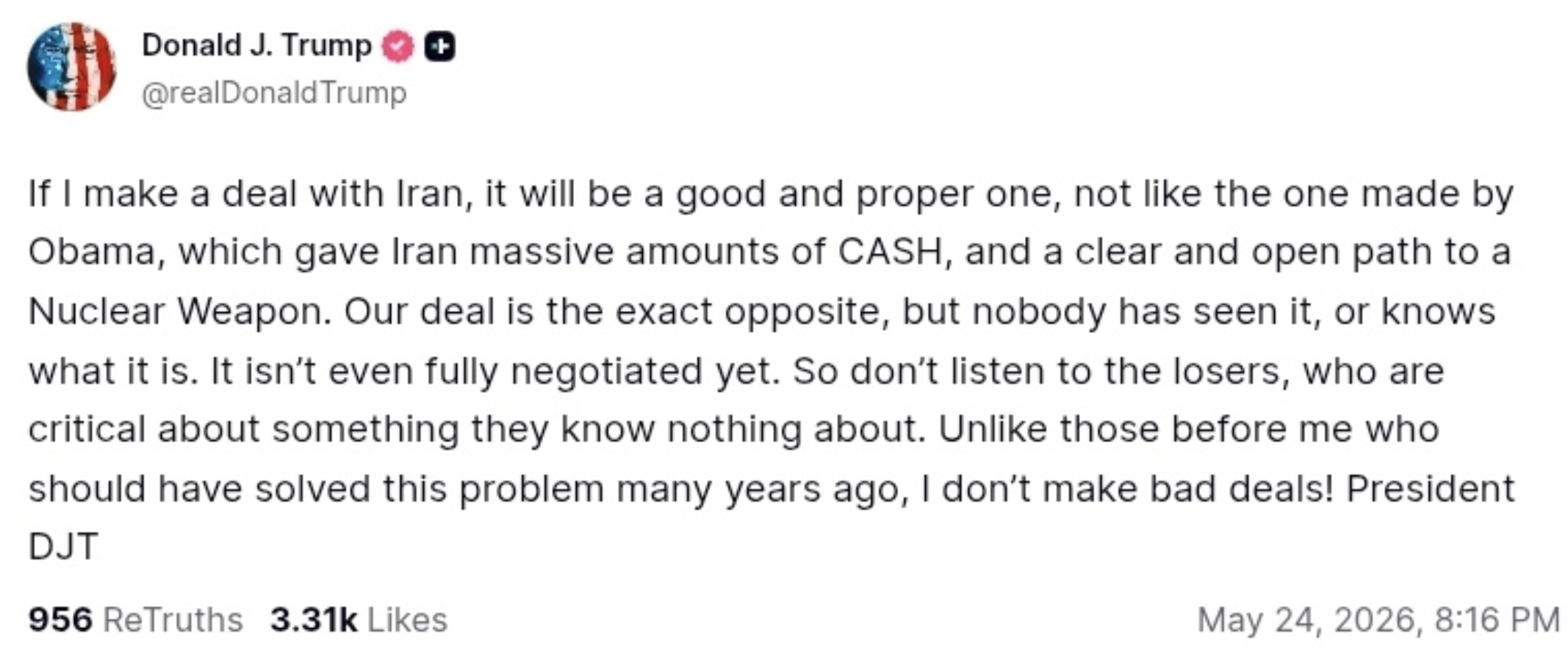
A new Trump tweet is an apparent reaction to loyal Republican screeching over the leaked terms (which are still too US favorable to be acceptable to Iran. More on that later in this post.
It is reminiscent of a famed prospectus during the South Sea bubble, which pitched “an undertaking of great advantage, but nobody to know what it is.” But that offering document was a parody while one assumes Trump to be serious.
But sadly the financial media is promoting Administration hopium, For instance, see the current Bloomberg lead headline:
The Financial Times at least showcases in its lead headline that Secretary of State Rubio is acknowledging that the talks might fail and saber-rattling, The article mentions but minimizes the Administration’s three card monte over a “deal” having been imminent:
From the text:
Speaking in New Delhi on Monday, Rubio said that the US is “going to give diplomacy every chance to succeed before we explore the alternatives”. “We’re either going to have a good agreement or we’re going to have to deal with it another way,” he added.
Hopes of a deal rose over the weekend as US President Donald Trump said on Saturday that the “final aspects and details” of an agreement that would open the Strait of Hormuz were “currently being discussed” and would “be announced shortly”.
However he later said he had told US negotiators “not to rush into a deal” with Iran that would lead to the reopening of the Strait of Hormuz, saying “both sides must take their time and get it right”.
Mind you, the remarks from Rubio above confirm that there will be no agreement. Iran will not “reopen” the Strait of Hormuz in the way the US means, as in give up control of traffic and not charge fees. Iran is prepared only to take measures to get transit levels up to where they were before the war. Iran has also said it is talking to Oman about a “permanent” toll system, but as far as I can tell, no Omani official has confirmed the discussions. Recall that Oman is a signatory to the UN freedom of the seas treaty UNCLOS which would prohibit them running a tolling operation jointly with Iran.
Oman may also be thinking twice about incurring the ire of Gulf State neighbors:
Gulf States Tell Ships Not to Use Iran’s Strait of Hormuz Route
Five Middle Eastern countries have formally rejected Iran’s establishment of the Persian Gulf Strait Authority to control transit through the Strait of Hormuz.
In a letter to a global shipping watchdog, Bahrain,…
— Tracy Shuchart (𝒞𝒽𝒾 ) (@chigrl) May 23, 2026
Experts are saying that the ceasefire is a gimmick, to buy Trump time. For instance:
But one might wonder why Trump wants yet another delay, since as many have repeatedly said, including your humble blogger, time is not on Trump’s side. In a much-watch interview with Mario Nafwal, Iran expert and former Congressional staffer Brandon Weichert confirms a line of though we had, that the negotiations were simply a gimmick to appease financial markets during the Hajj (which ends May 30) and facilitate a new round of strikes shortly afterward.
From a lightly-edited machine transcript:
Weichert: I think it’s very important to understand what’s going on right now in the Middle East as I’m sure you know is is Hajj, the great uh pilgrimage to Mecca, is occurring right now for the next I think week or so. And then there’s the is it the Muslim holiday of Eid I think is also going on.
In my opinion, what you’ve seen with this so-called deal has been a joint action by the Saudi government and their partners in Pakistan to basically get the Americans to kind of pull back for this holiday season so that people can flow in to the holy sites of Mecca and and you know have their their time, their religious time uninterrupted, by the war. Um, and I think that the President Trump is because he he is close to the the Saudi government and he’s he’s got to worry about how far he can push the Arab states. I think he acquiesced to the the pressure from them to at least have the appearance of a deal.
And I don’t think the deal’s real. I’ve said since they announced it what, 24 hours ago.
You look at what happened. The American side has not really gotten anything out from this the Iranians that the Iranians weren’t already willing to part with. The Iranians have not confirmed really any of the the contents of the deal that the president Trump has released to the public.
And then this morning I woke up to a report that Trump was telling his adviserss to slow walk the finalization of the agreement anyway because he has all the time. He said, “Well, he doesn’t have all the time.” And you, as you and I have spoke about for the last couple weeks, the economy in the West is getting ready to implode.
There are other reasons to doubt the idea of a 30 to 60 day ceasefire/negotiation period. Why would Iran agree to stop its toll operation before a deal was complete? The status of the fees and Iran controls still being uncertain during this time increases rather than reduces uncertainty for shippers. If Iran regularizes operations, even if the US sulks and occasionally messes with Iran ships that were actually sanctioned that would seem to be less of a risk than moving ships into the Gulf to pick up new cargoes and then being stuck again if the talks failed and a hot war was back on.
Iran official sources and other commentators have made clear Iran is not on board with the terms Team Trump has leaked:
BREAKING: Iran warns the US-Iran agreement “will be completely cancelled” due to ongoing US obstruction on clauses including the release of Iran’s $100 billion of frozen assets, with the US now trying to link them to nuclear concessions which Iran rejects, per Tasnim.
The White…
— The Hormuz Letter (@HormuzLetter) May 24, 2026
Worse it appears the US has been engaging in bad faith dealing in walking back some concessions:
Less than 24 hours after optimism emerged around a possible Iran-US memorandum, negative vibes are already surfacing.
A well-informed Iranian source tells me there are signs of U.S. retreat on two central issues: the mechanism for unfreezing Iranian assets, and the scope of a… https://t.co/Jciwt2wrBd
— Ali Hashem علي هاشم (@Alihashem) May 24, 2026
The full text of that tweet:
Less than 24 hours after optimism emerged around a possible Iran-US memorandum, negative vibes are already surfacing.
A well-informed Iranian source tells me there are signs of U.S. retreat on two central issues: the mechanism for unfreezing Iranian assets, and the scope of a ceasefire in Lebanon.
According to the source, the memorandum includes a Lebanon ceasefire framework, but Israel is reportedly uncomfortable with the arrangement and is pushing Washington to include language allowing it to carry out military operations in Lebanon under the justification of responding to “any threat.” Iran is rejecting that formulation and insisting on a sustainable and lasting ceasefire.
Tehran has informed all mediators, including Pakistan, that it will not sign the memorandum unless all clauses are fully agreed and guaranteed. Pakistan reportedly suggested moving forward with agreed sections while postponing contentious points, but Iran rejected that approach, insisting the disputed clauses are fundamental and non-negotiable.
The overall picture suggests Tehran increasingly views Washington as backing away from earlier understandings reached through mediators.
I expressed doubts in comments yesterday as to whether the US could readily release all the Iran frozen assets:
Most of the frozen funds cannot be released without Congress unwinding earlier legislation:
Congressional action has been critical to the development and expansion of U.S. sanctions on Iran. Congress authorized sanctions targeting Iran’s proliferation activities beginning in 1992 and, in 1996, enacted landmark legislation mandating the first Iran-related secondary sanctions, on foreign firms involved in the development of Iran’s oil resources (Iran has the world’s third largest proven oil reserves). After the Iranian government’s violent crackdown on mass protests over its disputed 2009 presidential election, Congress authorized sanctions on officials responsible for the crackdown and other human rights abuses. As international concern about Iran’s nuclear program increased, Congress, beginning in 2010, increased the scope of U.S. sanctions, targeting Iran’s oil exports and other economic sectors in a bid to deny the Iranian government financial resources and compel it to make policy changes. In enacting these authorities, Congress mandated that to waive or lift sanctions, the President must certify that Iran is meeting certain conditions, including that the Iranian government has ceased its support of international terrorism and its proliferation activities.
https://www.congress.gov/crs-product/IF12452
I would hazard that the $25 billion Iran has asked for out of an estimated $100+ billion is the only part that can be freed without Trump making the stipulated certifications, which he can’t do if Iran is still besties with Hezbollah, Ansar Allah, the Iraqi militias, and Hamas (which Iran is not giving up) and still has any nuclear enrichment (which Iran is also not giving up).
Now there is admittedly the question of who would have legal standing to stop an arguably impermissible release, as in who could go to court. But a filing might have enough color for it to be litigated, as to simply be dismissed over the question of standing. Iran is not going to have any stomach to have its funds tied up even via seemingly loser lawsuits.
In addition, another carrot the US has held out to Iran also looks dodgy, as in sanctions relief. The mechanism would be a sanctions wavier as opposed to cancelling the underlying sanctions. That is even flimsier legally than the JCPOA, which Trump tore up.
Larry Johnson describes long-form the fast backlash against Trump’s deal scheming, which likely played a big role in the effort to roll back key terms. Some tidbits from his 250,000,000 Reasons Why Trump is Backing Away From a Deal with Iran:
The most significant pushback came from Trump’s own right flank, where critics argued the war’s objectives were being abandoned:
Senator Ted Cruz wrote on X:
If the result of all that is to be an Iranian regime — still run by Islamists who chant ‘death to America’ — now receiving billions of dollars, being able to enrich uranium and develop nuclear weapons, and having effective control over the Strait of Hormuz, then that outcome would be a disastrous mistake.
Mike Pompeo, Trump’s own former Secretary of State, was devastating:
Pay the IRGC to build a WMD program and terrorize the world. Not remotely America First. It’s straightforward: Open the damned strait. Deny Iran access to money. Take out enough Iranian capability that they can never threaten us again….
In one of the more striking social media moments, even Fox News’ own audience pushed back. When Fox News reshared Trump’s Truth Social post about the deal, its own followers responded with deep skepticism. One commenter wrote: “‘Nobody has seen it, nobody knows what it is, it isn’t fully negotiated yet,’ but trust him, it’s better than Obama’s deal. Incredible pitch!” Another wrote: “He needs to listen to the critics before he signs something stupid.” A third wrote: “Critics are not asking what the deal is, but why there is a deal in the first place.”
Johnson also makes an important point in a talk with Nawfal that a terrorist attack by members of a radical Baluchi independence movement looks to have been instigated by Israel to try to get Pakistan to back off from mid-wifing a negotiated settlement (see starting at 6:00):
But to return to Weichert’s thesis, why would it make sense for Trump to buy time to make another attack on Iran when that at best digs his hole deeper, by further depleting already-low weapons stocks, and risks Iran destroying the global economy by destroying Gulf energy production and desalination plants? Back to the transcript:
Weichert: I think that the whole conflict was about Trump believed he could do this. He could do regime change for cheap in 96 hours or less, and that the people of Iran would rise up after he killed Khamenei and that they would basically create this democracy or whatever. It didn’t work out. So now he’s stuck holding the bag and Netanyahu won’t let him let go. So he’s in this this very awkward position where he clearly is trying to figure out a way out, but he can’t. So his only solution is to escalate. And I still think we’re on track to escalate on some level or the Israelis are trying to get us back in…
They [US weapons] are depleting. And I would say if we do one more round of fighting, we will have nothing left. But that that won’t that that hasn’t stopped the president so far from doing these insane things. The Joint Chiefs told him on February 27th, the day before the war, if you do this, you’re going to deplete all of the those 14 top systems that we need for other conflicts potentially against China. You’re going to deplete and we can’t restore them anytime soon.
Trump didn’t listen. So, I agree with you on the stockpile crisis, but that hasn’t stopped the president so far.
Nawfal [interjecting]; To zero just is wild, man. Like, I understand depending 50% is stupid. He made a stupid decision, but there’s a difference between stupid….
Weichert: I know. II get it…
Nawfal: And suicidal…
Weichert: I was talking to Michael Jan and he said to me that when you’re in war, logic and rationality, it’s a different type of logic and rationality. You can’t apply what you would do in normal peacetime conditions. Once you’re in it, it’s a totally different rationality. It’s it’s it’s mania. It’s madness. It’s ego. It’s ignorance. I mean, Trump has never been in war. Trump has never been in a foreign policy position other than the president. Now, he doesn’t I don’t think he fundamentally understands he’s out of his element.
Recent news snippets show that Iran is balking:
BREAKING: Iran’s Foreign Ministry speaks as the US says there has been progress on a deal, but details are still under negotiation. Esmaeil Baghaei says there is no assurance that US President Donald Trump will honour his commitments.
🔴 Follow https://t.co/hGzrK2N8WC for more pic.twitter.com/SMBJ8rupEl
— Al Jazeera Breaking News (@AJENews) May 25, 2026
BREAKING: Iran’s Foreign Ministry now officially confirms that no Iranian nuclear commitments and uranium handover exist or will exist in any draft agreement with the US, calling all reports that claim otherwise a “pure lie,” making further talks pointless due to the US…
— The Hormuz Letter (@HormuzLetter) May 25, 2026
If Iran wants to turn up the heat further (in case Mr. Market and/or the financial press have still not taken not that Iran is not just not on board with the latest Trump tap-dance), perhaps the Foreign Ministry could announce the negotiations are off unless and until the US recognizes realities on the ground and stops walking back from commitments made during talks. And most importantly, do so 15 minutes before the US markets open on Tuesday.
Done for today! See you tomorrow!
