


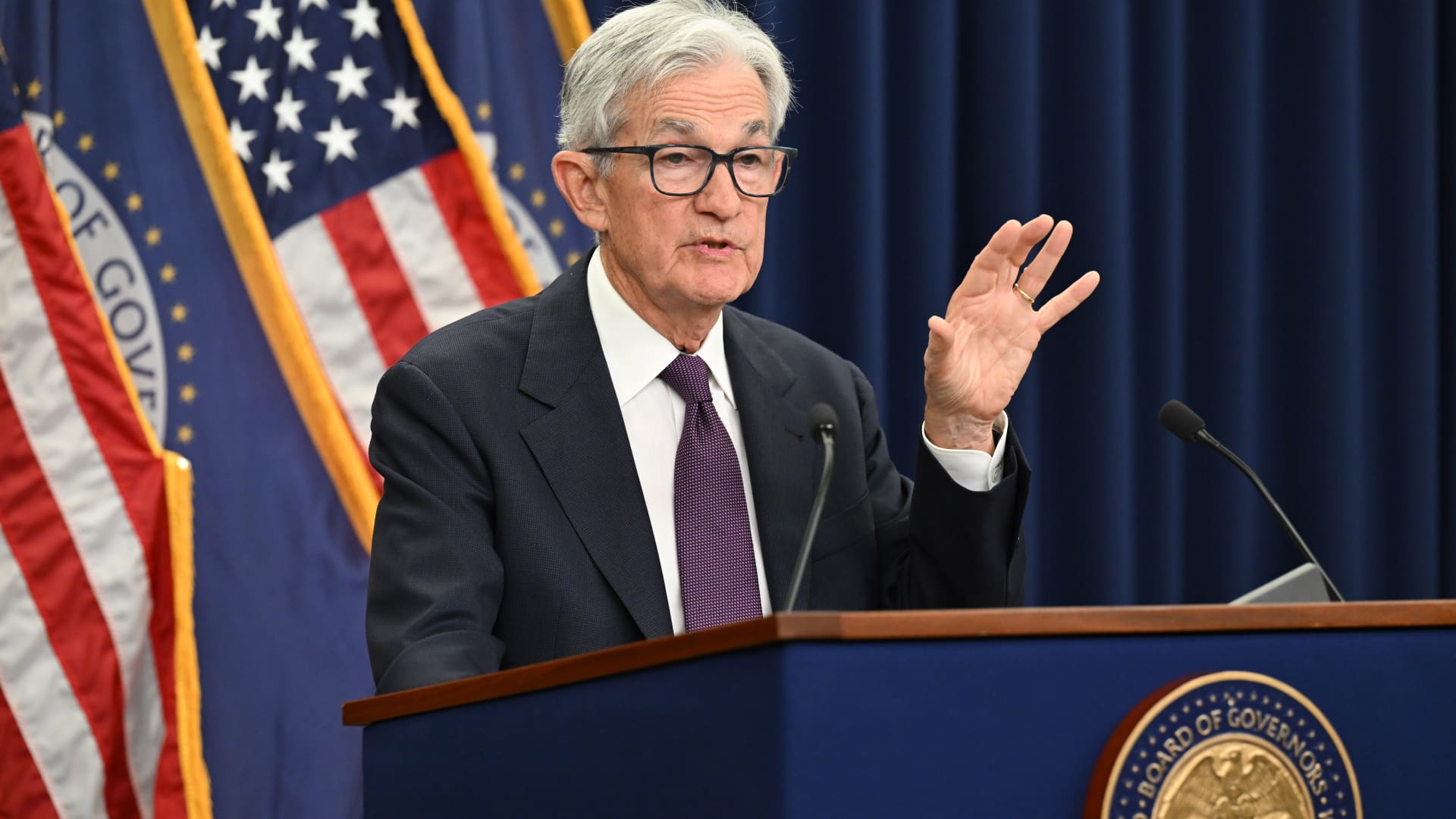
U.S. Federal Reserve Chairman Jerome Powell attends a press conference on April 29, 2026, in Washington, DC, USA.
Li Rui | Xinhua News Agency | Getty Images
A majority of Fed officials at recent meetings expected a rate hike would be necessary if the Iran war continues to worsen inflation, according to minutes released Wednesday.
The Federal Open Market Committee, which decides interest rates, once again voted to maintain its interest rate target between 3.5% and 3.75%, but the meeting received four “no” votes, the most since 1992, clearly increasing disagreement over the direction of policy.
At issue was the impact of the Iran war on prices and how that would affect monetary policy. Officials differed on how long the war’s effects would last and whether post-meeting statements should continue to reflect a bias toward rate cuts as the next likely policy.
Several meeting participants said a cut would be appropriate if it was clear that inflation was returning to the Fed’s 2% target or if the labor market was weakening, “but the majority of participants emphasized that some level of policy tightening would likely be appropriate if inflation remained above 2% on a sustained basis.”
Three of the four “no” votes came from presidents in regions whose policymakers insisted on keeping interest rate hikes open amid soaring inflation. The group agreed to keep the benchmark federal funds rate unchanged, but opposed including language that referred to “further adjustments” to interest rates. It is widely believed that this expression suggests that the next move is a cut.
“Many participants expressed the view that it would be preferable to remove language from the post-meeting statement that suggested an easing bias in the direction of the Committee’s future interest rate decisions,” the minutes said.
However, in Fed terminology, a “majority” does not constitute a majority, so this language remained in the statement.
Officials generally agreed that the Iran conflict would have a “significant impact” on the Fed, which pursues the twin goals of full employment and price stability, but there was debate over how long the impact on inflation would last.
“The majority of participants noted that there was a growing risk that it would take longer than previously expected for inflation to return to the Committee’s 2% target,” the document said.
Warsh’s Challenge
The meeting took place against an interesting backdrop. It was the last time Jerome Powell chaired the committee, and it was held amid rising inflationary pressures, largely as war and other factors have left officials cautious about the future of policy.
After a long campaign that included 11 candidates, former Governor Kevin Warsh has now taken over the reins. President Donald Trump nominated Warsh to make it clear that he expected the Fed to lower interest rates.
However, market prices point out that the committee’s next action is likely to be a rate hike by the end of 2026 or early 2027.
Inflation had been trending towards the Fed’s 2% target from 2025 until the beginning of this year. However, the war changed the situation, and high energy prices pushed most inflation indicators above 3%.
Policymakers typically view supply shocks like soaring oil prices as temporary. However, core inflation, which excludes food and energy, has risen as well. Goldman Sachs expects inflation to be at an annual rate of 3.3% in April, when the Fed’s main inflation forecast will be released next week.
Warsh’s challenge, therefore, will be to convince his colleagues that increased productivity through enhanced artificial intelligence can eliminate inflation and counter the temporary effects of rising energy costs.
One of those colleagues will be Mr. Powell himself, who has chosen to remain on the board. Mr. Powell has two years left in his term, and in April he said he would remain in office “for a period to be determined,” repeating his previous statement that he would remain in office until “this investigation is fully and completely concluded.” No other Fed chair has remained on the board in nearly 80 years.
Never miss the most trusted news moments in business news when you choose CNBC as your preferred source on Google.
Source link
