


[This Iran war post launched before complete yet again. Please come back at 8:00 AM EDT or refresh this page then for a final version]
The latest Trump move to try to keep himself at the top of news reports1 was to double down on his rejection of the Iran response to the latest US demands. As you likely know well, Iran told the US to pound sand via a mild rewrite of its existing position. We’ll turn in due course to increasingly signs of opposition to the war as economic and military costs escalate, critically from elite sources: the Financial Times in a long and well-documented lead story, and top neocon Robert Kagan (co-author of Project for the New American Century) via his article, Checkmate in Iran in The Atlantic. To whet your appetite, his subhead:
Trump is yet again threatening kinetic escalation, but his signaling is predictably misleading He is acting as if what Chas Freeman has called a ceasefire with Israeli characteristics is the real deal and preparing to scupper that:
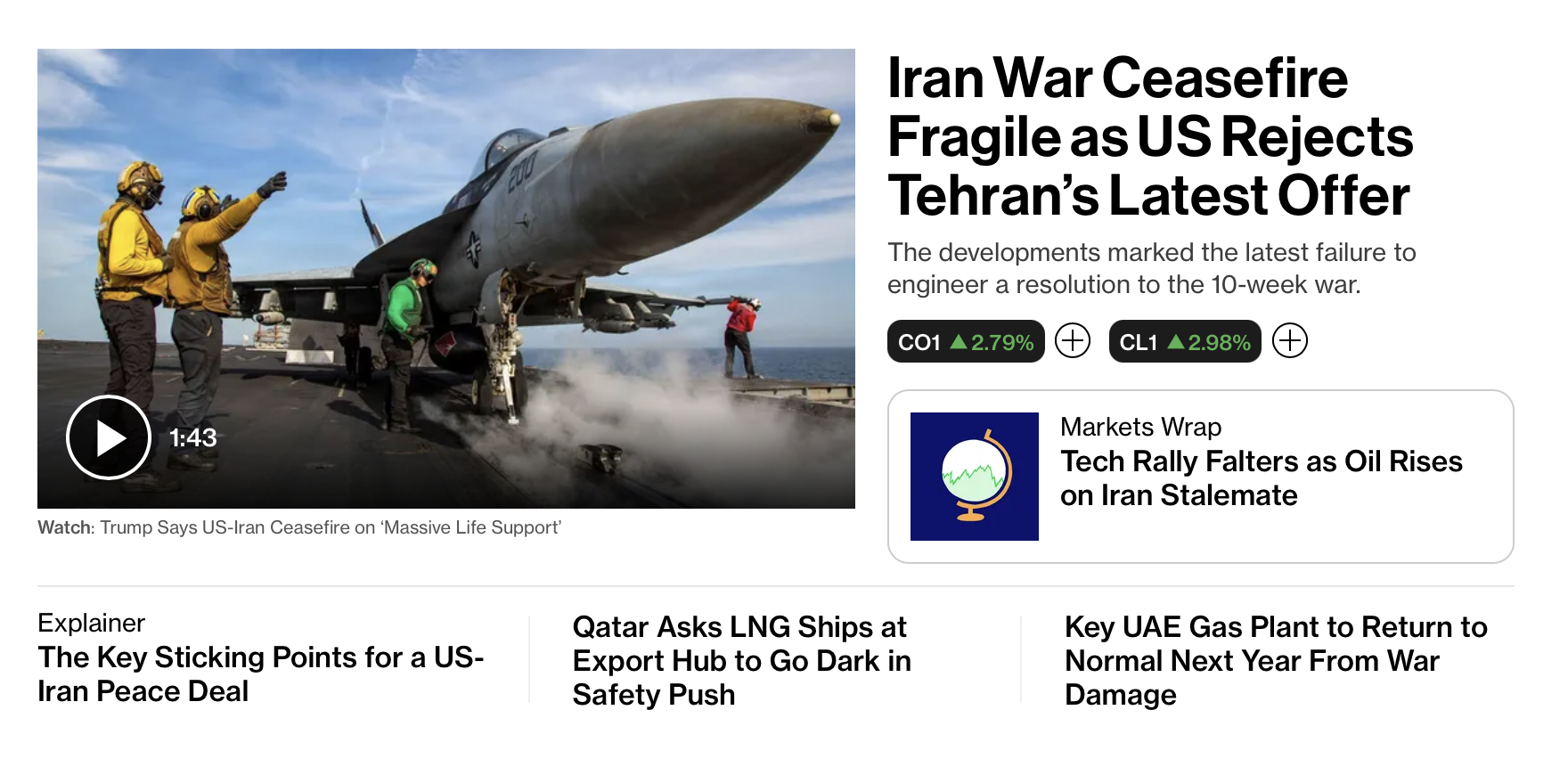
President Trump said Monday that the ceasefire with Iran is on “life support” after the “garbage” response Iran sent the U.S.
“It’s unbelievably weak, I would say,” the president told reporters during an event in the Oval Office when asked if the ceasefire remains in place. “I… pic.twitter.com/AuVl0Xj60x
— CBS News (@CBSNews) May 11, 2026
On the ceasefire, Bloomberg is in Schrodinger’s cat mode, that if the lid has not yet been opened, the cat might be alive. That is a conveniently investor-soothing view to take:
NO1’s news summary reports otherwise:
Iran-US ceasefire collapse: Trump called Iran’s counter-proposal “TOTALLY UNACCEPTABLE” and a “piece of garbage”, put ceasefire “on life support”, met with generals Monday, and is considering reactivating Project Freedom (military escorts through Hormuz). Iran’s Parliament Speaker responded: “Our armed forces are ready… they will be surprised”. US Navy deployed nuclear-armed submarine USS Alaska through Gibraltar. Iran deployed combat-ready mini subs in Hormuz.
However, pretty much every competent Iran war commentator agrees Trump is not likely to do anything before he returns from his summit with Xi, so Bloomberg’s cheery posture given the givens is likely true for the near term. It is remotely possible Trump could launch over the weekend, but it seems more likely he would wait another week. The delay would harm the ability to engage in any sustained ground operation, such as trying to seize and hold….something. But the US looks to be readying an massive air attack, throwing everything but the kitchen sink into the fray.1
However, if you look to the entry on the lower left, Bloomberg the notion that there could be a “peace deal.” We and many others have said there will not be one. Chas Freeman and Robert Pape, in two fresh updates, say the talks are dead. Both discussions are worth your attention since they come from very different vantage points.
Freeman gives a fine one-stop overview of where US-Iran (and related China) matters stand now. He stresses a key point that the mainstream media refuse to acknowledge, that negotiation are not happening. Smoke signals at a distance are not negotiations.
Freeman puts a stake in the ground as to where this is going. From a mildly-cleaned-up machine transcript:
I think we can see as I said where this is all going to end.
First of all, it will end with some sort of reconciliation between the Gulf Arabs and Iran, which involves the removal of the American military presence from the Gulf. The United States has proven unable and unwilling to defend the Gulf Arabs against Iran.
The bases on their territory have become targets rather than uh defense assets for them. And so that is clearly unfolding.
Second, I believe Iran will remain in control of the Strait of Hormuz. That is in development because it contradicts 263 years of Anglo-American maritime supremacy and the rules established under that, including those in the United Nations Convention on the Law of the Sea which declare that straits meaning bodies of water, narrow bodies of water, that connect the international waters, in this case the Persian Gulf inside it and the Arabian Sea outside to the Gulf of Oman. These cannot be obstructed according to the UN convention. Now they are obstructed. That rule was established by first by British sea power after the defeat of France in the Seven Years War in 1763.
The baton passed of maritime hegemony passed of the United States in World War II in March of 1943 with the Battle of the Bismark Sea. And this is over now.
Land-based missiles, artillery if you will, can now strike at huge distances.
Um the history here is interesting because it began with the range of cannons in the 18th century which was 3 miles. So a ship that came within 3 milesi of the shore was in danger of being struck. That limit was overtaken by events and of course now we have the ability to strike ships at a distance of 2,000 km or 1500 miles or at least with drones within a 300 km or 200 mile limit. So we’ve seen we’re we’re watching the decay the fall of um a fundamental element of global order as of this war. So that’s another result.
The third result will be that while Iran uh will tighten its repression of its citizens in response to their suffering from continuing sanctions, those sanctions are becoming ever less effective. I think they will continue, but the world will be less and less respectful of them and American power to impose unilateral sanctions which are illegal under the UN charter but nevertheless have become a common place will decline. So American power in the financial sector, since this is all based on the control of financial transactions will have a way.
But finally and perhaps most consequentially a war that is now justified as aimed at ending Iran’s nuclear program has galvanized its nuclear program. Iran is almost certain to develop nuclear weapons and the delivery. the means to deliver them first to Israel and ultimately to the United States. It will follow the path in other words of North Korea in response to the maximum pressure to which it has been subjected.
So we end up with a a a world in which Iran is still sanctioned. It still controls the Strait of Hormuz. The American military presence in the Gulf is gone. Israel is chastised but not defeated and Iran has a nuclear weapon. This is not what those who started the war wanted to see come from it, but it is where we are headed.
Robert Pape, by contrast, contends that the negotiations ended last weekend. He depicts US at a very dangerous escalation inflection point.
Pape makes a key points: that the dispute between the US/Israel and Iran is over sovereignity. First, these are zero-sum matters. Second, if Iran concedes on any, that sets up further concessions, since Iran will be weakened by its preceding retreats. Pape does not say so directly, but this makes Iran’s “maximalist” positions entirely rational. Third, Iran has come to regard these matters as existential (having another state openly seek regime change and bomb the shit out of you when it failed would tend to do that).
Now to the increasingly visible opposition with the ruling classes to Trump continuing the war. First from the Financial Times, in a a lead story.3
Please take the time to read this long and well-substantiated indictment in full. Key sections:
Donald Trump’s Iran war is ripping across the US economy at a cost of hundreds of billions of dollars in lost output, as soaring fuel prices, rising borrowing costs and supply chain snags erode Americans’ prosperity….
The Pentagon has burned through years’ worth of costly missiles and air defence interceptors during the conflict, which it says has been the primary driver of its $25bn estimate for the cost of the war….
While defence boosts output, economists say the money would be better spent on education and infrastructure, which have higher so-called “multiplier effects” and a greater impact on Americans’ prosperity.
…The closure of the Strait of Hormuz, through which a fifth of global oil supply flowed prior to the war, has pushed up US petrol prices by more than half to $4.55 a gallon, marking the most severe fuel shock of any G7 economy.
Diesel — a vital input for America’s industrial economy — has risen by a similar margin to $5.66, just shy of its all-time record of $5.82.
As of Friday, American consumers had paid an extra $35bn in petrol and diesel costs since the war began, according to Brown University’s Watson School of Public Affairs. That equates to about $268 per household or about the cost of a week’s groceries….
Jet fuel, meanwhile, has risen by more than 70 per cent, driving up the cost of airfares and placing huge strain on the airline industry….
In late February, before the conflict began, investors expected the Federal Reserve to cut US borrowing costs by a quarter-point twice this year….
Wolfers estimates the Fed’s inability to cut interest rates by half a percentage point will have a substantial hit. “That one channel alone adds up to about $200bn worth of lost output,” he said.
Higher rates are also costing would-be American homeowners dearly. The average 30-year mortgage rate — the industry standard — is now 6.37 per cent, up from 5.98 per cent before the conflict began….
Shortages in some raw materials are beginning to emerge, while the costs of shipping metal containers around the world at short notice have jumped.
“Even the Transatlantic from North Europe to US East Coast — which does not call at Asia transshipment hubs or Middle East ports — short-term freight rates have surged 56 per cent from end-February,” said Peter Sand, of shipping data specialists Xeneta. “The crisis is still very much present — it has simply migrated from the regional to the global level.”
Austan Goolsbee, president of the Chicago Fed, said this week that, despite the shocks of the Covid era, many manufacturers in his industry-heavy district were still heavily reliant on “just-in-time” delivery…
Economists expect a roughly six-month lag until the higher costs of diesel translate into a noticeable rise in grocery prices, with perishable goods such as fruit, vegetables, meat and seafood, which rely on refrigeration and rapid distribution, likely to lead the way….
The hit from diesel is set to be compounded as farmers shell out on higher fertiliser costs. The price of nitrogen fertiliser, much of which is produced in the Middle East, has risen more than 30 per cent since the war began, which could curb crop harvests over the coming year as farmers cut back on fertiliser, shrinking food supply and driving up costs.
The impact of the Iran war on food prices is expected to be less than what followed Russia’s full-scale invasion of Ukraine, a critical agricultural supplier to the world. Grocery price inflation surged to more than 13 per cent in August 2022.
Still, economists warn it is the latest blow to a sector that has been rocked by Covid, the Russia-Ukraine war, tariffs and the impact of immigration policies on labour supply, each fuelling inflation for US consumers. Food costs have risen about 30 per cent in the past six years.
Another waring on the economic front in from Saudi Aramco’s CEO from Sputnik (hat tip Robin K):
The global oil market will not return to normal until next year unless shipping traffic in the Strait of Hormuz resumes within a month, Saudi Aramco CEO Amin Nasser said.
“The longer the supply disruptions continue, even for another few more weeks, it is going to take a much longer time for the oil market to rebalance and stabilize,” he said during a video conference to discuss Aramco’s first-quarter results.
The crisis could last until 2027 if the impasse in the Strait continues until mid-June, he added.
According to the head of the world’s largest energy company, the market, which has lost a billion barrels of oil due to a lack of production or transportation, will continue to lose approximately 100 million barrels of oil each week as long as the strait remains closed.
More on oil shortages:
BREAKING: The US Strategic Petroleum Reserve released last week >1.22 million barrels a day (~8.6 million for the week).
That’s the largest ever weekly release, surpassing the peak rate seen in 2022 when President Biden tapped the SPR after Russia invaded Ukraine.
— Javier Blas (@JavierBlas) May 11, 2026
And oil shortage knock-on effects. From Business Insider Oil shortages are even hitting colored snack bags
Now, even potato chips aren’t safe from the global petrochemical squeeze.
In Japan, snack giant Calbee — known for its popular potato chips — is switching some colored snack packaging to black and white after oil shortages linked to the Iran war squeezed global ink supplies, local media reported.
The culprit is naphtha, an oil-derived chemical used to make solvents and resins for printing ink. Naphtha is also a key ingredient in plastics, packaging material, and adhesives. Prices for the material have surged amid the conflict in Iran.
In recent weeks, companies including toilet maker Toto and Panasonic have warned of delivery disruptions and price hikes tied to naphtha-based materials.
We can’t say often enough how much production and distribution will suffer if the plastics shortage becomes acute in parts of much of the world. Japan looks to be the canary in this coal mine.
Another confirmation of pain at the US consumer level from Breaking Points. Eurodollar University was all over signs of budget stress revealed by the actions of food companies and fast food chains before the war and more so after:
We had also warned that the West Coast was more exposed to the oil crunch than other parts of the US. That issue is getting more traction:
Finally, some topical levity:
We are not bullies; we are anti-bullies. pic.twitter.com/P9fcVIlf6V
— Iran Embassy in Zimbabwe (@IRANinZIMBABWE) May 11, 2026
____
1 Trump failed. See the landing page for the BBC international edition. No Iran war at all above the fold:
2 Donald Gorbachev points out that a second 7700 call from a F-35 in mere days was from the same aircraft. He explains why this is seriously Not Good, as in it represents a maintenance failure. Recall that F-35s are fragile and fussy and require a ton of servicing between flights. Gorbachev argues that this is a sign of the US overtaxing its weapons. This already looks to be happening with ACAWS, which the US is now critically dependent upon to back-fill for the loss of radars at the tender hand of Iran.
Do click through for the details:
§ VI. SAME AIRFRAME TWICE IN TWENTY-FOUR HOURS
Tail 13-5067 squawked 7700 in this AOR on Day 72. Tail 13-5067 squawked 7700 in this AOR again on Day 73. Same airframe. Twenty-four hours apart. Both on the public tape. Both landed. The maintenance cycle between Day 72 emergency… pic.twitter.com/e65jyMZ8VH
— Donald J. Gorbachev (@donaldgorbachev) May 11, 2026
3 I regard the Financial Times weighing in, which is what this story amounts to, as more consequential than it might seem. The US edition of the Financial Times is the pink paper’s biggest profit center, which means the US editor, Gillian Tett, has a lot of clout. The Financial Times has managed to displace the New York Times in being able to secure exclusive interviews with world leaders and have them run opinion pieces in its Comments section. This may at least be in part due to the Financial Times being perceived to have a particularly influential readership and also running somewhat wonkier pieces than the Gray Lady.
I know Tett personally. She was an absolutely top notch reporter as capital markets editor in the runup to the 2008 crisis. I had been disappointed to see her occasional pieces now that she is US editor (which does not afford her anywhere near as much time to be on top of bona fide information) as much more political, as in being just a hair ahead of what I call leading edge conventional wisdom. But her demonstration of a finely-tuned sense for power dynamics strongly suggests that Tett herself thought it was important for the paper to take a stand against the war in this way.
