


[Today’s Iran war post is again not complete at launch. But we are very hopeful of being done by 8:00 AM EDT. So please return or refresh this page then]
Predictably, Iran taking its sweet time to respond to the Trump Administration’s latest demand for capitulation was yet another sign that Iran would continue to reject US demands, not just on how to conduct any talks (process or “shape of the table”) but also content. Weirdly, as far as I could tell, the Western media, in reporting that Iran had passed its reply to Pakistan, ignored the accounts of Iranian outlets like Press TV, that immediately described some details that meant the Iran position had not moved on those matters and were sure to be reject by the US.
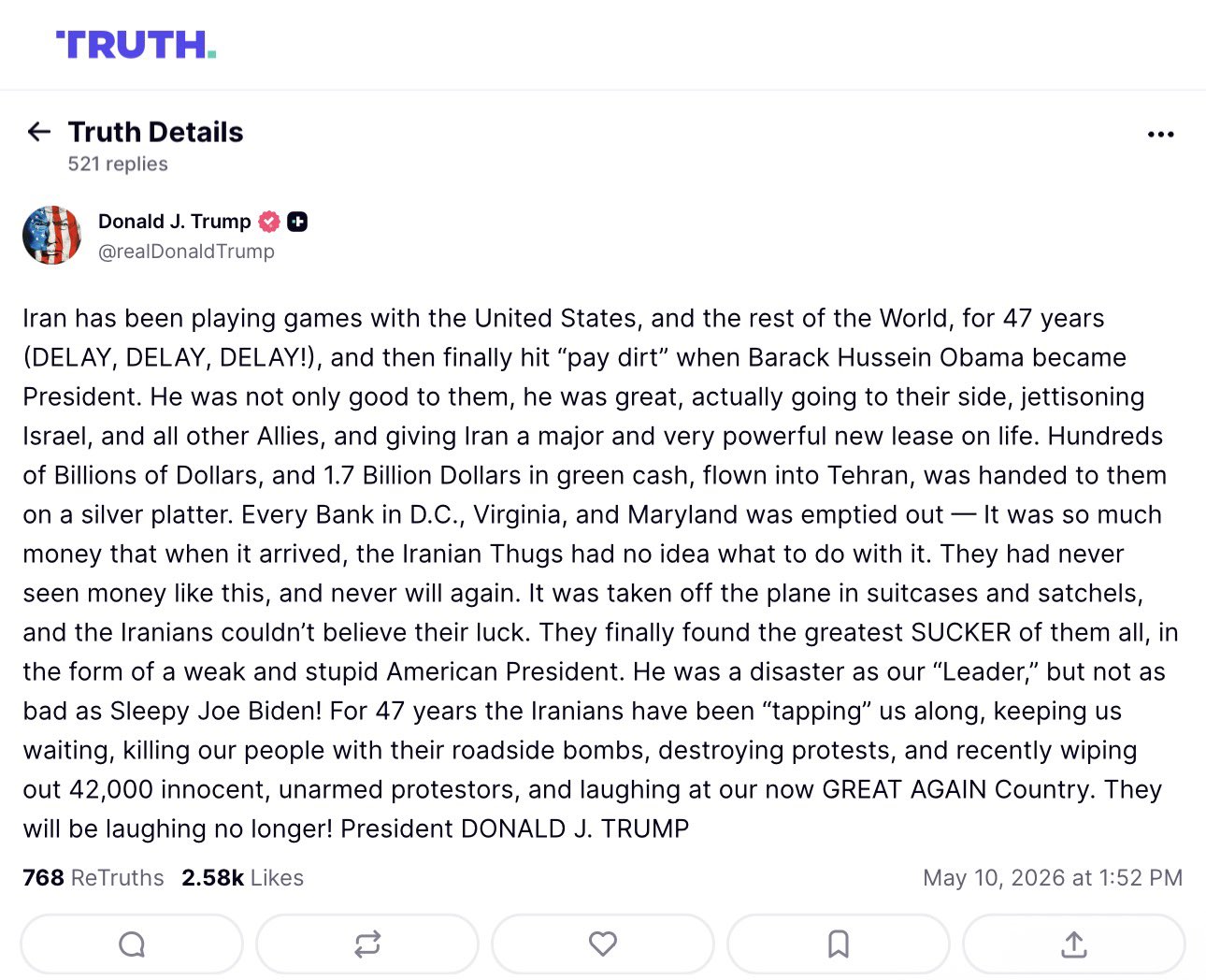
Trump was true to his bad form. The first was right before Iran sent its latest missive:
And after:
Yours truly had suggested an obvious move, that Iran should make its reply in a way to upset Mr. Market. That looks to have been pretty successful. As NO1 summarized:
Oil prices surge on collapsed peace talks — WTI nearing $98-100 with a ~5% weekend move after the rejection. Iran submitted its response just before oil futures opened, a timing move noted by multiple accounts.
I had intended to throw down this marker sooner, but better late than never. When a member of the Administration says “unacceptable” that means they are unable to change an outcome but fantasize that enough threat display could still work. Marco Rubio has recently developed a great fondneess for the “u” word.
As we will explain, Trump’s continued very loud and ugly noises do not change the underlying fact of US and Israel impotence. The most they can do is inflict a short punishment campaign by air and engage in terrorism.1 Neither will break Iran’s will. And the fallback of continued economic sanctions will fail. The pain level in the West will hit unbearable levels long before that would happen in Iran, particularly since Russia is now providing essentials via the Caspian Sea, and Pakistan has opened trade corridors.
Not only is Trump trapped by limited and bad US kinetic options, such as a US navy too small even if allies were to help to bust the blockade, a threadbare weapons cupboard, and the wee inconvenience of not being able make much use of bases in the Gulf due to damage and host restrictions, but the timetable is even more against him. The now-confirmed Xi summit (more on that shortly) rules out any big escalation until Trump has returned (Trump likes being in the Situation Room while they are underway). The summit is set for the 14th and 15th. Travel from Beijing to Washington is about 14 hours, and do not forget that it takes more time to get to and from the airports, so say at a bare minimum 18 hours door to door. That does make it dimly possible that Trump could still have, in advance, set a go live time for Sunday, which he would oversee in an exhausted state. But Trump likes to keep his options open and given his state of delusion, may think he can get Xi to help muscle Iran. So he probably does want to see how that conversation goes before deciding to act.
That pushes out the much-ballyhooed possible big punch at Iran, if it happens until the next weekend at the earliest. That timetable would seriously crimp any related Special Forces showy operation. It will be getting too close to being too hot to do more than a very short raid, and none of the contemplated moves would be that.
But as you can see in a segment in this Janta Ka update, that Netanyahu and thus all sorts of Zionists, are still pumping for Trump not merely to hold fast, but also to reinstate demands that the US had quietly dropped, such as eliminating Iran’s ballistic missile program (see at 4:45):
This show also flags that after Macron made noises that it would join the UK in sending a ship or two to the theater (clearly a show of support since there was no intent to act unless the US had vanquished Iran), he backed down when Iran made ugly noises.
This impasse comes against a backdrop of the US’ former Gulf state allies ex the UAE seeking to distance themselves from the US. Remember they still depend on the for defense, even if that “defense” has been revealed making them magnets for destruction. But one can anticipate that the US will demand that the Saudis et al foot most of the bill for the reconstruction of their bases. The only way I can seem them doing that is by exercising great control over anything other than very tightly circumscribed defensive operations.3
Note that Tasnim has called out a Wall Street Journal report2 on the contents of Iran’s response as inaccurate, but some influential commenters are treating accurate as valid and thus unintentionally propagating misinformation. From Tasnim:
The informed source told Tasnim on Sunday night that details published by the American media outlet about Iran’s proposed text concerning negotiations with the US do not correspond to reality in important parts.
The source added that the points raised by The Wall Street Journal regarding nuclear materials are not accurate.
The source noted that Iran’s text emphasizes the necessity of an immediate end to the war and guarantees against renewed aggression toward Iran, along with several other issues within the framework of a political understanding.
According to the source, Iran’s text also stresses the necessity of lifting US sanctions and ending the war on all fronts, as well as Iranian management of the Strait of Hormuz should certain commitments be fulfilled by the United States.
The necessity of ending the naval blockade against Iran immediately after the signing of the initial understanding is also among Iran’s emphasized demands, the source said.
The informed source further noted that Iran has stressed the necessity of repealing OFAC sanctions related to the sale of Iranian oil during the 30-day period as well.
The release of Iran’s blocked assets upon the initial understanding, as well as the implementation of certain US measures during the same 30-day period, also forms part of Iran’s proposed text, the source added.
The Journal (in an updated version of its story) acknowledge the Tasnim correction rather than revising the piece!4
I have yet to see more detail from an official Iran account. Per the first tweet below, IRIB may have one but I am being barred from accessing that site to cite it directly:
Iran’s state IRIB News Agency:
– Iran has rejected the US proposal
– Iran demands war reparations
– Iran demands control over the Strait of Hormuz
– All sanctions must be removed
– Iranian assets must be unfrozen pic.twitter.com/1sobEISelr
— Faytuks News (@Faytuks) May 10, 2026
BREAKING: Iran responds to the US with a “10-point” message on the Persian Gulf and Strait of Hormuz:
The full 10-point response:
1. US military presence is described as the “main source” of instability
2. American bases are portrayed as “unable to secure themselves”
3. Iran…
— The Kobeissi Letter (@KobeissiLetter) May 10, 2026
This Aljazeera segment shows the Iranian Foreign Ministry’s response to Trump’s choleric reaction:
The translation is very clunky. Tasnim has a summary in Iran’s Proposal to US Was ‘Reasonable, Generous’, Spokesman Says.
China has confirmed the Trump summit, albeit at the absolute 11th hour. Were the Chinese hoping Trump would cancel via yet another deferral?
I concur with Helmer that the very fact of a meeting, when Trump has imperiously hit Chinese concerns with two rounds of sanctions in the last ten days, looks way too accommodating:
FLASH FROM THE DRAGON THRONE IN FORBIDDEN CITY: First-ever kowtow of Chinese emperor to foreign emperor, announced at 0900 Beijing time, today Monday May 11, 2026. https://t.co/NInF8FxyS3 pic.twitter.com/wk7JCQwQ1B
— Dances_with_Bears (@bears_with) May 11, 2026
But Helmer depicted this concession as baked in:5
“The Chinese are either indecisive, or decisive, or simply concealing – they aim to receive Trump without looking as if they are until the very last minute” – Min 30:10 https://t.co/NVQ9rV7TbB pic.twitter.com/Ki5dE9vsKu
— Dances_with_Bears (@bears_with) May 11, 2026
Perhaps Xi hopes a stern face-to-face will knock some sense into Trump’s addled brain. But a tough talk by Putin seems to have done little to deter Trump. Larry Johnson argued, in an article that went live before the summit was confirmed, Oil Will Be at the Top of the Agenda if Trump Meets Xi Jinping:
Experts agree that the market has moved beyond immediate price shocks into a structural depletion of reserves. Goldman Sachs reports that the rapid drawdown of global oil inventories has reached an eight-year low, with stocks projected to fall from 101 to just 98 days of demand coverage by the end of May (down from ~128 days in 2020). More critically, “easily accessible” refined product buffers (gasoline/diesel) have dropped from 50 to 45 days of demand since the conflict began, leaving the market vulnerable to even minor additional shocks.
I have to differ. Oil is not the big sticking point. It is control over the Strait of Hormuz. What happens to oil supplies is a secondary effect.
Johnson later mentions fertilizer and has in past posts discussed other critical supply shortages, so he has been on top of this issue.
China is in an awkward position. Even though it is an ally of Iran and pretty much all of the world ex its remaining Gulf State allies, the UK, and EU poodles, are opposed to the US and Israel and in theory are all on board with taking the US hegemony down many pegs via a successful war against colonialism, there is the huge question of what that price is and who pays it. A global depression would do great damage to China, since its exports would collapse. It is already in deflation, with at least as high a level of private debt to GDP as the US, so it could suffer a destructive debt deflation spiral. And that’s before getting to the real risk of starvation in Africa, South Asia, and the poorer parts of many other countries.
China is also positioning itself as the new leader of a world order where Global South countries have more of a vote. China has been seeking to revise the governance of rather than overthrow the post World War II architecture of bodies like the UN, IMF, World Bank. But Iran’s assertion of control over the Strait of Hormuz cannot be squared with any existing rules, save Trump’s recent promulgation of governance by raw power, which Iran opposes. The most generous reading of existing treaties gives Iran supremacy over only its own territorial waters. Oman is a signatory to UNCLOS and thus has agreed to allow free passage on its side of the Strait of Hormuz.
Back to the kinetic front: an F-35 appears to have gone missing:
F-35 squawking 7700 emergency this morning while operating over the Gulf of Oman, landing in Al Dhafra Air Base, UAE.
2nd day in a row … odd. https://t.co/nb1LYR57BS pic.twitter.com/a7wJyFKaQv
— MenchOsint (@MenchOsint) May 11, 2026
Further detail:
I have not seen this promise of a more fierce Iran response confirmed yet. Recall that Iran has promised disproportionate retaliation and that did not happen in the recent dustups in the Strait of Hormuz:
از امروز خویشتنداری ما تمام شد، هر تعرضی به شناورهای ما، با پاسخ سنگین و قاطع ایران به شناورها و پایگاههای آمریکایی مواجه خواهد شد.
ساعت در گذر زمان و به ضرر آمریکاییهاست به نفعشان هست که حماقت نکنند و خود را در باتلاقی که افتادهاند بیشتر فرو نبرند،
بهترین راه، تسلیم شدن و…
— ابراهیم رضایی (@EbrahimRezaei14) May 10, 2026
Translation:
As of today, our restraint is over. Any aggression against our vessels will be met with a heavy and decisive Iranian response against American vessels and bases.
The clock is ticking against the Americans’ interests; it is to their benefit not to act foolishly and sink themselves deeper into the quagmire they have fallen into.
The best course is to surrender and concede concessions. You must get used to the new regional order.
Admittedly, Iran may have decided to temper its actions before the Trump-Xi summit.
Not verified but big if true:6:
جزئیات جدید درگیری/ ایران پنج شنبه شب از چه مدل موشکی استفاده کرد؟
حالا تا حدی معلوم شد اون شب جمعه تاریخی تنگه هرمز چی به سر ناوهای آمریکایی اومده که ترامپ بلافاصله بعدش تهدید به حمله هستهای کرد.
بنابر گزارشها ۳ ناو آمریکا هنگام تلاش برای گذشتن از تنگه هرمز به شدت آسیب… pic.twitter.com/jEbBJ3cvtu
— Ehsan Taghadosi (@demokracy) May 9, 2026
More attempts to clear the fog of war over what happened in and around the Persian Gulf over the last week:
Kharg Island update: The Western berths have remained empty since May 8, suggesting there may be facility damage at the western offloading wing following the recent oil spill.
On May 9, only one vessel, a 180m oil/chemical tanker, was observed loading at the island’s Sulfur…
— Windward (@WindwardAI) May 10, 2026
If the naval attacks (which includes US air support) interests you, Sal Mercognliano tries to piece the story together. He does have a pro-US military bias, but one can generally filter that out. As you can see, even he is stymied at points:
On the economic front, I had wondered why the government here had not implemented additional emergency energy measures (we are at 108-110 days of supply). One reason may be the big falloff in signs of stress in the spot market in the last two weeks. From Bloomberg in The Physical Oil Squeeze Eases for Now as Buyers Back Away:
The cost of a real-world oil cargo is dropping fast as buyers back away, in a dramatic reversal from last month’s bidding frenzydespite the ongoing closure of the Strait of Hormuz.
The sharp retreat provides a counterintuitive backdrop to warnings that the oil market is barreling toward a crisis point — possibly in a matter of weeks. Still, traders cautioned that the calm may be shortlived, raising the risk that physical prices soar again as the industry relies on stopgap measures that can’t fill the gap indefinitely.
An easing that began in the second half of April accelerated over the last week. Premiums of major North Sea grades, which are used to set the global benchmark Dated Brent, have plunged by as much as 90% over the past month to almost prewar levels. Several cargoes for West African and Mediterranean CPC crude for prompt delivery have even traded at small discounts to the benchmark. While prices broadly are still indicative of a tight market, they’re now within a normal range seen in recent years, before the Iran war removed more than 10% of global supply.
Some traders suggested last week that buyers have held back as the US and Iran seemed closer to a deal, wary of paying elevated prices ahead of a crash if the Strait of Hormuz reopens. Others said that oil refiners are increasingly adapting to a world where the bulk of the Middle East’s crude is locked inside the Gulf — operating on a just-in-time basis for crude supplies, drawing down inventories, reducing run rates, or getting supplies from more distant producers.
Oil’s Deep Backwardation Is Almost Gone
Brent CFD spread has narrowed sharply to near pre-war levels
Source: PVM
Brent futures jumped above $105 a barrel on Monday after US President Donald Trump rejected Iran’s latest response to his proposal to end the war, while a drone strike on Sunday briefly set a cargo vessel ablaze off Qatar.
The US in particular has sharply ramped up exports, while the top oil buyer China has been selling cargoes of crude into global markets in an unusual move, Bloomberg reported on April 22. Its imports have dropped sharply — adding to downward pressure on physical prices.
While this development looks positive, there are many ways to interpret it.
First is that panicked spot buying produced enough of a buffer near term for many players so that they can sit back and hope that the Strait of Hormuz mess gets straightened out in the next few weeks. My non-expert take is that this is normalcy bias, big time, that very few are prepared to look at the serious and lasting, probably permanent, break from the old normal that is underway.Based on the warnings by bona-fide experts, is that the energy shortfall will hit start to hit critical levels at the end of May. Unless Xi succeeds in hitting Trump between the eyes with a 2×4 and schemes with him as to how devise a somewhat face-saving retreat from the Strait of Hormuz standoff, I can’t imagine that movement towards the end Iran insists on, of accepting (even with gritted teeth) Iran’s control of the Strait of Hormuz, will be all that fast.
Second is that the change in refiner habits could be a very big part of the reduction in demand. If so, that won’t continue. The effects will be a one-off (there admittedly may be a tail as laggard refiners adopt the practices of the swift-of-foot, but there are limits as to how much short-term demand reduction this would provide).
Third is that some of the buyer pullback may be the result of buyers anticipating demand destruction happening faster than investors and the business press realizes. We have repeatedly said that the cure for high oil prices.
And note above that now paper prices jumped, despite ongoing manipulation:
The current effort to keep WTI June 26 oil future contract to trade below 100$ is truly remarkable, isn’t it?
Kind of feels like the top of the volcano can explode at any moment https://t.co/To97w7Apha
— JustDario 🏊♂️ (@DarioCpx) May 11, 2026
Other Bloomberg stories are less cheery for Team Trump. From Midwest Pump Prices Are Spiking at Worst Possible Time for Trump:
As gasoline prices have ratcheted higher across the US due to the war in Iran, several Midwestern states have seen the steepest increases. That’s putting a strain on many of the voters Republicans need at the midterm elections in November to keep control of Congress.
Indiana, Illinois, Michigan and Wisconsin have all borne the brunt of price hikes since the conflict began 10 weeks ago. Sticker shock is worst in Ohio, where gasoline has surged 72%. That’s double the increase for California, long the poster child for sky-high fuel prices.
Some stray informational hygiene items: we pointed out yesterday that Iran was asserting control over the cables under the Persian Gulf (recall that the lines on its Strait of Hormuz control map extend all the way to the south side of the Strait and include the UAE port of Fujairah). Those cables are, not surprisingly, in Omani, not Iranian, territorial waters. In addition, Oman has signed UNCLOS, the UN treaty that requires that channels like the Strait of Hormuz, which lie entirely in within national territorial waters, are nevertheless subject to freedom of passage for vessels that need to navigate them to serve ports of other nations.
So the idea that Iran has been trying to sell, that Iran and Oman will share the control of the Strait of Hormuz and spilt the tolling proceeds, is a non-starter from the Oman end. But Oman has not cleared its throat.
On a lighter note:
Remember the “Iran Expert” on WSJ Claiming Iran Is Using DOLPHINS with Mines in the Hormuz?
🇮🇷 WSJ’s “Iran Expert” Thought Iranian Submarines Nicknamed Dolphins Were Real Dolphins
The Iranian Navy has MINI SUBMARINES nicknamed “Persian Gulf Dolphins” by their own officers.… pic.twitter.com/JoPQ2vsSg7
— Ryan Rozbiani (@RyanRozbiani) May 10, 2026
Done for today! See you tomorrow!
____
1 Both Larry Johnson and Professor Mohammed Marandi have explained long-form why a even nuclear attacks will not bring Iran to its knees. An additional impediment is fallout. Most of souther Iran is off limits since the fallout would hit Gulf States (impairing oil production and shipments) and Israel.
2 Even before getting to the recent Saudi and per some reports, Kuwaiti nix on Project Freedumb, a precedent also exists with the Incircik base in Turkiye, where Turkiye greater rights over it than other NATO members do over their bases, and can and has barred certain US operations.
3 Weirdly, the Wall Street Journal gives no play to the Iran reply and the Trump hissy:
4 From the Journal in Iran’s Lengthy Response to the U.S. Leaves Some Gaps:
Iran proposes to have some of its highly enriched uranium diluted and the rest transferred to a third country, the people said.
Iran’s response, delivered to mediator Pakistan and forwarded to Washington, calls for guarantees that the transferred uranium will be sent back if negotiations fail or the U.S. exits the agreement at a later stage, the people said.
Iran also said it was willing to suspend enrichment of uranium but for a shorter period than the 20-year moratorium proposed by the U.S., they said. Iran rejected dismantling its nuclear facilities, they said.
The semi-official Tasnim news agency, affiliated with the Islamic Revolutionary Guard Corps, cited an informed source saying The Wall Street Journal’s reporting of Iran’s proposals concerning nuclear materials is not true.
5 I must have misunderstood Helmer when he wrote:
State media reporters representing France, Russia, and the US propaganda agencies – Associated Press, Bloomberg, Reuters, New York Times – asked for China’s response to threats by President Trump to escalate militarily at the Hormuz Strait and in sanctions against Chinese purchases and tanker shipments of Iranian oil.
Asked to confirm Trump’s arrival for the meetings with Xi on May 14-15, the official answer appeared to be non-committal. “Do you have any details on that visit, such as when it might happen? Lin Jian: Please stay tuned.” Bloomberg asked the question; it hasn’t reported the answer. Nor have AP, Reuters, or the New York Times who all heard it.
That answer isn’t non-committal. It is now Wang’s and Xi’s precondition for Trump – and this marks a change in China’s policy towards the Iran war. “China believes,” Wang’s spokesman said, “that bringing about a full stop of hostilities is of utmost urgency, a relapse in fighting must be avoided and sticking to negotiations is highly important. China supports Iran in safeguarding its national sovereignty and security.”
If Trump “relapses into fighting” and does not “stick to negotiations”, Xi is communicating that Trump will not be allowed to land in Beijing next week. China will not permit itself to be Trump’s cover for attacking Iran, as India’s Prime Minister Narendra Modi allowed himself to endorse the Israeli-American war against Iran in the Knesset on February 25, two days before the war began. Wang is changing the meaning of what he told Rubio on April 30.
6 The translation of the full tweet:
New Details on the Conflict / What Type of Missile Did Iran Use on Thursday Night?
Now it’s somewhat clear what happened to the American ships that historic Friday night in the Strait of Hormuz, causing Trump to immediately threaten a nuclear strike afterward.
According to reports, 3 U.S. ships were severely damaged while attempting to pass through the Strait of Hormuz.
Before the conflict began, the Americans initiated heavy electronic warfare to smoothly cross the strait by disabling Iran’s radars, allowing them to pass without trouble. In the middle of the dark night, Iran began firing anti-radiation missiles. The Americans were trapped in the middle of the sea.
The purpose of firing these missiles was to destroy the radar sections of the American ships, and based on reports, the radar systems of all 3 ships were completely destroyed, with one also catching fire badly—we still don’t know what happened to it. The anti-radiation missile, also known as an anti-radar missile, is a specialized tactical weapon for detecting and destroying enemy radio wave emission sources, especially radar systems. It plays a vital role in electronic warfare and blinds and deafens the enemy’s air defense systems by disabling their radars.
In the world, only 6 countries—America, Iran, Russia, China, Brazil, and England—possess this type of missile, and among them, only Iran produces its advanced models. This is one of the wonders of Iran’s missile capabilities, which has single-handedly locked down the Strait of Hormuz for over 2 months.
Unlike conventional missiles that use their own radar to locate targets, the anti-radiation missile operates completely passively for targeting and emits no signals of its own.
The missiles Iran has feature an important capability called “target memory”; meaning that if the enemy radar suddenly shuts off to escape, the missile
