


Connor: I remember Bernd Lange, the German chairman of the European Parliament’s International Trade Committee (INTA), saying at the beginning of the whole risk aversion boom:
Lange must be unfamiliar with the Chekhov’s gun principle, and the Lange and EU approach naturally does not lend itself to large peace dividends.
“Risk aversion” has gained notoriety in recent years, especially in Europe. The authors of the following article claim that it can actually increase the likelihood of conflict. That is not surprising, given the misfortunes of Europe’s ruling class in recent years.
In a world increasingly destabilized by conflict and climate change, it’s hard to blame nations for pursuing safer trading partners or autarky, but it would be great if leaders actually had viable plans. For example, the EU continues to have greater exposure to China than the US for both imports and exports, with the latter becoming increasingly ‘strategic’, and Europe’s disadvantage continues to grow, exacerbated by rising energy costs due to ‘risk aversion’ from Russian energy. One might think that disaster would serve as a warning, but Ursula and her colleagues are moving forward despite this data. The EU relies on China for more than 90 percent of its supplies of certain medicines, chemicals and materials, and in some cases there are no substitutes. Oops.
In March, the World Bank reversed course for the first time in more than 30 years, announcing that it was a mistake for Western countries to outsource nearly all industries. But now they are faced with the impossible task of reindustrialization under neoliberalism. So the gun is on the table.
Written by Ling Feng, Qiuyue Huang, Zhiyuan Li, and Christopher Meissner. Originally published by the Center for Economic Policy Research.
Many governments have recently renewed their interest in risk aversion, or policies that restrict trade to reduce economic coercion. This column argues that this policy ignores the security benefits of trade. The authors estimate that doubling bilateral trade reduces the probability of military conflict by about 30%, demonstrating the causal “peace dividend” of international trade. Efforts to reduce dependence on global supply chains must also consider how they increase the likelihood of costly international disputes.
Since 2018, “risk aversion,” the policy of restricting trade to reduce economic coercion, has become the defining mantra of global economic security. Fearing that economic dependence will be weaponized and critical supply chains disrupted, many countries support de-risking, diversification, investment screening and export control tools. Geopolitics is already reshaping the geography of global trade flows (Aiyar and Ilyina 2023, Alfaro and Chor 2023, Bosone et al. 2024, Doan et al. 2026).
Reducing strategic vulnerability is a legitimate goal. However, current policy debates may be leaning too cautiously. By focusing almost exclusively on how trade exposes states to coercion, the risk-aversion narrative largely overlooks powerful countervailing forces. In other words, trade can reduce the likelihood of war by making military conflict economically costly.
This idea is often referred to as “commercial peace” and is a classic insight in economics and political economy (Polachek 1980, Martin et al. 2008). However, empiricists have never identified a causal effect of trade on conflict. Trade and conflict are jointly determined, leading to reverse causality. For example, trade may promote peaceful relations, but pairs of conflict-prone countries may have less trade, biasing the effects of trade upwards. Alternatively, communication technology may improve trade, but it may also fan the flames of nationalism and ‘civilizational conflict’ (Huntington 1996).
Our new study addresses this empirical challenge by exploiting the ways in which advances in aviation technology reshape the effective geography of global trade, allowing us to isolate trade flattening effects (Feng et al. 2026).
Geography of the aviation revolution
To identify the causal effects of trade on peace, we leverage improvements in aviation technology. Although air transport became cheaper and faster in the second half of the 20th century, it did not reduce transport costs uniformly across countries. Instead, it triggered a systematic redistribution of world trade. Pairs of countries where air routes offered a significant geographic shortcut over circuitous sea routes experienced much larger trade booms than pairs where sea routes were already direct.
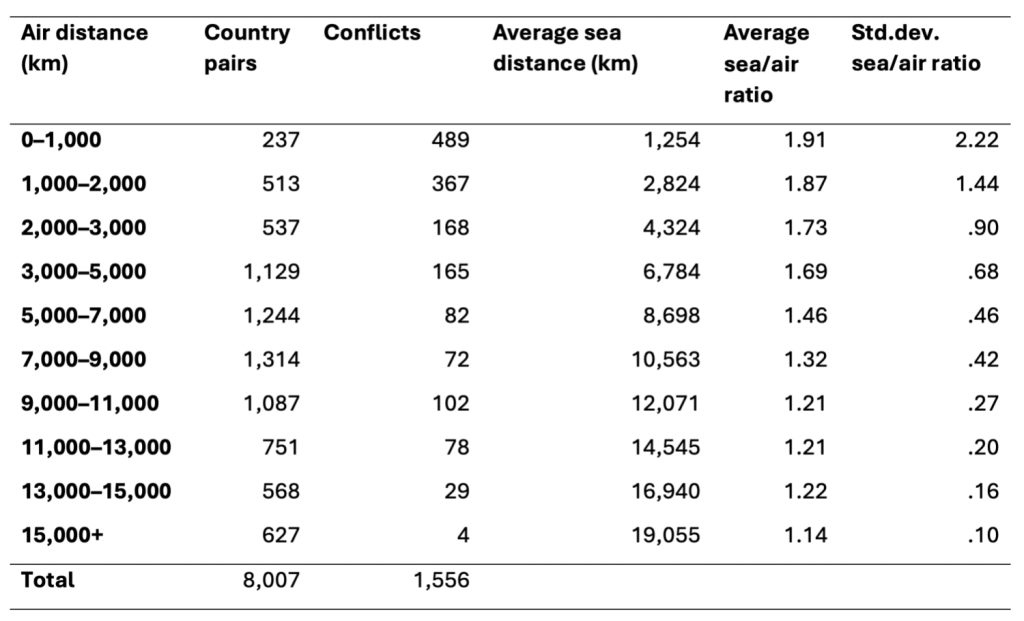
Table 1 shows the extent of geographic variation and its overlap with historical conflicts. Sea-to-air ratio measures the detours required for sea transport compared to direct flights. As the table shows, military conflicts are concentrated in pairs of geographically close countries. More than 76% of conflicts occur between countries located within 5,000 kilometers of each other. Importantly, these same short-range and medium-range pairs have the largest mean sea-to-air distance ratios, ranging from 1.69 to 1.91, and also the greatest variation in their ratios.
Table 1 Conflict and air geography by direct flight distance, 1962–2014
Note: The table reports the distribution of conflicts by direct air distance for the period 1962-2014. For pairs of countries within each air distance range, the table reports (1) the number of pairs, (2) the number of conflicts that occurred within these pairs, (3) the average sea transport distance, (4) the average sea-to-air distance ratio, and (5) the standard deviation of this ratio. Source: Feng et al. (2026), Table 2.
This adjustment between high baseline conflict risk and large variations in geographic shortcuts by air provides a suitable environment for identifying the causal effects of international trade on conflict. Because these geographic structures are primarily fixed by physical geography, rather than chosen by governments according to political alliances or security concerns, they can be used to predict the redistribution of exogenous trade and better isolate the pacifying effects of economic integration.
Defusing crises: reducing conflict and defusing conflict
Our empirical analysis supports a robust and economically meaningful “peace dividend” of international trade. Our recommended instrumental variable estimates indicate that doubling bilateral trade reduces the probability of military conflict by approximately 30%.
Trade can also reduce the severity of conflicts. Our estimates show that greater trade integration reduces the likelihood that conflicts will escalate to the highest levels of hostilities, involving the use of military force and high-casualty wars.
Moreover, this calming effect takes hold before the conflict becomes militarized. Using data on strategic rivalries, we find that trade reduces the likelihood that two states view each other as strategic rivals. This effect is particularly pronounced in positional conflicts, such as competition for status, influence, or regional position. Trade thus appears to deescalate before hostilities escalate into open crises.
Geography of the Peace Dividend of Trade
To assess the importance of trade, we use baseline instrumental variable estimates to calculate, for each country, the expected reduction in the probability of conflict resulting from trade integration.
We find that the largest estimated peace dividends are concentrated in East and Southeast Asia. Economies that have experienced rapid industrialization and deep integration into global value chains, such as China and South Korea, fall into the top 10 for conflict reduction. The same goes for countries like Myanmar, the Philippines, and Thailand.
Figure 1 plots the increase in peace (i.e., the decrease in the likelihood of war) predicted by our model against the actual historical decline in military conflict that countries have experienced. The correlation is positive and statistically significant. The countries that our model identified as the biggest beneficiaries of the aviation-led trade boom are also now the ones that have experienced the largest decline in conflict occurrence. Many economies in East and Southeast Asia appear to have benefited greatly from increased trade.
Figure 1 Actual and fitted reduction rates in conflict probability by country
Note: The horizontal axis shows the fitted reduction in the probability of conflict in 2012 from the baseline model compared to a counterfactual that resets bilateral trade to 1970 levels. The vertical axis shows current country-level reductions. Each dot represents a country.
Source: Feng et al. (2026), Figure 6b.
Unraveling the mechanisms: Where is trade most important?
There is a clear geographical logic underlying these overall peace dividends. We find that the pacifying effects of trade are concentrated precisely where (and when) the aviation revolution brought about the most profound structural changes in trade.
First, trade greatly reduces conflicts between countries with high sea-to-air distance ratios. For countries for which air transport does not offer significantly greater geographical shortcuts than sea transport, the pacifying effect of trade is small and statistically insignificant.
Second, the impact is primarily borne by non-island countries. For country pairs that include at least one island state, which naturally rely more heavily on maritime routes, the impact of trade on conflict is weaker and imprecisely estimated. In contrast, an aviation-driven trade boom eased political tensions between the continental pair.
Finally, the timing of the peace dividend coincides with the acceleration of modern globalization. When we split the sample chronologically, we find that before 1980, the estimated impact of trade on conflict is negligible. However, after 1980, as long-range aircraft and modern logistics became increasingly important to global production networks, the conflict-reducing effects of trade became larger and more accurately estimated.
Don’t evaluate the benefits and costs of production network fragmentation with a single security margin
Policymakers may underestimate the benefits of international trade by focusing almost exclusively on how interdependence exposes states to shocks and coercions. Trade can increase the opportunity cost of conflict and strengthen incentives for restraint (Martin et al. 2008, Mayer et al. 2025). Economies that are less connected to the global economy may be safer from coercion, but evidence also suggests that such reduced integration can intensify international conflict and increase the likelihood of outright war.
Therefore, the policy challenges relevant to the 21st century are not binary choices between “openness” and “security.” Rather, countries should seek to measure the benefits of risk aversion against both economic and security costs.
After all, the policy distinctions that will be relevant in the coming years will not be a binary choice between openness and security. It is a balance between dangerous dependence and stable integration.
References
Aiyar, S, A Ilyina (2023), “Geoeconomic fragmentation and the global economy”, VoxEU.org, March 27.
Alfaro, L, D Chor (2023), “Perspectives on the large-scale redistribution of global supply chains”, VoxEU.org, September 28.
Bosone, C, E Dautović, M Fidora, G Stamato (2024), “How geopolitics is changing trade”, VoxEU.org, May 14.
Doan, TTH, Aito, C Luo, and H Zhang (2026), “Geopolitical risk and supply chain diversification,” VoxEU.org, February 23.
Feng, L, Q Huang, Z Li, CM Meissner (2026), “The “Peace Dividend” of International Trade: A New Empirical Approach”, NBER Working Paper No. 35078.
G7 (2023), “G7 Hiroshima Leaders Communiqué”, May 20th.
Huntington, S.P. (1996), The Clash of Civilizations and the Remaking of World Order, New York: Simon and Schuster.
Martin, P, T Mayer, and M Thoenig (2008), “Trade rather than war?”, Review of Economic Studies 75(3): 865–900.
Mayer, T, I Méjean, and M Thoenig (2025), “The Fragmentation Paradox: Trade Risk Reduction and Global Security”, CEPR Discussion Paper 20564.
Polachek, S.W. (1980), “Conflict and Trade”, Journal of Conflict Resolution 24(1): 55–78.
