


[Today’s Iran war updated launched before complete because jet lag. Please return at 8:00 AM or refresh your browser then for a final version]
The last 24 hours on the Iran front have been noisy from both a kinetic and reporting vantage. We will endeavor to give a quick recap of that action, since a lot is likely to remain disputed, potentially clarified much later (which leaves the initial impression intact), and does not have much strategic significance, and focus on the the more consequential development.
Also forgive me for being heavy on tweets today, but in news overload times, Twitter is good for obtaining new news and hot takes (which often includes debunkings). However, I did see an important breaking story on Tasnim, and not Twitter: Iranian FM to Visit China for Talks.
Keep in mind that even if all CENTCOM claims are true, that Iran did not hit any Navy ships, that 2 vessels got through the Strait of Hormuz despite Iranian opposition, and that the US sunk 5 to 7 (account weirdly vary) Iranian fast ships, this extremely limited achievement merely underscores that the US Project Freedom effort is another big fat US failure. Iran is still in control of the Strait of Hormuz and commercial traffic is either super low or non-existent.
On the bigger picture front, to which we will return soon:
1. The US looks set to resume large scale air strikes soon, perhaps in concert with Special Forces acting in a ground operation capacity
2. Iran hit the UAE hard as the UAE has been more openly and loudly working with the US and Israel. One of the big targets was the port of Fujairah, on the south side of the Sea of Oman coast past the narrowest part of the Strait of Hormuz chokepoint. This is the delivery end of a pipeline that in theory allows the UAE to partly escape the Strait of Hormuz closure. However, the extent of damage is not clear
3. Iran has delineated what it considers to be its Strait of Hormuz zone of control. That includes Oman territorial waters and the afore-mentioned port of Fujairah. This is occurring as the US in its so-far lame Project Freedom is directing ship trying to leave the Gulf not just to go on the Oman side of the Gulf but also to coordinate with the Omani Coast Guard. This raises the question of where Oman sits in this conflict. Oman has remained silent os Iran has periodically said it intends to run its tolling operation in conjunction with Oman and share receipts (potentially with other “playing nicely” Gulf states too. Iran has denied reports that a small strike on Oman was its doing. However, Oman has signed UNCLOS, which commits it to support the right of free passage through the Strait of Hormuz, so it seems obligated to support Project Freedom.
4. Putin has put the so-far-verboten issue of Israel’s nuclear program on the table, stating that the Middle East should be a WMD-free zone.
5. On the looming food crisis front, China may be more exposed than many surmise now.
Some overviews of recent developments, first from the BBC:
President Donald Trump says the US has struck seven Iranian “fast boats” in the Strait of Hormuz, as Washington seeks to guide stranded ships out of the Gulf through the largely closed waterway.
The UAE and South Korea both reported strikes on ships in the vital channel on Monday. The UAE also said a fire broke out at the oil port of Fujairah after an Iranian attack.
Shipping company Maersk told the BBC that one of its US-flagged vessels had successfully exited the strait with US military protection – under what Trump has called “Project Freedom”….
Trump said: “We’ve shot down seven small boats or, as they like to call them, ‘fast’ boats. It’s all they have left.” The US military said it had used helicopters to attack the boats.
Iranian state media later disputed Trump’s announcement that the US had struck the speed boats. Citing a military source, the Tasnim news agency reported that two small cargo vessels had been hit instead, killing five civilians.
The US earlier said navy destroyers and US-flagged merchant ships sailed through the strait on Monday. Iran called the claims “entirely false”, with its military saying it fired warning shots at a US warship. The US military denied this.
Later on Monday, shipping firm Maersk said its US-flagged vessel the Alliance Fairfax, which had been stranded in the Gulf since the US and Israeli attack on Iran at the end of February, had exited the Strait of Hormuz…
Meanwhile, the UAE’s foreign ministry reported a tanker affiliated with Adnoc, its state-owned oil company, was hit in the Strait of Hormuz. South Korea also reported an explosion on one of its ships anchored just off the UAE.
UAE authorities also reported air defences had engaged 12 ballistic missiles, three cruise missiles and four drones. Local officials said one strike caused a large fire and three injuries at its key oil port of Fujairah…
The benchmark Brent crude oil price passed $115 a barrel shortly after the reports that Fujairah had come under attack, up more than 5% on the day.
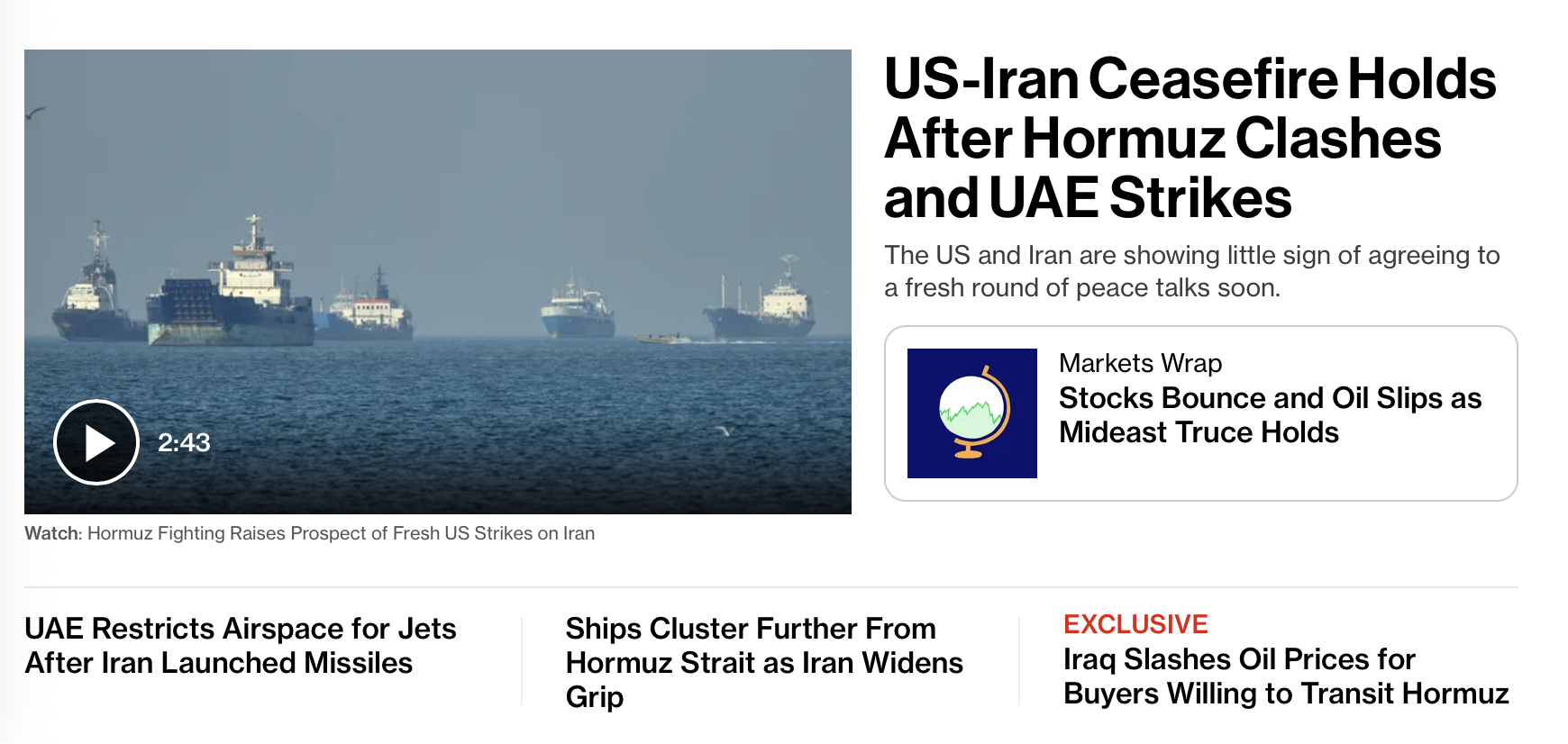
We have become disappointed in Bloomberg’s too-obvious market-goosing, via putting the happiest possible spin on news. Here we have Bloomberg keeping up the bogus patter that there is a ceasefire when the fact of a US blockade is an act of war:
From the Bloomberg story in the image above on the Iraq discount offer:
Iraq is offering discounts for crude loaded this month, with tankers having to transit the Strait of Hormuz to collect the barrels.
The discounts include as much as $33.40 a barrel for Basrah Medium crude, according to a notice from state oil marketer SOMO.
Buyers who accept SOMO’s May terms are notified that “force majeure shall not be applicable to this offer, given that it has been issued under existing exceptional conditions already known to all parties”
Some commentary:
Discounts on oil are useless with the Strait of Hormuz closed
Bloomberg: Iraq is offering its spot buyers significant discounts on crude oil, but tankers to load cargo must pass through the Strait of Hormuz, which is currently impossible. pic.twitter.com/Qexxn1y72f
— Sprinter Press Agency (@SprinterPress) May 5, 2026
Discounts on oil are useless with the Strait of Hormuz closed
Bloomberg: Iraq is offering its spot buyers significant discounts on crude oil, but tankers to load cargo must pass through the Strait of Hormuz, which is currently impossible. pic.twitter.com/Qexxn1y72f
— Sprinter Press Agency (@SprinterPress) May 5, 2026
Another good high level take comes from Lt. Colonel Anthony Aguilar on Dialogue Works:
Aguilar argues out that even if the CENTCOM claims about the Iranian number of fast boat it has taken out are correct, it’s unimportant given how many Iran has. He also points out that the US Strait of Hormuz-opening effort will require more Navy logistical vessels, which are vulnerable. He describes in detail how Iran has not just arial and torpedo-type munitions, which military ship defenses are primed to handle, but also surface-skipping ones, which are hard to detect as threats (as opposed to noise) and also difficult to target. He sees this conflict as primed to blow even bigger. He also later sets out in some detail the amount of assets and willingness to sustain the level of material and human losses the US would have to make in a serious attempt to force the Strait of Hormuz open and secure safe passage simply does not exist.
Trita Parsi suggests (as we have wondered about of late) that Iran is no longer willing to be on the back foot in its dealings with the US, and even kinetically, is now willing to move first when US action is imminent (and the US is often very obvious about that):
Iranian analyst tells me that Tehran’s warning shots at US warships and the strikes on the UAE reveal Iran’s new posture:
If Trump plans to restart the war, Iran will not wait for Trump to do so before it retaliates. It will strike preemptively in a measured way to deter Trump.
— Trita Parsi (@tparsi) May 4, 2026
If reactions on Twitter are any indicator, the US is losing ground in the narrative war:
The Iranian navy, which has been destroyed eight times, closed the Strait of Hormuz again, because the United States for the seventh time won the war that wasn’t a war, so the United States can open the Strait of Hormuz that was open before the not war.
The not war that started…
— Mohamad Safa (@mhdksafa) May 4, 2026
Rude for Iran to be firing missiles after 37 truth social posts about how they’ve been defeated. It’s like they didn’t even read them.
— Jenni (@hashjenni) May 4, 2026
Now to the more strategic matters.
Larry Johnson’s contacts continue to say the US is about to pull the trigger. From his All Indicators Signal that Trump Will Restart the War Against Iran This Week:
Late Monday afternoon in Florida, I learned that there was a large movement of KC-135s over the Arabian Peninsula. This movement was consistent with air-refueling operations for US combat aircraft. I also learned that the US was “spinning up,” which is military slang for going hot. I fully expected air strikes to commence inside Iran early Tuesday morning.
And:
⭕️⚡️ Source to CNN:
US/Israeli attacks on Iran are expected within the next 24 hours.
— Middle East Observer (@ME_Observer_) May 4, 2026
More airplanes will be in theater soon:
BREAKING: CENTCOM:
“USS George H.W. Bush (CVN 77) transits the Arabian Sea as U.S. forces enforce the naval blockade against Iran from the Gulf of Oman and support Project Freedom in the Strait of Hormuz. The carrier has more than 60 aircraft on board.” pic.twitter.com/CDR57iPjOW
— Sulaiman Ahmed (@ShaykhSulaiman) May 5, 2026
Nevertheless, I question whether attacks will start during the week, given that Mr. Market has reacted badly to Operation Freedumb. But this weekend seems all too likely.
A spooky contact told me yesterday:
1. He looked carefully at the Special Forces units deployed to theater. They consist heavily of ones trained to take ports and airfields. He thinks the US will try to take the Bander Abbas port.
Yes, this is ridiculous but so are all the other US schemes. Even if they could seize it, their ability to hold it is nada. The US could instead try to wreck it in a show of potency. But that would not help reopen the Strait of Hormuz, the wellspring of Iran’s power.
2. If Israel is an active participant in the next round of attacks, Iran will not hold back. It will take out Israeli desalination and electrical plants.
3. Iran has been often talking up a new weapon which will set the US/Israel side aback. He says it is a hypersonic missile with a 3000 km range which can be directed in its terminal phase. He says this would be deadly against ships, particularly aircraft carriers.
On the newly explicit (and arguably more extensive) Strait of Hormuz claims and the question of Oman. From Anadolu Agency in Iran releases new map outlining areas in Hormuz under its control:
The designated zone stretches between two defined maritime lines: one running from the western tip of Iran’s Qeshm Island to Umm Al Quwain in the United Arab Emirates, and another extending from Kuh-e Mobarak in Iran to the area south of Fujairah in the UAE, the semi-official Fars news agency reported.
It was not immediately clear to what degree the claimed area of control has changed.
This version of the new control map from the Jerusalem Post may be easier to read:
From the Aljazeera live feed
Shipping trapped in Gulf advised to sail through Omani waters
The US-led Joint Maritime Information Centre is advising ship’s captains to sail in Oman’s territorial waters instead of Iran’s to transit the Strait of Hormuz.
The centre says an “enhanced security area” has been set up there.
It is unclear whether any vessels are attempting to transit the strait, or whether shipping companies and their insurers feel comfortable taking the risk after Iran recently fired warning shots.
Iran’s state-run IRNA news agency described Trump’s “Project Freedom” to get commercial vessels moving through the strait as “delirium”.
Iranian military commanders on Monday said ships passing through Hormuz must coordinate with them.
More specifically, from Middle East Monitor US directs ships to transit Strait of Hormuz through Oman’s territorial waters
The US Navy on Monday directed vessels seeking to transit the Strait of Hormuz to route through Oman’s territorial waters south of the Traffic Separation Scheme, warning that the main shipping lane remained extremely hazardous due to sea mines that had not been fully surveyed or cleared, Anadolu reports.
The US Naval Forces Central Command advisory urged ships to contact Omani authorities on VHF channel 16, given anticipated traffic volume, and encouraged operators to carefully review risk assessments before attempting transit.
A tidbit: There is an argument that Iran not having signed UNCLOS (the treaty that obligates most states to treat certain waterways within national territorial waters, including the Strait of Hormuz, as subject to a right of free passage) does not get it off the hook. From Aljazeera in mid-April:
Given that Oman has signed and ratified the UNCLOS, its free transit passage regime applies to its waters and any user state that has ratified the UNCLOS. In this sense, Iran has no jurisdiction over this area in the Strait of Hormuz, as an IMO member state that has signed but not ratified the UNCLOS.
On the UAE being even more ferociously target by Iran. Recall that any state that hosts a base and/or lets the US use its airspace is a belligerent per the UN and thus a legitimate target, so please ignore all the Gulf State whinging. But the UAE has been particularly enthusiastic in aiding the US and Israel. A bit of backstory:
The UAE doubles down, risking the social contract
On May 3rd, Iran confirmed that the United Arab Emirates (UAE) used fighter jets to bomb Iranian territory.
This comes weeks after Iran downed at least four Chinese-made Wing Loong drones. At that time, Tehran was uncertain… pic.twitter.com/OhBpaBhvDe
— Patricia Marins (@pati_marins64) May 4, 2026
And:
#Iran’s announcement of an expanded control envelope in the Strait of Hormuz – coupled with strikes on oil facilities in Fujairah and strikes on oil tankers – points to a deliberate escalation toward the United Arab Emirates’ oil export bypass routes.
The objective is to keep…
— Hamidreza Azizi (@HamidRezaAz) May 4, 2026
Iran reportedly attacked the Fujairah oil terminal. This is the endpoint of the ADCOP pipeline, the UAE’s only Hormuz bypass. 1.5 million barrels per day of crude capacity, expandable to 1.8 million.
This pipeline was built specifically so the UAE could export oil without… pic.twitter.com/iPbTg4RyLS
— Chris Rollins (@ThePowerAudit) May 4, 2026
UAE says intercepted missiles and drones launched against the country — the first attack since a ceasefire between the US and Iran took hold about a month ago.
The attack caused a fire in Fujairah, the end point of the pipeline the UAE uses to bypass the Strait of Hormuz.
— Javier Blas (@JavierBlas) May 4, 2026
The attack on the UAE allegedly extended beyond physical strikes:
Handala: 🚨🚨🚨 Breaking News
A coordinated hybrid cyber and missile attack has targeted Fujairah Port.
Hours ago, in a fully coordinated operation, the systems of Fujairah Port in the United Arab Emirates were first infiltrated by “Handala Hack.” Minutes later, the port came…
— Calla (@CallaWalsh) May 4, 2026
Saudi Arabia and UAE are now pushing the US to restart the war with Iran according to Israel sources.
— WarMonitor🇺🇦🇬🇧 (@WarMonitor3) May 4, 2026
On Putin clearing his throat and implicitly challenging Israel’s nuclear program:
Without taking time to unpack this development further, it is potentially a very big deal, since Russia is effectively saying it is not reasonable to ask Iran to limits its nuclear enrichment when Israel is widely believed to posses at least 100 nuclear bombs.
