


Aerial observation remains a central element of modern warfare. Intelligence, surveillance, and reconnaissance (ISR) platforms, drones, and specialized manned aircraft provide persistent visibility into enemy capabilities and operations. Reconnaissance satellites have expanded ISR coverage, but cannot match the continuous, localized observations provided by aircraft roaming over the battlespace. This article examines the evolving limitations of U.S. Airborne ISR and the implications for future force structure.
Modern U.S. military operations are based on assumptions so deeply embedded that they are rarely considered. This means the battlespace can be observed continuously, in real time, and with sufficient fidelity to support accurate decision-making. From long-range strikes to distributed operations, this continued awareness expectation underpins doctrine, planning, and procurement alike. Airborne ISR drones, manned sensor aircraft, and their associated networks form the backbone of this capability.
But the very characteristics that make airborne ISR valuable also make it vulnerable. For continuous observation, these platforms need to be durable. To provide actionable intelligence, we need to send data. To collect and transmit detailed intelligence, it must be equipped with sensors and communication systems that impose size and signature constraints. In a permissive environment, these traits allow for an advantage. In a competitive environment, exposure occurs.
Persistence as exposure
Airborne ISR is characterized by persistence. Unlike attack aircraft, which temporarily enter conflict airspace to be effective, ISR platforms are designed to remain in their field for long periods of time, often measured in hours or days. This persistence allows for pervasive monitoring, continuous tracking, and real-time targeting. This is the source of ISR’s operational value.
But persistence also creates structural vulnerabilities. The longer a platform remains in a competitive environment, the more likely it is to be detected, tracked, and ultimately engaged. Detection is not a binary event, but a cumulative stochastic process. Even weak or intermittent signals such as radar reflections, electronic emissions, and visual signatures can accumulate over time. Things that are not immediately visible can be inferred, related, and eventually solved through repeated observations.
This dynamic creates a fundamental asymmetry. The Strike platform trades survivability for persistence. ISR platforms trade survivability for persistence. As sensor networks improve and detection methods become more diverse, time becomes the enemy of ISR. Continuous presence, once a cornerstone of advantage, has become increasingly burdensome.
physics of visibility
Aircraft ISR vulnerabilities are primarily due to physical and operational constraints that cannot be eliminated, rather than a lack of technology. Long flights require fuel, and fuel requires volume and lift. Therefore, ISR platforms tend to be large airframes with large high aspect ratio wings. Although this shape is aerodynamically efficient, it imposes a lower limit on the radar cross section.
ISR also depends on emissions. Active sensing systems transmit detectable energy, but the communication links required for real-time operation create additional electromagnetic signatures. Passive sensing also requires the transmission of collected data. These emissions essentially make the ISR platform observable in the electromagnetic domain.
Stealth is further complicated by the sensor payload. Radar arrays, optical systems, and antennas require apertures that disrupt their ideal geometry. These features create reflective surfaces and structural discontinuities. Therefore, the visibility of an airborne ISR platform is a result of its mission requirements. They must be large enough to persist, electronically active enough to be sensed, and connected enough to transmit, each of these requirements increasing their detectability.
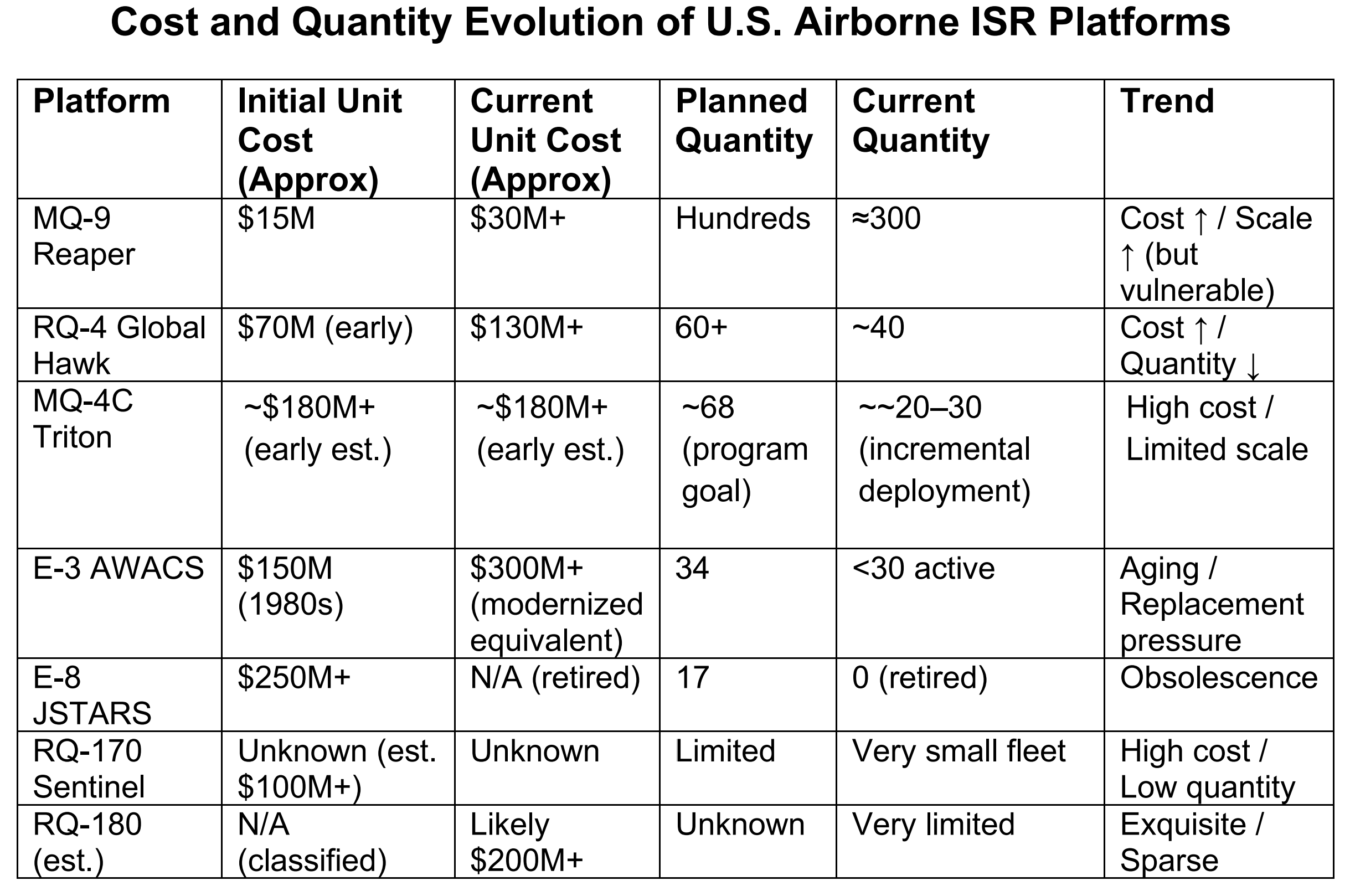
The U.S. defense industry has responded to the challenge of ISR vulnerability by designing increasingly sophisticated manned and unmanned ISR systems. Along with this, unit prices have also increased as shown in the table below.
MQ-9 Reaper – No longer unchallenged
The defensive environment has changed
Although ISR platforms remain physically constrained, the defensive sensor environment has evolved dramatically. Modern air defense systems integrate multiple sensing methods. Low-frequency radar detects targets that evade high-frequency systems, and high-frequency radar provides precise tracking. Passive systems utilize ambient radiation and eliminate the need for active transmission. Optical and infrared tracking and homing mechanisms, while relatively undetectable, pose a threat to ISR platforms.
Distributed sensor networks further enhance detection. Fuse data from multiple sources to create coherent tracks from weak or intermittent signals. Processing advances make it possible to extract targets from noisy environments and maintain tracking over long periods of time. Multi-layered anti-aircraft networks combine advanced detection modes with advanced battle management of multiple interceptor systems to create a hostile environment for ISR drones and manned platforms. Even the most advanced stealth ISR platforms are unlikely to be immune to the most advanced air defense systems.
RQ-4 Global Hawk – Bigger, Better, and Less
In this environment, stealth no longer guarantees invisibility and intermittent detection is often sufficient. Detections are cumulative. Persistence ultimately increases the likelihood of detection and is a time burden for ISR platforms. ISR assets that can operate with impunity against lightly armed insurgents will face increasingly greater survival challenges when operating against medium- and high-level enemy defenses.
ISR in Attrition – Iran War Experience
Recent combat operations in Iran provide evidence of these dynamics. Iran’s air defense systems are reportedly subject to significant attrition on ISR platforms, especially unmanned systems. The loss of multiple MQ-9 Reaper drones, each costing around $30 million, has been attributed to Iran’s SAM system, according to an open source report. Other reports and visual evidence indicate that an expensive airborne ISR platform, likely an E-3 AWACS, was destroyed in a precision strike on a Saudi air base. Although official confirmation is limited, the incident highlights the vulnerability of even large and well-supported ISR systems when exposed to missile attack.
E-3 AWACS – Expensive but vulnerable
Remarkably, Iran was able to effectively target fixed infrastructure without having comparable airborne ISR capabilities. This does not imply equivalence, but emphasizes that high-end ISRs are not necessarily required to achieve desired operational results. These observations suggest a disconnect between ISR costs, vulnerability, and marginal utility. Airborne ISR remains valuable, but its advantages are no longer decisive under competitive conditions.
Conditional validity across the threat spectrum
The effectiveness of ISR depends on the scope of the threat. Against upper-tier adversaries, ISRs are increasingly constrained by advanced defenses and sensor networks. It can still be used against medium-tier threats, but is being challenged. Low-tier adversaries are often over-provisioned relative to operational needs.
ISR is not a complete failure. It gradually deteriorates when pressure is applied. Coverage gaps result in intermittent tracking, increased latency, and reduced data reliability. Effectiveness is not guaranteed by ability alone, but is conditional, depending on the environment and situation.
ISR as an investment sink
The dynamics observed in U.S. Air Force ISR—increasing costs, conditional effectiveness, and increased vulnerability—are not unique. These reflect a broader pattern of open-ended investment defenses (OEDIs) where requirements are open-ended and sufficiency cannot be clearly defined. OEDI describes a system in which capacity can increase infinitely, but whether it is sufficient cannot be defined. In such systems, investment is driven not by the achievement of stable goals, but by the continuous reduction of defects.
RQ-170 Sentinel – Stealthy and expensive, but not invincible
U.S. airborne ISR development clearly demonstrates this. Operational performance is a challenge across multiple functions, and each shortfall requires additional investment. These responses are additive rather than alternative, and each introduces new costs and dependencies without resolving the underlying constraints.
Similar patterns can be seen in U.S. missile defense, aircraft carrier operations, and nuclear modernization. In both cases, requirements are steadily increasing and investments continue without a clear endpoint. The result is expansion without closure. Because the definition of national security requirements is very flexible, there is no clear cap on these defense expenditures. The expensive RQ-170 and RQ-180 stealth ISR drone programs are examples of this pattern.
conclusion
Aircraft ISR remains essential, but its effectiveness is increasingly conditional. Even if investments continue to grow, structural constraints limit their reliability under harsh conditions. The issue is not competency, but sufficiency. There is no clear threshold at which an ISR is considered complete or fully effective. As a result, investments continue without converging to a stable target. The broader implication is that the challenge is not simply to build more capable systems, but to recognize where functionality cannot be stabilized with additional investment alone. U.S. airborne ISR has demonstrated that the development of essential systems can evolve into an open-ended investment pattern when its requirements exceed what can be reliably achieved in operational conditions. Therefore, future developments must be based on these realities rather than open-ended performance goals.
