


The threat comes as Spain appears to be leading a shift in Europe away from Donald Trump’s US.
The Trump administration is studying a plan to punish NATO members who have not been forthcoming enough with assistance in the US-Israeli war of aggression against Iran. At the top of the list is Spain whose prime minister, Pedro Sánchez, is the only EU leader to have taken Trump properly to task over his disastrous war. In a recent address, Sánchez said Spain would “not applaud those who set the world on fire just because they turn up with a bucket of water.”
During the month-long conflict Sánchez’s government not only refused to allow US forces to use the joint military bases of Rota and Morón for operations in the West Asian conflict but also closed Spanish airspace to US military aircraft involved in the hostilities.
Now, the Trump White House is threatening to withdraw US troops from countries that have not contributed to the US-Israeli war effort, such as Spain and Germany, and relocate them to NATO members that have been more cooperative. The plan has reportedly gained traction among US government officials as Trump’s requests for help from NATO have fallen on deaf ears, according to The Wall Street Journal:
The proposal would fall far short of President Trump’s recent threats to fully withdraw the U.S. from the alliance, which by law he can’t do without Congress…
[The plan] underscores the growing rift between the Trump administration and European allies following the president’s decision to launch the war with Iran.
NATO Secretary-General Mark Rutte traveled Wednesday to Washington to meet with Trump. Rutte has sought to deepen ties with Trump despite tensions in the trans-Atlantic alliance and was among those who persuaded him not to take over Greenland.
“It’s quite sad that NATO turned their backs on the American people over the last six weeks when it’s the American people who have been funding their defense,” White House press secretary Karoline Leavitt said Wednesday. She said Trump planned to have a very “frank and candid conversation” with Rutte.
Rutte has sought to strengthen US-NATO ties despite rising tensions within the organisation, including over US plans to annexe Greenland. Even as those divisions have risen, the much-ballyhooed NATO divorce or separation is not going to be easy to accomplish, as Yves recently noted. Meanwhile, here is Rutte performing his ritual genuflection to “Daddy” Trump:
“Is the world safer today than it was before the war was started?”
Secretary-General of NATO, Mark Rutte: “Absolutely, and this is thanks to President Trump’s leadership” pic.twitter.com/jjOWexNsOg
— Glenn Diesen (@Glenn_Diesen) April 9, 2026
Despite all the recent complaints coming from Trump admin figures, the reality is that most NATO allies have quietly helped to enable the US’ war effort even as they have tried to keep their political distance from the war, as notes a recent WSJ op-ed by two Lithuanian-based analysts.
Germany has kept Ramstein Air Base — a crucial US hub for logistics and force projection — available under standing agreement, even as Berlin insists this isn’t NATO’s war. Even France has allowed US aircraft to use French bases for missions supporting Gulf partners, while prohibiting those planes from taking part in strikes on Iran.
The most extreme example of this trend is Keir Starmer’s Schrödinger’s war, which continues to intensify in both of its contradictory forms. As Starmer and his government ministers cling to the narrative that they refused to be dragged into the war, more and more evidence stacks up of UK complicity in US-Israeli war crimes, including Israel’s recent carpet bombing of Lebanon:
It’s “not the language I would use” is the most inadequate response to a threat of genocide. https://t.co/GSVqQtDTHf
— Harry Eccles (@Heccles94) April 9, 2026
🚨Keir Starmer sent a MQ-9 Reaper drone over Lebanon for 13 hours yesterday
Departing from RAF Akrotiri, it flew in circles near Baalbek. At same time, Israeli strikes killed 18 people in area
Starmer flew intel flights over Gaza for Israel. Is this part of same arrangement? pic.twitter.com/WShUvyvQ62
— Matt Kennard (@kennardmatt) April 9, 2026
Indeed, the only real exception to this trend is Spain, notes the WSJ op-ed:
The leftist Prime Minister Pedro Sánchez seemed eager to pick a fight with Mr. Trump. Last year Madrid alone refused to commit to NATO’s 5% defense-spending target. Now it has denied the use of Naval Station Rota and Morón Air Base for Iran-related operations and closed its airspace to U.S. military flights linked to the war. Yet when Spain blocked some routes and facilities, flights were simply rerouted elsewhere in Europe, including through Germany.
Spain’s Sánchez government shows no sign of changing course. If anything, it is intensifying its criticism of Israel and Trump. Spain’s Foreign Minister Manuel Albares called the war “the greatest assault on the civilization built upon the humanist ideals of reason, peace, understanding, and universal law.”
On Wednesday night, Sánchez reiterated his call for the EU to suspend its association agreement with Israel, urging an end to “impunity for (Israel’s) criminal actions”.
In a post on X, Sanchez described Israeli Prime Minister Benjamin Netanyahu’s “contempt for life and international law” as “intolerable”. He has also welcomed the Pakistani-brokered ceasefire alongside the caveat that Spain would “not applaud those who set the world on fire just because they turn up with a bucket,” in reference to the Trump administration.
Pedro Sanchez, Spanish PM,
“Of course, we are going to put all the resources of the State at the service of the people to protect them from a war, the one with Iran, which the Government of Spain does not support”
“And I say to the right and the far-right, that they cannot be… pic.twitter.com/e1JVQiLPfy
— Farrukh (@implausibleblog) April 8, 2026
The Spanish government was also quick to reopen its embassy in Tehran, becoming the first Western nation to do so, even as its diplomatic relations with Israel remain on hold.
“I’ve instructed our ambassador in Tehran to return, to take up his post again and reopen our embassy, and for us to join in this effort for peace from every possible quarter, including from the Iranian capital itself,” Albares told reporters on Wednesday.
In addition, Spain summoned Israeli envoys over incidents involving UN peacekeepers in Lebanon, including the reported detention of a Spanish UNIFIL member.
In a recent interview with the WSJ, Sánchez suggested that Trump may have been duped into this disastrous military campaign by Netanyahu. Whether this take is true or not, and personally speaking I don’t buy it, Netanyahu’s decision to attack Lebanon on the first day of the ceasefire lends it credence.
Massive expose by 🇪🇸 Spanish PM Pedro Sánchez in an interview
Journalist : Why are you so vocal about the war against Iran?
Sánchez 🤯: “Israel PM Netanyahu 🇮🇱is trying to create a new reality in Middle East and there are chances that the US (Trump) administration is unware… pic.twitter.com/FkcjxaPrOx
— Amock_ (@Amockx2022) April 10, 2026
As we have noted in previous posts, Sánchez’s anti-war stance, like his anti-genocide stance, is partly, if not largely, based on expedience. The broad coalition Sánchez has led for almost eight years includes left-wing parties like Podemos, Bildu and Esquerra Republicana that are strongly pro-Palestine and anti-war.
Pro-Palestine sentiment has also always been strong in Spanish society, with 82% qualifying Israel’s acts in Gaza as genocide, according to a survey late last year. Plus, Sánchez is facing myriad scandals at home and appears to have decided, quite wisely, that supporting the Gaza cause and opposing the war against Iran makes shrewd political sense.
There are concerns, however, about the genuineness of the government’s embargo on Israeli weapons. A new report of the Delàs Centre for Peace Studies warns that six months after the government’s emergency decree banning the weapons trade with Israel, Spain continues to engage in business with Israel’s military industry, in particular on the military tech side.
Meanwhile, Sánchez continues to reap the electoral benefits of his stance on the Iran war. As Reuters reports, polls show an overwhelming majority of Spanish voters rejects the war. Since the war began Sanchez’s Socialist Party has gained voter support while far-right Vox, which backed the US and Israel, has seen a decline. To borrow from Yves, “quelle surprise!”
Even more interesting is speculation that Spain may be leading a shift in Europe away from Donald Trump’s US and Netanyahu’s Israel. On Tuesday, Sánchez reiterated his call for the EU to end its association agreement with Israel. Two days later, the tiny country of Slovenia echoed the demand. It’s hard to see Germany’s fanatically pro-Israel government agreeing to any such move, however.
Slovenia has joined Spain in demanding the suspension of the EU-Israel Association Agreement over the situation in Lebanon
Honestly, it’s a shame that so many lack the courage shown by Slovenia and Spain in opposing Netanyahu
Hats off to the Slovenians and the Spaniards
🇪🇺🇪🇦🇸🇮 pic.twitter.com/I7nVFvQSjt
— Elisa Mosini 🇪🇺🇮🇹 (@MosiniElisa) April 9, 2026
Meanwhile, from Politico:
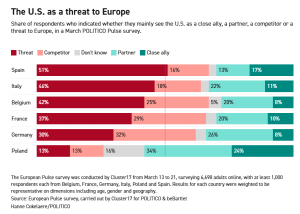
In a poll of people in six EU countries in March, a majority of Spanish respondents — 51 percent — said Washington poses a “threat” to Europe, the largest proportion of all the countries polled. The results also revealed strong Spanish opposition to President Trump’s foreign policies and the U.S. and Israel’s war in Iran.
Spain’s respondents stood out for their wholesale support for Europe to increase its autonomy. Ninety-four percent said the continent needs to become more self-sufficient and less dependent on other major powers — even if that shift comes with major economic costs.
People in Spain also indicated a broad willingness to rush to the defense of an EU country under attack from a foreign power, and large backing for a European army.
Spanish Prime Minister Pedro Sánchez has stood out as the U.S. president’s chief critic in Europe and an outspoken opponent of the war in Iran. After Madrid banned the U.S. from using jointly operated military bases or the country’s airspace to carry out attacks in the Middle East, Trump issued an ultimately empty threat to cut commercial ties with Spain.
That threat has so far led to nothing, perhaps due to the legal uncertainty surrounding Trump’s tariffs. There’s also the fact that much of US trade with Spain falls under bilateral trade agreements between the US and the EU. Or perhaps the Trump administration has decided it has already inflicted enough damage to the global economy through its idiotic war against Iran.
One way or another, Washington will presumably take some form of vengeful action against Spain. However, it is arguable whether withdrawing US troops from one or both of the two main bases on Spanish territory will constitute punishment. While such a move would have an immediate economic impact on local communities, it could be a blessing in the long run.
After all, one of the three conditions of the 1986 referendum on Spain’s continued membership of NATO, which the YES won with 56% of the votes, was the progressive reduction of US military bases in Spain installed after the Madrid Pacts of 1953. Since then, the number of joint US bases has fallen from four to two. Could they now fall from two to one, or even zero?
The US — and Israel — could also retaliate by stoking tensions on Spain’s southernmost border, by supporting the independence of the two tiny Spanish enclaves of Ceuta and Melilla, which sit on the northern shores of Morocco’s Mediterranean coast. Morocco is closely allied with the US and Israel, both of which already supported Morocco’s territorial claims over Western Sahara — in return for Rabat’s official recognition of Israel, in late 2020 as part of the Abraham Accords.
Michael Rubin, an influential neo-con analyst and former Pentagon advisor, recently urged Morroco to launch a civil march on Ceuta and Melilla similar to the one in 1975 that triggered the withdrawal of Spanish forces from Western Sahara. Those forces were quickly supplanted by Moroccan occupying forces.
In an interview with El Español, the Republican congressman Mario Díaz-Balart, a gusano hawk closely tied to Marco Rubio, made some veiled threats in that direction.
“We have seen that [Sánchez] is a president who acts aggressively and I would not be surprised if the US administration is looking for alternative options that are different from those we have had with Spain for many decades.
…
[I]t seems that Mr. Sánchez values the relationship with the dictators of Iran, Cuba and Venezuela more than with the United States…
QUESTION: Does the United States consider Morocco as an alternative where to take the military bases if Spain continues with its ‘no to war’ position?
ANSWER.– It is interesting, because Ceuta and Melilla are in Moroccan territory. The attitude of the King of Morocco has been positive.
It is always interesting to see what the geopolitical and geographical reality of Morocco is, these are important issues for this country.
The relationship between the US and the Alawite country has remained consistent, it is very important, there is an alliance that has remained even in difficult times.
And those are questions that exist: the attitude of Ceuta and Melilla and whether they are part of Spain or should be part of Morocco are issues that are always open and are resolved through alliances and friendship.
But it is very sad that this individual [Sánchez] is jeopardizing that alliance between the United States and Spain, something that the Kingdom of Morocco has not done.
In European capitals, meanwhile, Sánchez’s approach to the war has been met with a mixture of derision and praise, reports Reuters.
“I never agree with Sanchez because he has a vision of the world that is the opposite of mine. He says one thing and then does another,” said Matteo Salvini, Italy’s Deputy Prime Minister and leader of the far-right League party, when asked at a press conference on Wednesday about Sanchez’s condemnation of the war in Iran.
German officials told Reuters they viewed Sanchez’s confrontational stance as aimed at a domestic audience and unconstructive for preserving NATO unity. Germany has been openly critical of Spain’s refusal to increase its defence spending in line with other members of the alliance.
Among the conservative-led German government’s Social Democrat coalition partners there is more sympathy.
“Sanchez expresses things about the U.S. policy we would like to say as well,” one lawmaker said.
In a tweet that went viral, Sophia Chikirou, a deputy for the La France Insoumise party, highlighted just how absurd it is that only one European head of state had the political courage to oppose Israel’s war crimes in West Asia:
History will remember that a single European head of state had the courage to stand up to the criminals who rule Israel. Pedro Sánchez belongs to the Spanish Socialist Party which, as everyone can see, has the same positions as La France Insoumise on this issue. Lebanon, like Palestine, deserves our solidarity and support.
Lastly, it’s worth noting that Sánchez is scheduled to embark on a four-day official visit to China — his fourth visit in as many years. Spanish officials have stressed that this is a high-level official visit as Madrid seeks to bolster relations with what they describe as a key strategic partner, with the caveat that Sánchez’s overtures towards China’s are in line with the EU’s approach and interests. Such assurances are unlikely to placate an already apoplectic Trump administration.
