


[This Iran war post launched before complete because reasons. Please return at 8:00 AM EDT or refresh your browsers then for a final version]
So the much-ballyhooed US/Israel ceasefire with Iran collapsed in less than 24 hours because it was yet another deception by the belligerents. The key immediate effect is that Iran has actually said is has closed the Strait of Hormuz, as opposed to before saying the Strait was open with conditions, and then correctly pointing to ship operator fears and war risk insurance availability and cost as the main impediment.1
For the Trump side, this will be a Pyrrhic victory. His ruse succeeded in getting oil prices down yet again due to the prospect of a resumption of something like old normal levels of Strait of Hormuz traffic in the not-too-distant future.
But Trump is missing the real stakes: what will be dispositive, and in not all that long, is actual physical supplies and not market action. This week is about the time when the last round of tankers and cargo ships that had left the Gulf before the war reach the US and Europe, meaning that the supply shortfall will start to actualize.
19/ This is highlighted in the map below by JP Morgan, which shows when the last Gulf tankers are due to arrive at various destinations. Europe is next to receive its final shipments, with the last jet fuel tanker due to arrive on 9 April.https://t.co/zJRxHvJUym
— ChrisO_wiki (@ChrisO_wiki) April 5, 2026
And as readers well know, Trump fixation of oil and gas prices obscures the impact of how the steep fall in other commodities that come out of the Persian Gulf will lead to more price hikes and shortages.
But even that belief was the result of Trump abjectly misrepresenting what Iran had agreed to, as we discussed longer-form yesterday.
New statement from the Speaker of Iran’s Parliament pic.twitter.com/WdGBO1RcrD
— Yashar Ali 🐘 (@yashar) April 8, 2026
The Trump Administration, true to form, doubled down on lying, with JD Vance and others maintaining that having Israel cease operations in Lebanon was never part of the deal. The Janta Ka clip below not only recounts how Israel launched its most savage air strikes against Lebanon ever, of 100 missiles in 10 minutes, killing over 182 as of recent reports, but also has none other than the White House’s pet Middle East stenographer, Barak Ravid, effectively calling out the falsehood.
This section from Ravid in a CNN video starts at about 8:20:
Well, I think it’s not only the Iranians. problem is that the Pakistani prime minister when he announced the ceasefire he made it clear that Lebanon was part of the deal, which raises the question of what happened there in the negotiations if the main mediator says that Lebanon is part of the deal. I know that the Egyptian mediators and the Turkish mediators see it the same way, that Lebanon is part of this deal.
Yesterday uh shortly before Trump announced a ceasefire he called Israeli Prime Minister Netanyahu who sort of lost control of the process and was very nervous about this ceasefire and during that call when Trump told him listen I’m going to agree to a ceasefire with Iran, Netanyahu told him but what about Lebanon we want to continue fighting. And Trump told Netanyahu, no problem you can continue fighting Lebanon is not part of this deal. So this was something that was agreed upon before the announcement of the ceasefire, it was agreed upon between Israel and the US. I heard it from both Israeli officials and US officials. And US officials told me today …
And US officials told me today that they’re not concerned about this those Iranian threats to withdraw from the negotiations or to uh close again the straight of Hormuz because of the situation in Lebanon. They think it will be solved and and it’s not going to be a reason for the agreement to collapse.
Other sources confirm the Iranian view:
It looks like Trump used the Pakistanis to get his off-ramp and then went directly against what Shehbaz Sharif had outlined in his ceasefire announcement.
The Pakistani ambassador to the U.S. confirmed today that the ceasefire proposal included Lebanon.
And yet, it’s being…
— Mehlaqa Samdani (@MehlaqaCAPJ) April 8, 2026
And now, the 5×7 glossies:
🇺🇸🇵🇰 CONFIRMED! The White House reviewed and approved a social media post by Pakistan’s prime minister, Shehbaz Sharif, which explicitly stated that Lebanon was part of the ceasefire agreement.
However, after Israel bombed Lebanon, the Trump administration backtracked, claiming… pic.twitter.com/W3UwIVaPJc
— DD Geopolitics (@DD_Geopolitics) April 9, 2026
Given that, I don’t understand how Larry Johnson gives Trump the benefit of the doubt via a headline like, Trump Got Played by Israel… And the Game Continues. It is not as if Bibi went out on his own and presented Trump with a fait accompli. Trump was totally on board.
Note also that both the French ambassador to the US and the EU’s top diplomat Kaja Kallas have both said Lebanon should be included in the ceasefire. Italian Prime Minister Georgia Meloni has condemned all ceasefire violations
White House spokescreature Karoline Leavitt made clear that Trump in fact has no interest in considering Iranian requirements:
🚨 Karoline Leavitt: Trump Threw Iran’s 10 Point Plan In The TRASH
“The Iranians originally put forward a 10-point plan that was fundamentally unserious… it was literally thrown in the garbage by President Trump.” https://t.co/5OvKaQDbWJ pic.twitter.com/Z6gJ6XwFdd
— Mr Producer (@RichSementa) April 8, 2026
The “Ceasefire” Was Nothing More Than A Trick…
Simply used to give Israel the upper hand in Lebanon through focusing its airforce there.
In addition it was an attempt to divide the regional war fronts, while attempting to make Iran look weak.
The US White House Spokeswoman…
— Robert Inlakesh (@falasteen47) April 8, 2026
Moreover, per AlJazeera’s live feed as of 7:00 AM EDT, Netanyahu just disputed a claim by JD Vance, that Israel would dial down its attacks on Lebanon to facilitate negotiations. Duh. Israel wants no negotiations:
Netanyahu says Israel will strike Hezbollah ‘wherever necessary’
The Israeli prime minister says Israel would keep hitting Hezbollah “wherever necessary”, a day after deadly Israeli strikes pummelled Lebanon.
“We are continuing to strike Hezbollah with force, precision, and determination,” Netanyahu said on his personal X account.
“Our message is clear: anyone who acts against Israeli civilians – we will strike them. We will continue to hit Hezbollah wherever necessary, until we fully restore security to the residents of the north” of Israel, he added.
So it should also come as no surprise, as the Speaker of Iran’s Parliament noted above, that the US smartly repudiated another position that Iran views as essential, namely the right to enrichment. As reported by The Hill: Trump: There will be no enrichment of uranium in Iran. Trump has later said Iran will not have a nuclear weapon, but it appears he sees any enrichment as tantamount to weapons development.
Similarly, there is ample evidence of continuing attacks on Iran…
And per Reuters (hat tip Ann) Iranian Oil Refining Company confirms attack on Lavan refinery.
….which led to Iran to launch new strikes against Gulf states:
Iran confirmed it carried out missile and drone attacks targeting the United Arab Emirates and Kuwait, describing the strikes as a direct response to what it called an attack on oil facilities on Lavan Island.
LIVE UPDATES: https://t.co/4wEizy72b8 pic.twitter.com/Sk580naz1H
— Roya News English (@RoyaNewsEnglish) April 8, 2026
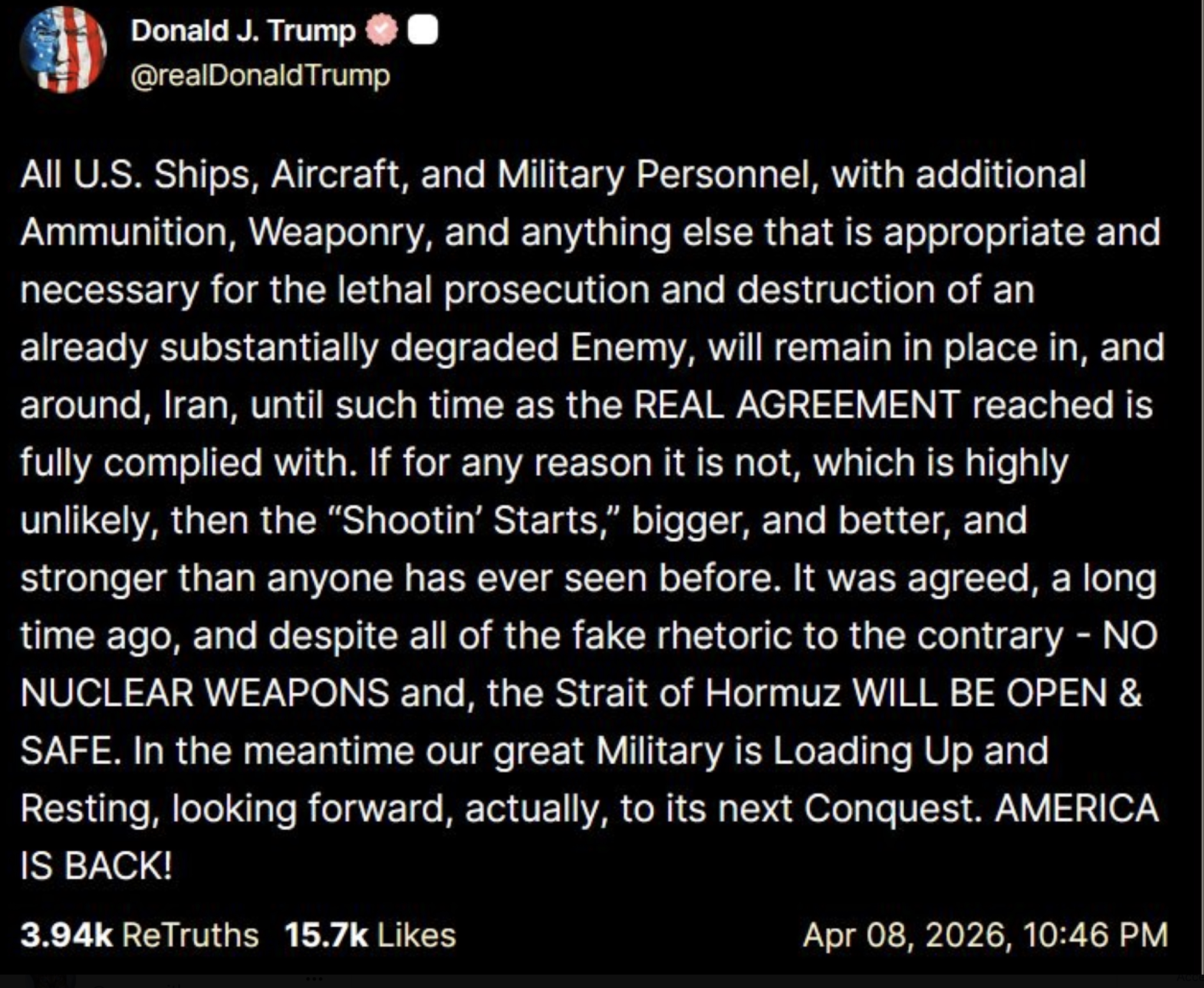
And Trump is again making threats:
Yet bizarrely, even though Foreign Minister Araghchi signaled that these violations might scupper the talks set for Saturday:
🚨 BREAKING
Iranian Foreign Minister Araqchi:
”The terms of the Iran-U.S. ceasefire are clear. The United States must choose between the ceasefire or the ongoing war through Israel. It cannot have both.” pic.twitter.com/ef5Tte4knW
— Iran TV (@Iran_TVv) April 8, 2026
But the Aljazeera live feed, in a 5:00 AM EDT entry, said that Iran has “confirmed its arrival” for the talks in Islamabad set to start on Saturday.
I do not understand the Iranian forbearance given the joke of a negotiating team the US is sending. Per Bloomberg:
US Press Secretary Karoline Leavitt said Vice President JD Vance will lead a delegation to Islamabad, which would include special envoy Steve Witkoff and Jared Kushner.
Is an Iranian sense of amour propre at work, that having said they would meet, they will honor that commitment? That perhaps they even see an opportunity to make it even more clear to the global community that the US is the bad actor here? Or is this to continue to placate China?
💢 Vice President JD Vance was brought into ceasefire talks late Tuesday, with China also playing a role in persuading Iran to accept the framework, according to the Associated Press citing a mediator.
The report underscores a last-minute diplomatic push to secure Iran’s buy-in… https://t.co/vH2Fl8nkn8
— Drop Site (@DropSiteNews) April 8, 2026
Despite what look like concessions on process (continuing to talk with a recidivist cheat), Iran is not backing down on substance:
— محمدباقر قالیباف | MB Ghalibaf (@mb_ghalibaf) April 9, 2026
As of 7:00 AM EDT, the landing page at Bloomberg:
And an entry three hours earlier in its live feed:
Despite rhetorical exchanges between the warring sides, there were signs the ceasefire agreement was largely holding, with a notable decline in attacks across Arab states in the Persian Gulf.
There were no reports of strikes from Arab Gulf nations for much of Wednesday, with the last major attack taking place on a key oil pipeline carrying crude to Saudi Arabia’s western coast.
On the “What is the status of the Strait of Hormuz” front, Sal Mercagliano’s latest:
Even Mercogliano’s misperceptions are revealing, in that they may be widely shared, including critically, within the Administration. He repeats the idea that the Iranian navy has been destroyed, which is at best exaggerated (the US did blow up some ships, but some were not even operating) and totally misses that this “navy” was never the main vector for closing the Strait of Hormuz. Iran has fast surface boats, per Professor Seyed Marandi, still stored safely underground, surface drones, underwater drones, and projectiles it can launch from a vast array of caves along its coast. US combat vet Stanislav Krapivnik has pointed out that a pickup truck with kids could operate drones well behind the cliffs and take out ships.
These bulk carriers are the ones Mercogliano mentions as just making transits….all from Iranian ports:
JUST IN: ZERO ENERGY TANKERS PASSED THROUGH THE STRAIT SINCE THE CEASEFIRE
All 4 vessels that passed had dry cargo. pic.twitter.com/tAypo2UY6j
— Iran Event News (@Iranevent_tv) April 9, 2026
BREAKING: Iranian media reports that an oil tanker which tried to pass through the Strait of Hormuz was just turned back to Gulf waters.
US oil prices are rising into $97/barrel on the news, now up +7% from the low of the day.
— The Kobeissi Letter (@KobeissiLetter) April 8, 2026
Mercogliano also cleared his throat to point out that the US does import oil and petroleum products from the Gulf and will not be as unaffected as Trump professes.
The IRCG has upped the ante by saying it mined the Strait of Hormuz, apparently so as to force carriers to go through Iran’s territorial waters and be inspected and pay tolls if deemed necessary. Mind you, Iran does not actual have to have deployed mines. The threat is enough to deter carriers from taking a chance. From AlJazeera’s live feed:
IRGC issues map to help ships avoid mines in Strait of Hormuz
The Iranian Revolutionary Guard Corps (IRGC) has released a map portraying alternate shipping routes in the Strait of Hormuz for ships to avoid naval mines, according to local media reports.
The circle on the map below is labelled an “area of danger”. The IRGC Navy says ships must coordinate with them to avoid naval mines.
Tankers that used to pass close to Oman, which is in the south of the Strait, are now being told to take a more northerly route, closer to the Iranian coast.
Alternative routes through the Strait of Hormuz announced by Iran’s IRGC [Screengrab/Al Jazeera]
Mercogliano was exercised about the latest iteration of the Iranian toll plan, arguing that it is against international law. Ahem, if international law mattered, the US and Israel would not have launched a war against Iran and be openly engaging in war crimes, nor would Israel be able to keep engaging in genocide, ethnic cleansing, and assassinations of diplomats. The US decided to pursue the raw exercise of power and is now finding out that two can play that game.
The Financial Times, in an exclusive story, presented what the Iran plans are. Note I would not place a huge amount of weight on details since the Iranians appear to be working through how to manage this process. However, even if they do prevail and regularize their process, the article indicates that will take a lot of manpower to check ships when needed (often?) which then raises doubts about how many could transit per day in a best-case scenario. Key points from Iran demands crypto fees for ships passing Hormuz during ceasefire:
Iran will demand that shipping companies pay tolls in cryptocurrency for oil tankers passing through the Strait of Hormuz, as it seeks to retain control over passage through the key waterway during the two-week ceasefire.
Hamid Hosseini, a spokesperson for Iran’s Oil, Gas and Petrochemical Products Exporters’ Union, told the FT on Wednesday that Iran wanted to collect tolling fees from any tanker passing and to assess each ship…..
“Everything can pass through, but the procedure will take time for each vessel, and Iran is not in a rush,” he added…
Before the [post-ceasefire] halt Hosseini said that any tanker passing must email authorities about its cargo, after which Iran will inform them of the toll to be paid in digital currencies.
He said that the tariff is $1 per barrel of oil, adding that empty tankers can pass freely.
“Once the email arrives and Iran completes its assessment, vessels are given a few seconds to pay in bitcoin, ensuring they can’t be traced or confiscated due to sanctions,” Hosseini added.
Tankers in the Gulf on Wednesday received a radio broadcast that warned they would be targeted with military strikes unless they first gained approval from Iranian authorities….
Western ship owners said on Wednesday they were taking a cautious approach while waiting for details on how and whether the strait might reopen, with no vessels currently braving the transit apart from two linked to Iran.
Maersk, the world’s second biggest shipping line, said it is “working with urgency” to clarify the terms…
Ali Shihabi, a commentator close to the Saudi royal court, said the kingdom would demand “unimpeded” access to global markets…
Around 175mn barrels of crude and refined products are currently loaded on to 187 tankers in the Gulf, according to Kpler data — which could now start to move, depending on what happens in the strait…
Several traders said they thought the situation in the coming days would resemble the system that has developed over the past fortnight, in which a handful of ships that have been approved by Iran are allowed to pass on a specific route.
During the conflict this was largely limited to vessels that had generally done business with Iran and that were not connected to the US, Israel or Gulf states that had provided staging for attacks.
Martin Kelly, head of advisory at maritime intelligence group EOS Risk, said that there was “no way” that the backlog of ships waiting to get out could be cleared in two weeks.
Around 10 to 15 ships might be able to transit the strait per day as the process was “quite time-consuming”, he said, down from 135 ships before the war.
And the economic damage grows, some Asian currencies are coming under serious pressure (note this segment posted before the ceasefire fell apart):2
And per Nikkei in Southeast Asian street food sellers hit by soaring packaging costs:
For Tresnayati, an Indonesian traditional cake maker from Sidoarjo, East Java, the effects of the war in Iran are very real. The plastic wrapping sheets she uses for her products have more than doubled in price from 9,000 rupiah ($0.53) to 19,000 rupiah for a pack of 50….
Tresnayati is one of the millions of small food vendors in Southeast Asia facing this challenge. Spikes in the price of ingredients, fuel, and, not least, packaging are eating into their thin margins. Few feel able to raise prices. And the recently announced ceasefire between the U.S. and Iran is unlikely to provide imminent relief, according to analysts…
Asia usually sources 60% to 70% of its naphtha from the Gulf, Lee Toong Shien, deputy head of Asian petrochemicals pricing at Argus Media, told Nikkei.
The disruption to that flow is rippling through the supply chain, starting with the factories, known as crackers, that turn naphtha into plastic feedstocks like ethylene and propylene. Two in Singapore and one each in South Korea, Thailand, Indonesia and Taiwan have already declared force majeure.
“All naphtha crackers in Asia are reducing operating rates because of this, with some declaring force majeure. Others have issued a letter warning of potential force majeure soon if this war is prolonged,” said Lee.
Some suppliers are proving more resilient. China is “grabbing market share” in the region said Lee, as their crackers are often able to use a wider range of feedstocks, such as propane, ethane, and in some cases coal or methanol.
A handful of big companies like Malaysia’s Petronas, Thailand’s PTTGC, and India’s Reliance ex-China are also relatively shielded for now, added Lee. They have their own gas fields and can also crack ethane, which mainly comes from the U.S., to make plastic feedstocks.
___
1 Iran’s announcement of an actual closure is an escalation that commentators and officials seem to have missed.
2 The Thai baht fell from elevated levels and is still comfortably within recent ranges.
