


Yves here. Aiee, everywhere you turn, planetary harm. The example of rocket exhaust pollution illustrates a general case: activities done at a small scale probably won’t do too much environmental damage and thus might be defensible in light of scientific or economic benefit. But our insufficiently regulated, short-term fixated approaches also seem designed to produce excess, and with that, consequences that often show up when they have become difficult if not impossible to undo.
By Ramin Skibba (@raminskibba), an astrophysicist turned science writer and freelance journalist who is based in the Bay Area. He has written for WIRED, The Atlantic, Slate, Scientific American, and Nature, among other publications. Originally published at Undark
Rocket launches used to be a rare occurrence. But with access to space proliferating, partly thanks to an abundance of commercial space companies, global launches have risen exponentially: In the last five years, they’ve nearly tripled. According to an analysis by SpaceNews, in 2025 alone, humans shot about 320 rockets into space.
All those rockets produce a fair amount pollution, from the sooty plumes that catapult them into orbit and beyond to derelict satellites that burn up upon reentry. Regulators have been monitoring and restricting other air pollutants especially since the 1970s, including the exhaust from cars and jet engines. Many researchers believe such regulations are overdue for rocket engines — especially because nobody really knows exactly how much damage those pollutants cause. “It might be another 10 years until we found how large the influences on the atmosphere actually are,” said Leonard Schulz, a geophysicist at the University of Braunschweig – Institute of Technology in Northern Germany. By that time, he added, the pollution could accumulate to the point that, you cannot easily reverse it.
Though space pollution is still small compared to the aviation industry, rocket exhaust may be gradually depleting Earth’s protective ozone layer, which is still recovering from the impacts of pollution from a class of chemicals called chlorofluorocarbons. (CFCs, as they are known, were once commonly used as coolant in refrigerators and air conditioners, among other uses, and were regulated in the late 1980s.) But with limited data and industry transparency, many unknowns and uncertainties persist, including the impacts of next-generation rocket fuels.
Compared to other sources of pollution, the effects of sending rockets into space and from space debris that comes back down from orbit “has been negligible,” said Christopher Maloney, an atmospheric scientist at the University of Colorado who works out of the Chemical Sciences Laboratory at the National Oceanic and Atmospheric Administration, or NOAA, with recent research on emissions from rockets and reentries. “But if you follow these trends, what is it going to look like?”
The boost in rocket launches is largely driven by the private sector, and in particular SpaceX’s Falcon 9 rockets, which are used in part to loft Starlink satellites into orbit. There are now about 10,000 such satellites, which provide internet services to remote regions. Starlink is just one example of a large network of satellites, known as megaconstellations, the deployment of which accounted for some 40 percent of rocket pollution as of 2022. “The proportion of those emissions coming from megaconstellations is growing every year,” said Connor Barker, a research fellow at the University College London who focuses on atmospheric chemical modeling. In January, SpaceX filed an application at the Federal Communications Commission for a megaconstellation of 1 million satellites, which are reportedly intended for orbiting data centers.
Additional launches have come from Chinese rocket companies that deploy satellites and provide spaceflights to the Tiangong space station and other missions; companies like the United Launch Alliance, Blue Origin, and Rocket Lab; and various European countries and Russia.
To account for pollution from both launches and reentries, Barker developed an online emissions tracker, which has shown a rapid increase in the pollution since 2020 — in particular, for the pollutants black carbon, also known as soot, as well as carbon dioxide and carbon monoxide. Barker expects the pollutants to continue rising for years. “We’re actually slowing down the repairing of ozone hole with the space industry,” he said. “Which is quite something.”
The ozone layer, a thin blanket in the atmosphere that formed half a billion years ago, hovers about 10 to 20 miles above the Earth’s surface. The layer shields all life on the planet, absorbing most of the harmful ultraviolet light from the sun, which otherwise would increase cases of skin cancer and other health effects in humans, as well as damage crops and ecosystems.
After decades of damage from CFCs and their subsequent ban, the ozone layer has been healing, and it was on track to recover by 2045 over the Arctic and 2066 over the Antarctic, the regions that were the most affected. But those ozone holes are persisting, and the recovery may slow down: Researchers say that the ozone layer is the part of the atmosphere most vulnerable to rocket pollution, which could soon be sufficient enough to delay its replenishment.
When a rocket bound for orbit or deep space punches through each layer of the atmosphere, including the ozone layer, it leaves a plume of emissions in its wake. As a rocket rises, burning fuel and generating thrust, emissions in the lower atmosphere dissipate, but those particles collect in the global stratosphere, where they can cause ozone loss.
One of the most concerning emissions from rockets is black carbon, which is released in some quantity by most rocket fuels today — especially kerosene-based propellants, which, as of 2019, were used in about half of rockets. According to Barker, getting a Falcon 9 rocket into space can require around 50,000 gallons of kerosene fuel, also known as refined petroleum, in addition to liquid oxygen, and a rocket belches out at least 5 metric tons of black carbon per flight. Other fuels, such as those in the solid rocket boosters of United Launch Alliance’s Atlas V, produce tons or even tens of tons of ozone-depleting chlorine and alumina. Rockets also generate carbon dioxide, a greenhouse gas, but in small amounts compared to aviation. (SpaceX, Blue Origin, Northrop Grumman, Relativity Space, and Stoke Space did not respond to Undark’s requests for comment. Rocket Lab provided information about its propellants, and neither that company nor ULA shared information about their rockets’ emissions.)
Most rockets today take off from sites in the Northern hemisphere, with a few exceptions, such as the company Rocket Lab’s launch site in New Zealand. As rockets puncture the atmosphere and release emissions, the black carbon and other particles spread quickly. Simulations show that they gradually accumulate in the polar regions. The particles can linger, though it’s not known exactly how long they persist, and in that time they absorb sunlight and thereby warm the stratosphere. That atmospheric heating disrupts the delicate chemical balance that normally maintains the ozone layer, causing ozone loss. That means most rocket pollution indirectly harms the ozone layer, in contrast to CFCs, components of which actively destroyed ozone molecules.
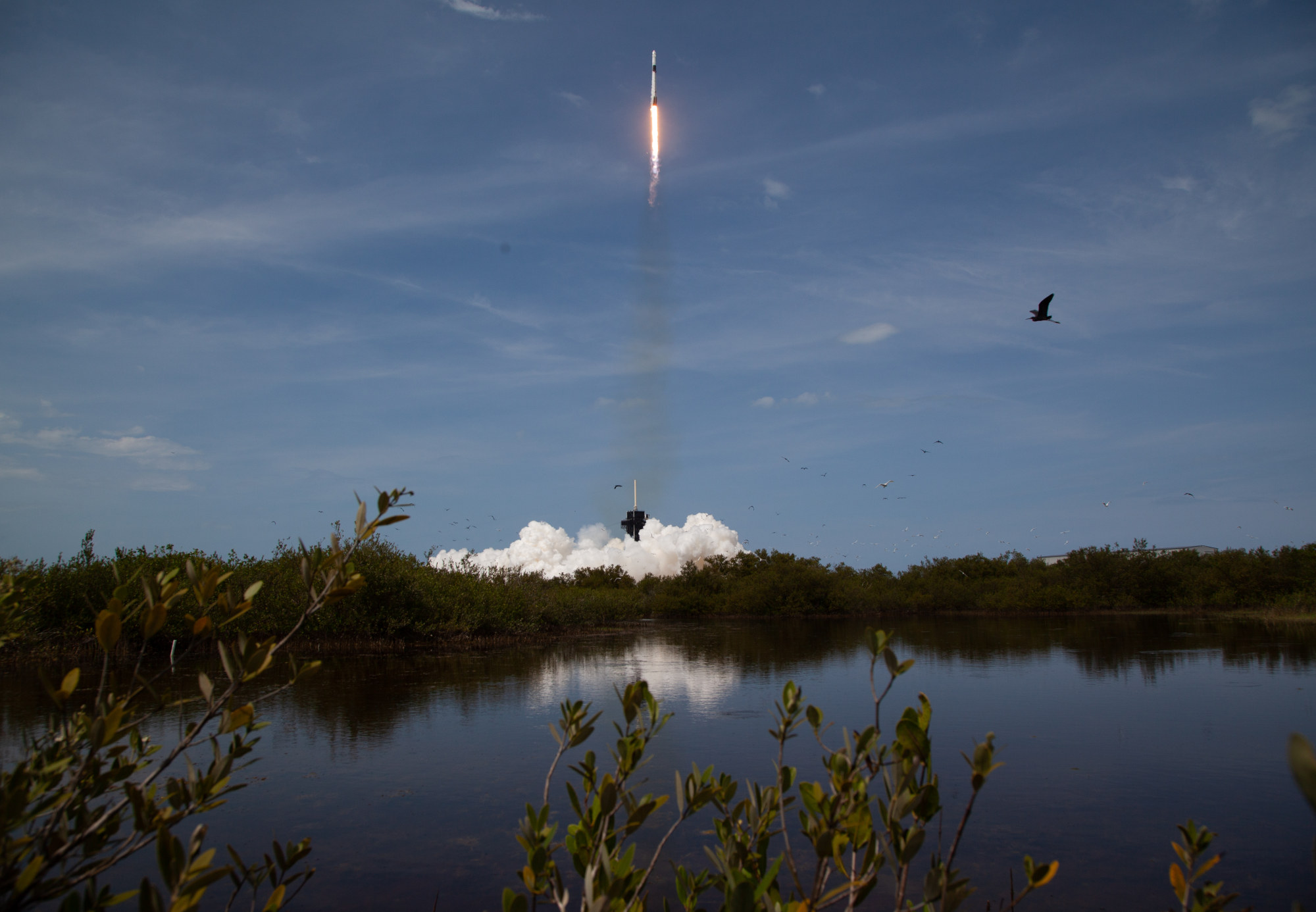
A SpaceX Falcon 9 rocket is launched on May 30, 2020, at NASA’s Kennedy Space Center in Florida. Getting a Falcon 9 rocket into space can require around 50,000 gallons of kerosene fuel, also known as refined petroleum, in addition to liquid oxygen, and the rocket emits at least 5 metric tons of black carbon per flight. Visual: Joel Kowsky/NASA
At the University of Canterbury in New Zealand, Michele Bannister, a planetary astronomer, and her team are trying to figure out to what extent the ozone layer’s potentially precarious recovery might be slowed by rocket launches. In an interview, Bannister emphasized that while potentially harmful rocket emissions are currently negligible, they could soon become a significant problem. “We know that people want to launch more rockets in the future,” she said. “So what level of rockets do we start to see effects at?”
To find out, her team is using a detailed physics and chemistry-based computer model, as well as data from their own published inventory evaluating all of the rockets that have existed as of 2019. In a 2025 paper, the researchers assessed two scenarios: One was a conservative estimate for the number of rocket launches in the near future, based on rockets already with licensing approval, and the other an ambitious one assuming a total of 2,040 launches per year, based on claims of additional planned launches.
The researchers extrapolated these trends to 2030, and they find that it’s a matter of when, not whether, the rocket exhaust impacts will be significant, slowing the ozone layer’s recovery. “What we see is, you will get an impact on the ozone layer in particular ways even at the conservative level” of launch rates, Bannister said. We are currently on track to exceed those conservation numbers, she added: “This year, we are now tracking above that curve already.” In the ambitious launch scenario, ozone losses of 3 percent become common in multiple regions in the upper stratosphere, with higher seasonal ozone losses, such as an almost 4 percent Antarctic springtime ozone decrease. Bannister and her colleagues liken these amounts to the atmospheric impacts of Australia’s 2019-2020 “Black Summer” wildfires; after such episodic events, however, ozone typically returns to previous levels within months, while rocket launches continue apace.
The work points to some of the top black carbon polluters, which produce more or much more than 5 metric tons of the pollutant per flight: SpaceX’s Falcon Heavy, Chinese Long March 5, and Russian Proton-M. Chlorine and alumina emitters include European Ariane 5, Indian PSLV, as well as ULA Atlas V. But the number of launches matters as much as the pollutants per launch, so while the Falcon Heavy’s amount of exhaust is about three times that of the Falcon 9, 56 times as many Falcon 9s have flown.
The annual emissions from such rockets are worsening and will soon threaten the ozone layer, but it’s solvable, Bannister said, with regulations and a responsive industry: “It’s an engineering problem, it can have an engineering solution.”
Spacecraft pollute not just on their way up, but also when they’re on their way down. All those satellites, rocket bodies, and random chunks of debris floating in orbit are mostly made of metals, and they have to go somewhere. “The biggest issue is, nobody has looked at this for quite a long time,” said Schulz, the German geophysicist, who recently published a paper about such “space waste.”
Schulz estimates that the total annual mass influx exceeded 2 kilotons for the first time in 2025, while analyzing trends over the past decade. That amount is dominated by fragments from rockets breaking up, while the proportion from satellites and debris is small but growing, likely due to megaconstellation satellites.
The spacecraft release transition metals, such as copper and titanium, in the atmosphere as bits of them burn up. These chemicals could react like a car’s catalytic converter, Schulz said, triggering chemical reactions that transform molecules, potentially including ozone. One critical source of data has come from NOAA’s SABRE mission, a high-altitude research plane that measures rocket exhaust particles and metal particles in the atmosphere, like aluminum and copper, which clearly originate from space junk.
Ultimately, researchers say, launch operators need to think about not only their rocket fuel, but the materials used to make their spacecraft. Because humanity depends on the ozone layer, if some of it were to disappear, the implications are clear — and different than those of climate change. “The environmental impact is an attack on the thing that makes life on Earth possible, the ozone layer,” Bannister said. “It’s very immediate.”
Many companies are shifting to propellants that they say are cleaner than kerosene, like liquid natural gas or liquid methane. These include ULA’s Vulcan rocket, SpaceX’s Starship, Blue Origin’s New Glenn, and Rocket Lab’s Neutron. “We know liquid natural gas is much cleaner, but we don’t know exactly how much cleaner. We don’t know if it’s a factor of five or a factor of 50,” said Martin Ross, a scientist with the nonprofit research organization The Aerospace Corporation. “We want to make sure there are no surprises there,” he added. In addition, Ross said, there is yet no accounting of before-launch emissions of methane, a potent greenhouse gas, from venting or tests. The core stage of the rocket used in NASA’s recent Artemis II mission emits primarily water vapor, but the solid rocket boosters release more harmful emissions.
NOAA’s research on atmospheric emissions continues to receive funding, though President Donald Trump’s administration has reportedly moved to strip a pollution-monitoring instrument from NOAA’s planned GeoXO weather satellites, which tracks the ozone layer. (NOAA declined Undark’s requests to comment on the record.)
As the evidence for rocket pollution accumulates, there is plenty of room for national regulatory agencies and policymakers to step in, Bannister said. In the U.S., the Federal Aviation Administration is one of those agencies. Launch licenses currently do not involve scrutiny of rocket propellants or exhaust, but that could change, depending on standards set by the Environmental Protection Agency. In a statement to Undark, FAA spokesperson Steve Kulm wrote by email: “As part of its environmental review of commercial space launch or reentry license applications, the FAA analyzes potential air emissions according to the [EPA’s National Ambient Air Quality Standards]. Based on the findings, the FAA may require ongoing monitoring of rocket emissions as a mitigation measure.”
In addition to cleaner fuels, some researchers would like to see launch rates stop rising indefinitely, such as those for building up Starlink and other satellite networks. “Do we actually need 10 different megaconstellations?” Schulz asks, comparing them to utilities, like a building’s power line or water provider. The space industry also needs to be more transparent about its rocket engines, materials, fuels, and exhaust, he said, because more real-world data is essential to inform computer models.
Ultimately, Bannister said that she wants to return to her work on space exploration, without having to worry about environmental impacts of launches and reentries: “I would love this never to be a problem.”
