


Turkish Finance and Finance Minister Mehmet Şimşek said last week that the war crimes-filled invasion of Iran would create opportunities for Turkiye by forcing it to diversify its supply chains and open new trade routes.
That’s a really strange statement. A war with Iran not only poses significant risks for Turkiye, including economic devastation, internal instability, a large-scale refugee crisis, and the growing influence of Kurdish groups along the border, but it also exposes the vulnerability of the entire West Asia trade corridor.
The Strait of Hormuz is the obvious choke point strangling the global economy, and the Bab el-Mandeb Strait could once again play a major role. However, there are several other logistics routes through the region and surrounding areas that have received so much attention and investment in recent years, and in some cases were supposed to serve as a backup plan to the main artery, but they are either virtually extinct or under serious threat, and it may be years, if ever, before they are seriously discussed again.
As Persian Gulf states begin discussions on new pipeline corridors that bypass the Strait of Hormuz, routes not directly affected by the war with Iran are also under severe strain, as an arc of conflict and instability stretches from the Baltic Sea to the coast of India.
Let’s take a look at some of them and how they are affected by wars and other global instability.
intermediate corridor
In recent remarks, Simsek called the route a “significant opportunity.”
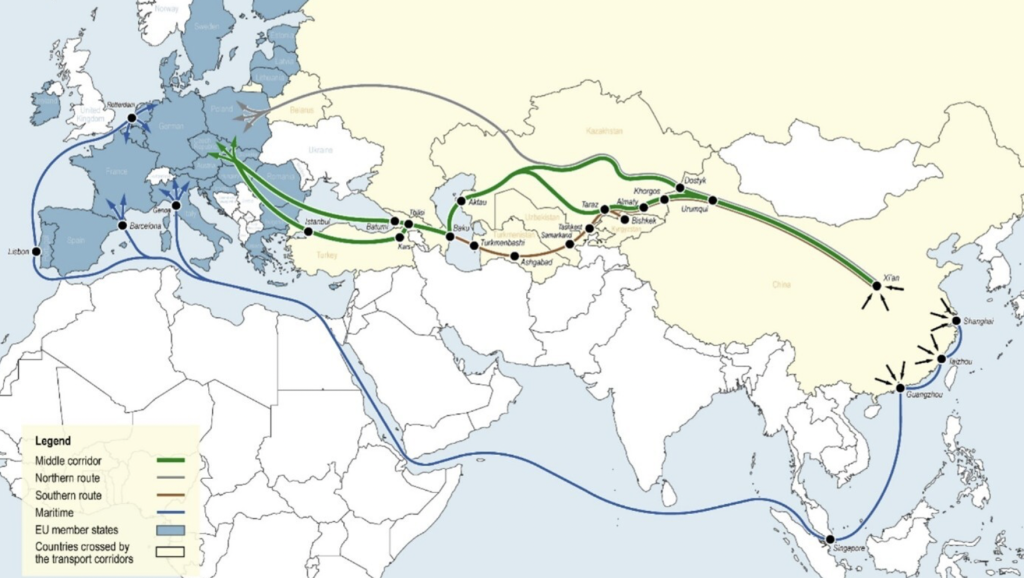
The Intermediate Corridor extends from China through Central Asia, across the Caspian Sea, the Caucasus, and Turkiye to Europe. “In-between” refers to its location between the northern sea route through Russia, which has been held back by sanctions, and the maritime route through the Suez Canal, where conflict restrictions are becoming increasingly tight.
The map shows two routes through the Caucasus, with a third arriving on the scene last year with the Trump Route for International Peace and Prosperity (TRIPP), which aims to cross a narrow strip of southern Armenia along the border with Iran. TRIPP connects Azerbaijan with its enclaves Nakhchivan Autonomous Republic and Turkiye.
Azerbaijan is an important node where energy connections to the East-West axis (China-EU), potential North-South axis (Russia-Iran-India), and the Black Sea converge. These connections also come with increased risk.
Remarkably, despite Israel’s strong presence in Iran and the widely known secret that the country is used as a launching pad for drones against both Iran and Russia, there has been no retaliation from Iran (yet).
Azerbaijan is likely involved in the attacks on Iran’s Caspian Sea infrastructure, but there has been no response from Tehran like the Persian Gulf states that host and support Americans and Israelis. Why on earth the Iranians (and Russians) gave Azerbaijan such a long rope is an open question.
Is the Iranian government concerned that it will cause internal instability for the country’s large Azerbaijani population? An attack on Azerbaijan could draw Turkiye, who acts as a big brother to Baku, more directly into the conflict. Perhaps China, which has invested so much time and money in Azerbaijan, asked for patience.
TRIPP brings further instability to this line and highlights how it is part of a broader competition between Beijing and Washington. The US will undoubtedly seek to ensure that TRIPP becomes a route through the Caucasus, and to that point, Georgia’s failure to toe the line has led the US government to ramp up discussions of sanctions, sanctions, and more sanctions, as well as “other measures.”
TRIPP, Turkiye and also called Zangezur Corridor in Azerbaijan.
Meanwhile, the United States is talking about extracting vital minerals from Central Asia and expanding its security footprint to do so. There are fears in both Moscow and Tehran that this route is part of a Washington-Ankara plan to expand Turkey’s influence into Central Asia at the expense of Russia and Iran, and countries like Azerbaijan and Kazakhstan have actually warmed to NATO. The US and EU have succeeded in pulling Armenia out of Russia’s orbit – geopolitically, rather than economically, where it remains dependent on Russia – and if the US fails in the middle corridor competition with China, as it likely will, one should expect the usual alternative options.
Apart from the risk of the Intermediate Corridor going up in flames, there are logistical and economic constraints.
Kazakhstan requires significant investment in railways to support planned increases in transport capacity. China is a major investor in the expansion of Azerbaijan’s Alat International Sea Trade Port, which handles Caspian Sea cargo as a key hub for the intermediate corridor that overlaps/collides with TRIPP. However, infrastructure is still lacking. Azerbaijan has just announced plans to bring 10 new roll-on/roll-off vessels to the Caspian Sea by the end of the year, a significant increase from the current 15, but a sign of how far this route has to go.
The Central Corridor remains the most expensive option due to its mix of road, rail and sea transport. Current costs are $3,500 to $4,500 per 40-foot equivalent unit, compared to $2,800 to $3,200 for the northern route through Russia and Belarus and $1,500 to $2,000 for the sea route through Suez.
Cargo volumes on the Central Corridor are expected to reach 4.7 million tons in 2025, increasing by 10% this year, according to Kubanichbek Omraliev, Secretary-General of the Organization of Turkish States. For comparison, 56 million net tonnes have already passed through the Red Sea and Suez Canal this year in 2026, but that total is still declining due to airlines’ reluctance to resume transit despite the US ceasefire with the Houthis in 2025.
International North-South Transportation Corridor
Oleg Belozerov, CEO of Russian Railways, said that traffic volume on the International North-South Transport Corridor (INSTC), which connects Russia and Iran and connects with countries such as the Persian Gulf and India via Azerbaijan and the Caspian Sea, will reach 11,000 containers in 2025. In comparison, the number of containers passing through the Suez Canal is 5.57 million.
INSTC was already facing several challenges, including Iran’s infrastructure development, sanctions, and relentless pressure on New Delhi from the Five Eyes, a Western group seeking to create choke points in the Caucasus and Central Asia. In a best-case scenario for Iran, the route is likely to be significantly set back, as the United States and Israel are attempting sabotage operations across Iran, including placing bombs close to the INSTC’s critical Chabahar port.
Iran’s B1 bridge, which President Trump gloated about destroying, happens to be on the International North-South Transit Corridor (INSTC), which runs from Russia to India.
The bridge was intended to improve a major commercial artery and accelerate trade and economic development in Iran and the surrounding region. pic.twitter.com/H4CvNJSh0C
— Chebureki Man (@CheburekiMan) April 4, 2026
Iran-China Railway
Although this route has received less attention than the others on this list, it is probably the most important, at least from an Iranian perspective.
Last June, the first cargo via this new rail corridor arrived in Iran. The main route spans more than 10,000 kilometers through Kazakhstan, Turkmenistan and Uzbekistan, connecting western Chinese cities such as Xi’an and Urumqi to a dry port near Tehran. Although rail (about two weeks) is shorter than sea (about 30+ days), it faces the usual challenges that slow adoption, including different gauges, costs, administrative burdens, and electrification differences across Central Asian states. Still, the issue is of great importance to both Tehran and China, and is also causing concern in Washington. From Asia Cable:
For Iran, the land route means it will be easier to export Iranian oil to China, and is an important means of circumventing existing U.S. economic sanctions. For China, it is a key component of the Belt and Road Initiative, which aims to connect Asia and Europe via a transcontinental rail network. For both countries, this development is an important geopolitical move that strengthens ties between China and Iran and, in theory, has the potential to change global power relations by reducing dependence on Western-controlled maritime trade routes, such as the Strait of Malacca, a chokepoint that requires a U.S. naval presence. This would provide China and Iran with safer and less vulnerable trade routes.
It could also offer a non-Russian rail option to Europe that is not blocked by the Caspian Sea.
Iran and China have been working to expand their rail networks since the first shipment last summer, and should Iran survive the current onslaught of war crimes by the United States and Israel, we should expect them to double down.
If Iran survives this war, China will invest significant amounts of money in Iran to strengthen its role in the Belt and Road network. If the sea lanes become congested, there will need to be a way to access Gulf energy products through pipelines or rail. Iran is at the center of that effort.
— tphuang (@tphuang) April 3, 2026
India-Middle East-Europe Corridor
First introduced at the Group of 20 summit in New Delhi in September 2023, the network of rail, ship-to-rail, road transport routes, energy pipelines and high-speed data cables linking South Asia, the Gulf and Europe was, in theory, supposed to be an answer of sorts to China’s Belt and Road Initiative (BRI). It didn’t make much sense as a logistics corridor, as cargo would have to be moved from India to the UAE via ship, loaded onto trains passing through the UAE, Saudi Arabia, Jordan and Israel, and then put back on board ships for Israel to Europe.
It seems uneconomical and quite inefficient. It then enters Europe via ports operated by China. https://t.co/befYuMQ9ox
— Evan A. Feigenbaum (@EvanFeigenbaum) September 11, 2023
Like many other responses to Belt and Road, IMEC seemed to be quickly forgotten, but the Trump “America First” administration enthusiastically supported it, with Donald calling it “‘the greatest trade route in history.'”
However, the new administration shifted its focus from logistics corridors to more cesspits of digital corruption, with each pole of IMEC reinforcing a new pole of lucrative US hegemony, with Israel playing a leading role. It was an invitation to AI supremacy from Europe to India written in the blood of genocide, but it is now falling apart as the Persian Gulf on which that “plan” depended goes up in flames.
Efforts are underway to popularize the IMEC model globally. In December, the U.S. State Department announced Pax Silica, an initiative to form a political and economic alliance in the field of AI and its supply chains, with participants including Japan, South Korea, India, Singapore, the Netherlands, the United Kingdom, Israel, the UAE, and Australia. What are the key principles of the IMEC model?
Israel provides an AI laboratory for monitoring, controlling, and killing humans, constantly tested and fine-tuned on Palestinians and others. The US shared technology with Gulf states such as Saudi Arabia and the UAE in exchange for guarantees that AI-enabled exports produced using US chips would be billed and settled in dollars, or dollar-backed stablecoins. The Persian Gulf not only provides capital, land and vast amounts of electricity for data centers and US computing power flowing out of the oil monarchy, but it also provides the Trump family and other US officials with billions in corrupt payoffs and helps keep the bubble inflated.
These Middle Eastern data centers and desalination plants that relied on gas for water and electricity are in flames.
At least the Trumps gained, but the gains were good. As the New York Times reported last year, “digital assets are one of, if not the single, largest source of funds for the Trump family.” Eric Trump’s World Liberty Financial has signed a $2 billion deal with UAE state-owned AI investment firm MGX, which holds rights to Trump’s USD1 stablecoin. MGX uses it for billions of dollars of trading on Binance. The Binance exchange has always been on the wrong side of the law, with its founder Zhao Changpeng pleading guilty to anti-money laundering failures in 2023 and receiving a pardon from President Trump in October.
The Trump administration attracted billions of dollars in stablecoin “investments” from Gulf states, in return likely including a defense handshake and the possibility of regime change in Tehran. If delivery is not possible, will I get my money back?
