


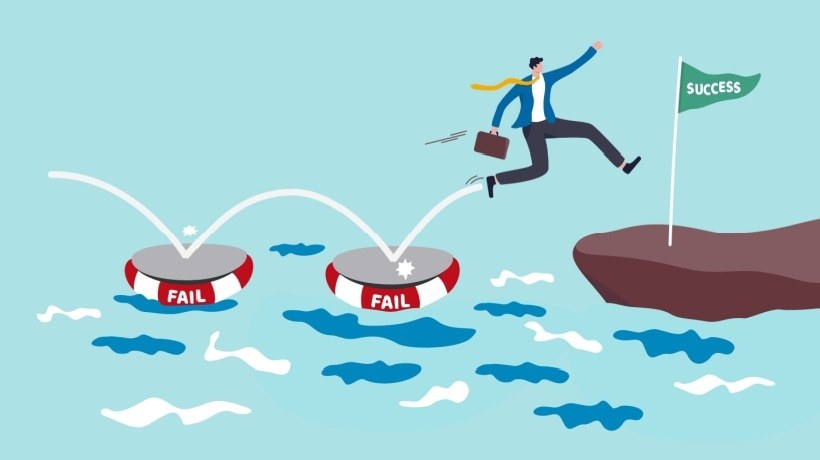
Turn failure into rapid skill acquisition
Let’s be honest: Most corporate training feels like a black hole. $85 billion is wasted every year because 70% of L&D efforts don’t lead to behavior change and employees forget 90% of what they were supposed to learn within weeks. But the good news is that things are changing as we learn from our mistakes. By learning from mistakes, companies report 4x faster skill acquisition and 200% higher retention rates. Think about it! Your brain is wired more effectively for failure than for success. Leading companies are now adopting a “fail forward” philosophy that leverages failure to generate explosive growth within adaptive learning strategies. In this article, we explore how failure can be a secret weapon in L&D.
A safe space for intentional, low-risk mistakes in adaptive learning
Do you have the awkward feeling of looking stupid in front of your co-workers? It hinders learning. Learning from failure starts with creating an environment where it’s safe to fail.
Short “microfail” exercises (3-5 minutes) allow people to explore without judgment and develop instincts 67% faster than perfect practice. Like training wheels that come off once you learn balance, gradually increase the difficulty while minimizing frustration levels. In group settings, seeing people fail normalizes it and reduces personal embarrassment by 40%. example
Sales teams practice tough rejection calls in a simulated environment. After 4 rounds, they learned how to deal with “no” without freezing and actually increased their conversion rate by 28%.
Instant feedback that actually sticks
Do you want to wait until the quarterly review to make adjustments? If you’re serious about growth, that’s too long to wait. Instant feedback is like having your own personal coach.
“Next 5 Minutes” sessions give you instant feedback on what to do next. “Failure Replay” uses videos designed to recreate key moments in a split-second “aha” moment. for a moment. “Plus Delta” discussions with colleagues are designed to focus on what more to do to maintain motivation levels.
In engineering, virtual reality simulations with error feedback buzzers reduced assembly errors by 52%. The learner says, “I felt like I had the wrong grip, but now I know!” Neuroscience shows that instant feedback rewires the brain before bad habits are formed. Learning from failure is a skill, and it comes naturally, just like learning any other skill.
Identify error patterns in corporate learning strategies to prevent future failures
Have you ever noticed that the same mistakes are repeated across your team? Learning from mistakes can help you turn these patterns into superpowers and accelerate employee skill development.
Distinguish between types of errors, such as knowledge gaps, execution errors, and poor judgment. AI scans your practice data to identify common pitfalls before they reach production. Create “anti-pattern” guides to easily fix common pitfalls. Link patterns between roles, such as sales disputes reflecting negotiations.
Sales teams that learned how to respond to pitch failures developed a pattern for handling objections and reduced live call hold-ups by 67%. “Always stay ahead of pricing rebounds. The lessons are fixed,” they said in a briefing. Learning from your mistakes gives you foresight and allows you to avoid pitfalls while your competitors continue to stumble.
Gamification and experiential learning: Making failure fun and addictive
Who would have thought that learning could become a game? Leaderboards that recognize your best mistakes make practice a habit and build learning agility through reflection, experimentation, and rapid deployment of skills.
“Epic Fail Awards” celebrates the best learning experiences with a 340% increase in participants. The “consecutive failure” badge recognizes persistence over perfection. Challenges when teams face difficult situations. Ranking of recovery speed.
Call centers with the “Rapid Recovery” badge had a 23% increase in first-call resolution rates. Agents voluntarily worked overtime. Gamification of learning from mistakes has become a hot topic in getting employees to choose learning over Netflix.
Quick learning techniques and micronudges for lasting habit change
General advice can be overwhelming, but in a culture of continuous learning, small tips for success can be game-changers. Feedback in the form of micronudges is a game changer.
One actionable shift per session: “Change stance here.” Connect to the moment, not the theory. Streaks like this show how small wins add up. The words “we’re crushing the team” create momentum.
Developers got commit feedback in 3 minutes and bugs were reduced by 41%. They’ll say, “We fixed that loop. It’s smoother.” Using nudges to learn from mistakes creates autopilot without burnout.
Master by combining error-driven learning, feedback, and winning.
Success alone is boring. Too many failures will lead to setbacks. The right balance guided by L&D innovation is the sweet spot.
60% intentional practice does not build resilience. 30% are guided wins, creating a sense of progress. Cross-application 10% wildcard challenge. Weekly “connect the dots” review.
Executives are living out crisis scenarios: deals fall through, budgets are cut, and crisis response improves by 36%. “This pressure preparedness made the difference,” one person noted. The right combination of learning from failure creates adaptive professionals.
Conclusion: Turn failure into the engine of a continuous learning culture
There is no risk in learning from mistakes. Stagnation is the risk. Deploy secure fail labs, instant feedback loops, pattern spotters, fun leaderboards, nudges, and blends. Start in a high-stakes role, measure behavioral changes weekly, spread early successes, and scale big. Envision a future where your team is not afraid to fail. Imagine a future where your team is looking for more challenges. Agile. It is elastic. Outperform your competitors. That’s the benefit of L&D. Every failure transforms your workforce, leading to accelerated growth and unstoppable competitive advantage.
